Quick answer: That's not even a debate, man. It depends who you are. So ask one question before anything else. Does this need to run without you, or does it need to think?
If it truly has to fire on a trigger forever, with stored credentials and retries and a run history when it breaks, that is connector work. Everything else is agent work.
And here is my actual answer, which is not the one most comparison pages give: for most people asking this in 2026, I would point at Codex. Even if you are new. Even if you think you need something visual.
I moved about 47 automation steps out of a visual builder and into code. I kept exactly one workflow running. That's why I answer this the way I do. And the one I kept matters as much as the 46 I didn't.
The actual difference, in plain EnglishConnector tool (Zapier, Make, n8n)
Coding agent (Codex, Claude Code)What the work looks like
Trigger in app A to action in app B
"Build me the thing that does X"Runs when
On a schedule or trigger, without you
When you run itWhat you get
Runs, logs, retries, credential handling
Files, code, working output you ownWho handles failures
The platform surfaces the failed step
You doApp coverage
9,000+ apps out of the box
Whatever has an APIBest at
Repetitive plumbing, forever
One-off or complex logicThe clearest statement of this I've seen wasn't from either vendor. It was a Reddit comment that Google now features at the top of this exact search.
u/ergod_dev on r/automation: "Connector tools (Zapier, Make, n8n) are best when the work is 'trigger in app A causes action in app B.' … Code-and-deploy tools (Replit Agent, Cursor, Claude Code) are best when the task is 'write me an actual script that does X' and you're okay running it yourself.
What kills people is trying to do agent-shaped work in a connector tool or vice versa."
That last sentence is where most people go wrong.
Why I'd still say Codex, even to a beginner
I disagree with most of the advice on this one.
The standard answer is: beginners need something visual, so send them to the connector. I do not think that is true anymore.
If you are staring at this going "I don't know what to do, I need something I can see," I would still tell you Codex. It's not as intimidating as Claude Code. It looks almost like a chat window.
At that point it is honestly not even Codex versus Zapier. You can just talk it out with a smart assistant that knows how to code, and it gets stuff done a lot faster than Zapier.
One catch: the visual builder is only simple until the logic is not.
I was in an interview once where the Zapier workflow would not work. We were pulling the wrong record for the test.
If you have built in these tools you know the dance: you need to pull a sample record that passes certain criteria so you can continue building the steps downstream. That is not simple. You end up fighting the tool instead of doing the work.
It's clunky. In my opinion it doesn't work anymore for how I build.
And if you genuinely want a visual workflow tool, I would not pick Zapier at all. I would use n8n. It is more fluid, and the same logic that takes twenty if-then conditions in Zapier is often about five nodes in n8n.
It's a little scarier to look at, but easier once you're in it.
But if you're gonna build, Codex hands down wins.
The honest caveat in Zapier's favor
I do not want to sell you a clean story, so here is the strongest point on the other side.
Zapier has far more app connectors out of the box. Zapier MCP advertises 30,000+ actions across 9,000+ apps. That's a lot you don't have to build yourself.
With a coding agent, when there is no connector, you connect via API instead. In practice that ends up being about the same thing, with more control and a bit more setup.
Where Zapier is really ahead is the boring stuff: managed credentials, retries, and a run history that tells you which step failed at 3am. That's real plumbing, and an agent doesn't give it to you for free.
Which is exactly why I kept one workflow instead of zero.
What I actually did: 47 steps out, one kept
So here's my migration. It doesn't end the way these stories usually do.
I ran a serious setup in a visual builder. And to be clear, it was n8n, not Zapier. For content it was really good. It would write, it would post, it would call APIs.
The reason I left is the 47-node problem. A complex process might be 47 steps on a canvas. Step one is "scrape this," fine.
But then it is do this, then do that, and now you are embedding complex prompts inside an agent node and wiring specific tools to it. It takes an hour to build something you could have tested and shipped in that same hour as a skill.
Those 47 nodes became one file, with far less to maintain.
But I kept one workflow running, and I still have it. It is a scheduled scraper experiment on a Mac mini: deterministic, on a timer, dirt cheap. Rebuilding it in code wouldn't make it better. It would just give me one more thing to maintain.
That one workflow is where my argument stops. My work moved to code because it was agent-shaped, not because connectors are dead. My automation was mostly "think, then write, then decide," which is terrible connector work and great agent work.
If your automation is "when a form comes in, add a row and send a Slack message," you would be moving in the wrong direction by rebuilding that in code. That job is plumbing, and plumbing belongs in a connector.
I moved because of what my work was. Check what yours is before you copy me.
Should you wire a coding agent to a connector?
Usually, no. I would talk you out of it.
If the app has an API, connect to it directly from the agent. A connector layer in between is a middleman for something the agent can already reach. Now you're maintaining two systems and a subscription instead of one.
That said, it's a real, documented setup, not a fringe hack. If you're already deep in Zapier, it's a fair way to get the agent talking to the tools you already use.
So here is how to do it if you decide the middleman is worth it.
How to use Zapier with Codex, step by step
Per Zapier's own guide, the setup is three steps:Open the Zapier MCP dashboard and select + New MCP Server.
Choose "Other" as the client when asked what you are connecting.
Configure your first action, which is the specific app-and-verb pair the agent is allowed to call.That gives Codex what Zapier describes as "governed access to 9,000+ apps and 30,000+ actions."Zapier's own guide, August 14, 2026: the connector company documenting how the coding agent borrows its app layer.
Two things to know before you build on it. Zapier draws its own line between the products: Zapier MCP "runs in chatbots like Claude and ChatGPT," while the SDK "runs in code files."
And every worked example in Zapier's Codex guide is a developer example: filing a GitHub issue from a failed test run, turning a Jira ticket into a scoped plan, logging deployments to a spreadsheet.
The version for a solo operator who is not shipping to a Jira board now lives on its own page: how to use Zapier with Codex, with the full click-through steps, the scoping safety trick, and the one-direction catch (Codex can reach into Zapier; Zapier cannot start Codex).
Which one you need
Use a connector tool when:the work has to happen on a trigger or schedule, without you present
it moves data between apps you already pay for
it needs credentials, retries, and a run history when something breaks
the logic is simple but the reliability mattersUse a coding agent when:the task needs judgment across files and context
the logic is really complicated, the kind that turns into a mess of branches in a visual builder
you want to own, version, and read the thing afterward
it's one-off or occasional, and you're fine running it yourself
you are learning, and you would rather talk the problem out than click it outIf you need both, that's normal. Build with the agent, run the repetitive part on the connector, and keep a human approving anything public.
The mistake: making one tool do both jobsMistake
What happensComplex reasoning stuffed into workflow nodes
Hard to version, review, and debug: the 47-node problemA coding agent used as a permanent scheduler
Weak run history and credential handling, fragile recurrenceAutomation publishing straight to the public
Fast mistakes with real consequencesAn agent step added to every workflow
Higher cost, slower runs, harder debuggingThe r/n8n version of this, from u/tesslate after testing the same workflow four ways: n8n is for "trigger → call → write somewhere" flows, while agent work needs "a real workspace."
The tool "wants to be a flow, not an environment." The top reply put it plainly: "The mistake is trying to make one tool do both."
The decision rule
Ask one question: does this need to run without me, or does it need to think?
Runs without you, on a trigger → connector tool.
Needs to think, across context → coding agent.
Both? Build it with the agent, schedule the boring part on the connector, and approve anything public yourself.
Codex builds. The connector runs. A human approves. That is my split, and it is the one that survived my migration.
And if you are new and just want one thing done this week: pick the task you keep redoing by hand because it needs a judgment call each time, and build that with the agent.
If instead your task is pure app-to-app plumbing, start with the connector. Either way you will know within days, which beats another month of comparing tools.
FAQ
Is Codex a replacement for Zapier?
Not structurally. Zapier's own docs describe Codex as focused on code and a small set of built-in integrations, reaching other apps through Zapier MCP. Codex does not remove the need for triggers, credentials, or run history. It does replace most of the logic people used to build on a canvas.
Can Codex do what Zapier does?
Mostly. Zapier has more connectors out of the box, and where one does not exist you connect via API from the agent instead, which works out about the same. What you give up is managed credentials and run history.
Do I need both?
Many people don't. If your automation is app-to-app plumbing, a connector alone is fine. Add a coding agent when you're building something with real logic in it.
Is AI automation dead now that Codex exists?
No. Coding agents changed who writes the logic. They didn't remove the need for scheduled, credentialed, retryable plumbing between apps.Next, compare the two concrete tools in more depth: Codex vs n8n. If you're picking your whole toolset, see the AI stack for solo founders.
Published July 24, 2026. Updated August 14, 2026: the migration kept one workflow, not zero, and the Zapier-with-Codex setup was added.
Quick answer: the best AI stack for solo founders is the smallest one that covers your actual jobs. Mine is five tools, one job each. The rule that keeps it small: if a tool doesn't earn its keep every week, it's a candidate to cut.
Most stack posts hand you twenty ranked tools, which is more of a shopping list. Here's what I actually run.
What I actually runTool
Its one jobClaude
Everyday content, thinking, and the actual workBlotato
Scheduling and distributionChatGPT ($20)
General-purpose second opinionKit
Newsletter and owned emailVidIQ
YouTube, and only if you post on YouTubeThat's it. Two AI subscriptions at $20 each, a scheduler, an email platform, and one channel tool I'd drop tomorrow if I stopped posting video.
The Blotato, Kit, and VidIQ links are affiliate links: a small kickback to me at no cost to you. Every tool in this table is one I pay for and run; nothing is here for the commission.
On paying for both Claude and ChatGPT: if you max out your usage on one, paying $20 on the other is a cheap way to keep working instead of waiting out a limit. Two $20 subscriptions solve a real problem. A fifth AI subscription doesn't.
VidIQ comes with an asterisk: it's in my stack because I post on YouTube. If you don't, that row doesn't exist for you. That's how a stack should work. Every tool ties back to something you actually do.The 60-second version, from my Shorts: 10 AI tools I use to ship as a one-person operator.The rule: one job per tool
The usual mistake is collecting five tools that each do 40% of one job.
This is the loudest complaint in every founder thread on the subject. As u/CellCog put it on r/AI_Agents: "Most people evaluate tools feature-by-feature and end up with five overlapping subscriptions doing 40% of one job each."
The same comment has the fix, and I think it's right. Pick your most repetitive multi-step workflow, write down how you'd explain it to a new hire, then evaluate tools against that document.
So it's workflow first, tool second. Almost everyone does it the other way around.
Cut this
The ranked listicles won't write this section, because they're affiliate-linked to everything they mention.
Next on my cut list: Notion. I don't really use it beyond the basic features. I'm paying for a database platform to store notes I could store anywhere. That's the kind of overlap that sticks around because you never look at it.
Already gone: n8n. I used to run a large n8n setup, and for a while it was brilliant. It would write, it would post, it would call APIs, and it was impressive. I don't use it at all anymore, including the self-hosted instance. It's not a bad tool, the work just moved.
The thing that killed it for me: a complex process might be 47 nodes in a workflow builder. Step one, scrape this. Fine, that's easy.
But then it's do this, then do that, and you're embedding complex prompts into an agent node, wiring up specific tools, and it just becomes a little complex. It takes more time. It'll take you an hour to build something you could have tested and delivered in that same hour as a skill.
Those 47 nodes become a simple skill.
I'm not telling you to cancel your automation tool. I'm just saying "I built it, so I keep it" isn't a reason. The question to ask is: did I use this last week?
The four questions your stack has to answer
Before you add anything, make it answer one of these:Question
The job
Good answerWhat am I making?
Creation
One AI that can do the real work, not just chat about itHow does it get out?
Distribution
A scheduler, plus the channels you actually post toWho hears about it?
Owned audience
An email platform you controlWhat do I remember?
Memory
One place for decisions and reusable prompts, not twoIf a tool doesn't answer one of those, it's not part of the stack yet. If two tools answer the same one, you're paying twice.
What $20 now buys that it didn't in May
Two changes matter here, because both cut the number of tools you need instead of adding to it:
Claude Cowork lets non-coders hand Claude a task instead of a prompt, right in the app. You still check the output. It isn't a set-and-forget employee. It's included at the Pro tier.
Voice mode with connected apps (updated July 23, 2026) means small stuff, like moving a calendar item or saving a note, can happen by talking. I spent a while testing it by booking calendar items out loud.
Know the limits before you plan around it: the free plan gives you Haiku and a single connected tool, and the underlying voice model didn't change. I wrote up what Claude voice mode can actually do in my voice mode breakdown.
Both of these are the $20 tier picking up jobs that used to need extra tools, which is exactly what you want.
The $20 / $100 / $200 questionTier
Cost
Who it's forOne AI subscription
$20/mo (Claude Pro is $20 monthly; annual billing is listed as $17/mo, $200 up front)
Almost every solo founder starting outTwo AI subscriptions
~$40/mo in AI alone, before your scheduler and email tools
You hit usage limits during real work and don't want to stopMax / Pro tiers
From $100/mo
You live in an AI tool all day, every dayPricing from claude.com/pricing, checked July 27, 2026.
Most solo founders do not need the $100 tier. The time to upgrade is when you keep hitting limits during work that matters. If you want to compare the top tiers honestly, I broke that down in Claude Max vs ChatGPT Pro.
Use the AI stack cost calculator if you want to model your own number.
What to automate first
Don't try to automate your whole business. Start with the loop that turns work you already did into distribution:Do the task manually once.
Write down the steps.
Delete the steps that shouldn't exist.
Hand the repeatable part to your AI tool.
Keep yourself in the approval seat anywhere quality matters.Step three is the one everyone skips, and it's what keeps you from automating a mess. Half the time, what looks like an automation problem is just a process that shouldn't exist.
For deciding what's worth automating at all, use the automation priority audit.
FAQ
What is the best AI stack for solo founders?
The smallest one that covers your real jobs. Five tools with one job each beats twenty overlapping subscriptions.
What is the cheapest AI stack for solo founders?
Around $40 a month: one or two AI subscriptions at $20, email on a free or starter tier, and a static site on a free host.
Do I need n8n or Zapier?
Only if something must run on a trigger without you. I ran a large n8n setup and stopped using it entirely once the work was easier to run directly through an AI agent. Plenty of solo founders never need one.
Do I need a vector database?
Almost certainly not at the start. Cleaner files and searchable notes solve the problem you actually have.
How do I know a tool is worth keeping?
Ask whether you used it last week. Not last quarter. If you can't name what it did for you in the past seven days, it's a candidate to cut.Want help mapping the lean stack to your actual workflow? Start here.This post is part of Claude Guides, the hub with every plan decision, task comparison, and setup guide for using Claude without code.
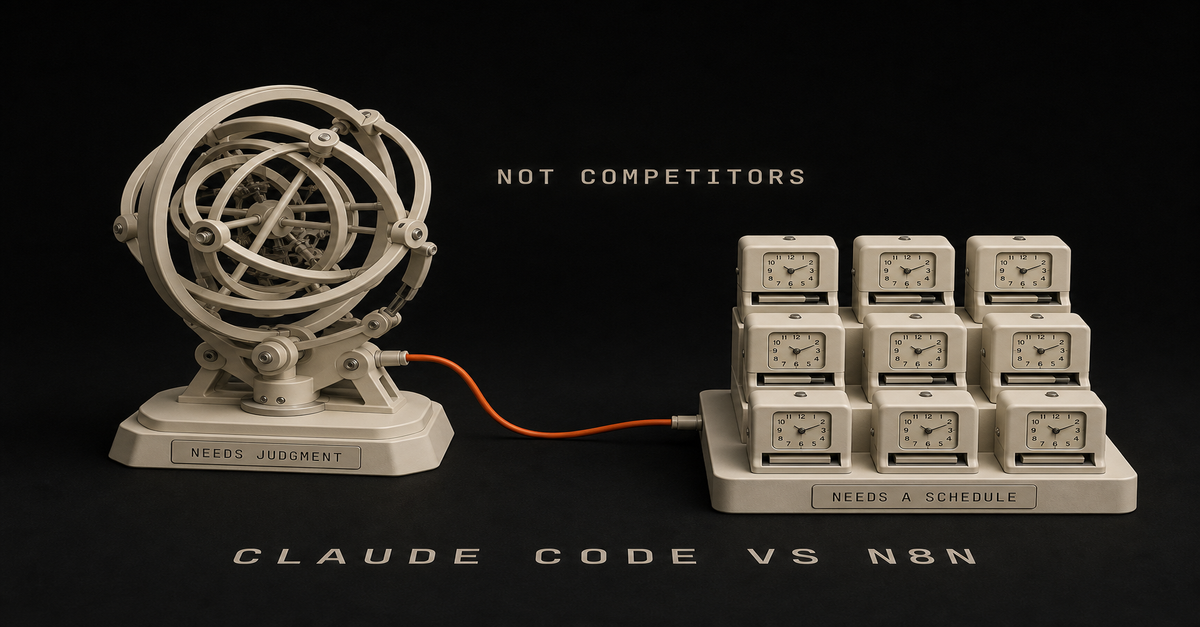
Whether you search it as "Claude Code vs n8n" or "n8n vs Claude Code," the answer is the same: you don't pick one. They do different jobs in the same system.
Use Claude Code when the task needs judgment, file edits, writing, reasoning, or codebase awareness.
Use n8n when the task needs triggers, data movement, scheduled runs, retries, and integrations.
Heads up: some links in this post are affiliate links: a small kickback to me at no cost to you. I only recommend tools I've actually run.
So the short version: Claude Code builds and thinks. n8n runs and routes.
Quick comparisonUse case
Claude Code
n8nEdit website files
Best
WeakBuild an internal script
Best
PossibleTrigger when a form is submitted
Possible
BestMove data between tools
Possible
BestWrite content in your voice
Best
Needs LLM nodeSchedule a daily workflow
Possible
BestInspect a repo and make changes
Best
WeakRoute content through approvals
Possible
BestThe 10-second decision rule
Ask this:
Does the task need context and judgment, or does it need a reliable trigger?
If it needs context and judgment, use Claude Code.
If it needs a reliable trigger, use n8n.
If it needs both, use both.
I know that sounds too simple. But it stops the common mistake, which is asking n8n to do the thinking or asking Claude Code to be your scheduler.Save this one. It settles the argument in ten seconds.
When to use Claude Code: messy work with context
Use Claude Code for work where the prompt is the product.
Examples:writing a blog draft from a real build log
refactoring a site page
creating a new Astro page
reviewing a workflow
generating a script
turning a messy idea into an implementation planClaude Code does its best work when it can read what's around the task and make calls.
That's a big deal for solo builders, because a lot of your business lives in files:site copy
product docs
workflow notes
analytics exports
newsletter drafts
messy markdown docs
code and configAn API call won't fix that. It's an "understand the room before touching things" problem.I walk through this on camera in How I Actually Use Claude Code in 2026 (Not Just Apps) (18 min).When to use n8n: repeatable work with triggers
Use n8n for the plumbing.
Examples:when a YouTube video is uploaded, create content tasks
when a Notion status changes, trigger a writing workflow
when an RSS item matches a topic, save it for review
every Friday, prepare the newsletter draft queue
when a form is submitted, add the person to MailerLiten8n is strongest when the workflow has a clear trigger and repeatable steps.
It also lets you see what happened. When a workflow fails, you can inspect the run, find the bad node, fix the credential, retry the step, and keep moving.
That matters once the workflow is running a real part of your business.
The best pattern: Claude Code plus n8n plus human approval
The clean pattern is:n8n detects the event.
n8n gathers the inputs.
Claude handles the judgment-heavy step.
n8n saves the output.
A human approves.
n8n publishes or routes the result.That's the pattern I use: automation for the boring parts, human review for the parts with consequences.
For content, it looks like this:Step
Owner
Job1
n8n
Detect new video, build log, or GSC CSV2
n8n
Gather transcript, URL, notes, metadata3
Claude Code
Create brief, draft, edit, and file diff4
Human
Approve quality and positioning5
n8n/GitHub
Route PR, deploy, notifyThat is the version I trust. Not "AI posts directly to production while you sleep." That sounds good until it publishes something stale, generic, or wrong.
What should solo builders choose first?
If your problem is "I need to build or improve the system," start with Claude Code.
If your problem is "I keep copying data between apps," start with n8n.
If your problem is "I shipped a thing and nobody knows it exists," use both. Claude Code turns the proof into assets. n8n routes and schedules them.
Common mistake: using n8n as the whole brain
n8n can call LLMs. That does not mean the whole system should live inside n8n.
Once prompts, examples, brand rules, page templates, and content logic get serious, they become easier to maintain in a repo. That is where Claude Code shines.
Use n8n to collect inputs and trigger the run. Use the repo for durable instructions. Use Claude Code to operate on the repo. Use n8n again to notify and route the result.
Common mistake: using Claude Code for recurring ops
Claude Code can write a script, run a command, and help you publish.
But work that runs over and over needs:schedules
retries
run history
credential handling
webhook triggers
alerts
handoff to other appsThat's n8n's job.
The setup I would run
For a solo builder trying to grow traffic:Claude Code owns the content system in the repo.
n8n watches for inputs: Search Console exports, YouTube videos, build logs, and newsletter notes.
Claude Code creates the page/tool/workflow draft.
The editor skill checks for thinness, reader fit, and whether the page actually helps.
Visual skill generates a diagram or comparison asset.
Human approves.
GitHub/Vercel ships.Want to estimate whether an automation is worth building? Run the automation priority audit. Want the stack cost? Use the AI stack cost calculator.
If your specific question is whether n8n should run an agent workflow, read what an n8n AI agent is and then map it with the n8n AI Agent Workflow Builder.
If you use Codex instead of Claude Code, the decision rule is almost the same. Read Codex vs n8n for the repo-agent version, or AI coding agent vs workflow automation for the broader split.
And if you have never opened a terminal at all, start one door earlier: Claude Cowork vs Claude Code - the same engine without the command line.
FAQ
Can n8n replace Claude Code?
No. n8n can call an LLM, but it does not replace a code-aware agent working inside your repo.
Can Claude Code replace n8n?
Sometimes for small scripts. But for recurring workflows with integrations, triggers, and retries, n8n is cleaner.
What is the best first workflow?
A content repurposing workflow is usually a strong first build because it turns work you already did into distribution.
Should I learn n8n if I already use Claude Code?
Yes, if you want recurring workflows that touch multiple apps. Claude Code helps you build and maintain the system. n8n helps the system run on schedule.
Last reviewed: July 2026.This post is part of the n8n AI agents hub: definitions, tutorials, workflow patterns, and the build-vs-run decision pages in one place.
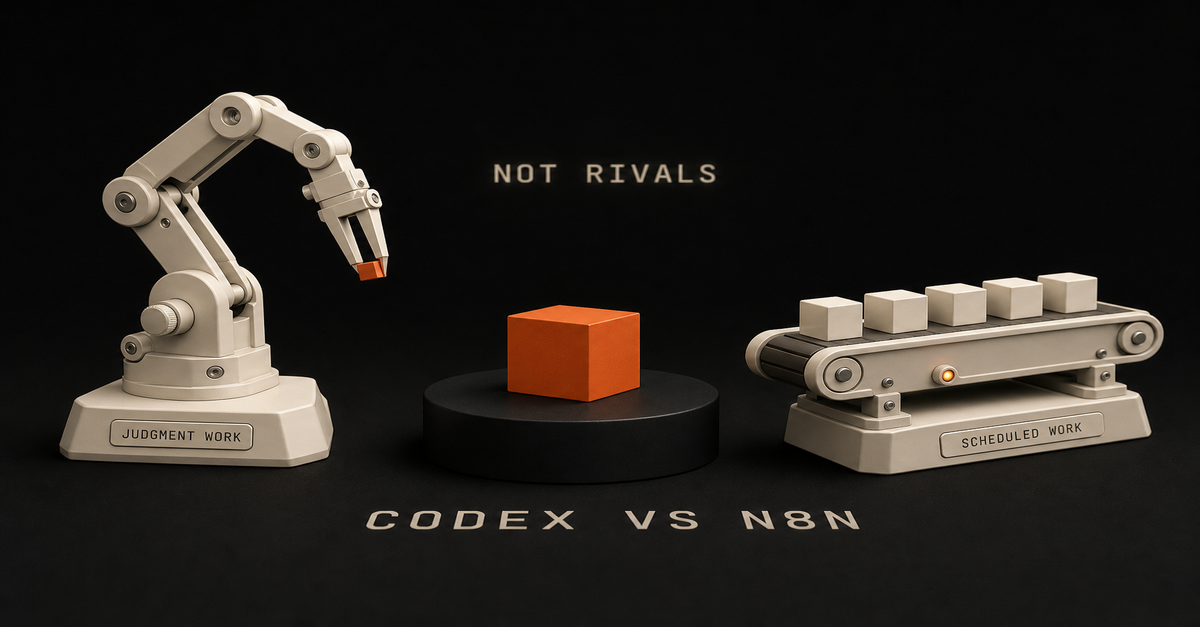
Quick answer: Use Codex when the work lives in a repo and needs judgment, editing, tests, or codebase context. Use n8n when the work needs a trigger, credentials, retries, run history, and repeatable automation. My rule is simple: Codex builds. n8n runs. Human approves.
Here is the receipt behind that rule: I moved about 47 n8n nodes into code, and I kept exactly one workflow running in n8n. Not zero. One. n8n is a tool that didn't evolve. It was good in its time, it's still useful. Which one survived, and why, is the most useful part of this page.
Heads up: some links in this post are affiliate links, a small kickback to me at no cost to you. I only recommend tools I've actually run.
Searching for "n8n codex" or "codex with n8n"? You usually do not pick one. You connect them: n8n owns the trigger and the routing, Codex does the build step that needs judgment, and a human approves before anything ships. Jump to the best pattern for the exact split.
Start with the n8n AI Agents hub if you want the whole system. If the workflow specifically needs an n8n agent, use the n8n AI Agent Workflow Builder before touching the canvas.
If you want the templates behind this split, use the public Claude Code Systems Kit. It covers repo-aware builder work, local agent runs, n8n approval gates, and workflow specs.I walk through this on camera in How I Use Claude Code + n8n to Automate What AI Can't (9 min).The Difference in One TableQuestion
Codex
n8nCan it read and edit repo files?
Best
WeakCan it run tests and inspect diffs?
Best
WeakCan it trigger from forms, webhooks, schedules, and apps?
Possible
BestCan it manage app credentials cleanly?
Not the job
BestCan it retry failed workflow steps?
Possible with scripts
BestCan it show run history?
Not the job
BestCan it draft, refactor, and QA content/code?
Best
Needs LLM nodesCan it route human approvals?
Possible
BestThis is why the comparison is not "which tool is smarter?" It is "which tool owns which layer?"The whole split on one card. The pattern that wins uses both.
What I Actually Moved, and the One Thing I Didn't
I ran a serious n8n setup. For content it was really good: it would write, it would post, it would call APIs. I am not going to pretend it was bad. It was impressive when it worked.
Then I moved almost all of it into code.
The reason is the 47-node problem. A complex process might be 47 steps on a canvas. Step one is "scrape this," which is easy enough. But then it is do this, then do that, and now you are embedding complex prompts inside an agent node and wiring specific tools to it.
It takes an hour to build something you could have tested and shipped in that same hour as a skill. And those 47 nodes become one file with far less to maintain.
But I kept one workflow, and it is still running.
It is a scheduled scraper running on a Mac mini. That is exactly the kind of work n8n still does well: very deterministic, scheduled, and cheap enough that the cost never comes up. There was no reason to move it.
That one survivor is the honest boundary of this whole argument. My work moved to code because it was agent-shaped, not because connectors and runners are obsolete. My automation was mostly "think, then write, then decide," which is terrible canvas work and great agent work.
The scraper is the opposite: no judgment, fixed rules, runs on a timer. Code would not make it better. It would just make it mine to maintain.
Check what shape your work is before you copy me.
Is n8n Still Worth Learning in 2026?
This is the question the threads are actually asking. So here is a straight answer.
For most people? I'd say no, don't do it. You're gonna waste your time, hands down.
If you'd asked me a year or two ago, that was the thing to learn. People who knew n8n had a real edge with AI. Today you do not get that edge from it.
It is good to know the fundamentals of how automation is shaped, triggers, credentials, retries, approvals, but you can learn that concept in an afternoon without becoming an n8n specialist.
The doubt is widespread among people who invested heavily. One r/n8n post opens: "For the past ~6 months I went all in on n8n. Built a pretty comprehensive 12-hour course (from zero to building quite advanced AI agent workflows)..."
One real exception, and it matters. If you are a business currently running on Zapier, n8n probably still has the edge. It is a little more daunting visually, but it is easier and cheaper to build in once you are past the first hour. That migration is still worth doing.
What n8n does not have anymore is the edge for modern workflows. That is a different claim from "n8n is dead," and the scraper on my Mac mini is the proof of the difference.
Which Agent Should Build Your n8n Workflows?
People argue about this constantly and I use both tools daily, so let me settle it as far as I honestly can.
First, the honest disclosure: I don't even call it an n8n workflow anymore. I don't build them. If I am building a workflow, I am building it in code with Claude or Codex.
But if I really needed one, here is my method, and it is not the one most tutorials sell.
Having AI generate the n8n workflow JSON is a gamble. It comes out clunky, and some of it does not work. You end up debugging someone else's generated structure, which is slower than building it yourself.
So: build it yourself in the canvas, and use Claude to plan the nodes and QA the result. That is faster for me than debugging generated JSON, every time.
The community lands in the same place on model choice. From an r/n8n thread on which agent to use: "Claude is consistently better. Stick with Claude Code. Codex or Gemini will not be more effective."
One update if you work outside the editor: there is a first-party n8n CLI.
Per n8n's own docs it is "a lightweight command-line client that communicates with a running n8n instance through the n8n API," and it can list and inspect workflows, create a workflow from JSON, check recent executions, create a credential, and manage projects.
Worth knowing what it is not. It is an API client, not a full workflow-as-code system, and its export and import command is still marked preview. So it makes scripting and inspection genuinely practical, but it does not turn the canvas into a repo.n8n's CLI docs, August 14, 2026. Last item in the nav: using the CLI as a skill with Claude Code.
Use Codex for Builder Work
Codex is the better choice when the work requires context from your project:refreshing a blog article against Search Console evidence
adding schema, metadata, internal links, or page sections
building a new calculator, tool, or workflow page
reading existing files before making a change
running a build and fixing failures
turning a messy idea into a concrete implementationThat is builder work. It benefits from repo context and judgment.
If you try to force that whole process into n8n, the canvas gets crowded fast. Prompts, examples, brand rules, page templates, and QA checks belong in files where a coding agent can inspect and update them.
Codex ships inside the ChatGPT Pro tiers, per OpenAI's Pro tiers page, so if you already pay for Pro you already have it.
Use n8n for Runner Work
n8n is the better choice when the work needs to happen repeatedly:every Monday, pull Search Console data
when a form is submitted, enrich the lead
when a video is uploaded, create repurposing tasks
when a page draft is ready, notify the human reviewer
when approval is granted, send the next step to GitHub, Slack, Notion, or emailn8n is strongest as the workflow layer because it handles boring operational details: triggers, credentials, retries, node-level debugging, and run history.
That boring part is the part that keeps systems alive. It is also why my one surviving workflow is still there.
The n8n template library listed 11,490 workflow templates as of August 2026, which is a decent shortcut if the runner work you need is a common one.
The Best Pattern: Codex Plus n8n
For organic traffic, the useful system looks like this:Step
Owner
Job1
n8n
Pull Search Console query/page data2
n8n
Filter for impressions, weak CTR, and low position3
Codex
Read the target page and refresh it4
Codex
Run build, SEO QA, and link checks5
Human
Approve the point of view6
n8n/GitHub/Vercel
Route deployment and notifyThat is the arbitrage: n8n finds and routes repeatable signals. Codex turns the signal into a useful asset.
How to use n8n with Codex, step by step
If you want the wiring rather than the theory, this is it:Trigger in n8n. A Schedule, Webhook, or Form node starts the run and carries the input data.
Call Codex as a build step. Run it from a script or an Execute Command node so it reads the repo, makes the change, and returns a result. You are not embedding the agent in the canvas.
Capture the output back into the workflow as structured data.
Route it to a human. Slack, email, or a GitHub pull request. Nothing that touches production, customers, money, or the public site ships without approval.
Let n8n handle the boring half: retries, credentials, and run history for the whole thing.The connector-plus-agent pattern is now mainstream rather than a niche trick. Zapier publishes its own Codex integration guide for the same shape of setup, and my plain-English version of that setup is at how to use Zapier with Codex.
When Codex Alone Is Enough
Use Codex alone when the task is one-time or repo-bound:"refresh this tutorial"
"add a hub page"
"fix this favicon"
"build a comparison page"
"run the local build"No workflow runner needed. The value is in the edit.
As one r/codex user framed the division: "Where codex is great is if you want to take an n8n automation and make it a standalone app. Or writing an endpoint that can be triggered by your [workflow]."
When n8n Alone Is Enough
Use n8n alone when the rules are clear:copy a form submission into a CRM
send a Slack notification after a status change
save an RSS item to a database
send a weekly report
route approved data between apps
scrape the same source on a schedule, foreverNo coding agent needed. The value is in the repeatable run. That last line is my one surviving workflow, and it is why this section is not a courtesy.
When You Need Both
Use both when the workflow has a repeatable trigger but the output needs judgment.
Good examples:Search Console opportunity scoring
weekly content refresh queue
transcript-to-blog draft routing
lead triage with human approval
workflow JSON review before importThe model should not publish directly. It should prepare the work, show evidence, and ask for approval when the output touches the public site, customers, money, or production.
The scaling argument from r/codex matches what my own migration found: "For simple workflows, n8n + an LLM might be fine, but once things get serious, Codex handles straight code much better than going through a [canvas]."
My Default Rule
If the problem is "build the system," use Codex.
If the problem is "run the system every week," use n8n.
If the problem is "use real signals to ship useful assets repeatedly," use both.
And if you are sitting on a canvas full of nodes wondering whether to migrate: count how many of them are making a decision.
If it is most of them, that is agent-shaped work and it belongs in code. If it is none of them, leave it alone. That is what I did with the one I kept.
Next, read AI coding agent vs workflow automation, then map the runner side with the n8n AI agent workflow example.
Published June 15, 2026. Updated August 14, 2026: the migration kept one workflow, plus the n8n CLI and the Codex setup. Checked against vendor pages, linked inline.
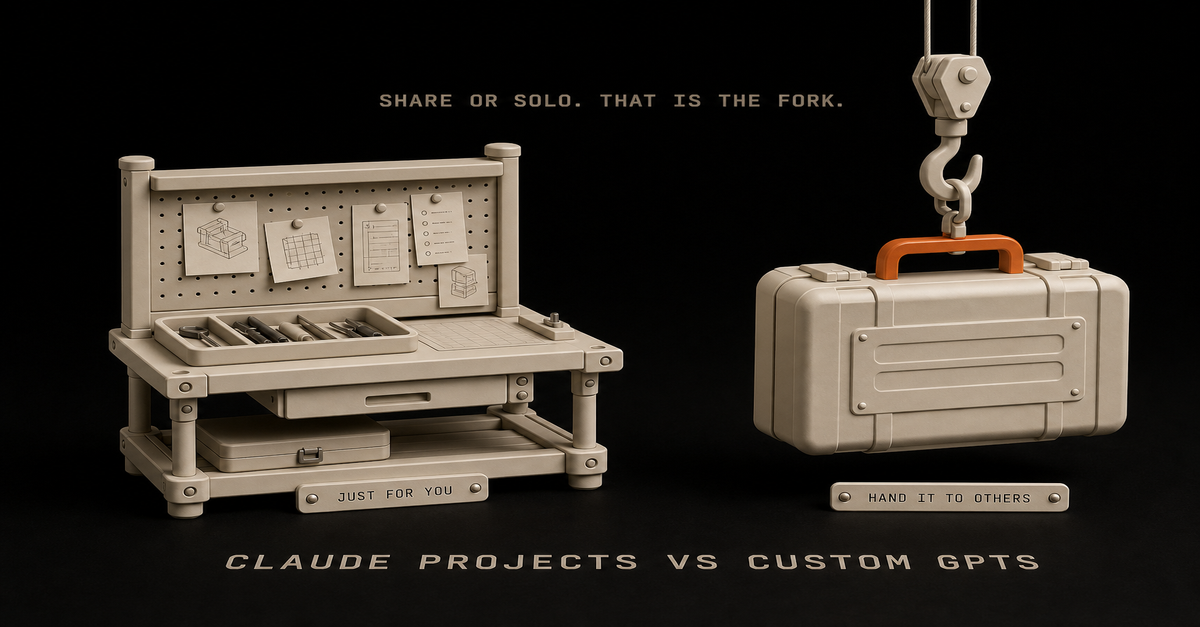
Claude Projects and Custom GPTs solve the same problem: you keep re-pasting the same background into a chat every morning. Claude Projects give you a workspace with saved instructions and reference files that every chat inside it already knows. Custom GPTs turn that same setup into a shareable assistant that other people can use too.
The short decision rule: if the assistant is just for you, use whichever tool you already pay for. If you need to hand it to other people, Custom GPTs are easier to share. And there is a decent chance you do not need either one yet. More on that below.
Quick comparisonClaude Projects
Custom GPTsWhat it is
A workspace inside Claude with saved instructions and files
A configured assistant inside ChatGPTBuilt for
Your own recurring work
Assistants you hand to other peopleSetup
Custom instructions plus project knowledge files
Instructions, knowledge files, optional actionsSharing
Inside a Claude Team or Enterprise workspace only
Direct link, workspace, or the public GPT StoreExtra powers
Skills, reusable instruction packs Claude loads when relevant
Actions, which let the GPT call other apps' APIsCost to build
Included on Claude's free plan, with limits
Requires a paid ChatGPT planCost to use
Free with limits, more on paid plans
Free users can use existing GPTsDoes Claude have an equivalent to Custom GPTs?
Yes, mostly. Claude Projects are the equivalent for personal use.
A Project holds two things: custom instructions (how Claude should behave in this context) and project knowledge (the files you would otherwise re-upload every time). Every new chat inside the project starts with all of that already loaded.
Projects also support Skills now, which are reusable instruction packs Claude pulls in when a task calls for them, like a house style for documents or a specific report format.
What Claude does not have is a store. You cannot publish a Project to a public gallery or send a coworker a link to "your assistant." Sharing only works inside a Claude Team or Enterprise workspace.
So the short answer: for "an assistant configured for my own work," Claude matches Custom GPTs. For "an assistant I can hand to anyone," it does not.
What is a Claude Project, in plain English?
Think of it as a folder that remembers.
Say you are an HR manager. You create a project called "Policy Questions," upload the employee handbook and your benefits summary, and write instructions like "answer questions using only these documents, quote the relevant section, and flag anything the documents do not cover."
From then on, every chat in that project answers from your actual handbook instead of generic HR advice.
A teacher might keep one project per course: syllabus, rubric, and a note about reading level. A project manager might keep one per client: status report template, stakeholder names, the tone the client expects.
Claude doesn't get smarter. You just stop spending the first five minutes of every session rebuilding context. I run my own recurring work this way, and the setup pays for itself in the first week.
If you want to see what a working example looks like end to end, here is my Claude SEO workflow. Different job, same pattern: instructions once, files once, then every chat starts warm.The 60-second version, from my Shorts: The free Claude folder that remembers you (3 setups beginners never turn on).What is a Custom GPT, in plain English?
A Custom GPT is a pre-configured version of ChatGPT with its own name, instructions, and knowledge files. You build it once through a conversational setup screen, no code involved, and it behaves the same way every time anyone opens it.
Two things make Custom GPTs different from a Claude Project:Sharing. You can send a GPT to a coworker as a link, share it across your company workspace, or publish it in the GPT Store. If you build a "Job Description Drafter" for your HR team, the whole team gets the exact same assistant without configuring anything.
Actions. A GPT can be wired to call outside services, so it can look something up or send data somewhere instead of just chatting. In practice, setting up actions requires API details most people will never touch. That is fine. The sharing alone is the reason most teams pick Custom GPTs.One cost note: anyone can use existing GPTs for free, but building your own requires a paid ChatGPT plan.
Which one fits how you work? Three questions
You can make this decision in five minutes. Ask these in order.
1. Which subscription do you already pay for?
This settles it for most people. Do not switch from ChatGPT to Claude, or the reverse, to get this one feature. Both products have a good version of "saved context plus instructions." Stick with the tool you already use. Your history and habits are already there.
2. Do you need to share the assistant, or just use it yourself?
Just you: Claude Projects or ChatGPT Projects, whichever side you are on. Done.
Your team needs the same assistant: Custom GPTs win clearly. A link your coworkers can open beats a setup doc you have to walk five people through. Claude can share projects too, but only if everyone is in the same paid Team workspace, which is a bigger ask than "click this link."
3. Where does your work context live?
If your context is documents you can upload, like handbooks, templates, rubrics, and past examples, both tools handle it well. If it lives inside other systems you would need to connect, neither one handles that cleanly out of the box. Get the document version working first anyway.
What about ChatGPT Projects vs Claude Projects?
If you are on ChatGPT and the assistant is just for you, skip Custom GPTs entirely. ChatGPT has its own Projects feature: chats grouped in a folder, with files and instructions attached, and memory scoped to that project.
For solo use, ChatGPT Projects and Claude Projects are close to interchangeable. Both hold files. Both hold instructions. Both keep your chats organized by context instead of one endless sidebar. People argue about which model writes better, and that's a real preference. But the projects features themselves won't decide it for you.
The clean way to remember the whole lineup:Projects (Claude or ChatGPT) = context for you
Custom GPTs = a configured assistant for other peopleDo you actually need either one?
Honestly, maybe not yet.
If you use AI a few times a week for varied tasks, a project is a filing cabinet for things you do not file.
What gets you most of the value is one well-written, reusable prompt: who you are, what you need, what format you want back, saved in a doc and pasted when needed. No setup, no subscription decision, works in any AI tool.
I keep 15 reusable prompts that cover most workdays on my start page, and that is where I would point anyone who has not built the habit yet.
My rule: when you catch yourself pasting the same prompt plus the same two or three files more than three times a week, move it into a Project. Until then, the prompt is enough.
When a Project stops being enough
There is a ceiling, and it helps to know where it is before you hit it.
A Project still requires you to show up, open the chat, paste the new input, and carry the output somewhere.
If you are running the same multi-step routine on a schedule, like every Monday you collect updates, format a report, and send it to the same people, that is not a chat problem anymore. That is a workflow.
The signs you have outgrown the chat window:the input arrives on a schedule, not when you feel like it
the output always goes to the same place
you are the only step in the middleWhen that describes your task, look at the workflows I have documented to see what the next level looks like.
And if you are wondering whether you need actual automation tools or are fine staying in the chat, I wrote a sibling decision page for exactly that: ChatGPT vs n8n, on whether you need automation at all.
If what you actually want is Claude doing the task instead of chatting about it, the fork is Claude Cowork vs Claude Code.
Most people do not need that level. But if you know the ceiling is there, you won't try to make a chat tool do a scheduler's job.
FAQ
Does Claude have an equivalent to Custom GPTs?
Yes. Claude Projects are the closest equivalent: saved instructions plus uploaded reference files that every chat in the project can use. The main thing missing is public sharing. There is no Claude version of the GPT Store.
Can you share a Claude Project the way you share a Custom GPT?
Only inside a Claude Team or Enterprise workspace. There is no public link or store. If you need to hand a configured assistant to people outside your workspace, a Custom GPT is the easier path.
Should I switch from ChatGPT to Claude just to get Projects?
No. ChatGPT has its own Projects feature that covers the same solo use case: files, instructions, and chats grouped in one place. Switching subscriptions for this one feature is not worth it.
Do I need a paid plan to use Claude Projects or Custom GPTs?
Claude includes Projects on the free plan with usage limits. ChatGPT lets anyone use existing Custom GPTs for free, but building your own requires a paid plan.This post is part of Claude Guides, the hub with every plan decision, task comparison, and setup guide for using Claude without code.
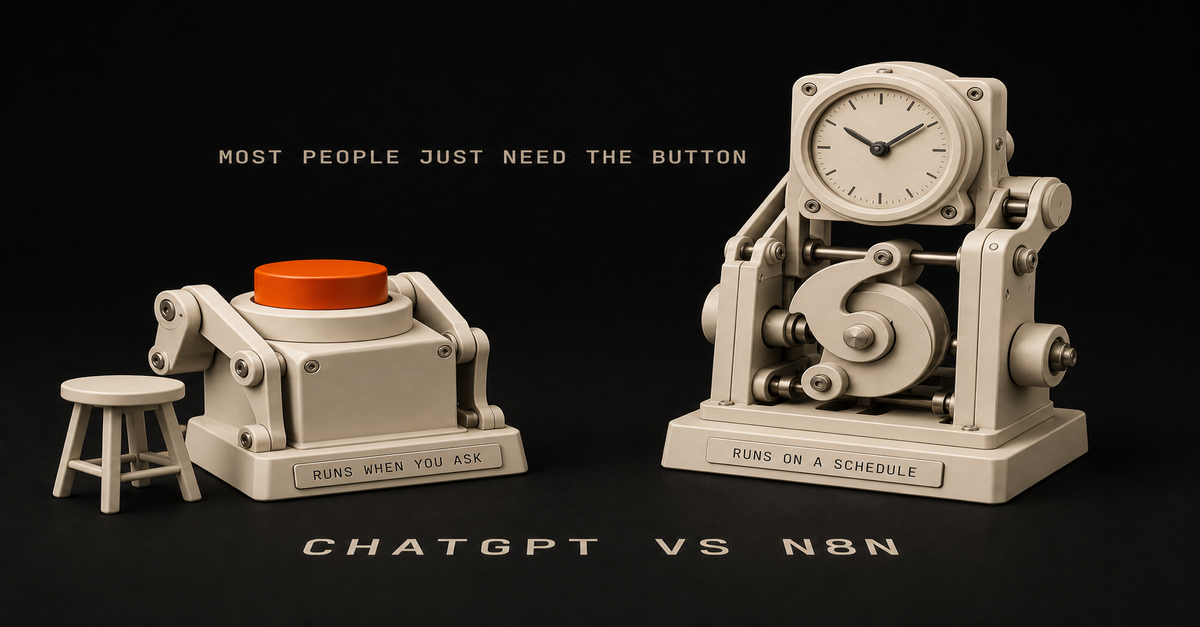
Most people asking this question do not need n8n.
Here is the test. If a task happens when you ask for it, and you are sitting there while it happens, a good reusable prompt covers it. n8n earns its place in exactly one situation: the same task has to run on a schedule or a trigger, without you, across two or more apps. That describes far fewer tasks than YouTube makes it sound.
I use both tools every week, so this is not tool loyalty. It is more like "do not buy a forklift to carry groceries."
What is the actual difference between ChatGPT and n8n?
They are not competitors. They do completely different jobs.
ChatGPT (or Claude) is a thinking tool. You give it something, it gives you something back. Summarize these meeting notes. Draft this awkward email. Turn 40 survey responses into the five complaints that actually matter. You are present for every exchange, and that is fine, because the task only exists when you ask for it.
n8n is plumbing. It moves data between apps when something happens. A form gets submitted, so a row lands in a spreadsheet and a Slack message goes out. Nobody is sitting there. That is the entire point of it.
The confusion comes from demo videos where n8n has an AI step in the middle, so it looks like "ChatGPT, but automated." True as far as it goes.
But that AI step does the same job ChatGPT does in your browser tab. The real question is never which tool is smarter. The question is whether the task needs to happen without you.
How do you know if you need n8n? Ask 3 questions
Run any task you are thinking about through these:Does it repeat on a schedule or a predictable trigger? Every Monday morning. Every time a form comes in. Every new invoice.
Does it cross two or more apps? Form to spreadsheet to email. Inbox to tracker to Slack.
Does it need to run when you are not watching? Overnight, during meetings, while you are on leave.Three yeses: automation software is worth a look. Two or fewer: a saved prompt almost certainly covers it, and it covers it today, for free, with nothing to maintain.
Real examples:"Summarize my meeting notes into action items." You are present, one app, on demand. Prompt.
"Help me draft replies to difficult parent emails." On demand, you review every word anyway. Prompt.
"Every Friday at 4pm, pull this week's form responses, summarize the complaints, and email me the digest." Scheduled, three apps, runs alone. That is a real n8n job.
"When a new applicant submits the intake form, score them against the role requirements and add the score to my tracking sheet." Triggered, multiple apps, unattended. Also a real n8n job.Notice the pattern. The prompt tasks are about judgment and wording. The automation tasks are about moving the same data the same way, over and over, with nobody watching.
ChatGPT vs n8n: quick comparisonThe task
UseSummarize notes, docs, or transcripts on demand
ChatGPT promptDraft or rewrite emails in your voice
ChatGPT promptTurn messy feedback into clear themes
ChatGPT promptPrep for a meeting from an agenda and past notes
ChatGPT promptMove form responses into a sheet automatically
n8nSend a weekly report without touching it
n8nWatch an inbox and route requests to the right person
n8nScore or sort new entries the same way every time
n8n with an AI stepAnything you do once or twice, ever
Neither. Just do it.If your whole list lands in the top half of that table, you have your answer. Save your prompts and skip the software.
What does n8n really cost if you cannot code?
The tutorials skip this part, so I'll be the honest friend here.
Money. n8n Cloud starts around $25 a month. The "free" self-hosted version needs a server, usually $5 to $10 a month, plus you become responsible for installing it, updating it, and backing it up. If words like Docker mean nothing to you, self-hosting is not free. It is a part-time hobby.
Heads up: some links in this post are affiliate links: a small kickback to me at no cost to you. I only recommend tools I've actually run.
Setup time. Your first real workflow takes an afternoon, not the 8 minutes the video showed. Most of that time is not building. It is connecting accounts: API keys, permission screens, and figuring out why Google says no. Plan 3 to 4 hours for workflow number one.
Debugging. Workflows break silently. A password-like credential expires. An app changes how it sends data. The workflow you built in March fails quietly in June, and you find out because the Friday report never showed up. Then you are staring at a red error node and a message written for engineers.
Maintenance. Every workflow you build is a small machine you now own. A few simple ones might need an hour a month. But it never goes to zero, and you are the repair person.
None of this means avoid n8n. It means n8n has to earn that overhead. A saved prompt has zero of these costs, which is why it should always be your first move.
When is a reusable prompt all you need?
If you are present when the task happens, the prompt is the automation.
The trick is writing it once, properly, and saving it, instead of improvising a new mediocre prompt every time.
A reusable prompt spells out four things: who the AI should act as, what input you will paste in, the exact format you want back, and one example of a good output. That takes 15 minutes to write and pays you back every week after.
Then keep your prompts somewhere you can grab them: a doc, a notes app, whatever you will actually open. If you want a starting set, I keep 15 reusable work prompts here, built for exactly this kind of on-demand work.
The honest comparison: a prompt like this saves you 20 minutes every time you use it, costs nothing, and cannot break while you sleep. That is a high bar for automation software to clear.
When does n8n actually make sense?
Volume and absence. Those are the two things that flip the answer.
If 30 form submissions arrive every week and each one needs the same three steps, you are not doing judgment work anymore. You are being a conveyor belt. Same if the task has to fire at 6am or while you are on vacation. No prompt fixes "I was not there."
If a task passes the 3-question test, the pattern that holds up is boring: a trigger, a step that gathers the data, an AI step for any judgment call, a human approval for anything customer-facing, then route the result.
I wrote up that exact pattern in the n8n AI agent workflow if you get to that point.
Also, an option nobody mentions: you do not have to build it yourself. If the task clearly qualifies but the setup sounds miserable, ask IT, or pay a freelancer for a day.
A capable n8n freelancer can build a clean first workflow in a day. The building is the cheap part. The maintaining is what you are really signing up for, so decide who owns that before anything gets built.
One more fork in the road: if you or a technical coworker work in code all day, the comparison changes shape. That version of the decision is in Claude Code vs n8n.The 60-second version, from my Shorts: More Automations = Better Results. Or Does It?.What I would do first
Skip the software question for one week and do this instead:List every task you repeat weekly. Most people find 8 to 12.
Run each one through the 3 questions: schedule or trigger, 2+ apps, runs without you.
For everything that fails the test, write and save the prompt today. That is 15 minutes per task.
For the one or two that pass, score them with the automation priority audit before you sign up for anything. It forces the time-saved versus time-spent math that the excitement skips.When I run this with people, the usual result is nine prompt tasks and one genuine automation candidate. That ratio is normal. It is also good news: you can fix most of your repetitive work this afternoon, without buying, hosting, or maintaining anything.
The boring answer wins here. Prompts first. n8n only when a task proves it deserves a machine.
FAQ
Is n8n better than ChatGPT?
Neither is better. They do different jobs. ChatGPT answers when you ask it something. n8n moves work between apps on a schedule or trigger, without you present. Most people only need the first one.
Can ChatGPT replace n8n?
For on-demand tasks where you are present, yes. A saved prompt covers summarizing, drafting, and rewriting. ChatGPT cannot replace n8n for tasks that must run unattended across multiple apps.
Do I need to know how to code to use n8n?
You can build simple workflows without code, but it gets technical fast: API credentials, error logs, and data formats. Budget real time for setup and debugging, or pay someone to build it.
Is n8n free?
The software can be self-hosted free, but you pay for a server, plus your time for setup, updates, and fixing broken workflows. n8n Cloud starts around $25 a month and removes the server work.This post is part of the n8n AI agents hub: definitions, tutorials, workflow patterns, and the build-vs-run decision pages in one place.
Direct Answer
Package the offer as a small website project plus a monthly retainer that owns one automation. The AI coding part is delivery, not pitch.
Local owners do not buy AI. They buy more booked jobs, faster lead responses, fewer no-shows, and a site that does not embarrass them. You sell that.
You deliver it with Claude Code drafting the site and n8n owning the workflow that produces the result. The offer reads: a flat-fee site, then a monthly fee for one workflow you own end to end. One scope, one outcome, one invoice.
Heads up: some links in this post are affiliate links: a small kickback to me at no cost to you. I only recommend tools I've actually run.
Use This When And When To Skip ItUse this
Skip thisYou can ship a small site and one working n8n workflow in a weekend
You have never deployed either and want to learn on a paying clientYou will answer the phone, drive to a meeting, and fix a broken Zap on a Saturday
You want a fully remote, faceless buyerYou want predictable monthly revenue from 3 to 8 clients
You want one $100k contract and no support loadYou like scoping in plain English and writing one-page proposals
You need a brand, a deck, and a sales team to feel readyTradeoff: this is a feet-on-the-ground offer. The reward is fast cash and a real reference. The cost is showing up.
The System
Trigger -> referral, local search, in-person ask, or a clear pain ("we miss calls")
Inputs -> one decision-maker, current website, current lead flow, one number they want to move
Decision -> site project + which single workflow gets the retainer
Claude step -> drafts site, intake form, and n8n workflow JSON inside your repo
Artifact -> deployed site, one live workflow, a 1-page operating doc the owner can read
Approval -> owner reviews the workflow output for one week before it runs unattended
Output -> monthly retainer invoice, monthly result note (what ran, what failed, what changed)
Feedback -> the one number they wanted to move, checked monthlyThe model writes the code. The workflow owns the result. You own the relationship and the gate.
Steal This Workflow
Here is the offer, broken into pieces you can copy.
1. Pick one outcome per client. Not "we will do your marketing." Pick one of: faster reply to inbound leads, automated review requests after a job closes, appointment reminders that cut no-shows, or a seasonal offer that fires on a weather trigger. One outcome means one workflow.
2. Scope the entry project. A 5 to 7 page site, a contact form that posts to a webhook, and one CRM or sheet as the source of truth. Fixed price. Two-week delivery. Written scope, written exclusions.
3. Draft with Claude Code in a real repo. Open Claude Code inside the client repo, hand it the brief, and let it write the Astro or Next pages, the form handler, and the n8n workflow JSON. Read the diff. Reject the parts that drift. Do not paste from a chat tab into production.
4. Run the workflow JSON through a real audit. Community templates and AI-generated JSON both ship credentials, webhooks, and code nodes you did not write. Pass anything before it goes live through the n8n workflow JSON auditor.
5. Build and QA before you hand it over.
npm run build
npm run qa:searchThe site is the proof. A broken sitemap or missing title tag tells the owner the work is sloppy.
6. Sign the retainer on one workflow. Monthly fee. One workflow owned. The contract names the workflow, the trigger, the input source, the output, and what counts as a failure. If they want a second workflow, that is a second retainer.
7. Send a one-page monthly note. Three lines: what ran, what failed, what you changed. The note is the renewal mechanism. Most local owners never get this from a vendor.
8. Use a planner to keep scope honest. When the owner asks for a second workflow inside the same fee, open the Claude Code n8n workflow planner and show them the node map. A picture turns "one more thing" into "that is a second project."
What This Looked Like For This Page
This page started as a Reddit source signal in the weekly AEO run, not as an idea I had in the shower.
The run pulled 936 raw Reddit RSS entries, scored 314 candidates, generated 25 AEO briefs, and marked 9 of those as publish_now. This topic passed because:Gate
Why it passedSource language
The thread used "first real AI coding income" and "local service business" instead of abstract "AI consulting" languageArtifact
The answer maps cleanly to one project plus one workflow plus one monthly note, which a reader can copyCluster fit
It links into Claude Code, n8n, the workflow planner, and the AI stack post without forcingThe page is research-inspired by the thread, not a claim that I ran these specific clients.
What Most People Get Wrong
The mistake is leading with "AI" in the sales conversation.
The owner is trying to decide if their phone will ring more next month. They do not care about Claude versus GPT. They care if the new system breaks their existing scheduling.
The pitch should sound like "you are losing 4 leads a week because nobody replies in under an hour, here is what I will do about it for a fixed fee" and not like a feature list.
Three more breakages that show up in the threads:Scope creep eats the retainer. Owners ask for "just one more thing" until the monthly fee becomes a part-time job. Name the workflow in the contract. Anything else is a new project.No approval week. The workflow goes live on day one, fires on the wrong record, and the owner cancels. Give it a one-week review window where every output gets manually read before it sends.The retainer has no artifact the owner can read. They cannot see what they are paying for. The monthly one-page note is the artifact.How I Would Build This
My version uses Claude Code for the build, n8n for the running workflow, and the repo for the audit trail.
Claude Code in the client repo. Each client gets a small Astro or Next repo with the voice and brand notes as files Claude Code reads on every run. The model never re-negotiates tone, link structure, or schema.
n8n owns the running workflow. The n8n AI agent workflow pattern handles trigger, decision, and approval. The lead intake or review request runs through the same shape as the n8n AI agent tutorial. One human gate before anything customer-facing fires.
Audit anything you did not write. Community JSON and AI-generated JSON both need a pass through the n8n workflow JSON auditor before activation.
The stack stays small. Repo, Claude Code, n8n, one CRM or sheet, one site host. The longer AI stack for solo founders writeup goes deeper on what to keep and what to cut.
The SEO layer for your own offer. Use the same workflow you use for clients on yourself. The Claude SEO workflow post explains how to wire Claude as a workflow step instead of a chat tab so your own service page is not the weakest part of the funnel.
Next Step
If you are sitting on AI coding skills and no offer, do one thing this week. Pick a local business you already know, write the one-page proposal as a fixed-fee site plus a one-workflow retainer, and send it.
If you want to map the workflow before the conversation, the Claude Code n8n workflow planner sketches the trigger, intake, decision, approval, and result so you walk in with a node map instead of a vibe.
Source Signal
Research-inspired by a Reddit thread describing a builder's first real AI coding income from a local service business: a website project, a monthly growth retainer, and a larger internal automation. Treat the thread as one operator's note, not as Chris's results. Original: the r/SaaS thread, "My first real AI/coding income case."
Related AEO PagesClaude SEO workflow
Weather-triggered HVAC booking workflow
Learning AI workflows from scratch
Pre-launch social media automationFAQ
Why pitch local service businesses instead of SaaS customers?
Local owners pay for outcomes they can see this month. They are the right buyer for an operator who is still learning the sales motion.
What is the actual offer shape?
A fixed-fee site project as the entry, then a monthly retainer that owns one workflow end to end.
Where does Claude Code fit?
Claude Code drafts the site and the workflow JSON inside your repo. You read the diff and approve the deploy.
How do I price it without guessing?
Flat fee for the site, flat monthly fee for one workflow. Skip hourly until you know how long the work takes.
When should I skip this offer entirely?
Skip it if you will not answer the phone, drive to one meeting, or maintain a workflow you shipped six months ago.
Direct Answer
Use Claude as one step inside a defined workflow, not as a chatbot you re-prompt every week.
A chatbot has no memory of your site, no schema rules, no internal-link map, and no approval gate. A workflow has a trigger, inputs, a decision rule, an artifact, and a review step.
Claude only sees the inputs you load. The output is the same shape every time. The system improves because you fix the workflow, not the prompt.
The smallest version: pull Search Console data on a schedule, score the query, brief the page in a file in your repo, draft in Claude Code with the repo as context, edit against a checklist, build, QA, publish. Same path every run.
Use This When And When To Skip ItUse this
Skip thisYou publish 2+ pages a month and they keep drifting in voice
You are writing one-off pages with no clusterYou have a repo with existing posts, voice notes, schema, and an internal-link map
You have fewer than five existing postsGSC is connected and showing impressions you are not converting
You have no GSC data yet. Fix that firstYou want the same shape every week without re-explaining tone
You enjoy the chat-window flow and only ship monthlyTradeoff: a workflow takes one weekend to wire. A chat window takes zero. The workflow pays back the second week.
The System
Trigger -> weekly cron or new GSC opportunity
Inputs -> GSC query, target page, internal-link map, schema rules, voice profile
Decision -> answer page, comparison, workflow, tool, or refresh?
Claude step -> draft against the brief with the repo as context
Artifact -> markdown file, frontmatter, internal links, FAQ schema
Approval -> human read for voice, claims, and receipts
Output -> commit, build, deploy, ping IndexNow
Feedback -> GSC impressions, CTR, position at 14/30/50 daysClaude owns: writing the draft, expanding the brief, drafting the FAQ, proposing internal links.
Claude does not own: deciding what to publish, approving claims, hitting publish, measuring results.
That split is the whole point. The model is one node. The workflow is the system.
Steal This Workflow
This is the actual shape that runs on this site. Copy the file paths, swap your repo.
1. Pull the data weekly.
npm run gsc:refresh
npm run reddit:aeo-scout
npm run aeo:weeklyOutput: a ranked list of real questions and queries with enough signal to become an answer page.
2. Pick the page type by query shape.Query shape
Asset"what is X"
Answer page + FAQ schema"X vs Y"
Comparison page"how to X"
Tutorial or workflow page"X calculator / template / planner"
Free tool"best X for Y"
List or stack page3. Write the brief as a file in the repo, not a chat message.
outputs/aeo-page-briefs/<run>/briefs.mdThe brief must contain the source query, the exact source language, the direct-answer angle, the artifact the page will ship, and the internal links it should hit.
4. Hand the brief to Claude with the repo as context.
claude --model opus -p "Read the brief at outputs/aeo-page-briefs/<run>/briefs.md. Read the voice profile. Read existing posts in src/content/posts/ so you do not duplicate angles. Draft the page per the AEO standard. Return markdown only."Claude reads voice, existing posts, schema rules, and the internal-link map from the repo. It does not re-negotiate tone.
5. Run the deterministic QA gate before you touch the build.
python3 /Users/chrisalarcon/Documents/Productivity/.claude/skills/ship-lean-aeo-page-factory/scripts/score_aeo_page.py path/to/draft.mdIf it returns below 8.5, revise. If any category scores 0, the page fails even at a high total.
6. Build, QA, deploy.
npm run build
npm run qa:searchCheck: title and meta unique, sitemap includes the URL, canonical correct, schema present, no broken internal links.
7. Ship and inspect.
After deploy, submit the URL to IndexNow and inspect it in GSC:
node scripts/gsc-inspect.mjs https://yourdomain.com/blog/<slug>8. Measure at 14, 30, and 50 days. Refresh the pages with impressions but weak CTR before writing new ones.
Every step has an owner, an input, an output, and a gate. The Claude step is one row in that table.The 60-second version, from my Shorts: My Dead Blog Hit 22-Click Days and Hosting Costs $0.What This Looked Like For This Page
This page did not start with "write me an SEO post about Claude."
It started as a recent Reddit source signal, then moved through the same page-factory path:
npm run reddit:aeo-scout -- --run-name 2026-05-14-weekly-aeo
npm run aeo:weekly -- --run 2026-05-14-weekly-aeo --run-name 2026-05-14-weekly-aeoThat run pulled 936 raw Reddit RSS entries, scored 314 candidates, generated 25 AEO briefs, and marked 9 as publish_now.
This topic won because it had the three things a real AEO page needs:Gate
Why it passedSource language
The question was not abstract. People were talking about using Claude for SEO work, not "AI content strategy" as a vague categoryArtifact
The answer could become a workflow map with commands, repo paths, QA gates, and a skip ruleCluster fit
It naturally links into Claude Code, n8n, GSC, AEO pages, and my content systemThe draft then went through an Opus pass, a Codex QA pass, and this local gate:
python3 /Users/chrisalarcon/Documents/Productivity/.claude/skills/ship-lean-aeo-page-factory/scripts/score_aeo_page.py src/content/posts/how-to-use-claude-as-an-seo-workflow/index.mdThat is the part most "AI SEO" content skips. The model can write the page, but the workflow decides whether the page deserved to exist.
What Most People Get Wrong
The mistake is treating Claude like a search assistant.
Open a fresh chat. Paste a keyword. Ask for an outline. Ask for a draft. Ask it to rewrite the intro. Next week, do it again with a different keyword. The output is fine. Nothing compounds.
Three specific things break.No memory of your site. Claude does not know what you already published, what you internally link, or what your schema looks like. You end up with thin pages that compete with each other for the same query.No decision rule. Every chat is a fresh negotiation about angle, length, and tone. You re-explain your voice on Monday and again on Friday.No approval gate. A chat window encourages "looks good, ship it." A workflow forces a checklist read: direct answer up top, no invented metrics, internal links present, schema correct.The fix is not a better prompt. The fix is a workflow that uses the prompt as one step.
How I Would Build This
My version uses Claude Code for judgment steps and n8n for routing.
Inputs live in the repo, not in chat.Voice profile and brand rules as files Claude Code reads on every run.
A list of existing posts and their primary queries so the model does not propose duplicate angles.
A schema reference for BlogPosting and FAQPage so the FAQ block is always valid.
An internal-link map of tool, workflow, and pillar pages.Claude Code as the draft step. Use the Claude Code n8n workflow planner to sketch where Claude sits in the pipeline. The model reads the brief and the repo. It writes one draft. It does not pick the topic.
n8n as the router. Use the n8n AI agent workflow pattern for triggers and routing. n8n pulls GSC data on a schedule, queues briefs, posts drafts to a review channel, pings IndexNow after deploy. The same approval pattern from the n8n AI agent tutorial keeps a human in the loop before anything goes live.
Heads up: some links in this post are affiliate links: a small kickback to me at no cost to you. I only recommend tools I've actually run.
Importing community workflow JSON safely. If you grab community n8n workflows for SEO tasks, run them through the n8n Workflow JSON Auditor before activating. Unknown JSON can include credentials, webhooks, and code nodes you did not write.
The stack stays small. Claude Code, n8n, GSC, the repo. That is enough. The full AI stack for solo founders post goes deeper on what to keep and what to cut.
Next Step
If you are still pasting prompts into a Claude chat for SEO work, do one thing this week. Pick the next page you plan to write. Build the brief in a file in your repo. Open Claude Code in that repo. Run the draft step there instead of in a chat tab.
If you want the same routing layer I use, the Claude Code n8n workflow planner maps the trigger, brief, draft, approval, and publish nodes for you. The model did not change. The workflow did.
Source Signal
Research-inspired by a Reddit thread where an operator described moving SEO work out of Claude chat and into a defined workflow. Treat the thread as one builder's note, not as proof of Chris's results. Original: the r/ClaudeCode thread, "Guys, I stopped using Claude as a chatbot for SEO work."
The pattern matches the broader rule I work by: the model is one step, the workflow is the system, and the approval gate is non-negotiable.
Related AEO PagesAI coding local service offer
Weather-triggered HVAC booking workflow
Learning AI workflows from scratch
Pre-launch social media automation
Self-hosted n8n Zapier gotchasFAQ
What does it mean to use Claude as an SEO workflow?
Treat Claude as one step in a defined pipeline: GSC query in, brief in, repo context in, one draft out, human approval before publish.
Do I need Claude Code or will Claude.ai work?
Claude.ai is fine for one-off drafts. Claude Code is stronger because it reads your repo, voice profile, and internal-link map on every run.
Where does n8n fit?
n8n owns triggers and routing: pull GSC on a schedule, queue briefs, post drafts to review, ping IndexNow after deploy. Claude owns the judgment steps.
Can I automate the whole thing end to end?
No. Keep a human approval gate. Automate the boring steps. Approve the taste calls.
When should I skip this entirely?
Skip it if you publish under one page a month, have no existing cluster, or have no GSC data yet. Wire the data first.This post is part of Claude Guides, the hub with every plan decision, task comparison, and setup guide for using Claude without code.
Quick answer: Use Zapier when you want the fastest simple automation between popular apps. Use n8n when you need a real AI agent workflow: tools, structured output, branching, retries, self-hosting, and deeper control. For systems like mine, Zapier is a shortcut and n8n is what actually runs the work.
Heads up: some links in this post are affiliate links: a small kickback to me at no cost to you. I only recommend tools I've actually run.
If you are new to the concept, start with what an n8n AI agent is. If you already know you want n8n, use the n8n AI Agent Workflow Builder.
Quick ComparisonQuestion
n8n AI Agent
Zapier AI ActionsBest for
Custom AI workflows with tools
Fast app-to-app AI actionsBuilder type
Technical solo builder, operator, team
Nontechnical operator, speed-first builderAgent depth
Stronger for tool-using workflows
Better for simple AI-assisted actionsHosting
Cloud or self-hosted
CloudWorkflow control
High
MediumDebugging
Node-level runs and logs
Simpler task historyBest first use
Agentic routing, enrichment, approval
Simple summaries, drafts, app updatesNeither one is better across the board. Pick based on what the workflow needs.
What n8n Does Better
n8n is stronger when the workflow has real logic:the agent needs to choose between tools
the output needs a structured schema
you need custom code in the middle
you want to self-host
the workflow needs approvals before publishing
the run history matters because this is becoming an operating systemThat makes n8n a better fit for AI workflows you plan to keep running.
For example, a Search Console workflow might:Pull query/page data.
Ask an AI Agent node to classify the opportunity.
Use a tool to inspect the current page.
Return structured fields: refresh, build, or ignore.
Create a draft task.
Ask for human approval before publishing.That is more than "summarize this row." It's a small system with a few moving parts.
What Zapier Does Better
Zapier is stronger when speed and app coverage matter more than control.
Good Zapier use cases:summarize a form submission
draft a Slack reply
move a lead into a CRM
create a simple email draft
connect two common SaaS tools quicklyIf the workflow is simple, Zapier may be the better first move, because you get something useful working fast.
The Hidden Question: Do You Need an Agent?
Most workflows do not need an agent.
Use simple automation when the rule is clear:Task
UseNew form submission goes to CRM
Simple automationNew meeting gets a Slack reminder
Simple automationSupport message needs urgency classification
AI stepSearch query needs refresh/build/ignore judgment
AI agentPublic content needs approval
AI agent plus human reviewIf the workflow is just moving data, don't turn it into an agent. If the workflow needs judgment, tools, and routing, n8n gets more interesting.
My Pick
For a solo builder trying to grow organic traffic, I would use:Codex or Claude Code to build and refresh pages
n8n to pull recurring signals, route tasks, and manage approvals
Zapier only when a simple SaaS handoff is faster than building a custom n8n workflowThat way you own the core system, and you still take the shortcut when it's actually faster.
When I Would Choose Each
Choose Zapier if:you need a working automation today
the workflow has two or three simple steps
you do not care about self-hosting
you do not need custom agent toolsChoose n8n if:you are building an AI agent workflow
you need structured output and branching
you want lower-level control
you want self-hosting or deeper data ownership
you want the workflow to become part of your operating systemFor deeper n8n patterns, read the n8n AI Agent Tutorial and n8n AI agent vs workflow automation.This post is part of the n8n AI agents hub: definitions, tutorials, workflow patterns, and the build-vs-run decision pages in one place.
Claude Code and n8n are not replacements for each other.
They're two different layers of how a solo builder runs things.Layer
Tool
JobBuild and judgment
Claude Code
Read context, edit files, draft, review, implementTrigger and routing
n8n
Detect events, gather inputs, retry, notify, routeApproval
Human
Protect quality, voice, brand, money, productionIf your workflow needs repo context, use Claude Code.
If your workflow needs a recurring trigger, use n8n.
Heads up: some links in this post are affiliate links: a small kickback to me at no cost to you. I only recommend tools I've actually run.
If your workflow needs both, use both.
Why solo builders confuse them
Both can touch AI.
Claude Code can run commands and make changes. n8n can call an LLM. So it is tempting to ask, "Which one should run the business?"
That's the wrong question. The better one is:
Which part of the workflow needs judgment, and which part needs reliability?
Claude Code is for judgment.
n8n is for reliability.
A practical example
Say you want to turn a Search Console export into a new page.
n8n should:detect the export
save the file
notify the system
route the final outputClaude Code should:read the repo
score opportunities
create or update the page
add internal links
run the buildYou should:approve before publishingThat's the pattern I use.
Start with the planner
Before building, use the Claude Code + n8n Workflow Planner.
If the workflow is agent-heavy, use the n8n AI Agent Workflow Builder.
If you are building the full workflow stack, start with the n8n AI Agents hub. The point is simple: Claude Code builds, n8n runs, and a human approves.
I also keep a public starter repo for this split: Claude Code Systems Kit. It has the decision matrix, Claude routines, OpenClaw runner pattern, n8n approval notes, and workflow spec templates.
FAQ
Should solo builders use Claude Code or n8n?
Use Claude Code for codebase work, repo context, writing, and judgment. Use n8n for triggers, routing, integrations, retries, and schedules.
Can Claude Code and n8n work together?
Yes. n8n can detect the event and gather inputs; Claude Code can create the draft, plan, script, or diff; then n8n can route it for approval.
For AI agent workflows, I would usually pick n8n over Make.
Heads up: some links in this post are affiliate links: a small kickback to me at no cost to you. I only recommend tools I've actually run.
Not because Make is bad. Make is clean, visual, and easier for a lot of app-to-app automations.
But for the technical or technical-adjacent solo builder, n8n has the better shape:Need
PickEasiest visual app automation
MakeSelf-hosting and control
n8nCode nodes and custom logic
n8nAI agent workflows with tools
n8nSimple marketing ops workflows
Make or n8nLower marginal cost at scale
n8n self-hostedWhere Make wins
Make is good when the workflow is visual and app-heavy.
Use it when:you want the easiest builder
you are connecting common SaaS apps
the workflow is not deeply technical
you do not care about self-hosting
you want a polished visual interfaceIf the goal is "move this from app A to app B with some formatting," Make is fine.
Where n8n wins
n8n is stronger when you want control.
Use it when:the workflow needs code
you want self-hosting
you care about cost at scale
you need custom API calls
you want agent tools and more flexible logic
you are comfortable debuggingThat last one matters. n8n gives you more flexibility, but it's not always easier.
The AI agent workflow angle
AI agent workflows tend to need:context gathering
tool access
memory/history
conditionals
retries
logging
approval steps
custom actionsn8n fits that shape well.
Make can do plenty, but n8n feels more natural when the workflow starts drifting from "connect apps" into "build an operating system."
My recommendation
If you are a solo builder using Claude Code, GitHub, Vercel, APIs, and custom workflows, start with n8n.
If you are a non-technical operator who wants polished app automation fast, start with Make.
If you already have Make working, do not migrate for sport. Move only when you hit control, cost, or flexibility limits.
Build your first n8n agent map with the n8n AI Agent Workflow Builder.
FAQ
Is n8n or Make better for AI agent workflows?
n8n is usually better for technical solo builders who want control, code nodes, self-hosting, and agent-style workflows. Make is easier for visual app automation.
Should solo builders start with n8n or Make?
Start with Make if you want the easiest visual builder. Start with n8n if you want more control and expect to build AI agent workflows.This post is part of the n8n AI agents hub: definitions, tutorials, workflow patterns, and the build-vs-run decision pages in one place.
Use normal workflow automation when the rules are clear.
Use an n8n AI agent when one step needs judgment.
Heads up: some links in this post are affiliate links: a small kickback to me at no cost to you. I only recommend tools I've actually run.
That's the decision. If you already know you need the agent version, the full n8n AI agent workflow pattern shows the build: trigger, context, scoped tools, human approval, and logging.Situation
UseCopy data from form to CRM
Normal workflowSend Slack alert after status changes
Normal workflowClassify messy customer messages
AI agentScore Search Console queries for content ideas
AI agentDraft a newsletter from a build log
AI agent plus approvalPublish automatically to production
Probably notWorkflow automation is for known steps
Normal automation is best when you can describe the rule clearly:when this happens, do that
if status is approved, send email
every Monday, pull this report
when form submits, create taskYou do not need an AI agent for that.
Adding one usually makes the workflow slower, harder to debug, and more expensive.
AI agents are for fuzzy steps
Use an agent when the workflow needs to interpret something:Is this lead qualified?
Is this query worth a page?
Does this transcript contain a strong proof moment?
Is this support message urgent?
Should this draft be published, revised, or killed?A simple if/then branch can't answer those. You need judgment.
The clean hybrid pattern
The best setup is usually both:n8n triggers the workflow.
n8n gathers data.
The agent handles the fuzzy decision.
n8n routes the result.
A human approves high-risk output.That gives you automation without pretending the agent should own the whole process.
Use the Claude Code + n8n Workflow Planner to split the work before building. If you're choosing between a coding agent and a workflow runner, read AI coding agent vs workflow automation.
What solo builders should build first
Start with a workflow where bad output is annoying, not a disaster.
Good:content idea scoring
transcript repurposing
newsletter draft creation
lead triage draft
workflow planningBad:customer refunds
publishing without review
deleting production data
sending sales emails with no approvalThe point is to keep the agent useful and give it clear limits.
FAQ
What is the difference between an n8n AI agent and workflow automation?
Workflow automation follows known rules. An n8n AI agent handles the judgment step inside a workflow.
Should every n8n workflow use an AI agent?
No. Use normal automation when the steps are clear and rule-based. Add an agent only when the workflow needs reasoning.This post is part of the n8n AI agents hub: definitions, tutorials, workflow patterns, and the build-vs-run decision pages in one place.
An n8n AI agent is a workflow step that uses an LLM plus tools to make decisions inside an automation. The agent reads context, chooses or calls tools, returns a structured result, and lets n8n route the next step.
Heads up: some links in this post are affiliate links: a small kickback to me at no cost to you. I only recommend tools I've actually run.
The short version:Part
Jobn8n
Trigger, gather data, route output, retry failuresAI agent
Read context, decide, draft, classify, score, or planTools
Let the agent check data or take actionHuman approval
Protect anything public, expensive, or brand-sensitiveThe mistake is thinking the AI Agent node is magic by itself. It is not.
The node becomes useful when it has a clear job, enough context, and access to the right tools.
If you want the full build sequence, read the n8n AI agent tutorial. If you want the repeatable pattern, use the n8n AI agent workflow. This page is the short definition.
The plain-English version
Think of n8n as the operations desk.
It knows when something happened. A form came in. A video published. A Search Console export landed. A Notion status changed.
The AI agent is the person at the desk who can read the packet and make a call.
Should this lead go to sales? Should this query become a tool page? Should this transcript become a newsletter? Is this task worth automating?
That decision is the agent's job.
The routing, logging, retries, and notifications are n8n's job.
What makes it agentic?
An agentic workflow has more than a prompt.
It has:a trigger
context
a decision
tools or actions
memory or history when needed
a clear output
an approval gate when consequences existWithout tools or actions, the agent is usually just an LLM response inside a workflow.
That can still be useful. But it is not the same as an agent that checks, decides, and routes.
A simple n8n AI agent workflow
Here's the pattern I'd start with:n8n detects a new input.
n8n gathers the context.
The agent makes one specific decision.
n8n saves the decision.
A human approves if needed.
n8n routes the output.Use the n8n AI Agent Workflow Builder to map that before you build.
For the full path, use the n8n AI Agents hub. It connects this definition to the workflow pattern, builder tool, and Claude Code/n8n handoff.
So which page do you need?Search intent
Best next pagewhat is n8n ai agent
Stay here for the definition.n8n ai agent tutorial
Use the build tutorial.n8n ai agent workflow
Use the workflow pattern.Good first use cases
For solo builders, good use cases are boring:score Search Console queries
classify inbound leads
turn a build log into a newsletter draft
summarize support requests
route content ideas
check if a workflow is worth automatingBad first use case: "run my whole business."
Start with one judgment step.
n8n AI agent vs Claude Code
n8n AI agents are good inside recurring workflows.
Claude Code is better when the task needs repo context, file edits, code changes, or actually building the thing.
Use both when the workflow needs a trigger and something that can work in your code:n8n detects and gathers
Claude Code edits or drafts
human approves
n8n routesRead the full decision rule in Claude Code vs n8n.
FAQ
What is an n8n AI agent?
An n8n AI agent is an automation step that uses an LLM plus tools to reason over context and take actions inside a workflow.
Is the n8n AI Agent node agentic by itself?
Not really. It becomes agentic when it can use tools, check context, make decisions, and route work instead of only generating text.
When should solo builders use an n8n AI agent?
Use it when one repeatable workflow needs judgment, classification, drafting, scoring, or routing.
What is the difference between an n8n AI agent and an n8n AI agent workflow?
The agent is the judgment step. The workflow is the full system around it: trigger, context, tools, approval, routing, logging, and retries.
One YouTube video should not stay one YouTube video.
If you are a solo builder, every long-form video is proof. It can become Shorts, X threads, LinkedIn posts, a newsletter draft, and search pages.
The baseline flywheel I run is:Output
CountYouTube Shorts
7LinkedIn posts
3X threads/posts
2Newsletter draft
1Total
13The key is not "make more content." The point is to take one real video and turn it into a few useful pieces, without flattening it into generic AI mush.I walk through this on camera in How I Batch a Full Week of Content in a Few Hours (15 min).The workflow in one screenStage
Input
OutputCapture
YouTube video
transcript, timestamps, screenshotsExtract
transcript + notes
proof moments, claims, examplesPackage
proof moments
Shorts, posts, newsletter, search page ideaReview
drafts
approved assets onlyPublish
approved assets
social, email, siteMeasure
analytics
next topics and refreshesThat review step is not optional. Skip it and the whole system turns into an automated content landfill.
Step 1: Pull the transcript and receipts
Start with the transcript, not the video file.
You need:the raw transcript
timestamps
title
description
any notes or screenshots from the buildThe transcript becomes the source of truth. The screenshots and notes become the receipts.
Do not skip the receipts. They are the difference between "here is some advice" and "here is what I actually built."
Step 2: Find the proof moments
Do not clip randomly.
Find moments where something useful happens:a mistake gets fixed
a tool choice is explained
a cost is revealed
a workflow is shown
a before/after is obvious
a decision is madeThose moments become Shorts and social posts.
Use this filter:Moment type
Why it works
Asset fitMistake
People trust honest friction
Short, X postDecision
Helps builders choose faster
LinkedIn, comparisonBefore/after
Shows concrete progress
Short, newsletterCost/time
Makes the system real
Short, SEO sectionWorkflow
Gives them something to steal
Blog, workflow pageStep 3: Create the 7 Shorts from one idea each
Each Short needs one idea.
Good Short angles:"I tried X so you do not have to"
"This saved me Y hours"
"The mistake was not the tool"
"Here is the stack"
"Most builders skip this step"Do not end every Short with a CTA. Often the strongest ending is the verdict.
Good Short structure:First line names the pain or surprise.
Middle shows the proof moment.
Last line gives the verdict.Example:I thought the tool was the bottleneck. It was not. The bottleneck was that I had no approval step, so every automation either stalled or published junk.Step 4: Create 3 LinkedIn posts with different jobs
LinkedIn should not be a transcript summary.
Use:one tactical post
one lesson post
one build-in-public postThe tactical post teaches the workflow. The lesson post explains what changed your mind. The build-in-public post shows what you shipped.
Those are three different angles, not three rewrites of the same paragraph.
Step 5: Create 2 X posts or threads with sharper edges
X is the sharpest version.
Use:one atomic takeaway
one short thread with stepsIf it does not have a strong first line, it will die.
For X, cut the setup. Start at the tension:"Most content automation fails because it automates before it understands the workflow."
"Claude Code should not replace n8n. It should make n8n less painful to build."
"The best AI stack is usually the one with fewer tools and better handoffs."Step 6: Create the newsletter draft as a field note
The newsletter should feel like a field note:What I built
Why I built it
What broke
What worked
What you can stealBuilders like that format because it doesn't waste their time.
Step 7: Create one search page or tool idea
Every video should create at least one searchable page idea.
Examples:"Claude Code vs n8n"
"Best AI stack for solo founders"
"How to automate content repurposing"
"How much does an AI content system cost?"That's how your YouTube videos turn into pages people keep finding in search.
Sometimes the search asset should be a tool instead of a post:cost calculator
automation priority audit
content flywheel ROI calculator
workflow checklist
stack selectorThat is why I like this system. Social gives you feedback fast. Search tools and workflow pages are slower, but they stack up over time.The 60-second version, from my Shorts: I turned one script into 5 platforms of content.The semi-automated version
Here is the version I trust:n8n detects a new YouTube video.
n8n saves the transcript, title, description, and URL.
Claude Code extracts proof moments and drafts assets.
The editor skill removes weak or generic assets.
A human approves the final pieces.
n8n routes approved assets to the scheduler/newsletter/site queue.Fully automated publishing sounds great. But semi-automated is how you keep the quality up and still move fast.
Want to sanity-check the value of the workflow? Use the content flywheel ROI calculator. If you are deciding whether this should be your first automation, run the automation priority audit.
Want help wiring this flywheel into your actual stack? Start here.
FAQ
How many assets should one YouTube video create?
Thirteen is a strong baseline: 7 Shorts, 3 LinkedIn posts, 2 X posts, and 1 newsletter draft.
Should AI fully automate content repurposing?
No. AI should draft, format, and route. A human should approve the final asset before publishing.
What tools do you need?
Claude Code for judgment-heavy drafting, n8n for routing and triggers, Notion or Obsidian for storage, and a scheduler for publishing.
Should every video become a blog post?
No. Every video should create a search idea, but not every idea deserves a full post. Some should become tools, workflow pages, refreshes, or internal notes.
You're paying for Zapier. ChatGPT Plus. Maybe a CRM you barely open.
And you're still copy-pasting the same data into the same spreadsheet every Monday morning.
You've got plenty of tools. Nobody showed you how to map what you're actually doing before throwing software at it.
So you keep stacking automation subscriptions that don't talk to each other.
And every Sunday night, you're staring at the week ahead knowing a chunk of it will disappear into the same repetitive tasks you did last week. And the week before.
I know because that was me. Most of what's on this site got built on borrowed time. The workflows, the agents, the content systems - all of it in the margins. Early mornings and late nights.
And the process that actually worked didn't start with a tool. It started with a 30-minute brain dump.
Here's the process I use to figure out what to automate, how to map it, and which tools to pick. No hype. No $500 courses.
Just the system I keep coming back to. It turned a pile of manual work into a content setup that runs while I focus on building. I break it down in my save-time-automation guide.
Let's build yours.
If you already know the workflow is worth automating, the next question is tool fit. Use the Automation Priority Audit to score it, then use Claude Code vs n8n to decide what should handle judgment versus triggers.
Why Most "Automate Everything" Advice Falls Flat
Every automation tutorial starts the same way: pick a tool, connect two apps, watch the magic happen.
But that's like buying a gym membership and expecting muscles to show up.
The advice skips the hardest part: figuring out what you're actually doing all day. Most solo builders can feel the drag, but they can't always name the workflow.
They know they're busy. They know tasks repeat. But if you asked them to write down every step of their content process - from idea to published post - they'd stare at a blank page.
You can't automate what you haven't defined.
I tried. I jumped straight into n8n, started wiring up nodes, and ended up with a tangled mess that took longer to maintain than the manual process it replaced. The tool wasn't the problem. I was building before I understood what I was building.
Turns out, the boring part - documenting your processes - is the part that makes everything else work. Skip it and you'll waste weeks building automations you'll never use.
So start with a notebook, not a tool.
The 30-Minute Brain Dump That Changes Everything
Block 30 minutes. That's it. Grab a notebook, open Notion, use your phone's notes app - doesn't matter. Just start listing every task you do in your business.
Not the high-level stuff like "marketing" or "sales." The actual tasks. The substeps. The clicks.
How to Do ItList every task by category. Content creation. Email. Social media. Admin. Customer service. Sales. Whatever applies to you.
Break each task into substeps. Don't write "create blog post." Write: research topic, outline, write draft, edit, find images, format in CMS, write meta description, schedule, share on social.
Note how long each takes. Even rough estimates help. "45 minutes" is better than "a while."
Mark what repeats. Weekly? Daily? Every time you publish?Pro tip: talking is faster than typing. I use a voice recorder app and walk through my business process out loud. Twenty minutes of rambling surfaces tasks I'd never sit down and type out. Dump the transcript into a doc and clean it up later.
Don't worry about making it perfect. Just get everything out of your head so you can see the full picture.
Most people are shocked by how much they're actually doing. That's the point. You can't fix what you can't see.How to See Your Workflows Before You Build Them
Once you've got your task list, pick the top 3 most time-consuming categories. That's where automation will save you the most.
Now draw them out. Seriously.
Use Excalidraw (free), Miro, or literal pen and paper. For each process, map the flow:Start (what triggers this task?)
Steps (every action in order)
Decision points (if X happens, then Y)
End (what's the output?)I used to jump straight into n8n. Open the canvas, start dragging nodes, figure it out as I go. It worked... until it didn't.
Then I started sketching in Excalidraw first. Sometimes with Claude Code helping me brainstorm. I'd lay out the entire workflow visually before touching a single automation tool.
Here's what I learned: 10 minutes sketching saves 4 hours rebuilding.
You catch the overcomplicated parts on paper. You spot redundant steps. You realize some tasks don't need automation at all. You can just stop doing them.
Spend 10 minutes per workflow. Sketch it rough. It doesn't need to be pretty. It just needs to show what you actually do.
Let AI Find the Patterns You're Too Busy to Notice
Take your brain dump - all those tasks, substeps, time estimates - and feed them into NotebookLM (powered by Gemini). It's a free Google tool that's ridiculously good at spotting patterns.
Upload your notes, your workflow sketches, whatever you've got. Then prompt it:Identify the top 10 most repetitive processes in my business. Rank them by estimated time spent per week.NotebookLM will create visual workflows, raw SOPs, even infographic-style breakdowns of your processes. It sees patterns you're too deep in the weeds to notice.
You can also use Claude Opus or ChatGPT for this. The key is having an AI look at your actual processes with fresh eyes. Not generic "automation ideas" - YOUR specific tasks, analyzed for repetition.
What you'll typically find: a small handful of processes eating most of your repetitive time. Those are your targets.
Once you know what to automate, you need to pick how. This is where most people mess up. They pick tools based on hype instead of what they need. You can also build AI agents to handle more complex tasks once you've got the basics down - see my AI Agent node tutorial.
Pick the Right Tool (Not the Hyped One)
I binge-watched "my tool stack" videos for weeks. Felt like everyone had figured it out except me. Every creator had a different setup, a different "must-have" tool, a different take on what's essential.
Your workflow is yours to build. Here's how I'd choose based on what you actually need, not what's trending.Tool
Best For
Cost
Learning CurveZapier
Simple app-to-app connections
$69+/mo (grows fast)
LowMake
Visual multi-step workflows
$16+/mo
Mediumn8n
Complex workflows, self-hosted
Cost of a small VPS
MediumClaude Code
Content creation, building apps, orchestrating agents
Anthropic plan + API
Medium-HighNotebookLM
Research, SOPs, pattern recognition
Free
LowMy recommendation for solo operators: Start with n8n. Self-hosted on a $5.99/month Hostinger VPS, you get unlimited workflows with no per-execution fees. Compare that to Zapier at $69+/month where costs scale with every automation you add.
Heads up: some links in this post are affiliate links: a small kickback to me at no cost to you. I only recommend tools I've actually run.
n8n is underrated. It handles scraping, data processing, API calls, and repetitive task automation like a champ. For content creation and building websites or apps, Claude Code is where I spend most of my time. Together, they cover about 90% of what a lean one-person business needs.
OpenCanvas is phenomenal for really complex workflows. But it's also complicated and still buggy. I'd wait unless you're comfortable debugging.
Check out these 7 workflow examples to see what n8n actually looks like in practice before you commit.
The 7 Tasks Worth Automating First
Some automations pay off way more than others. Here's my rough order, biggest payoff first - your numbers will depend on volume:Email sequences and follow-ups - Welcome sequences, follow-up drips, re-engagement. Usually the one that pays off fastest for a small business.Content repurposing - One blog post or video becomes a LinkedIn post, a thread, a newsletter snippet, and short-form ideas. Build once, run forever.Social media scheduling - Stop manual posting. Build an AI-powered social media workflow that drafts and schedules across platforms.CRM data entry - Every form submission, email reply, or meeting booking auto-populates your CRM. No more copy-pasting contact details.Meeting scheduling - Calendly or TidyCal connected to your CRM and email. Zero back-and-forth.Invoice and payment reminders - Awkward to send manually and easy to forget. Let the system handle it.Data backup and reporting - Weekly dashboards, metrics roundups, and backup routines that run without you thinking about them.Pick one from this list. Just one. Build that first. Then move to the next.The 60-second version, from my Shorts: Stop Hiring VAs. Build These Workflows Instead..What Automation Actually Costs and Saves
Let's set expectations honestly.
The shape, not the magic number:
The savings depend entirely on what you're already doing manually. Two people can both "automate content repurposing" and one saves five minutes a week while the other claws back half a day. Volume and current process drive everything.
What I can tell you from running this stack:Stack cost for a solo operator stays low when you self-host n8n and use APIs you only pay for when they run. Most of the heavy SaaS cost gets replaced by per-token API costs that scale with usage.
Setup is the front-load. Month one is mostly building. Month two is when the saved time starts showing up. By month three, each new workflow is faster because you've learned the patterns.
It doesn't stay saved without maintenance. APIs change. Things break. Set aside a little time each week to fix what broke.If you want to run your own numbers before building, the Automation Priority Audit and the AI Stack Cost Calculator are the tools I'd reach for.I walk through this on camera in 5 AI Automations Running My Business 24/7 (11 min).My Actual Setup: n8n + Claude Code + a Human in the Loop
Most of what's on this site got built in the margins. That matters, because the stack was built for someone with zero spare hours.
Here's how the pieces fit together:The hub: Notion database. Content ideas, task status, publishing schedule all live here.
The automation layer: n8n (self-hosted on Hostinger). Triggers, routing, retries, scheduled checks.
The judgment layer: Claude Code. Where prompts, brand rules, content logic, and code edits live.
The human: me, plus an operations assistant for the parts that still need a person. Anything that ships gets approved.Honestly, it's not set-and-forget. I'm constantly refining the workflows I rely on. They're never "done." If something breaks or slows me down, I fix it the same week.
That's the part of automation nobody talks about. You don't build it once and walk away.
The Mistakes That Cost Me Weeks (So They Don't Cost You)
I've made every mistake on this list. Learn from mine so you don't make your own.
1. Building Before Validating
My first big project was a faceless YouTube channel. Relationship content. Reddit scraping. Auto-generated voiceovers. Took me 2 weeks to build.
I never used it.
I was interested in faceless YouTube as a concept, not passionate about the content. The automation worked perfectly. I just didn't need it. Now I check every idea before I build: "Will I actually use this? Does it solve a real problem in my actual workflow?"
2. Overengineering Everything
That same YouTube automation had 4 agents when it should have had 1. I made it complicated because it felt impressive. It didn't need to be. Your first automation should be simple. One trigger, a few steps, one output. Ship it. Refine later.
3. Skipping Visual Mapping
Every time I've jumped straight into n8n without sketching first, I've regretted it. 10 minutes in Excalidraw saves 4 hours rebuilding. Every time.
4. Not Testing in Small Batches
Don't build a 20-step workflow and hit "execute" for the first time. Build 3 steps. Test. Add 3 more. Test. That way you catch errors before they pile up.
5. Choosing Tools Based on Hype
I watched every "ultimate tool stack" video on YouTube. Felt like I was falling behind because I wasn't using the same 15 tools as everyone else. Turns out most of those creators switch tools every 6 months. Find what works for your workflow and ignore the noise.
Your Monday Morning Is About to Change
You don't need to automate everything this week. Just one thing.
Here's your action plan:Tonight (15 minutes): Pick the one task that eats the most of your time
Tomorrow (30 minutes): Do the brain dump. List every substep.
This week: Feed it into NotebookLM. Let AI find the patterns.
Next week: Build one workflow in n8n. One.That's it. By Week 2, you'll have one automation running and a real read on what it's actually saving you. The number matters less than seeing that your process was the problem all along, not the tools.
You've been working harder than you need to, because nobody showed you this part first. Now you've got it.
Start with the brain dump. The rest gets easier from there.
If you need a place to begin with n8n, start with this beginner tutorial or grab ideas from these 7 workflow examples.
What's the one task you're going to automate first?This post is part of the n8n AI agents hub: definitions, tutorials, workflow patterns, and the build-vs-run decision pages in one place.
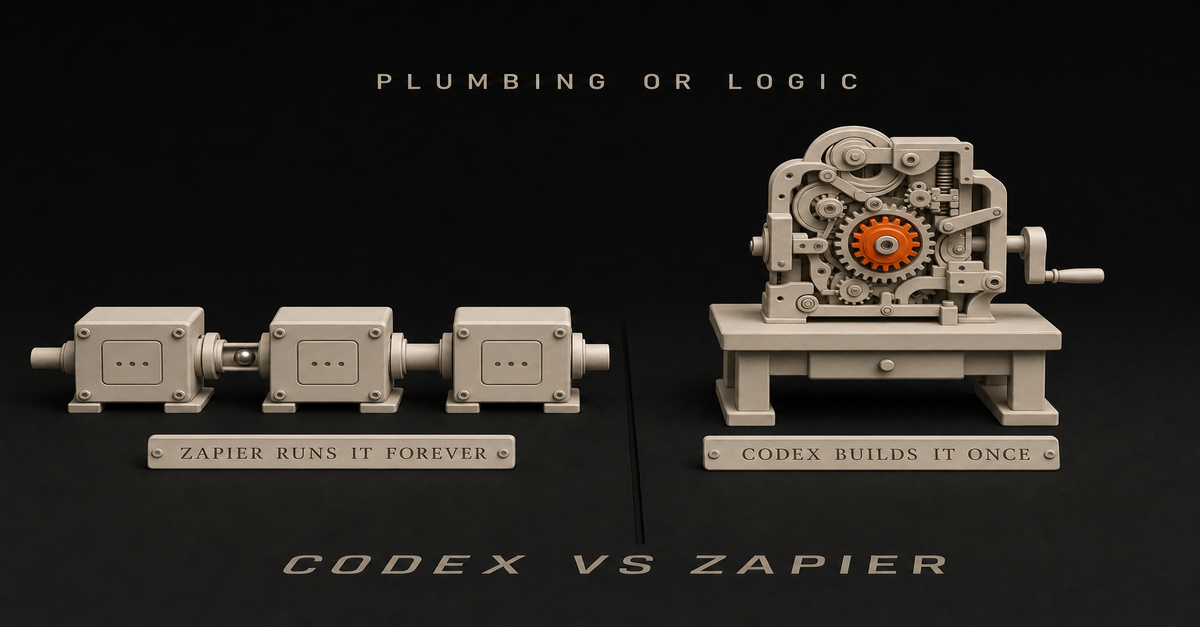
 Chris Alarcon