-
 Chris Alarcon
 - 21 Aug, 2026
Claude vs ChatGPT for Research (2026): ChatGPT Wins the Research, Claude Wins the Build
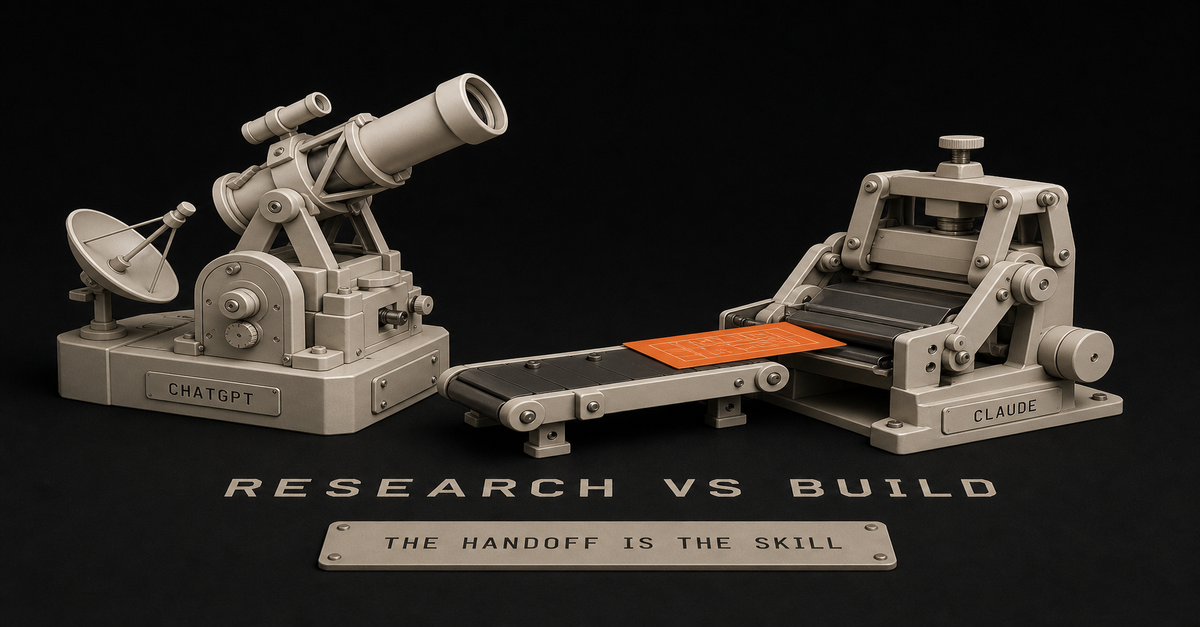
Quick answer: I never thought I would write this sentence, but here it is: for research, ChatGPT wins - even against Fable 5, which I consider the strongest model available. ChatGPT's Sol Ultra tier is phenomenal at digging into a question. Claude wins the moment research has to become something real. My split: ChatGPT wins the research. Claude wins the build. The handoff is the skill. I pay $200/month for each, and both tools earn it at different points of the same project. Quick decisionResearch job PickOpen-ended digging on a hard question ChatGPT (Sol Ultra tier)Talking a problem through until it makes sense ChatGPT, voiceReading your own live dashboards and analytics ChatGPT's agent, in the browserTurning findings into a document or system ClaudeResearch inside your own files and projects ClaudeCited quick answers on current events Honestly, free PerplexityA real session, start to finish The easiest way to show you the split is a session I actually ran. I needed to figure out why my YouTube shorts were slipping and what to change. Here is how it went:OpenAI's plan documentation, captured August 21, 2026. Sol Ultra, the reasoning tier I keep praising, sits at the top. Phase 1 - research, in ChatGPT, by voice. I opened voice and said, roughly, "look at my analytics." Its agent works in a real browser, so it logged into my YouTube dashboard - no API, no exports - and read the backend with me. That's huge, and most people have no idea it exists. We walked the numbers together and saw where shorts were dropping. Then we brainstormed. That part felt new to me. It was like brainstorming with a partner. What about this? What about that? For 30 to 60 minutes we went hard at it, until I actually had clarity. Phase 2 - the plan. Once it clicked, I had it write up the plan. It looked at my existing setup and came back with a plan I understood and believed in. That last part matters. I didn't want some plan handed to me. I wanted the one we had just worked out together, written up. Phase 3 - the build, in Claude. We started building in ChatGPT's coding side, and honestly, for this job it was not the right fit. So I took the finished plan to Claude and built it there. Building is where Claude is strongest right now. It has the model for it and the place to do the work. I gave it the plan and got a working system back. Research and clarity in one tool, the build in the other. Every time I run it that way, it beats either tool alone. ChatGPT wins the research phase on voice, browser, and Sol UltraSol Ultra is phenomenal. OpenAI's top reasoning tier - the one that ships with the Pro plans - digs deeper on open questions than anything else I have used, my own beloved Fable included. It pains me a little, but it's true. Voice makes research a conversation. Thinking out loud is how most of us work through a problem. ChatGPT is the only tool where that's good enough to use every day: on walks, in the car, on the go. The browser agent reads your real data. Logging into your own analytics and interrogating live numbers, no exports, no API keys, is a whole different kind of research. Better interface for the messy middle of research: branching, revisiting, riffing. It feels like a workspace, and OpenAI keeps putting money into exactly this. The business side of ChatGPT is growing fast.Claude wins the moment research becomes a buildExecution. When findings must become a document, a system, or code that runs, Fable 5 is the strongest builder I have used. The research gives you a plan. Claude builds it. Your own material. Research over your files, past work, and ongoing projects fits right into Claude's Projects and Cowork. Instruction-holding on long outputs. The finished piece sticks to what you asked for (structure, voice, constraints) and drifts less. When research has to turn into a deliverable, that's the difference between one pass and four.The 60-second version, from my Shorts: Stop Claude and ChatGPT Contradicting Each Other on Your Work.Concessions, both directions ChatGPT's research win is not total: for cited quick lookups, free Perplexity is often the faster tool, and for source-grounded work over a fixed pile of documents, Google's NotebookLM is a sleeper pick. And Claude's build win is not total either: plenty of light execution - emails, summaries, quick drafts - is fine in ChatGPT, and switching tools for it is just extra work. No one model wins everything. I'm not hedging here. That's just what I've found paying top dollar for both, month after month. How I compared these Both tools: daily paid use at the $200 tiers, across real research-to-build projects like the session above. Plan and pricing facts on this page and the tracker are read from official pages, dated August 21, 2026. Verdicts are mine and labeled as experience, not benchmarks. Three setups, three movesOne subscription, research-heavy work: ChatGPT - my full worth-it verdict. Add free Perplexity for citations. One subscription, build-heavy work: Claude - sized via Pro vs Max. Both, or planning to get both: steal the workflow above as is: voice-research in ChatGPT until clarity, plan on paper, build in Claude. The general comparison lives at Claude vs ChatGPT, and the top-tier money question at Claude Max vs ChatGPT Pro.Last reviewed August 2026.