-
 Chris Alarcon
 - 14 May, 2026
How to Turn AI Coding Skills Into a Local Service Business Offer
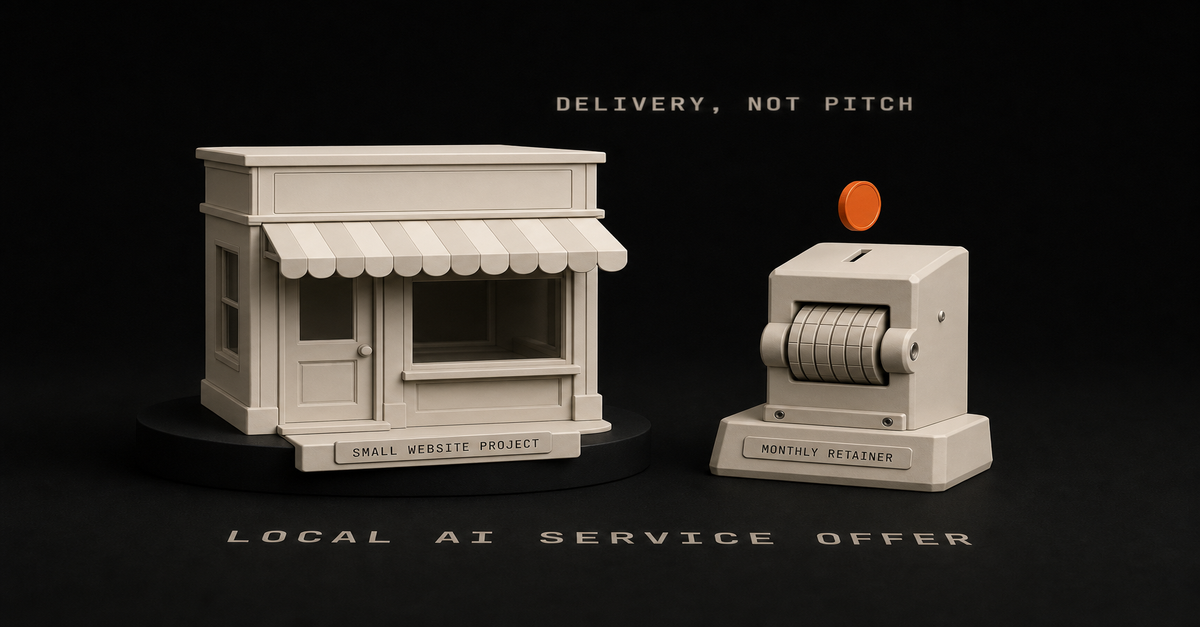
Direct Answer Package the offer as a small website project plus a monthly retainer that owns one automation. The AI coding part is delivery, not pitch. Local owners do not buy AI. They buy more booked jobs, faster lead responses, fewer no-shows, and a site that does not embarrass them. You sell that. You deliver it with Claude Code drafting the site and n8n owning the workflow that produces the result. The offer reads: a flat-fee site, then a monthly fee for one workflow you own end to end. One scope, one outcome, one invoice. Heads up: some links in this post are affiliate links: a small kickback to me at no cost to you. I only recommend tools I've actually run. Use This When And When To Skip ItUse this Skip thisYou can ship a small site and one working n8n workflow in a weekend You have never deployed either and want to learn on a paying clientYou will answer the phone, drive to a meeting, and fix a broken Zap on a Saturday You want a fully remote, faceless buyerYou want predictable monthly revenue from 3 to 8 clients You want one $100k contract and no support loadYou like scoping in plain English and writing one-page proposals You need a brand, a deck, and a sales team to feel readyTradeoff: this is a feet-on-the-ground offer. The reward is fast cash and a real reference. The cost is showing up. The System Trigger -> referral, local search, in-person ask, or a clear pain ("we miss calls") Inputs -> one decision-maker, current website, current lead flow, one number they want to move Decision -> site project + which single workflow gets the retainer Claude step -> drafts site, intake form, and n8n workflow JSON inside your repo Artifact -> deployed site, one live workflow, a 1-page operating doc the owner can read Approval -> owner reviews the workflow output for one week before it runs unattended Output -> monthly retainer invoice, monthly result note (what ran, what failed, what changed) Feedback -> the one number they wanted to move, checked monthlyThe model writes the code. The workflow owns the result. You own the relationship and the gate. Steal This Workflow Here is the offer, broken into pieces you can copy. 1. Pick one outcome per client. Not "we will do your marketing." Pick one of: faster reply to inbound leads, automated review requests after a job closes, appointment reminders that cut no-shows, or a seasonal offer that fires on a weather trigger. One outcome means one workflow. 2. Scope the entry project. A 5 to 7 page site, a contact form that posts to a webhook, and one CRM or sheet as the source of truth. Fixed price. Two-week delivery. Written scope, written exclusions. 3. Draft with Claude Code in a real repo. Open Claude Code inside the client repo, hand it the brief, and let it write the Astro or Next pages, the form handler, and the n8n workflow JSON. Read the diff. Reject the parts that drift. Do not paste from a chat tab into production. 4. Run the workflow JSON through a real audit. Community templates and AI-generated JSON both ship credentials, webhooks, and code nodes you did not write. Pass anything before it goes live through the n8n workflow JSON auditor. 5. Build and QA before you hand it over. npm run build npm run qa:searchThe site is the proof. A broken sitemap or missing title tag tells the owner the work is sloppy. 6. Sign the retainer on one workflow. Monthly fee. One workflow owned. The contract names the workflow, the trigger, the input source, the output, and what counts as a failure. If they want a second workflow, that is a second retainer. 7. Send a one-page monthly note. Three lines: what ran, what failed, what you changed. The note is the renewal mechanism. Most local owners never get this from a vendor. 8. Use a planner to keep scope honest. When the owner asks for a second workflow inside the same fee, open the Claude Code n8n workflow planner and show them the node map. A picture turns "one more thing" into "that is a second project." What This Looked Like For This Page This page started as a Reddit source signal in the weekly AEO run, not as an idea I had in the shower. The run pulled 936 raw Reddit RSS entries, scored 314 candidates, generated 25 AEO briefs, and marked 9 of those as publish_now. This topic passed because:Gate Why it passedSource language The thread used "first real AI coding income" and "local service business" instead of abstract "AI consulting" languageArtifact The answer maps cleanly to one project plus one workflow plus one monthly note, which a reader can copyCluster fit It links into Claude Code, n8n, the workflow planner, and the AI stack post without forcingThe page is research-inspired by the thread, not a claim that I ran these specific clients. What Most People Get Wrong The mistake is leading with "AI" in the sales conversation. The owner is trying to decide if their phone will ring more next month. They do not care about Claude versus GPT. They care if the new system breaks their existing scheduling. The pitch should sound like "you are losing 4 leads a week because nobody replies in under an hour, here is what I will do about it for a fixed fee" and not like a feature list. Three more breakages that show up in the threads:Scope creep eats the retainer. Owners ask for "just one more thing" until the monthly fee becomes a part-time job. Name the workflow in the contract. Anything else is a new project.No approval week. The workflow goes live on day one, fires on the wrong record, and the owner cancels. Give it a one-week review window where every output gets manually read before it sends.The retainer has no artifact the owner can read. They cannot see what they are paying for. The monthly one-page note is the artifact.How I Would Build This My version uses Claude Code for the build, n8n for the running workflow, and the repo for the audit trail. Claude Code in the client repo. Each client gets a small Astro or Next repo with the voice and brand notes as files Claude Code reads on every run. The model never re-negotiates tone, link structure, or schema. n8n owns the running workflow. The n8n AI agent workflow pattern handles trigger, decision, and approval. The lead intake or review request runs through the same shape as the n8n AI agent tutorial. One human gate before anything customer-facing fires. Audit anything you did not write. Community JSON and AI-generated JSON both need a pass through the n8n workflow JSON auditor before activation. The stack stays small. Repo, Claude Code, n8n, one CRM or sheet, one site host. The longer AI stack for solo founders writeup goes deeper on what to keep and what to cut. The SEO layer for your own offer. Use the same workflow you use for clients on yourself. The Claude SEO workflow post explains how to wire Claude as a workflow step instead of a chat tab so your own service page is not the weakest part of the funnel. Next Step If you are sitting on AI coding skills and no offer, do one thing this week. Pick a local business you already know, write the one-page proposal as a fixed-fee site plus a one-workflow retainer, and send it. If you want to map the workflow before the conversation, the Claude Code n8n workflow planner sketches the trigger, intake, decision, approval, and result so you walk in with a node map instead of a vibe. Source Signal Research-inspired by a Reddit thread describing a builder's first real AI coding income from a local service business: a website project, a monthly growth retainer, and a larger internal automation. Treat the thread as one operator's note, not as Chris's results. Original: the r/SaaS thread, "My first real AI/coding income case." Related AEO PagesClaude SEO workflow Weather-triggered HVAC booking workflow Learning AI workflows from scratch Pre-launch social media automationFAQ Why pitch local service businesses instead of SaaS customers? Local owners pay for outcomes they can see this month. They are the right buyer for an operator who is still learning the sales motion. What is the actual offer shape? A fixed-fee site project as the entry, then a monthly retainer that owns one workflow end to end. Where does Claude Code fit? Claude Code drafts the site and the workflow JSON inside your repo. You read the diff and approve the deploy. How do I price it without guessing? Flat fee for the site, flat monthly fee for one workflow. Skip hourly until you know how long the work takes. When should I skip this offer entirely? Skip it if you will not answer the phone, drive to one meeting, or maintain a workflow you shipped six months ago.