Drowning in tasks?
Automate them.
I build content systems with AI and n8n that run while you sleep. Steal my workflows.

Hey, I'm Chris Alarcon
I automate content creation so you can focus on building.
Look, you're drowning in tasks. There's 100 AI tools out there promising magic. LinkedIn posts, YouTube scripts, social content. All of it eating your limited hours.
I've built content systems that generate ideas, write scripts, create posts, and schedule everything. All while I sleep. Now I share every workflow I build. What works. What doesn't.
What You'll Learn
Three ways I can help you
Content Systems
YouTube scripts, LinkedIn posts, X threads, captions. Automated pipelines that run daily.
n8n Workflows
Self-hosted automation that connects your tools. No monthly fees, unlimited runs.
AI Prompts That Work
Tested prompts for Claude, ChatGPT, Gemini. Copy, paste, customize.
Featured Resource
Idea Engine Starter Pack
30 days of content ideas generated in minutes. Stop staring at a blank screen and start creating content that resonates with your audience.
- AI prompts that actually work
- Content calendar template
- Hook formulas for engagement
30 Days of Ideas
Generate a month of content in under 15 minutes
Latest
Tutorials & Guides
-
 Chris Alarcon
 - 05 Jan, 2026
How to Save Time with Automation (Without Building Systems You Never Use)
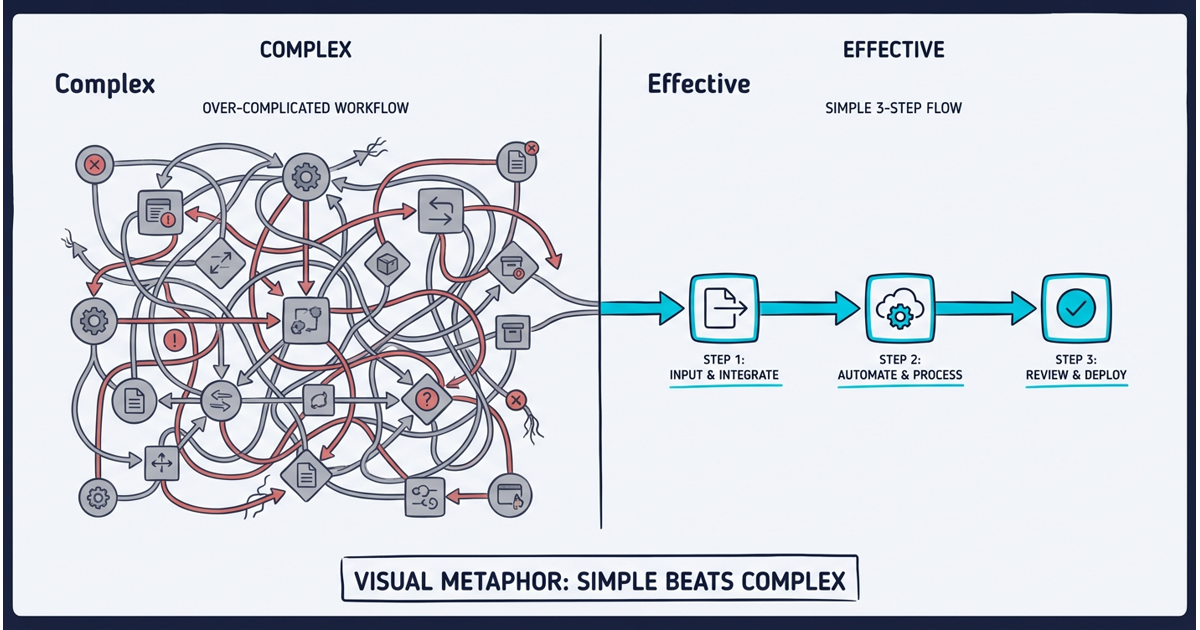
I spent 2 weeks building an automation I never used. Four agents. Late nights after my day job. Reddit scraping, 11Labs voiceovers, Creatomate video stitching - a full faceless YouTube pipeline. The workflow actually worked. Videos would generate automatically from trending relationship posts. And I never published a single one. Turns out, I wasn't passionate about relationship content. I was interested in the theory of faceless YouTube, not the content itself. So I built a beautiful machine that sat there collecting digital dust. Here's what I learned: Automation speeds up whatever you're doing. If you have a broken process, automation just makes it fail faster. The problem wasn't my n8n skills. The problem was I skipped the part where I figured out if I actually needed this thing. Sound familiar? Maybe you've spent a Saturday building a workflow that's supposed to save you hours. Then Monday comes, you're back at your desk, and that automation hasn't touched your real work. That's what this guide is about. Not another "automate everything" tutorial. A framework for building automations you'll actually use - ones that save you 10-15 hours a week instead of costing you weekends. Here's the process-first approach I use now, after learning the hard way. Why Most Automation Advice Fails (And Costs You Weekends) You've heard the standard automation advice: "If you do something more than twice, automate it." Sounds reasonable. Except it's not. Here's the problem - that advice assumes the thing you're doing twice is worth doing at all. It assumes your process is already good. It assumes automation will magically make a broken workflow work. The truth is, most people automate broken processes. Then they're confused when automation doesn't save time. I've been there. I used to admire workflows with 100 nodes. Complex branching logic. Dozens of API calls. "Look at that beautiful automation," I'd think. Now? I admire the simplest workflows that actually run. The 5-node system that saves 3 hours a week beats the 50-node masterpiece that never gets used. But here's the thing about automation tutorials online: they teach you how to build, not whether to build. Nobody makes viral content about the workflow they decided NOT to create. So you end up in a loop. Watch tutorial. Get excited. Spend the weekend building. Realize it doesn't fit your actual work. Feel frustrated. Repeat. Another weekend gone. Nothing shipped. The solution isn't more automation skills. It's a framework for deciding what to automate in the first place. The Process-First Framework for Time-Saving Automation After wasting those 2 weeks on my faceless YouTube system, I changed my approach completely. Now I follow a 4-step process before I ever open n8n. Step 1: Justify the Use Case Before building anything, I answer one question: What's the ROI? Not vague "this would be nice" thinking. Actual numbers. Here's how I calculate it:How many hours does this task take per week? How many hours will the automation take to build? What's the payback period?If a task takes 2 hours weekly and the automation takes 10 hours to build, that's a 5-week payback. Worth it. If a task takes 15 minutes weekly and the automation takes 20 hours to build? That's an 80-week payback. Not worth it. Most people skip this math. They build because building is fun. Then they wonder why their calendar is still full. Step 2: Document the Manual Process First Here's a counterintuitive truth: you should do the thing manually before automating it. Not forever. Just long enough to understand what you're actually doing. I track tasks in a Notion database for 1-2 weeks before automating. I note:What triggers the task? What are the actual steps? Where do I make decisions? What could go wrong?This documentation reveals the hidden complexity. That "simple" task you wanted to automate? It probably has 5 edge cases you'd only discover mid-build. Finding those edges before building saves hours of debugging later. Step 3: Sketch It Before Building The breakthrough came when I started using Excalidraw before opening n8n. I used to jump straight into building. Add a node. Add another. Get tangled in logic. Realize I needed to restructure. Waste 2 hours. Now I spend 10 minutes sketching first. Just rough boxes and arrows showing:What triggers the workflow What each step needs to do Where decisions happen What the final output looks likeSometimes Claude Code helps me brainstorm the flow. We'll talk through the logic together before I touch any automation tool. The best part? Sometimes the sketch reveals that I don't need automation at all. The best automation is the one you don't build because you realized you didn't need it. Step 4: Build the Minimum Viable Automation My first n8n workflow had 4 agents when it should have had 1. I was so excited about what was possible that I built everything. Reddit scraping AND script writing AND voice generation AND video editing AND publishing. All at once. That's a recipe for something that never works reliably. Now I build the smallest version first. One workflow that does one thing. Get it running. Use it for a week. Then add the next piece. For content repurposing, I didn't start with a 10-step pipeline. I started with: blog post goes in, Twitter thread comes out. One input, one output. Everything else came later. The 5 Automations That Actually Save Time for SolopreneursNot all automations are created equal. Some save 15 minutes a week. Others save 15 hours. After building dozens of workflows, here are the five that actually moved the needle: 1. Content Repurposing (3-5 hours/week saved) This is the highest-ROI automation I've built. One piece of content becomes five. Blog post turns into Twitter thread, LinkedIn post, email newsletter, YouTube script outline. The core ideas stay the same - just reformatted for each platform. Before automation: I'd spend an hour per platform manually rewriting. After automation: One trigger, multiple outputs, maybe 20 minutes of editing. Related: How to Automate Social Media Posting with AI 2. Social Media Scheduling (2-4 hours/week saved) Note: I'm not talking about automated engagement. That's a path to getting flagged and annoying people. I mean scheduling posts you've already created. Batch your content creation on Sunday, queue it up, let the scheduler handle the timing. Tools like Publer make this dead simple. No custom n8n workflow needed - sometimes the right tool beats the custom build. 3. Email Triage and Filtering (30-60 minutes/day saved) I don't automate email responses. Too risky, too impersonal. But I absolutely automate email sorting. Newsletters go to one folder. Client emails get flagged. Junk gets deleted. By the time I open my inbox, it's already organized. Most email clients have this built in. Gmail filters, Apple Mail rules, whatever. The point is: automate the sorting, not the replying. 4. Meeting Scheduling (1-2 hours/week saved) The back-and-forth of finding meeting times is pure waste. Calendly or Cal.com handles this completely. Share a link, they pick a time, it's on the calendar. No more "Does Tuesday work? How about Thursday?" This is a solved problem. Don't build a custom solution. 5. Client Onboarding Sequences (2-3 hours/client saved) When someone becomes a client, there's a checklist: send welcome email, create project folder, add to CRM, send intake form, schedule kickoff call. Automating this sequence means clients get a consistent, professional experience while you save 2-3 hours per new client. Start with the welcome email. Add the folder creation later. Build it piece by piece. Related: 7 n8n Workflow Examples That Save 20+ Hours a Week The "Should I Automate This?" FrameworkBefore building any automation, I run through these four questions: 1. Does this task repeat weekly (or more)? If you do something once a month, the automation probably won't pay off. The build time rarely justifies the savings for monthly tasks. Weekly or daily tasks? Those are automation gold. 2. Is the process already clear and working? If you're still figuring out how to do something, don't automate it. You'll bake confusion into the system. Do it manually until the process is solid. Then automate. 3. Will automation ACTUALLY save time, or just move complexity? Some "automation" just shifts where you spend time. Instead of doing the task, now you're maintaining the workflow, fixing errors, updating triggers. Be honest about total time spent, not just time on the original task. 4. Do I need human judgment in the loop? Some decisions shouldn't be automated. Client communications, creative direction, anything with nuance. Automation should handle the mechanical parts, not replace your judgment entirely. If a task passes all four questions, it's a candidate for automation. If it fails any of them, think twice before building. How to Build Your First Automation (The Right Way) Ready to build? Here's the process I wish I'd followed from the start. Pick ONE High-Impact Task Don't automate five things at once. Pick the one task that:Happens most frequently Takes the most time Has the clearest processFor most solopreneurs, content repurposing or email sorting wins this test. Sketch the Workflow Open Excalidraw (it's free) and draw:The trigger (what starts the workflow?) Each step (what happens next?) The output (what does success look like?)Spend 10-15 minutes here. It saves hours later. Choose Your Tool For most automations, n8n is my go-to. Self-hosted, unlimited workflows, no per-execution fees. Related: n8n Tutorial for Beginners: Your First Workflow in 15 Minutes But sometimes the right answer is a dedicated tool. Calendly for scheduling. Publer for social posting. Don't build what's already solved. Build the Minimum Version Start with the smallest version that provides value. If you're automating content repurposing:Version 1: Blog post → Twitter thread Version 2: Add LinkedIn Version 3: Add email Version 4: Add imagesEach version works independently. You don't need version 4 for version 1 to save time. Test with Real Data Don't test with fake examples. Run your actual content through the workflow. Real data reveals real problems. Edge cases you didn't consider. Formatting issues. API quirks. Refine Based on What Breaks Here's the part nobody talks about: debugging workflows is part of the game. I have 10+ workflows running regularly. I'm constantly tweaking them. Something breaks, I fix it. Output isn't quite right, I adjust. Automation isn't set-and-forget. It's a living system you maintain. Expect to iterate. The good news? Each iteration makes the system more reliable. After a few weeks of refinement, you have something that truly runs automatically. Real Automation Workflows You Can Copy Here are three workflows from my actual system: Workflow 1: Notion Content Hub → Multi-Platform Publishing My content operation runs through one Notion database. The flow:Write draft in Notion Mark as "Ready to Publish" n8n detects the status change Claude reformats for each platform (Twitter, LinkedIn, email) Content queues in Publer I wake up to posts scheduledThe key: I still review before publishing. Automation does the heavy lifting, but I approve the final output. Workflow 2: Blog Image Generation with Claude Code Creating header images used to take 30 minutes per post. Now:Claude Code reads the blog post Generates image prompt based on content Calls Gemini 3 API for image generation Saves to the right folderTime: about 2 minutes, mostly waiting. Workflow 3: YouTube Script → Multi-Format Content One long-form video becomes multiple assets:Script goes into the system Pull key points for Twitter thread Create LinkedIn article summary Generate newsletter section Draft TikTok hook ideasCommon Automation Mistakes (I've Made Them All) Learning from my failures so you don't have to: Mistake 1: Automating Before Understanding the Process This was my faceless YouTube disaster. I automated a process I hadn't validated. Two weeks of work for zero output. Now I do things manually first. Understand the task. Document the steps. Then automate. Mistake 2: Building 4 Agents When You Need 1 My first n8n workflow was comically overengineered. Reddit scraping, script writing, voice generation, video creation - all in one system. Should have been one agent doing one thing well. Start simple. Add complexity only when the simple version works. Mistake 3: Set-and-Forget Mentality The myth of "passive" automation. Build once, never touch again. Doesn't work that way. APIs change. Your needs evolve. Edge cases appear. Expect to maintain your workflows. Budget time for it weekly. Mistake 4: Automating Things You Actually Enjoy Not everything that CAN be automated SHOULD be. If you enjoy writing Twitter threads, don't fully automate them. Maybe automate the formatting, but keep the creative part. Automation should free you for work you enjoy, not eliminate the enjoyable parts. Mistake 5: Ignoring Human-in-the-Loop Full automation sounds great until you send a weird email to a client because an edge case slipped through. Keep humans in the loop for:Client communications Final approval before publishing Anything with real consequencesAutomation handles the grunt work. You handle the judgment calls. Tools I Actually Use (And Why) After trying dozens of tools, here's what stuck: n8n - Self-hosted on Hostinger. $5.99-20/month for unlimited workflows. No per-execution fees. This is where most of my automation lives. Claude Code - My most-used tool. Blog writing agents, image generation, workflow brainstorming. If I could only keep one AI tool, it's this one. Notion - Central hub for all content. Everything flows through Notion databases. n8n watches for changes and triggers workflows. Publer - Social scheduling. Could I build this in n8n? Probably. But Publer does it better than I could. Excalidraw - Free workflow planning. Every automation starts as a sketch here. The theme: use the right tool for the job. Sometimes that's a custom workflow. Sometimes it's a SaaS product. Don't build what's already solved. Your First Automation Is One Decision Away I built everything you see here while working a full-time finance job. 10-20 hours a week. Early mornings. Late nights. Weekends when I could swing it. You don't need to quit your job to build automation systems. You don't need 40 hours a week. You need the right framework and the willingness to start small. Here's the process again:Justify - Calculate the actual ROI Document - Do it manually first, understand the process Sketch - Map it in Excalidraw before building Build - Start with the minimum version Refine - Debug, iterate, improveThat's it. No complex methodology. No expensive courses. Just a system for building automations you'll actually use. Pick one task. The one that eats the most time. Run it through the framework. Sketch it out. Then build version one. Not the perfect version. The minimum version that works. You'll save more time with one simple automation that runs reliably than with five complex workflows that never get finished. Your future self is already running systems that work while you sleep. The only question is when you'll ship the first workflow that gets you there. Build it this week.

- Chris Alarcon
- 04 Jan, 2026
n8n Tutorial for Beginners: Step-by-Step Guide (2026)
I tried n8n five times before it clicked. Each time I quit because it felt too complex, too overwhelming, too... much. Authentication errors. Weird node configurations. Tutorials that assumed I already knew what I was doing. Everyone said n8n was "easy" and "just like Zapier but free" but I kept bouncing off it like a brick wall. Then I saw a YouTube video about "vibe marketing" and got hooked on the idea of building a faceless YouTube channel. I signed up for the 14-day trial and committed: I'm not quitting this time until I build something that actually works. 1.5 weeks later, I had a working automation. It scraped Reddit posts, wrote scripts, generated voiceovers with different voices, created satisfaction videos, and stitched everything together with Creatomate. It was clunky. I built 4 agents when I should've built 1. But it worked. That's when n8n clicked for me. This is the tutorial I wish I'd had on attempt #1: complete setup walkthrough, 3 working workflows you can build in your first hour, and the debugging tricks that finally made everything stick. After 6 months of building with n8n - 10+ workflows running daily - I'm going to show you exactly how to get past the "this is too hard" phase and into the "holy shit, I actually built this" moment. What Is n8n? (And Why It's Worth Learning Even Though Zapier Is Easier) n8n is a free, open-source automation tool that connects apps and services together. Think Zapier or Make.com, but you own it. Here's the honest comparison:Feature n8n Zapier Make.comCost Free (self-hosted) or $20/mo (cloud) $19.99-$69/mo $9-$29/moWorkflows Unlimited Limited by plan Limited by planLearning curve Steeper Easiest MediumCustomization Full code access Limited MediumExecution limits None (self-hosted) Plan-based Plan-basedWhy people choose n8n:No per-execution fees (huge if you run workflows at scale) Self-hosting means you control everything Code nodes let you customize anything Open-source community constantly adds integrationsWhy it's harder: Zapier holds your hand. n8n expects you to figure some things out. Authentication setup is more manual. Error messages are less friendly. The first hour is rougher. But here's the thing: once you get past the setup friction, n8n becomes your most powerful tool. You're not locked into pricing tiers. You're not limited by "tasks per month." You build what you need, exactly how you need it. Worth it? For me, absolutely.Related Reading:7 n8n Workflow Examples for Content Creators How to Automate Social Media with AIHow to Set Up n8n (2 Options: Cloud vs Self-Hosted) You have two paths. Pick based on your comfort level and budget. Option 1: n8n Cloud (Fastest - 5 Minutes) If you just want to start building:Go to n8n.io Click "Start for free" Sign up with email You're in. Start building immediately.Pros: Zero setup. 14-day free trial. Good for testing. Cons: Costs $20/month after trial. Limited to their infrastructure. Option 2: Self-Hosted on Hostinger (15 Minutes - What I Use) This is what I use. One-time setup, then you're running n8n on your own server. What you'll need:Hostinger VPS (I use the $5.99/mo plan) Basic command line comfort (I'll walk you through)Steps:Sign up for Hostinger VPS SSH into your server Install Docker: curl -fsSL https://get.docker.com -o get-docker.sh && sh get-docker.sh Run n8n container: docker run -it --rm --name n8n -p 5678:5678 -v ~/.n8n:/home/node/.n8n n8nio/n8n Access at http://your-server-ip:5678Hostinger has a one-click n8n installer now, which makes this even easier. But even the manual Docker route takes 15 minutes max. Why I chose self-hosted: Unlimited workflows. No monthly fees beyond hosting ($5.99/mo vs Zapier's $69/mo). Full control. First Login: What You'll See You'll land in a blank canvas with a "+" button. This is your workflow editor. Don't panic - it's simpler than it looks. Click the "+" and you'll see the node library. Over 400 integrations. Ignore most of them for now. The 7 n8n Nodes That Actually Matter (Ignore the Other 400+) n8n has 400+ nodes. I use the same 7 for 90% of my workflows. Here's what I learned: You don't need to learn all the nodes. You need to master the ones you'll actually use.1. Schedule Trigger Runs workflows on a schedule (daily at 9am, every Monday, etc.). Perfect for recurring automations. 2. Webhook Trigger Lets external services trigger your workflow via URL. Foundation for Zapier-style integrations. 3. Code Node Write custom JavaScript. This is where n8n becomes infinitely flexible. I use this constantly. 4. Switch Node Routes data based on conditions (if status = "paid", do X; if status = "pending", do Y). Essential for complex logic. 5. IF Node Simple true/false logic. Cleaner than Switch when you only need 2 paths. 6. Set Node Formats data. Renames fields, extracts values, cleans up messy API responses. 7. Wait Node Pauses workflow execution (wait 5 minutes, wait until specific date). Critical for timing-sensitive automations. Bonus: AI Agent Node Connects Claude, ChatGPT, and other LLMs directly into workflows. This is where automation gets scary powerful. Start with these. Once you're comfortable, explore the other 393 nodes. But you can build 90% of useful automations with just this core set. Workflow #1: Gmail to Slack Notification (The "Hello World" of n8n) Let's build your first workflow. Simple, practical, teaches the fundamentals. What it does: When you get an important email, it sends a Slack notification instantly.Step-by-step:Add Gmail TriggerClick "+" → Search "Gmail Trigger" Select "On Message Received" Click "Connect my account" Authorize Google (this is the authentication step everyone struggles with - just follow the OAuth flow)Add IF NodeClick "+" → Search "IF" Set condition: {{ $json["subject"] }} contains "urgent" This filters only urgent emailsAdd Slack NodeClick "+" → Search "Slack" Connect your Slack workspace Choose channel (e.g., #alerts) Message: New urgent email from {{ $json["from"]["name"] }}: {{ $json["subject"] }}Test ItClick "Execute Workflow" Send yourself a test email with "urgent" in subject Check SlackWhat you just learned:Authentication (connecting Gmail + Slack) Triggers (Gmail watching for new emails) Data mapping (those {{ $json["field"] }} expressions) Testing workflows before activating themCommon error: "Authentication failed" → Go back to the node, click "Reconnect", re-authorize. n8n's OAuth sometimes needs a second try. Workflow #2: Daily Twitter/X Post Automation (Schedule Trigger + AI) Now let's build something that runs on autopilot. What it does: Every day at 9am, Claude generates an automation tip and posts it to Twitter/X. Step-by-step:Add Schedule TriggerClick "+" → "Schedule Trigger" Set to "Every Day" at 9:00amAdd AI Agent NodeClick "+" → Search "AI Agent" Connect Claude API (you'll need an Anthropic API key) Prompt: Write a 1-sentence automation tip for solopreneurs building side projects. Make it actionable and specific. No hashtags.Add Twitter NodeClick "+" → Search "Twitter" Connect your Twitter account Tweet text: {{ $json["output"] }}Activate ItClick the toggle in top-right: "Inactive" → "Active" Your workflow is now live. It'll run every morning at 9am automatically.Key difference from Workflow #1: This one RUNS without you. Once activated, n8n executes it on schedule. You're not clicking "Execute" - it just happens. What you just learned:Schedule triggers (time-based automation) AI integration (Claude generating content) Activating vs testing (live workflows vs manual execution)This is where automation gets addictive. You build it once, and it runs forever. Workflow #3: Webhook to Google Sheets (Capture Data from Anywhere) Final workflow: the foundation for advanced automation. What it does: Create a custom webhook URL that receives data and saves it to Google Sheets. Use this for form submissions, Zapier alternatives, custom integrations - anything. Step-by-step:Add Webhook TriggerClick "+" → "Webhook" Method: POST Copy the webhook URL (looks like https://your-n8n.com/webhook/abc123)Add Set Node (optional but recommended)Formats incoming data Map fields: name = {{ $json["body"]["name"] }}, email = {{ $json["body"]["email"] }}Add Google Sheets NodeClick "+" → "Google Sheets" Connect your Google account Choose spreadsheet and sheet Map columns to data fieldsTest ItUse Postman or curl to send test POST request:curl -X POST https://your-n8n.com/webhook/abc123 \ -H "Content-Type: application/json" \ -d '{"name":"Chris","email":"test@example.com"}'Check Google Sheets - data should appearWhat you just learned:Webhooks (HTTP endpoints you control) Data transformation (Set node cleaning up messy inputs) Google Sheets integration (foundational for so many workflows)This pattern is HUGE. Every SaaS tool, every form builder, every API - they all send webhook data. Once you understand this workflow, you can connect anything to anything.Want more n8n workflows delivered weekly? Join 500+ solopreneurs getting practical automation systems every Saturday. No spam, unsubscribe anytime. Get the Saturday Drop →What Just Broke? The n8n Debugging Guide That Actually Works You'll hit errors. Everyone does. Here's how to fix the most common ones.Error #1: "Authentication Failed" What it means: The app connection dropped or expired. Fix:Click on the node with the error Click "Reconnect" or "Select Credential" Re-authorize the app (OAuth flow) Test againError #2: "Cannot Read Property of Undefined" What it means: You're trying to access data that doesn't exist. Fix:Click the node BEFORE the error Look at the output data (bottom panel) Check your expression: {{ $json["field"] }} must match actual field names Use the "Expression Editor" (click the = icon) to see available fieldsError #3: "Expression Could Not Be Resolved" What it means: Syntax error in your data mapping. Fix:Common mistakes: Missing brackets: {{ $json["name"] }} not {{ $json[name] }} Wrong node reference: {{ $node["Node Name"].json["field"] }} Typo in field nameUse the Expression Editor to validate syntaxMy 5-Step Debug Process:Execute one node at a time - Click "Execute Node" instead of "Execute Workflow" Check the output panel - Bottom of screen shows exactly what data the node produced Use the Code node to log data - Add console.log(items) to see what's actually there Test with static data first - Use "Set" node with hardcoded values to isolate issues Check the n8n community forum - Someone's hit your exact error beforeTurns out: Debugging is half the skill. Get good at reading error messages and checking data output, and you'll fix issues in 2 minutes instead of 2 hours. How to Learn from 1,000+ Pre-Built Workflows (Without Copy-Pasting) You don't have to build everything from scratch. Where to find templates: n8n.io/workflows - 1,000+ pre-built workflows How to use them:Browse templates (filter by category: Marketing, Sales, Productivity, etc.) Click "Use Workflow" It opens in your n8n editor Reconnect credentials (templates don't include your API keys) Modify to fit your use caseBest templates for beginners:"Send Slack notification for new Gmail" - Teaches triggers + messaging "Save form submissions to Google Sheets" - Teaches webhooks + data storage "Daily weather report to email" - Teaches schedule triggers + external APIs "Summarize web articles with AI" - Teaches AI integration + HTTP requestsHere's what I learned: Don't just copy-paste. Study how they built it. See how they structured nodes. Then adapt the pattern to your own workflows. The template library is a masterclass in workflow design. Use it. The 7 Lessons I Learned After 6 Months of Building with n8n After 6 months, 10+ daily workflows, and countless hours debugging - here's what I wish I'd known on day 1: 1. Plan First, Build Second I used to jump straight into n8n. Bad move. Now I sketch workflows in Excalidraw first. 10 minutes of planning saves hours of rebuilding. 2. Only a Few Nodes Matter You don't need to learn 400 nodes. Master the core 7-10. I still barely touch 90% of the library. 3. Find the Nodes You Enjoy Some people love the Code node. Others prefer visual logic (IF, Switch). Figure out which style fits your brain and lean into it. 4. Give Yourself Permission to Fail Not every workflow needs to be perfect. Some are stepping stones. My first automation (that faceless YouTube workflow) was clunky - 4 agents when it should've been 1 - but it taught me everything I needed to build better ones. 5. Start with Templates, Then Customize Templates teach you patterns. Once you understand the pattern, you can apply it anywhere. 6. Debugging Is Part of the Process I used to think errors meant I was doing it wrong. Now I know: errors are just feedback. Read them, fix them, move on. 7. Self-Hosting Pays Off Fast If you're serious about automation, self-hosting n8n on Hostinger ($5.99/mo) beats Zapier's pricing ($69/mo) after month 1. Unlimited workflows. No execution limits. Full control. Quick callback to the faceless YouTube story: That first workflow was a mess. But it worked. And that's the whole point - ship something, even if it's clunky. You'll refine it later. Your Next Steps: From Beginner to Builder You've built 3 workflows. You know the core nodes. You can debug basic errors. Now what? Immediate (Next 24 Hours):Build one of the 3 workflows above (pick the one you'd actually use) Test it until it works Activate it and let it runThis Week:Explore the template library - find 3 workflows you'd use Customize one template to fit your exact use case Break something, then fix it (seriously, debugging practice is how you learn)This Month:Build 1 automation that saves you 30+ minutes per week Examples: Daily digest of top Hacker News posts → email New blog post → auto-post to Twitter, LinkedIn, Facebook Form submissions → auto-add to CRM + send confirmation emailAdvanced Path (3-6 Months):Self-host n8n on your own server Build multi-step workflows with complex logic (Switch, Loop, Merge nodes) Integrate AI agents for content generation Connect n8n to your entire tech stackRelated Reading:7 n8n Workflow Examples for Content Creators How to Automate Social Media with AIYou're Not Behind - You're Right on Time Look, I tried n8n five times before it worked. You might need 2 tries. You might get it on the first one. Doesn't matter. What matters is this: you now know how to set up n8n, build 3 working workflows, and debug the most common errors. That puts you ahead of 90% of people who hear "n8n" and think "too complicated." You have the tutorial. You have the workflows. You have the debugging checklist. The only thing left is to actually build something. Pick one workflow from this guide. Build it. Break it. Fix it. Then build another one. Six months from now, you'll have 10+ automations running while you sleep. Systems that save hours every week. Workflows that just... work. Before you go full speed, read how to save time with automation without building systems you never use. It'll help you pick the RIGHT workflows to build first - the ones that actually pay off instead of sitting there untouched. But only if you start today.
- Chris Alarcon
- 03 Jan, 2026
7 n8n Workflow Examples for Content Creators (Save 20+ Hours/Week)
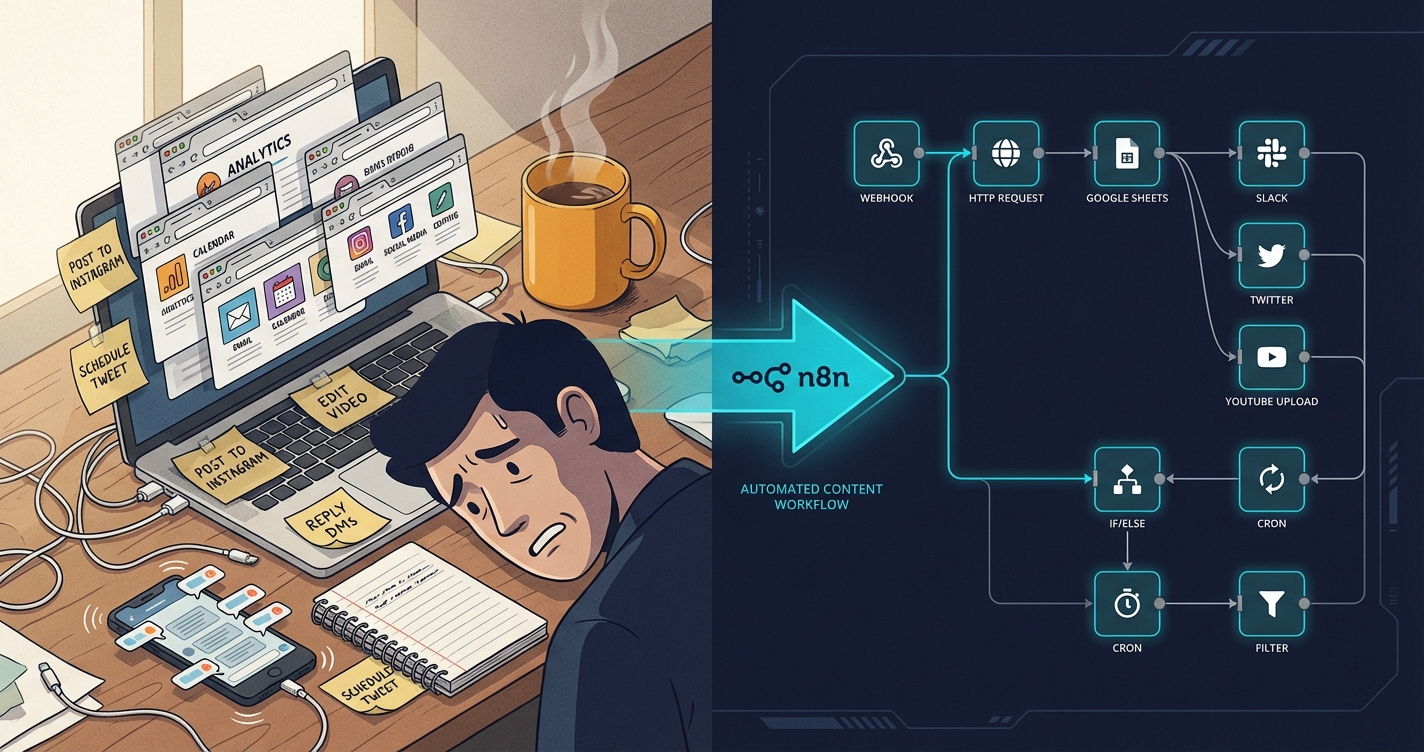
My first n8n workflow took 2 weeks to build. It was clunky, overcomplicated, and had 4 agents when it should have had 1. But it worked. That ugly automation scraped Reddit, wrote scripts, generated voiceovers with 11 Labs, created background videos, and stitched everything together with Creatomate. A complete faceless YouTube pipeline - built by a guy who'd never touched n8n before. Here's the thing about content creation: the actual creative work takes maybe 20% of your time. The other 80%? Formatting. Scheduling. Cross-posting. Research. All the repetitive tasks that drain your energy before you even start writing. I was drowning in that 80%. Working a full-time job, trying to build on the side, and watching my limited hours evaporate on tasks a robot could do. Then I discovered n8n. Self-hosted. Unlimited workflows. No monthly fees eating into my budget. Before diving into these workflows, a quick note: building the right automation matters just as much as building it well. I learned this the hard way after wasting 2 weeks on systems I never used. Here's the framework I now use to decide what's worth automating - it'll help you pick workflows that actually pay off. What follows are seven workflows that changed how I work. Not theoretical examples - these are the exact automations running in my business right now.Why n8n Over Other Automation Tools? Before diving into the workflows, let me address the obvious question: why n8n? I've tried them all. Zapier's pricing made me do math every time I wanted to automate something. Make (formerly Integromat) is solid, but the visual interface gave me headaches. n8n hits different:Self-hosted option: Run it on a $5/month VPS and never pay per workflow Unlimited executions: No counting tasks or worrying about overages Visual workflow builder: See exactly what's happening at each step 200+ integrations: Connect to basically anything Open source: Community-built nodes for edge casesThe learning curve is real - probably a weekend to get comfortable. But once it clicks, you'll wonder how you ever lived without it. (New to n8n? Start with my beginner's tutorial that walks through the interface, core concepts, and your first workflow.) Workflow 1: Content Repurposing Engine Time saved per week: 4-5 hours This is the workflow that started it all. I write one blog post, and n8n transforms it into:3 LinkedIn posts (hook, insight, story format) 5 Twitter/X threads 1 YouTube script outline 1 newsletter sectionHow it works:Webhook triggers when I publish a new post Claude API extracts key insights and quotable moments Separate branches format content for each platform Everything lands in my Notion content calendarThe magic is in the prompts. Generic "summarize this" prompts produce garbage. I spent weeks refining prompts that capture my voice and match each platform's style. (Want to see the exact prompts I use? They're in my social media automation tutorial.) Setup time: About 2 hours for the full pipeline Key nodes: Webhook Trigger → Claude AI → Multiple branches → Notion API Workflow 2: Social Media Scheduler with AI Optimization Time saved per week: 3 hours I used to manually schedule every post. Now I batch-write, and n8n handles the rest. The twist? It doesn't just schedule - it optimizes posting times based on engagement patterns. How it works:Cron trigger runs daily at 6 AM Pulls upcoming posts from my content queue Checks historical engagement data from my spreadsheet Adjusts posting times for optimal reach Schedules via Buffer APII've seen 30-40% better engagement since implementing this. Not because the content improved - because it's hitting when my audience is actually online. Setup time: 90 minutes Pro tip: Start simple. Get the basic scheduling working before adding the AI optimization layer. If you want the complete step-by-step tutorial for building this from scratch, check out my guide on how to automate social media posts with AI. Workflow 3: Trending Topics Monitor Time saved per week: 2-3 hours (plus competitive advantage) I used to waste hours scrolling Twitter, Reddit, and Google Trends trying to catch what's blowing up. Now n8n tells me. How it works:Scheduled trigger every 4 hours Pulls from multiple APIs: Reddit (subreddits I care about), Twitter trending, Google Trends Claude analyzes for relevance to my niche Scores and filters by potential Sends Slack notification with top 3 opportunitiesThe real value isn't just time saved - it's catching trends before competitors. I've published posts that ranked specifically because I was early to a topic. Setup time: 2 hours Note: The Reddit API requires developer access. Twitter API has become expensive. Consider alternatives like Perplexity or news APIs.Workflow 4: Email Newsletter Automation Time saved per week: 2 hours My newsletter workflow is embarrassingly simple, but it eliminated my biggest weekly headache. How it works:Every Thursday at 9 AM, workflow triggers Pulls my top-performing content from the week (based on analytics) Grabs any bookmarked links from my research Claude drafts the newsletter with my structure Sends draft to my email for reviewI still edit and personalize. But the 80% that's just assembly? Automated. Setup time: 1 hour Key insight: Don't try to fully automate newsletters. The personal touch matters. Automate the structure, not the soul. Workflow 5: Research and Clipping Pipeline Time saved per week: 3-4 hours Every content creator has the same problem: amazing ideas pop up at random times, and they disappear before you can use them. This workflow captures everything. How it works:Multiple entry points: email forwarding, Slack command, browser extension webhook Everything funnels into a central processor Claude categorizes, tags, and summarizes Stores in Notion with full metadata Weekly digest of unused clipsMy "content ideas" folder used to be a graveyard. Now it's a searchable, organized library that actually gets used. Setup time: 2 hours The game-changer: The categorization AI. Without it, you just create a different kind of mess. Workflow 6: YouTube Thumbnail and Title Testing Time saved per week: 1-2 hours For creators with YouTube channels, this one's gold. How it works:When I upload a video, workflow triggers Generates 5 title variations using Claude Creates thumbnail text variations A/B tests over 48 hours using YouTube's built-in feature Logs results to a spreadsheet for pattern analysisAfter 50+ videos, I now have data on what works for MY audience. Not generic "best practices" - actual patterns from my content. Setup time: 2 hours Requires: YouTube API access and some patience for data collection Workflow 7: Content Performance Dashboard Time saved per week: 1 hour (plus strategic value) This workflow doesn't create content. It tells me what's working. How it works:Daily trigger at midnight Pulls analytics from: Google Analytics, YouTube, Twitter, LinkedIn Normalizes data and calculates week-over-week trends Generates a Slack report with insights Flags posts that need updating or promotionThe strategic value is hard to quantify. But knowing exactly what's working (updated daily, no manual checking) changed how I think about content. Setup time: 3 hours (most complex workflow on this list) Note: Analytics APIs can be finicky. Expect some debugging. Getting Started: The Practical Path Don't try to build all seven workflows this weekend. That's a recipe for burnout. Here's what I'd recommend: Week 1: Pick ONE workflow that addresses your biggest pain point. Build the simplest version that works. Week 2: Refine that workflow. Add error handling. Test edge cases. Make it bulletproof. Week 3: Add a second workflow. Build on what you learned. The compound effect is real. Each workflow you add makes the next one easier. And the time you save? It compounds too. The ROI Reality Check Let me be honest about what to expect: Upfront investment:n8n learning curve: 10-20 hours Each workflow: 2-4 hours to build Refinement: OngoingReturns:15-20 hours saved per week (once all workflows are running) Better content (more time for creative work) Competitive advantage (faster to market) Less burnout (no more soul-crushing repetitive tasks)The math works. But only if you actually build the workflows. Reading about automation doesn't automate anything. Common Mistakes to Avoid After helping dozens of creators set up n8n, I've seen the same mistakes repeatedly:Over-engineering from day one. Start simple. Add complexity later.No error handling. Workflows break. Build in notifications so you know when they fail.Generic AI prompts. The quality of your AI-powered workflows depends entirely on your prompts. Invest time here.Forgetting the human element. Some things shouldn't be automated. Editorial judgment, relationship building, creative direction - keep those human.Not documenting. Future you will thank present you for leaving notes about what each workflow does and why.What's Next These seven workflows are my foundation. They run 24/7, saving me hours every week, letting me focus on the work that actually matters. If you're building on the side while working full-time, you know how precious every hour is. Automation isn't about being lazy - it's about being strategic with the limited time you have. Start with one workflow. The one that'll give you back the most time. Build it this week. Then come back and grab the next one. The time you invest now pays dividends forever. Every repetitive task you automate is time you never have to spend again. I built all of this while working a 9-to-5. If I could find the hours, you can too. More n8n Tutorials Coming I'm publishing step-by-step guides for each workflow with screenshots, JSON exports, and the exact prompts I use:Social Media Automation: How to automate social media posts with AI (complete tutorial with Claude integration) Content Repurposing Engine (detailed setup guide - coming soon) Trending Topics Monitor (including API alternatives - coming soon)Subscribe to get notified when they go live.Want the actual workflow templates? I share templates and do live build sessions in my Skool community. Or subscribe to the newsletter for weekly automation breakdowns.
One workflow.
Every week.
Join solopreneurs getting actionable AI automation strategies delivered every Saturday. Zero fluff. Just systems you can steal.