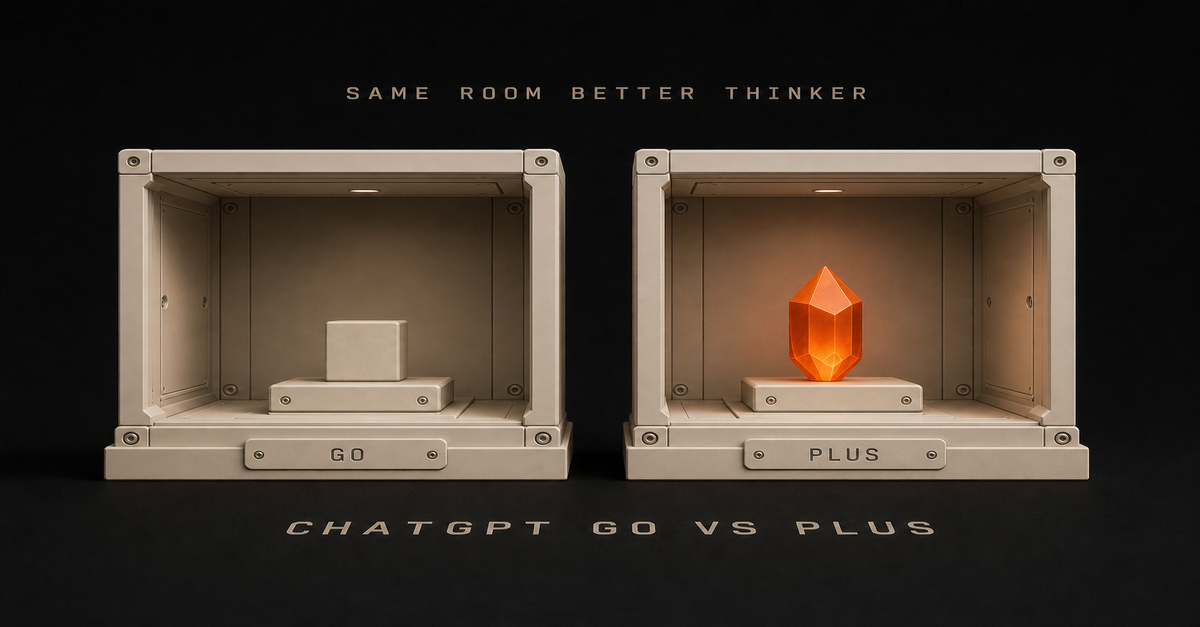
Quick answer: Go is $8/mo, Plus is $20/mo, and the $12 gap buys you two things that matter - the GPT-5.6 reasoning models and a surface with no ads. It does not buy you more context, more uploads, or custom GPTs. Those are the same on both.
If ChatGPT is where you draft, rephrase, summarize, and ask things you would otherwise Google, Go is genuinely enough. If you need the model to actually think - multi-step problems, research you will act on at work - the difference in answer quality is, in my experience with the state-of-the-art models, night and day.
I have not used Go myself. I have paid the $20 since early on, so what follows is the spec sheet read carefully and checked against OpenAI’s own pages, plus my rule for when a cheap tier is a bargain and when it is a trap.
First: most articles about this are wrong
I checked the current ranking pages against OpenAI’s comparison table on 27 July 2026. The error rate is high enough that you should not trust any of them, including the ones with confident-looking tables.
| What you will read elsewhere | What OpenAI’s own page says |
|---|---|
| ”Go can’t create custom GPTs” | False. Create and share GPTs: Yes on Go |
| ”Go doesn’t include Projects” | False. Projects, shared projects, and scheduled tasks: Yes on Go |
| ”Go has a smaller context window” | False. 54K instant and 256K reasoning - identical to Plus |
| ”Go has no voice mode” | False. Voice is Expanded on Go, and voice with video is included |
| ”Go has no reasoning at all” | Misleading. Go gets GPT-5 Thinking Mini. It does not get the GPT-5.6 family |
| ”Go runs a generation behind” | Misleading. Both get GPT-5.5 Instant; Go gets more of it than Free |
The identical context window is the fact I would tattoo on this page. You are not paying $12/mo for more room to work. You are paying for a better thinker inside the same room.
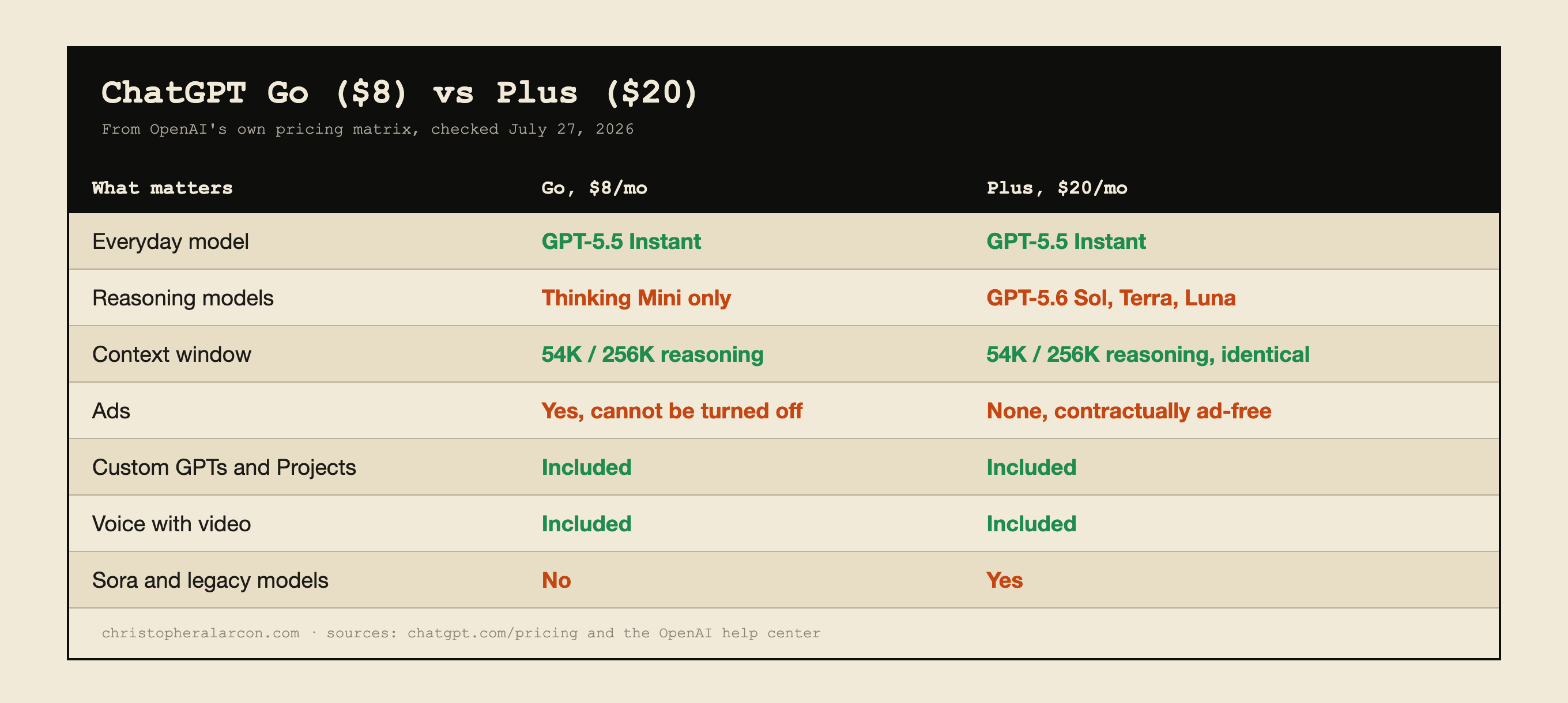 The whole decision in one table, built from OpenAI’s own pricing matrix on July 27, 2026. Green is identical, orange is what your $12 actually buys.
What Plus actually buys
Three things, honestly weighted. The first two are the entire decision.
1. The GPT-5.6 reasoning family. Plus unlocks GPT-5.6 Sol, Terra, and Luna. Go tops out at GPT-5 Thinking Mini. OpenAI hedges the wording on Go - “ChatGPT Go can include access to reasoning, subject to current model availability” - which is not a guarantee of anything specific.
This is the real wall, and it is where the quality gap lives. The state-of-the-art model makes a huge difference on complex problems, whether that is coding or just thinking something through properly. It is night and day.
2. No ads. Plus, Pro, Business, Enterprise, and Edu accounts are ad-free. Free and Go are ad-eligible - OpenAI began a phased US test on 9 February 2026, with ads appearing below responses, clearly labeled.
Worth knowing: OpenAI’s own pages are currently inconsistent here. The ads FAQ describes a live test covering Go, while the Go help page says “we may start testing ads in ChatGPT Go in the future.” Check your own account rather than trusting either page - or this one.
The part that is unambiguous: on Go you cannot buy your way out of ads. Ads-Free is a Free-plan option. Turning off personalization changes which ads you see, not whether you see them.
3. The power-tools tail. Sora, legacy models, deep research, image generation with Thinking, interactive tables and charts, record mode, Sites, developer mode, full Codex, and ChatGPT Work on web and mobile instead of desktop only.
Real, but do not let a long list outvote the two things above it.
Who should not upgrade
No page on this SERP says this, so let me.
Stay on Free if you are not hitting limits. If you use ChatGPT a few times a week and never see a cap, you are shopping for a solution to a problem you do not have.
Stay on Go if your work is volume of ordinary language - drafting emails, rewriting paragraphs, summarizing documents, everyday questions. Users who moved down and stayed happy describe exactly this:
“For just conversations, there is absolutely no difference… I am going back to Go.”
Upgrade to Plus if you noticed a quality drop, or you are asking it to reason. The other side of that thread is just as consistent:
“answers feel much more geared towards being fast than being thoughtful… if you mainly use ChatGPT for in-depth discussions, I can definitely understand why people choose to stick with Plus.”
The switching traps
Read these before you click downgrade.
- Downgrades are not prorated. Your current plan runs to the end of the billing cycle, then you switch to Go and pay the Go rate. u/Icy-Imagination5185, who did it by accident, put it plainly: “Now I can’t go back to Plus for a FULL MONTH.”
- No annual billing. OpenAI does not offer annual or multi-month prepay on Go, Plus, or Pro.
- Legacy models disappear on Go. If you have a workflow pinned to an older model, it goes away.
- No Sora on Go.
- Ads-Free is a Free-plan setting, not something you can add to Go.
My rule for cheap tiers
Here is the rule I actually use: pain is the upgrade trigger. It is the only reason I have ever moved up a tier.
Start free. If you only occasionally bump a limit, do not upgrade - you are not really using it yet. But once you find real use cases and the tool becomes part of your life - managing email, planning your day, health and financial goals, the stuff you connect through apps and connectors - you will need the state-of-the-art model and you will need more usage. That is when $20 becomes obviously worth it.
And if you are constantly hitting that, then $100 and $200 start to make sense, and you can do fancier things like coding and building tools that solve your own problems. That is more advanced. For the average person, $20 is plenty.
So where does that leave Go? Go is what you pay when you are past free, you keep hitting the limit, and you want more usage of a model that is not state of the art. That is it. That is what the $8 buys. It is a real product for a real person - just be honest about which person that is.
The cheap tier is a trap in exactly one situation: when your work needs judgment and you bought volume instead. A wrong answer you act on at work costs far more than the $12 you saved.
One more option the comparison pages skip: $8 on Go plus a second free or cheap tool from another provider often gets you further than $20 on one. People in these threads already do it and report getting more out of the pair. It is more friction. It is also more model.
Related reading
- Claude vs ChatGPT - the full comparison, and why caps decide it
- Claude Pro vs ChatGPT Plus - if you are choosing between $20 plans
- Copilot vs ChatGPT - if your employer already gave you an AI tool
All prices and features here were checked against OpenAI’s pricing and help pages on 27 July 2026. OpenAI does not publish hard message counts for these tiers, so any specific “X messages per day” number you see elsewhere is folklore. Check the live page before you buy.

Written by
Chris AlarconChris Alarcon builds Ship Lean: the boring Claude and AI setups that actually work, handed to people who don’t code. He runs his one-person operation on these systems, around a full-time job, and shares every workflow, prompt, and tool combo in public. Start with the 15 prompts he uses every day.
Work With Me
Run a business or a team?
I build these systems for clients: I turn your calls, demos, and expertise into a steady stream of buyer-facing content. If that's you, the offer is one click away.
See the offer →The 15 AI prompts I actually use every day
I tested hundreds and kept the 15 that survived at my desk. You get them right away, then one short Ship Lean note every Tuesday.