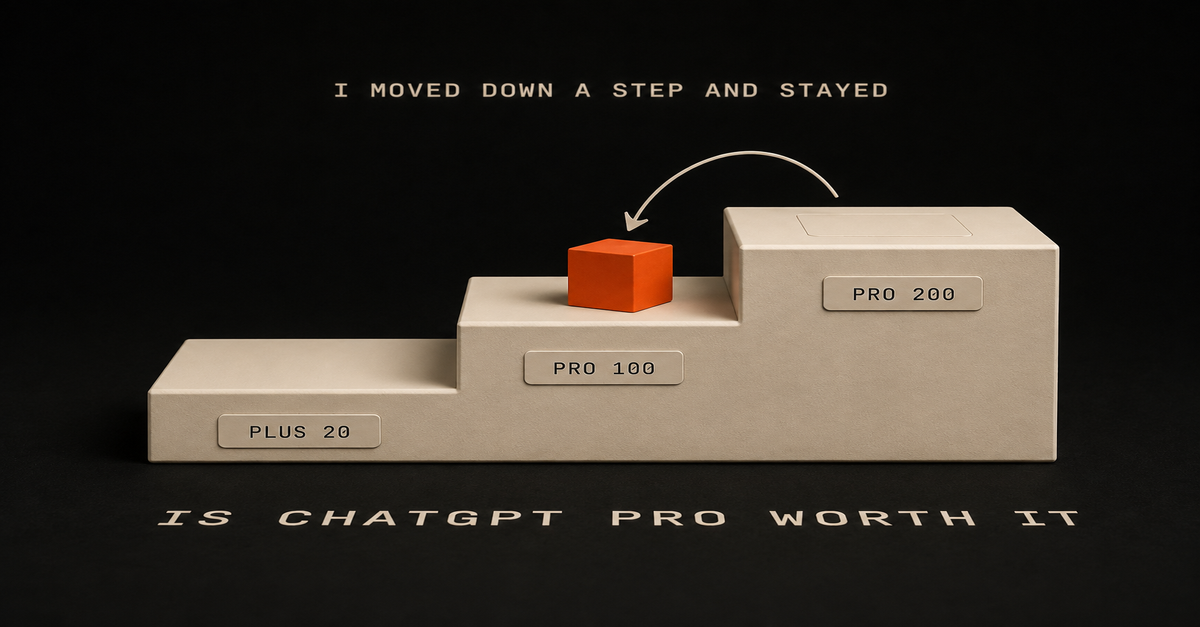
Update, September 11, 2026: OpenAI paused new sign-ups and upgrades to the $200 Pro tier on September 10, after demand for GPT-6 Astra outran its capacity. Existing $200 subscriptions keep renewing, and Pro $100, Plus, Go and the API are unaffected. No reopening date has been given, so if the verdict below points you at $200, you may have to wait. Tracked on the AI plan tracker — OpenAI's help page.Quick answer: Probably not at $200, and maybe at $100. Pro is worth it when waiting has started costing you more than the money does, and not one day sooner. There are two Pro tiers now and the honest question is not yes or no, it is which rung. I paid $200, dropped to $100 to fund something else, and did not miss it.
Every page ranking for this question is answering the $200 version. Nobody is going to win that argument, because for almost everybody the answer is obviously no.
The $100 tier is the one that actually changes the math, and nobody has written about it.
The short answer, by who you areYou are
Buy this
WhyAsking questions, drafting, summarising
Plus, $20
You will not hit the ceiling. Save your moneyHitting limits occasionally and you can wait
Stay on Plus
Annoying is not the same as expensiveGetting stopped mid-task on work with a deadline
Pro $100
5x Plus usage. This is the real first stepStill stopped on $100, running agent work daily
Pro $200
20x Plus. The top of the ladderWant GPT-5.6 Sol Pro
Pro, either tier
The one thing Plus genuinely cannot buyTempted by Pro but also want a second AI
Two $20 plans
Two allowances, two models. Often the better tradeThere are two Pro tiers, and the whole SERP is a year behind
This is why the other pages are useless to you.OpenAI's own Pro tiers help article, captured September 5, 2026. The tier split is stated in plain language and most ranking articles still do not mention it.
From OpenAI's Pro tiers article, verbatim:"Both Pro tiers include the same core capabilities. The main difference is usage allowance: Pro $100 unlocks 5x higher usage than Plus, while Pro $200 unlocks 20x usage than Plus."And on whether the expensive one changed:"No. The $200 Pro plan remains the highest usage tier. The $100 plan simply adds another option."So when someone writes "is ChatGPT Pro worth $200," they are answering a question about the ceiling of a product whose entry point is now $100. The step up from Plus is $80, not $180.
What the $100 actually gets you
I will give you the unglamorous answer, because it is the true one.
It is mostly more usage. You get to use the strongest models for longer, and room to experiment without watching a meter. The genuine additions are the two Pro-only models, the Extra High reasoning setting, a bigger context window and expanded Codex, and those matter to fewer people than the headroom does.
That sounds like a letdown until you have been stopped mid-task. Then it is the only thing you want.
The precise version, from OpenAI's pricing comparison read on September 5, 2026:Plus, $20
Pro $100
Pro $200Usage vs Plus
baseline
5x
20xGPT-6 Astra in Chat
No
Yes, as GPT-6 Pro
Yes, as GPT-6 ProGPT-6 Astra in Work and Codex
Yes
Yes
YesGPT-5.6 Sol
Yes
Unlimited*
Unlimited*GPT-5.6 Sol reasoning levels
Medium and High
+ Extra High
+ Extra HighPro models (GPT-6 Pro, Sol Pro)
No
50/week, shared across both
200/week GPT-6 Pro, 170/day Sol ProInstant context window
54K
128K
128KReasoning context window
256K
400K
400KCodex
Yes
Expanded
ExpandedAnnual billing
none
none
noneNotice what is identical between the two Pro tiers. Everything except the size of the bucket.
And notice what you already have on $20. You get a lot on the $20 plan. You get Sol, you get Codex, you get deep research, and you get Astra in ChatGPT Work and Codex, just not in the chat box. The main difference is mostly not what you can do, it is that you are going to run out.
The one row that is a genuine capability gate is the Pro models. Those come with published message counts rather than an unlimited badge.
On $100 it is one shared allowance of 50 messages a week across GPT-6 Pro and GPT-5.6 Sol Pro; switching between them does not give you more. On $200 they are metered separately: 200 GPT-6 Pro messages a week, a separate 170 a day for Sol Pro, and a combined ceiling of 200 a day. Worth knowing before you upgrade for the frontier model.
The receipt: I went down, not upMy ChatGPT app, September 5, 2026: Pro plan at $100 a month, and 70% of the week's general usage already gone with two days to the reset. This meter is the whole decision.
Here is my actual history with this, because I have been on all three rungs and the direction of travel is the part nobody writes about.
I had the $20 plan and I ate my own cooking. I used it until it ran out. It was painful, and I sat there thinking I either need to figure out how to make do with the twenty or I need to upgrade.
I eventually upgraded. I went to the $200 plan.
What pushed me there is worth telling properly, because it was not a feature announcement. I had a video editing skill that was not working, and I asked Codex to review it. It went and built something. That was my first time using Codex and honestly I did not get the hype at first; I did not think it was good enough.
Then Sol came out and it started getting impressive. It was actually doing the thing. Actually building the skill.
I got a lot of use out of that on a $20 plan. Then I hit the limit, repeatedly, and that is when it was time to move.
Then I scaled it back down to $100. Not because Pro disappointed me. Because Grok Bot came out and I needed it, and the money had to come from somewhere.
I have not regretted it since.
That is the part I want you to take: the right tier is not the best tier, it is the one that leaves budget for the other tool you actually need. You have to figure out your use cases.
The pain test, made specific
My rule for this is simple: let the pain tell you. Here is what that means in a normal week, because "upgrade when you need to" is useless advice.
You will not hit the limit asking it things. Rewrite this email, what should I wear, summarize this article, help me think through a decision. That is what the $20 plan is sized for and you can do it all day.
You start burning real credit when you ask it to build something. Help me make a website. Help me edit a video. Make me a video. That is a different class of work and it drains the allowance fast.
So the moment to watch for is specific: you are sitting there unable to continue on something you wanted to finish, and waiting is costing you.
Not a warning banner. Not a percentage. Just you, stopped, on a weekday, on work that mattered.
If waiting two hours is merely annoying, you are not ready. If waiting two hours means a client does not get their thing today, you are.
When Pro is definitely not worth it
The sharpest disqualifier I have seen on this whole question came from u/positive on r/ChatGPTPro:"If gpt-5 thinking is already pretty good for your tasks, gpt-5 pro will be either the same or better but slower. If gpt-5 thinking is not good at your task, gpt-5 pro won't be any better."Sit with that, because it kills the most common reason people upgrade. If the model is already handling your work, paying more makes it slower, not smarter. If the model is failing at your work, paying more will not rescue it.
Pro buys capacity. It does not buy comprehension.
The speed cost is real too. u/petermalik01, who is otherwise a fan and says the top tier is worth $200 for genuinely complex legal problems, adds the catch in the same breath: the top model is "slow" and runs "~10–15 min per reply" in their experience.
Three other things Pro will not do for you.
Support cannot reset your limits. OpenAI states it flatly: "OpenAI Support does not reset ChatGPT or Codex usage limits." Nobody writes this down and it is the most useful operational fact on the page.
"Unlimited" has an asterisk. Individual models keep separate allowances, and those allowances differ between the $100 and $200 tiers. A model can go temporarily unavailable on Pro.
There is no annual discount. Per the same help article, OpenAI does not support annual billing on Go, Plus or Pro. You cannot commit your way to a lower rate.
Where Plus genuinely wins
Plus is the right answer for most people reading a page called "is ChatGPT Pro worth it," and I would rather say that than sell you an upgrade.
It has Astra. It has Sol. It has legacy models, Codex, deep research, projects and scheduled tasks. It is not a crippled tier, it is the same product with a smaller bucket.
And there is an option the comparison pages skip entirely: $20 here plus $20 somewhere else often beats $100 in one place. Two separate allowances, two different models, two sets of strengths.
That is roughly the shape my own stack has taken. I run ChatGPT with Codex, Claude, and Grok with Grok Bot, and the $200 ChatGPT tier lost its slot to the third of those rather than to anything OpenAI did.
How to try Pro cheaply
The no-annual-billing rule cuts in your favor here, so use it.
You switch tiers in Settings then My Plan. Upgrades take effect immediately with billing adjusted automatically. Downgrades take effect at your next renewal and you keep your current plan until then.
That means one month of Pro $100 costs you $80 to find out for certain. Nothing locks. If it was not the problem, you drop back at renewal.
Eighty dollars is cheaper than another month of guessing. It is also cheaper than what I did, which was jump straight past the middle rung to $200 because I assumed I would need it.
How I checked this
The two Pro tiers, the usage multiples, the support policy, the billing rules and the switching mechanics all come from OpenAI's Pro tiers help article, read September 5, 2026. Models and context windows come from chatgpt.com/pricing as it rendered in a browser the same day, since OpenAI serves those values client-side.
The tier history is mine: $20, then $200, then down to $100, where I still am. I have not run a controlled comparison of $100 against $200. OpenAI publishes no message counts for ordinary chat, so I am not going to give you a number for how much of a week either tier absorbs; anyone who does is guessing. The Pro-model allowances above are the exception, and they are quoted exactly as OpenAI states them.The 60-second version, from my Shorts: My AI limit stopped running out (the routing loop).So is it worth it?Your work is questions, drafting and everyday tasks: no. Stay on Plus and stop reading upgrade pages.
You are building, editing or researching hard and getting stopped: yes, at $100. That is what the 5x is for.
You are stopped even on $100 and AI is doing real work in your day: yes, at $200.
The model is already failing at your task: no. More capacity will not fix a comprehension problem.
You want Pro and a second AI tool: buy the second tool first. That is the trade I made and I would make it again.If the comparison you actually want is the tier below, that is ChatGPT Plus vs Pro. If Pro is settled and only the price is not, that is Pro $100 vs $200. And if you are weighing this against the other side of the market, Claude Max vs ChatGPT Pro is the $100-against-$100 version.
Current plans and prices live on the AI plan tracker.
This post is part of Claude at Work, the hub for using AI at your job without code.
Published September 5, 2026. Tiers, usage multiples, models, context windows and billing rules checked that day against OpenAI's Pro tiers help article and chatgpt.com/pricing, both linked inline. OpenAI changes these often, so open the live pages before you buy.
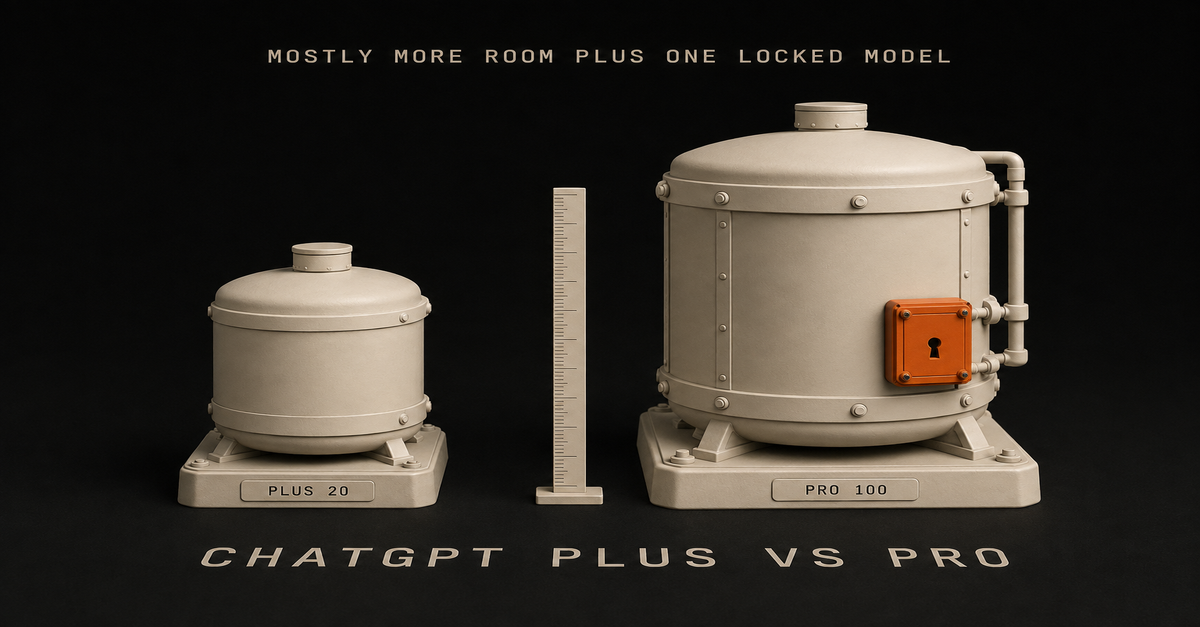
Quick answer: Plus is $20 a month. Pro starts at $100. What the extra $80 buys is mostly room, not brains: OpenAI says the $100 tier gives you 5x the usage of Plus.
It also unlocks two Pro-only models and a bigger context window. If you are not currently hitting walls, none of that is worth $80 to you.
I pay for the $100 tier. I got there by hitting the ceiling on $20 over and over, not by reading a feature list.
So this page answers "ChatGPT Plus vs Pro" and "ChatGPT Pro vs Plus" the way I would answer it for a friend: what actually changes, what does not, and the one test that tells you whether to move.
The short answer, by who you areYou are
Get this
WhyAsking it questions, drafting, summarising
Plus, $20
You will not hit the ceiling doing this. Ordinary chat is cheapBuilding things with it: sites, video edits, long research
Watch your limits
This is the work that burns the allowanceGetting stopped mid-task, waiting for resets, on a deadline
Pro $100
5x the usage of Plus, per OpenAIRunning agent work all day and still hitting the $100 wall
Pro $200
20x Plus. This is the top of the ladderYou want GPT-5.6 Sol Pro specifically
Pro, either tier
The one thing $20 genuinely cannot buyAlready decided on Pro and choosing between the two prices? That is Pro $100 vs $200.
Pro is two prices, and most comparison pages only know about one
This is the single biggest reason the other pages on this search are wrong.
There are two Pro tiers, not one. From OpenAI's Pro tiers page:"Both Pro tiers include the same core capabilities. The main difference is usage allowance: Pro $100 unlocks 5x higher usage than Plus, while Pro $200 unlocks 20x usage than Plus."Read that carefully, because it is doing a lot of work. The difference between the Pro tiers is capacity only. Same models, same features, different ceiling.ChatGPT's pricing page, captured September 5, 2026. OpenAI renders these numbers in the browser rather than in the page source, which is why so many articles quote stale prices.
Almost every page ranking for this query compares $20 Plus against a single $200 Pro. That is a $180 gap. The real first step up is $80.
What the extra money actually buys
Here is the honest inventory, from OpenAI's own pricing comparison as it rendered on September 5, 2026.Plus, $20/mo
Pro, from $100/moUsage
baseline
5x Plus at $100, 20x Plus at $200GPT-5.6 Sol reasoning
Medium and High only
Medium, High and Extra HighPro models (GPT-6 Pro, Sol Pro)
Not included
Included, with a message allowanceGPT-6 Astra in Chat
No
Yes, as GPT-6 ProGPT-6 Astra in Work and Codex
Yes
YesGPT-5.6 Luna
Yes
Unlimited*Legacy models
Yes
YesInstant context window
54K
128KReasoning context window
256K
400KInstant input maximum
~40 pages of text
~250 pages of textReasoning input maximum
~320 pages of text
~680 pages of textCodex
Yes
ExpandedAnnual billing
none
noneThree things worth pulling out of that table.
Pro models are the real gate. GPT-6 Pro and GPT-5.6 Sol Pro are the two rows where Plus says no and Pro says yes. Everything else is a bigger portion of something Plus already has.
Plus tops out at High on the reasoning slider. Extra High is a paid-tier-above-Plus setting. If you have been wondering why your reasoning options look shorter than someone else's, that is why, and almost nobody writes about it.
The context window grows more than the token numbers suggest. Instant goes from 54K to 128K, which is about 2.4x on tokens, but OpenAI's own input maximums for those same rows read ~40 pages against ~250. Those are OpenAI's figures, not a conversion I did, and they do not scale linearly with each other. If your job is dropping long documents in and asking questions about them, read the pages row rather than the tokens row.
The Astra question, answered per surface
This is where almost every page on this search goes wrong in one direction or the other, and the honest answer needs one extra word: where.
Availability is per surface, not per plan.
From OpenAI's GPT-5.6 and GPT-6 Pro article, updated the day before this page:"GPT-6 Pro, powered by GPT-6 Astra, is rolling out in ChatGPT for Pro $100, Pro $200, Business and Enterprise plans... Plus plans include GPT-6 Astra in ChatGPT Work and Codex as it rolls out."So both halves of the internet argument are wrong.
Plus is not locked out of Astra. It reaches it through ChatGPT Work and Codex.
But Plus does not get it in the chat box. In Chat, Astra is branded GPT-6 Pro, and that is a Pro, Business and Enterprise thing.
That distinction is the actual $80 question, and we have a whole page on it: which ChatGPT plans get Astra has the plan-by-surface table.
Pro's headline models come with a message countMy ChatGPT app, September 5, 2026: Pro plan at $100 a month, and 70% of the week's general usage already gone with two days to the reset. This meter is the whole decision.
Here is the fact that reframes the two Pro tiers, and it is the one thing OpenAI does put a number on.
GPT-6 Pro is not unlimited on either tier. From the same help article:Plan
GPT-6 Pro allowance in Chat
How Sol Pro shares itPro $100
50 messages per week
One shared 50-per-week allowance across both Pro modelsPro $200
200 messages per week
Separate 170 per day for Sol Pro, both capped at 200 per day combinedRead the $100 row twice before you buy it.
Fifty messages a week, shared across GPT-6 Pro and GPT-5.6 Sol Pro. Switching between the two models does not give you more once that allowance is gone.
That is roughly seven top-model messages a day. If the reason you are upgrading is the frontier model specifically rather than general headroom, the $100 tier is a much smaller purchase than "5x usage" makes it sound.
On $200, hitting the GPT-6 Pro weekly limit drops you automatically to GPT-5.6 Thinking at Medium rather than stopping you.
The upgrade trigger: let the pain tell you
This is my actual rule, and it is the only part of this page I would defend in an argument.
Let the pain be the reason you move up. Not the spec sheet. That is my rule for every AI tier I have ever climbed.
Here is how it went for me. I started on the free tier and used it until waiting for the reset became unbearable. Then I paid $20 and used that until waiting became unbearable again. Then I moved up. Every step was forced by friction I actually felt, never by a feature I read about.
What that looks like in a normal week is the useful part.
You are not going to hit the limit just asking it things. Should I eat this with my steak, what is the weather like, what should I wear, help me rewrite this email. The $20 plan handles that all day long. If that is your usage, you are shopping for a solution to a problem you do not have.
Where it starts burning is when you ask it to make something. Can you help me build a website. Can you help me edit a video. Can you create a video. That is when you start burning real credit, and that is when this becomes a serious workflow question instead of a chat question.
For me the differentiator was always testing new things. I am tinkering and documenting all day, so I outgrew tiers faster than a normal person would. That is my job, not a general truth about the plans.
What Pro does not fix
Two things people expect from the upgrade and do not get.
Support cannot rescue you. From OpenAI's Pro tiers article: "OpenAI Support does not reset ChatGPT or Codex usage limits." If you hit a wall you wait, or you switch models. There is no setting to bypass it and no favor to ask for.
There is no annual discount to soften the jump. OpenAI states it does not support annual billing or multi-month prepay on Go, Plus or Pro. You cannot commit your way to a better rate.
That second one cuts in your favor, though, and it is the reason I would tell anyone to just try it. There is no lock-in. You switch tiers in Settings then My Plan, billing adjusts automatically, and a downgrade takes effect at your next renewal.
One month of Pro costs you $80 to find out. That is a cheaper experiment than a week of guessing.
Where Plus genuinely wins
Not "wins on price." Wins, full stop, for most people reading this.
Plus has GPT-5.6 Sol, legacy models, Codex, deep research, projects and scheduled tasks, and Astra in Work and Codex. The feature list is not meaningfully shorter. It is the same product with a lower ceiling and one locked door.
Real users say this better than I can. On r/ChatGPTPro, u/alexoff put it plainly:"For everything else - ChatGPT Plus is usually enough. Also, try better prompting and you will see much better results in my opinion that would be enough even on a Plus plan."That last clause is the one to sit with. A lot of people who think they need more compute actually need a better prompt.
The counterweight, from the same thread, is u/peraltz94 explaining what made Pro worth it for them:"Having access to better models, more context, more juice, legacy models, and deep research and agent mode limits, were my factors. If I can get improved responses and save me time, and I can quantify to hours then it has enough value."Note the test they applied. Not "is it better." Can I quantify the saving in hours. That is the right question.
How I checked this
Everything factual on this page comes from OpenAI's own pages, read on September 5, 2026: the pricing comparison for models, context windows and prices, and the Pro tiers help article for the tier split, the support policy and the billing rules. The screenshot above is that pricing page as it rendered in a browser, because OpenAI serves those prices client-side and page scrapes miss them.
The upgrade rule and the usage story are mine, from paying for these tiers and moving between them. I have not run a controlled test of $100 against $200.
One caveat on numbers: OpenAI publishes no message counts for ordinary chat usage, so any general "X messages per day" figure is guesswork. The Pro-model allowances above are the exception. Those are published, and they are quoted here exactly as OpenAI states them.The 60-second version, from my Shorts: One workday of AI chat ate 31% of a monthly quota.So which one should you buy?You use it for questions, drafting and everyday work: stay on Plus. You will not hit the ceiling, and you already reach Astra through Work and Codex.
You are building, editing or researching heavily and getting stopped: Pro $100. That is the wall the 5x is for.
You are stopped even on $100: Pro $200, and at that point you are not asking this question anymore.
You need GPT-5.6 Sol Pro: Pro, either tier. It is the one thing $20 cannot buy.
You are not sure: stay where you are until waiting costs you something real. Then move. There is no annual lock-in, so the experiment is one month cheap.If you are weighing this against the other side of the market, Claude Pro vs ChatGPT Plus is the $20-against-$20 version, and Claude Max vs ChatGPT Pro is the $100-against-$100 one. If you have not paid for anything yet, start at is ChatGPT Plus worth it.
Every current plan and price I track lives on the AI plan tracker.
This post is part of Claude at Work, the hub for using AI at your job without code.
Published September 5, 2026. Prices, models, context windows and billing rules checked that day against chatgpt.com/pricing and OpenAI's Pro tiers help article, both linked inline. OpenAI changes these often and renders prices in the browser, so open the live page before you buy.
Quick answer: Go is $8 a month, Plus is $20, and the $12 gap buys model access, not capacity. Plus gets GPT-5.6 Sol, legacy models, full deep research and Sites, reaches GPT-6 Astra through Work and Codex, and will never show you ads. Go gets none of those. What the gap does not buy is context: both tiers sit at the same 54K instant and 256K reasoning window.
I have never paid for Go. I saw the $20 plan, started there, and have been upgrading ever since, so trying Go now would make no sense for how I work.
That means everything factual below is read off OpenAI's own pages rather than lived. Including one thing this page previously got wrong.
First, the correction I owe you
The earlier version of this page told you that Go's reasoning tops out at GPT-5 Thinking Mini and framed the gap as "Go has no real reasoning."
That is wrong, and OpenAI says so directly on the Go help page:"Are reasoning models included with ChatGPT Go? Yes. ChatGPT Go users can access Think on the web and in the ChatGPT mobile app... Think uses GPT-5.6 Luna. ChatGPT Go does not include GPT-5.6 Sol."So Go reasons. It just reasons with Luna instead of Sol.
The gate is which reasoning model, not whether there is one. That is a smaller and more honest distinction than the one I published, and I would rather correct it in public than quietly swap a sentence.
I also removed the comparison graphic that used to sit on this page, because it carried the same stale claim and two model names OpenAI no longer lists.
The short answer, by who you areYou are
Pick
WhyNot hitting any limits on Free
Stay free
You are shopping for a problem you do not haveDrafting, rewriting, summarizing, everyday questions
Go, $8
Genuinely enough, and the context window is the sameBothered by ads on principle
Plus, $20
Go is ad-eligible and you cannot buy your way outAsking it to think through work you will act on
Plus, $20
This is what Astra and Sol are forAttached to a legacy model workflow
Plus, $20
Go drops legacy models entirelyWanting full deep research and Sites
Plus, $20
Go gets a limited version; Sites is Plus onlyGo is $8, and our own tracker had it wrong
OpenAI renders its plan prices in the browser rather than in the page source, which is why articles quote wildly different numbers and why our own plan tracker carried a wrong one until today.
So here it is, rendered and captured.ChatGPT's pricing page as it actually renders, captured September 5, 2026. Go is $8. Plus is $20.
Go is $8 a month. Plus is $20. The gap is $12.
Our AI plan tracker previously listed Go at $12, confusing the gap with the price. That is corrected as of today, with the correction logged on the tracker itself rather than silently edited out.
What the $12 gates: Astra, Sol, legacy models and ads
From OpenAI's pricing comparison as it rendered on September 5, 2026.Free
Go, $8
Plus, $20GPT-6 Astra
No
No
Yes, in Work and CodexGPT-5.6 Sol
No
No
YesGPT-5.6 Luna
Yes
Yes
YesGPT-5 Thinking Mini
Yes
Yes
ExpandedReasoning (Think)
limited
Yes, on Luna
Yes, expandedLegacy models
No
No
YesAds
eligible
eligible
neverInstant context window
27K
54K
54KReasoning context window
Varies
256K
256KInstant input maximum
~12 pages
~40 pages
~40 pagesDeep research
limited
limited
YesSites
No
No
YesResponse times
limited on bandwidth
limited on bandwidth
FastTwo rows in that table deserve to be pulled out.
One clarification on that Astra row, because it trips people up. Plus reaches Astra through ChatGPT Work and Codex, not through the chat box, where the model is branded GPT-6 Pro and gated to Pro and above. Go does not reach it on any surface. The full breakdown is on which plans get Astra.
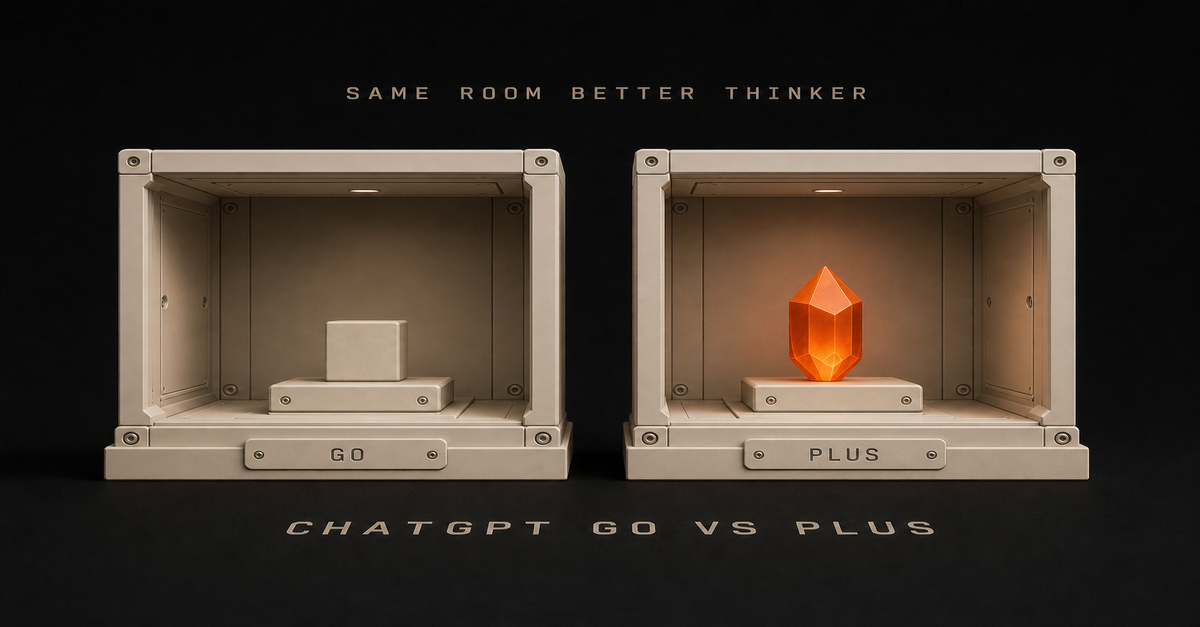
The context windows are identical. 54K instant, 256K reasoning, on both tiers. This is the fact I would tattoo on the page. You are not paying $12 for more room to work; you are paying for a better thinker inside the same room.
Response times differ, and nobody mentions it. Free and Go are listed as "Limited on bandwidth & availability." Plus and Pro are listed as "Fast." At peak times, that is a real difference in a way a feature checklist does not convey.
The ads question, which settles it for a lot of people
This alone decides it for some readers, and almost no comparison page leads with it.
From OpenAI's ads FAQ, which was stamped "Updated: 4 days ago" when I read it on September 5, 2026:"Ads may appear for users on the Free and Go plans. Plus, Pro, Business, Enterprise, and Edu accounts will not have ads."The US test began on February 9, 2026, with ads appearing below responses, clearly labeled and visually separated. OpenAI says they do not influence answers and that advertisers never receive your chats, chat history or memories.
Here is the part that matters for this decision: on Go you cannot pay your way out of ads.
The "Ads-Free" option is a Free-plan setting, and it trades ads for lower message limits and reduced feature access. OpenAI's own FAQ spells it out: if you are on Go and you want Ads-Free, you would have to switch back down to Free, or up to a plan that is already ad-free.
Turning off ad personalization is not the same thing. It changes which ads you see, not whether you see them.
One inconsistency worth knowing about, because it is OpenAI's and not mine: the ads FAQ describes a live test covering Go, while the Go help page still says "We may start testing ads in ChatGPT Go in the future." Two OpenAI pages, two tenses. Check your own account rather than trusting either page, or this one.
Go is no longer region-locked, and both tiers chat without limits
Go is no longer region-limited. OpenAI's help center now states that "ChatGPT Go is now available in all ChatGPT supported countries." A lot of content still describes Go as a select-regions product, including some of OpenAI's own marketing.
Free and Go both get unlimited everyday text chats. OpenAI states it plainly: "Free and Go users both have unlimited everyday text chats." What Go raises is the limits on the expensive things: image generation, file uploads, data analysis.
That reframes the $8 a bit. You are not buying the ability to chat more. You are buying more of the tools.
Where Go genuinely wins
Go is a real product for a real person and I want to say so clearly, because the internet's instinct is to treat cheap tiers as traps.
If your work is volume of ordinary language, drafting emails, rewriting paragraphs, summarizing documents, everyday questions, Go covers it. You get the same context window as Plus, you get Think on Luna, you get projects, custom GPTs and scheduled tasks.
Users who moved down and stayed happy describe exactly this. u/varik21 put it simply:"For just conversations, there is absolutely no difference... I am going back to Go."The other side of that same thread is just as consistent. u/Stade_gangster:"answers feel much more geared towards being fast than being thoughtful... if you mainly use ChatGPT for in-depth discussions, I can definitely understand why people choose to stick with Plus."Read those two together and you have the whole decision. Conversations, Go is fine. Thinking you will act on, pay the $12.
Downgrading is not refunded, and three other traps
Read these before you click downgrade.Downgrades are not refunded. OpenAI states your current plan runs to the end of the billing cycle, then you switch to Go and pay the Go rate. u/Icy-Imagination5185, who did it by accident, put it plainly: "Now I can't go back to Plus for a FULL MONTH."
No annual billing. OpenAI does not offer annual or multi-month prepay on Go, Plus or Pro.
Legacy models disappear on Go. If you have a workflow pinned to an older model, it goes away.
Ads-Free is a Free-plan setting, not something you can add to Go.
No Sora on Go. The video model, along with Sites, record mode and full Codex, sits above the $8 tier. ChatGPT Work is on both, but Free and Go get it as "Limited (desktop app)" while Plus gets desktop, web and mobile.My rule for cheap tiers
Here is the rule I actually use, and it is the only reason I have ever moved up a tier: pain is the upgrade trigger.
Start free. If you only occasionally bump a limit, do not upgrade. You are not really using it yet.
Once you find real use cases and the tool becomes part of your life, managing email, planning your day, the stuff you connect through apps and connectors, you will want the state-of-the-art model and more usage. That is when $20 becomes obviously worth it.
So where does that leave Go? Go is what you pay when you are past free, you keep hitting limits, and you are fine without the newest models. That is what the $8 buys. Be honest about which person that is.
The cheap tier is a trap in exactly one situation: when your work needs judgment and you bought volume instead. A wrong answer you act on at work costs far more than the $12 you saved.
One option the comparison pages skip: $8 on Go plus a second free tier from another provider often gets you further than $20 on one. More friction, more model.
How I checked this
Reasoning access, the ads policy, availability, the unlimited-chats language and the refund rules come from OpenAI's Go help page and its ads FAQ, both read September 5, 2026. Prices, model rows and context windows come from chatgpt.com/pricing rendered in a browser the same day, which is the only way to read those numbers reliably.
I have never subscribed to ChatGPT Go, so there is no first-hand usage report here and I am not going to invent one. OpenAI publishes no message counts for these tiers either, so any "X messages per day" figure you see elsewhere is folklore.
Related readingChatGPT Plus vs Pro - the next rung up, if $20 is already settled
Is ChatGPT Plus worth it - the $20 decision on its own
Claude Pro vs ChatGPT Plus - if you are choosing between $20 plans
Claude vs ChatGPT - the full comparison, and why caps decide itThis post is part of Claude at Work, the hub for using AI at your job without code.
Published July 27, 2026. Last reviewed and updated September 5, 2026: corrected this page's central claim that Go lacks real reasoning (it has Think on GPT-5.6 Luna), re-cut the gate around GPT-6 Astra, Sol, legacy models, deep research and Sites, settled the price at $8 against OpenAI's rendered pricing page and fixed the wrong $12 figure on our own plan tracker, added the ads section and the response-time row, noted that Go is now available in all supported countries, and removed a comparison graphic that carried the stale reasoning claim. All facts checked that day against OpenAI's own pages, linked inline.
 Chris Alarcon