In this article
- 1 The workflow in one screen
- 2 Step 1: Pull the transcript and receipts
- 3 Step 2: Find the proof moments
- 4 Step 3: Create the 7 Shorts from one idea each
- 5 Step 4: Create 3 LinkedIn posts with different jobs
- 6 Step 5: Create 2 X posts or threads with sharper edges
- 7 Step 6: Create the newsletter draft as a field note
- 8 Step 7: Create one search page or tool idea
- 9 The semi-automated version
- 10 FAQ
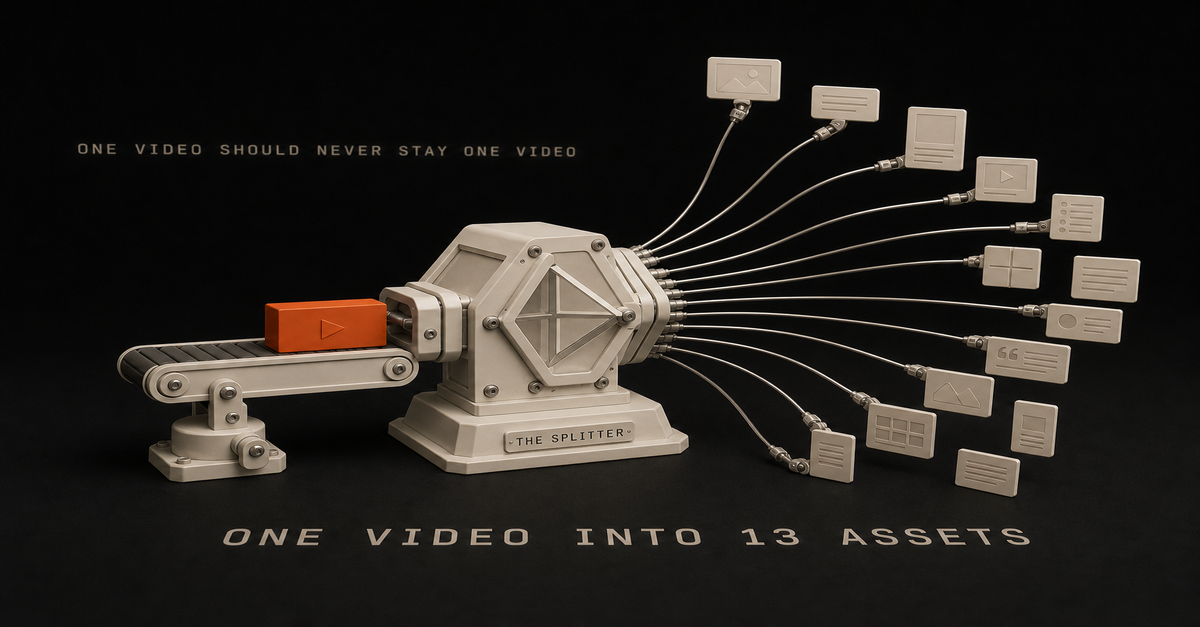
One YouTube video should not stay one YouTube video.
If you are a solo builder, every long-form video is proof. It can become Shorts, X threads, LinkedIn posts, a newsletter draft, and search pages.
The baseline Ship Lean flywheel is:
| Output | Count |
|---|---|
| YouTube Shorts | 7 |
| LinkedIn posts | 3 |
| X threads/posts | 2 |
| Newsletter draft | 1 |
| Total | 13 |
The key is not “make more content.” The key is to turn one real proof asset into multiple useful surfaces without flattening it into generic AI mush.
I walk through this on camera in How I Batch a Full Week of Content in a Few Hours (15 min).
The workflow in one screen
| Stage | Input | Output |
|---|---|---|
| Capture | YouTube video | transcript, timestamps, screenshots |
| Extract | transcript + notes | proof moments, claims, examples |
| Package | proof moments | Shorts, posts, newsletter, search page idea |
| Review | drafts | approved assets only |
| Publish | approved assets | social, email, site |
| Measure | analytics | next topics and refreshes |
That review step is not optional. It is what keeps the system from becoming an automated content landfill.
Step 1: Pull the transcript and receipts
Start with the transcript, not the video file.
You need:
- the raw transcript
- timestamps
- title
- description
- any notes or screenshots from the build
The transcript becomes the source of truth. The screenshots and notes become the receipts.
Do not skip the receipts. They are the difference between “here is some advice” and “here is what I actually built.”
Step 2: Find the proof moments
Do not clip randomly.
Find moments where something useful happens:
- a mistake gets fixed
- a tool choice is explained
- a cost is revealed
- a workflow is shown
- a before/after is obvious
- a decision is made
Those moments become Shorts and social posts.
Use this filter:
| Moment type | Why it works | Asset fit |
|---|---|---|
| Mistake | People trust honest friction | Short, X post |
| Decision | Helps builders choose faster | LinkedIn, comparison |
| Before/after | Shows concrete progress | Short, newsletter |
| Cost/time | Makes the system real | Short, SEO section |
| Workflow | Gives them something to steal | Blog, workflow page |
Step 3: Create the 7 Shorts from one idea each
Each Short needs one idea.
Good Short angles:
- “I tried X so you do not have to”
- “This saved me Y hours”
- “The mistake was not the tool”
- “Here is the stack”
- “Most builders skip this step”
Do not end every Short with a CTA. Often the strongest ending is the verdict.
Good Short structure:
- First line names the pain or surprise.
- Middle shows the proof moment.
- Last line gives the verdict.
Example:
I thought the tool was the bottleneck. It was not. The bottleneck was that I had no approval step, so every automation either stalled or published junk.
Step 4: Create 3 LinkedIn posts with different jobs
LinkedIn should not be a transcript summary.
Use:
- one tactical post
- one lesson post
- one build-in-public post
The tactical post teaches the workflow. The lesson post explains what changed your mind. The build-in-public post shows what you shipped.
Those are three different angles, not three rewrites of the same paragraph.
Step 5: Create 2 X posts or threads with sharper edges
X is the sharpest version.
Use:
- one atomic takeaway
- one short thread with steps
If it does not have a strong first line, it will die.
For X, cut the setup. Start at the tension:
- “Most content automation fails because it automates before it understands the workflow.”
- “Claude Code should not replace n8n. It should make n8n less painful to build.”
- “The best AI stack is usually the one with fewer tools and better handoffs.”
Step 6: Create the newsletter draft as a field note
The newsletter should feel like a field note:
- What I built
- Why I built it
- What broke
- What worked
- What you can steal
That format matches builders because it respects their time.
Step 7: Create one search page or tool idea
Every video should create at least one searchable page idea.
Examples:
- “Claude Code vs n8n”
- “Best AI stack for solo founders”
- “How to automate content repurposing”
- “How much does an AI content system cost?”
This is how your YouTube work becomes long-term search inventory.
Sometimes the search asset should be a tool instead of a post:
- cost calculator
- automation priority audit
- content flywheel ROI calculator
- workflow checklist
- stack selector
That is why I like this system. Social gives you feedback fast. Search tools and workflow pages compound slowly.
The 60-second version, from my Shorts: I turned one script into 5 platforms of content.
The semi-automated version
Here is the version I trust:
- n8n detects a new YouTube video.
- n8n saves the transcript, title, description, and URL.
- Claude Code extracts proof moments and drafts assets.
- The editor skill removes weak or generic assets.
- A human approves the final pieces.
- n8n routes approved assets to the scheduler/newsletter/site queue.
Fully automated publishing sounds attractive. Semi-automated publishing is how you keep quality while still moving fast.
Want to sanity-check the value of the workflow? Use the content flywheel ROI calculator. If you are deciding whether this should be your first automation, run the automation priority audit.
Want help wiring this flywheel into your actual stack? Start here.
FAQ
How many assets should one YouTube video create?
Thirteen is a strong baseline: 7 Shorts, 3 LinkedIn posts, 2 X posts, and 1 newsletter draft.
Should AI fully automate content repurposing?
No. AI should draft, format, and route. A human should approve the final asset before publishing.
What tools do you need?
Claude Code for judgment-heavy drafting, n8n for routing and triggers, Notion or Obsidian for storage, and a scheduler for publishing.
Should every video become a blog post?
No. Every video should create a search idea, but not every idea deserves a full post. Some should become tools, workflow pages, refreshes, or internal notes.

Written by
Chris AlarconChris Alarcon builds Ship Lean: the boring Claude and AI setups that actually work, handed to people who don’t code. He runs his one-person operation on these systems, around a full-time job, and shares every workflow, prompt, and tool combo in public. Start with the 15 prompts he uses every day.
Work With Me
Setting this up for your team?
I do that. The right plan per seat, the boring setup that makes it stick, and the first three chores handed off. A 2-hour workshop or a done-with-you build, for teams of 2-50.
See how it works →The 15 AI prompts I actually use every day
I tested hundreds and kept the 15 that survived at my desk. You get them right away, then one short Ship Lean note every Tuesday.