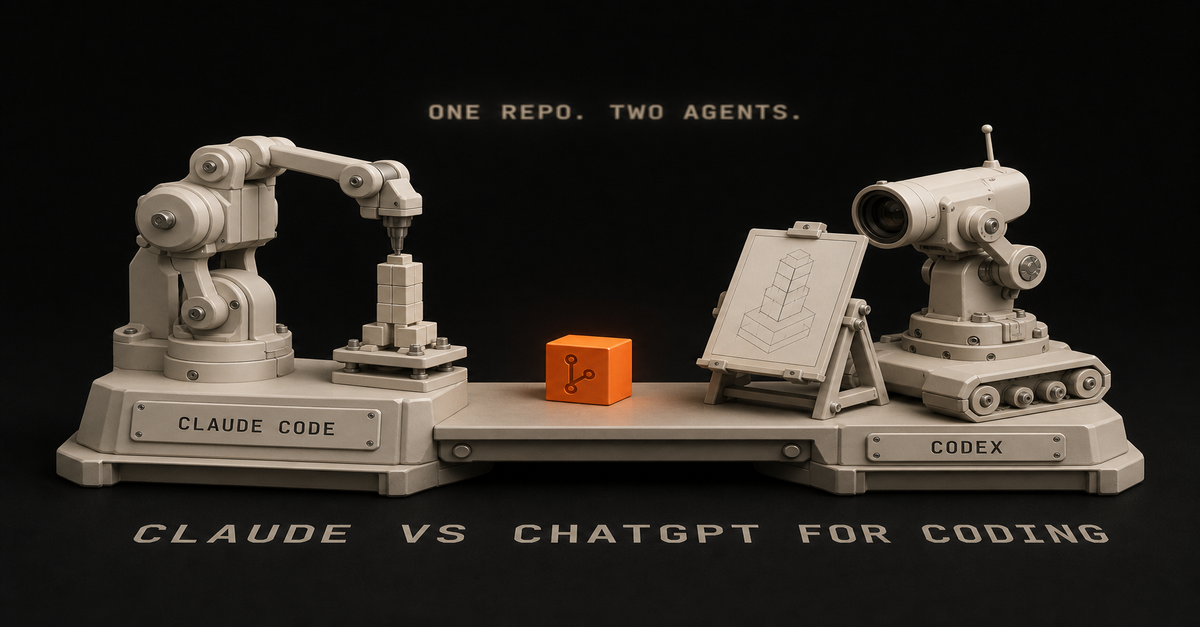
Quick answer: Claude Code waits for you. Grok Bot works without you. That one line decides almost every routing question between them, and it is why I run both daily and have never had them compete for the same task.
Before anything else, the correction that half this SERP needs.
Grok Bot is not Grok Build
These are two different xAI products and several pages ranking for this query compare the wrong one to Claude Code without saying so.Grok Build is xAI's coding tool. That is the product that lines up against Claude Code as a coding tool.
Grok Bot is xAI's agent product. Named persistent bots, each with standing instructions, running on a cloud virtual machine.You do not have to take my word for the split, because xAI's own pricing page lists them as separate rows on different plans:xAI's pricing page, captured September 10, 2026. Grok Build ships on every tier including Free. Grok Bot only on the three individual SuperGrok tiers, and not on Business or Enterprise.
Different rows, different availability, different products. If a page tells you "Grok Bot is a terminal coding agent," it has not opened either one.
For the record: I have access to Grok Build and have not used it, so it gets no verdict on this page.
Claude Code waits for you. Grok Bot works without you
The obvious hypothesis is "does the job need my files." That is the line most comparisons draw, and in my setup it is wrong.
Grok Bot has access to my repo. It knows how to pull it, and if my computer is off, it knows how to SSH into my Mac mini.
It is even routing its browsing through that machine, so the bots do not look like bots and get slowed down by captchas. Nothing shady, just not being treated as a scraper while reading public pages.
So "whose files" does not separate them. Both can reach mine.
The real line is what kind of work it is:
Claude takes the content. All of it. Writing, building, the things where judgment about quality matters and I want to be in the loop while it happens.
Grok Bot is the sidekick. It runs analytics on everything. How is the long-form doing, how are the shorts doing, how is LinkedIn doing, how is the newsletter doing. It logs the wins and the losses. When something pops, it tells me. When someone comments on a thing, it logs it and tells me.
Consistent grunt work, on a schedule, that produces a record.Claude Code
Grok BotShape
Task-shaped, resets around each job
Employee-shaped, persistsWhere it runs
Your machine, your terminal
Its own cloud VM, one per accountWhose logins
Yours
Its own, authenticated onceWhen it works
While you are there
On a schedule, without youWhat I give it
Content and building
Analytics, inbox, monitoringWhat happens at 3am
Nothing
The job runsCost
Included on every paid Claude tier
From $30 on SuperGrokFailure mode
Stops
Can keep spendingWhy not just build the grunt work as workflows?
Fair question, and I did, for a long time.
The difference is not capability. It is that a conventional workflow can break silently.
You find out three weeks later that a thing stopped, and by then the ledger has a hole in it. It is also less interactive: you cannot really talk to it.
A hand-built workflow stack is more customizable, and that is a genuine advantage. It is also its problem. It becomes a machine assembled from scraps. Some good parts, some bad parts, some generic parts, all bolted together and none of it fluid.
Grok Bot is one system, same parent, same heart. Everything flows the way it should because it was built as one thing. More unified, less yours.
That tradeoff is the whole choice, and which side you want depends on whether you enjoy owning the plumbing.My Grok Bot roster as captured August 28, 2026. Named bots with standing instructions on one shared cloud machine, not a workflow canvas.What it grew into by September 10: a Chief of Staff bot that the other bots report into. I ask it one question a day.
Has Grok Bot taken a job away from Claude Code for good?
No.
That is the honest answer and I think it is the most useful sentence on this page, because it is not what a launch-week comparison would tell you.
Grok Bot did not take work off Claude Code. It picked up work that was not happening at all.
The analytics ledger did not exist before. The inbox got triaged by me, badly, or not at all.
Nothing migrated. Something new started.
The thing that makes me think that could change: Codex has genuinely surprised me lately, to the point of generating a tweet. Which makes me suspect the next Grok model might eventually take on work I currently keep on Claude. That model is not out and I am not going to pretend to know what it does.
For now: no job has moved, and I do not switch between them mid-task. I use both.
Where Claude Code actually lives
The mirror image of the roster above is that Claude Code is not a roster. It is a session in a terminal on my machine, plus Cowork as its non-terminal sibling in the desktop app.Claude Code and Cowork in the Claude desktop app. Same brain, two cockpits, both attached to my actual machine and my actual files.
And the honest caveat about the terminal: when I finally got into Claude Code it clicked immediately, but I am used to looking at a terminal window. I do not recommend that for everybody. If the terminal is the blocker rather than the capability, the fork you want is Cowork vs Claude Code, not this page.
Cost and risk, which are not symmetrical
Claude Code is included on every paid Claude tier. Pro at $20, Max 5x at $100, Max 20x at $200, per Anthropic's Max plan page and claude.com/pricing. You are not buying Claude Code, you are buying capacity for it. When you run out, it stops.
Grok Bot is included from $30 on SuperGrok, per xAI's pricing page as of September 10, 2026. Each eligible plan carries a weekly Grok Bot allowance, and overage is reported to bill from model and token cost with no Grok Bot specific spend cap yet.
That asymmetry deserves a sentence of its own. One of these fails by stopping. The other can fail by spending, unattended, at 3am. I have not been surprised by a bill, and I would still watch it closely for a first month.
There is a second risk that is structural rather than financial. All your bots share one cloud machine, along with its logins and its files.
That is convenient, and my read of it is that the bots are not meaningfully isolated from each other. Whatever one bot can log into, you have effectively handed to the whole roster. Scope what you connect accordingly.
Claude Code's risk profile is the opposite and more familiar: it is on your machine, in your files, and the blast radius is local.
Which one to start withYou want an agent doing something useful by Friday and you do not code. Grok Bot. Pick one job you do at the same time every day and hate. Not nine.
You want to build or write things and be in the loop. Claude Code, on any paid Claude plan you already have. And if the terminal is the problem, Cowork.
You are comparing coding tools specifically. Then you want Grok Build against Claude Code, not this pairing.
AI does real work in your week. Both. I do.The reason for "both" is not greed. There is no AI that does it all, and if you are running a business on this you do not want to rely on one. They get cancelled, they get rate limited, they go down, they get changed underneath you. Two vendors means one bad day is not your bad day.
If I were being properly serious about it, the most important jobs would run locally on hardware I own, with the paid frontier models sitting on top for the heavy thinking. Then a subscription change is an inconvenience rather than an outage. I am not there yet. I am running on paid models and I know that is a risk I am choosing.
The neighboring comparisons: Grok Bot vs Claude Cowork if you are choosing between the two agent products, what is Grok Bot for the week-one field test, Grok Bot use cases for the full roster and what each bot produces, and Grok vs Claude if you actually meant the models. More at Claude at Work.
Published and last reviewed September 10, 2026. The Grok Bot and Grok Build plan rows were read and captured that day from xAI's pricing page, screenshotted above. Grok Bot's VM, login and connector mechanics were verified for my week-one field test on August 28, 2026. Claude Code tier inclusion and Claude plan prices were verified for Claude Max 5x vs 20x against Anthropic's Max plan support article and claude.com/pricing. The routing rule, the repo and SSH setup, and the "no job has moved" answer are my own, from my own accounts. The overage-billing point is secondary reporting and labeled as such. A published head-to-head benchmark circulating for this pairing was left out because I could not trace it to the benchmark's own publisher.
Quick answer: stop comparing chatbots. The real 2026 decision is which coding agent you live in: Claude Code or Codex, and both now come inside the normal subscriptions, starting at $20 a month each. I pay for both stacks. My serious builds happen in Claude Code. My research, sparring, and everything around the code happens in ChatGPT. If you can afford both, get both. If you can only pick one, the split below tells you which.
The Ship Lean split, in one line: Claude Code builds it, Codex challenges it, and the boring work goes to whichever one is not busy.
Searching this as "ChatGPT vs Claude for coding"? Same answer, both directions. And if you are comparing the $20 chat plans themselves, that is a different page: Claude Pro vs ChatGPT Plus.I walk through this on camera in Claude Design + Codex = The Real Website Rebuild Workflow (14 min).What "Coding" Means for You Decides the PickWhat "coding" means for you
PickSerious multi-step builds, agents, real systems
Claude CodeCreative output: web design, visuals, writing code that touches words
Claude CodeResearch before you build, competitor teardowns
ChatGPT (Codex)A second opinion on your plan before you execute
The one you did NOT build withEveryday questions, brainstorming, on-the-go voice
ChatGPTExtracting data from a web dashboard with no export button
Codex, it drives the browserYou can afford $40/month total
Both. Not a luxury, a setup.Both Agents Now Ship Inside the $20 Plans
This is the fact most comparison pages miss, because most of them were written when coding AI meant pasting snippets into a chat window.
Claude Code is included with Claude's paid plans from Pro at $20 a month, and I keep the live numbers on my AI plan tracker. Codex is included with paid ChatGPT plans, per OpenAI's tier page. No API keys, no per-token bills. The agent works inside your actual project folder, runs commands, and keeps working while you do something else.
So the question is not which model writes a cleaner function. It is which agent you trust in your repo, and my answer depends on the job.
This is also why the Cursor and GitHub Copilot comparison misses now: those are editors you code inside. Claude Code and Codex are agents you hand a job to and walk away from.
Where Claude Code Wins for Me: The Serious Builds
I have not built anything serious with Codex. Every system I actually rely on was built in Claude Code. That is just my honest scoreboard.
The clearest example is my video editor. It is a sophisticated agent pipeline that polishes my shorts: it does the cuts, but the part that sold me is the creative judgment.
When I run it, Claude (Opus, on high effort) chooses the visual aids, picks the screenshots, and even generates its own infographics. It has access to a Mac mini that acts as its hands, so it can screenshot any app, browse the web, and capture whatever the edit needs.
It handles maybe 90 percent of that capture work on its own.The output folder from a real run of my Claude Code video editor. One render takes 30 to 60 minutes; I am involved for maybe an hour and a half total, mostly approving plans.
It feels like I hired a senior editor.
Not a metaphor I use lightly. A render takes 30 to 60 minutes per video and I do not wait on it, I just run it. My involvement is sporadic, roughly an hour to an hour and a half across the whole batch, mostly approving the plan at a few checkpoints.
It is not 100 percent passive. It is still better than any editor I could hire right now.
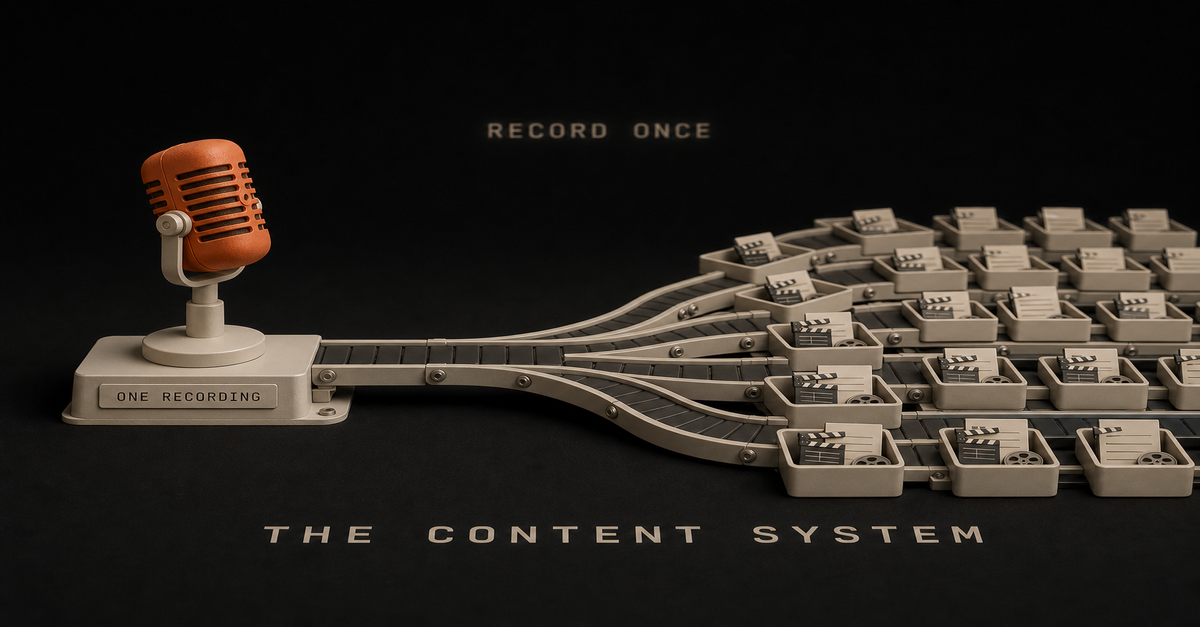
The other place Claude wins is anywhere code touches words. It writes in my voice better than anything else I have used. My whole content system runs on Claude Code, one recording out, fourteen shorts plus a newsletter and LinkedIn back.
People online argue about whether AI-written text is detectable. I genuinely do not care, as long as my vision and my voice survive into the output. So far they do.
Where ChatGPT Genuinely Wins: Everything Around the Code
Here is the section the Claude fan pages skip, and it matters, because this is half my day.
Research. When I want to study competitors or go deep on a topic before building, ChatGPT is my default now. It takes longer, but the quality is there, and it presents the result like a mini masterclass: charts in the output, tables, a real interface instead of a wall of terminal text.
With Claude I invented workarounds for this, asking for a "buddy version" instead of twenty blocks of analysis, or an HTML page instead of terminal output. Codex gives me the readable version right out of the gate. It runs a bit verbose, which you can tune in its agent config, and I take that trade.
The sparring partner. This is my favorite pattern and nobody ranking for this query talks about it. Both agents have access to the same repo.
So when Claude Code produces a plan, I have Codex challenge it, and it is smart about it, routing to a heavier model when the review deserves one. One agent builds, the other pokes holes, and I only step in to break ties.
You can run it in either direction: plan with Claude, execute with Codex, or the reverse.
On-the-go voice. I take walks and review my analytics by talking to ChatGPT: why did this flop, what changed, what should I test. When we land on something, it writes the findings into a Markdown file, and I take that file straight to Claude Code to execute.
Hands down the best working loop I have found.
The voice mode has real bugs. Mine has timed out on me around the 10-minute mark more than once and made me log back in. But when it holds, a 30 to 60 minute working session on foot is a phenomenal experience.
Browser work and images. Codex driving a browser just works for the annoying manual stuff, like logging into a dashboard and pulling data that has no export API. And image generation on the ChatGPT side is, in my opinion, the best available, full stop.
I am not alone on the split. The top result for this exact query is a six-month-old r/ChatGPTCoding thread whose top take is that "Claude wants to make a more compact, more ergonomic code, ChatGPT/Codex tends to modularize sometimes to the extreme." And a 100-hour Claude Code vs Codex test on YouTube landed where I did on the creative half: "for front-end work, especially anything with real interactivity and design polish, Claude was the clear winner."The 60-second version, from my Shorts: Claude Code and Codex together: how I 10x my output.The Setup I Would Actually Run
If you are starting from zero and the $40 for both is fine:Put your project in a folder and give Claude Code the build work: the multi-step stuff, anything with creative judgment, anything that touches your writing.
Give ChatGPT the surrounding work: research before the build, data pulls, brainstorming, and voice sessions away from the desk.
Before any expensive or irreversible step, have the other agent review the plan. Same repo, fresh eyes, zero ego.
Route the output of thinking sessions into Markdown files so either agent can pick up where the other stopped.That last one is the quiet unlock. The two stacks do not talk to each other natively; a shared repo full of plain files is the bridge.
Both Stacks Cost $40 Together, and Both Break in Predictable Ways
I pay for the top of both ladders, but you do not have to.My actual Claude billing. The same Claude Code agent is included from the $20 Pro tier; Max just raises the ceiling.And the other side of the split: my ChatGPT subscription. Codex comes with the paid plans; the $100 tier is 5x the usage of Plus.
The failure points, honestly:Capacity, not capability, is what you buy up. Heavy agent work burns the allowance on either side; on Claude the fix is the tier, not a different model. Claude Pro vs Max covers when that jump is worth it.
Codex runs verbose by default, and its deep research mode is slow. I do not time it, but I never send it something deep when I need the answer in the next ten minutes.
ChatGPT voice sessions can drop. Mine has timed out around 10 minutes in and forced a re-login. Annoying, survivable.
Two subscriptions is real money. $40 a month minimum for the both-agents setup. If that is not obviously worth it for what you build, start with one.Who Should Pick Which
Pick Claude (from $20) if coding for you means building real things: agents, pipelines, a product, anything where taste and multi-step execution decide the outcome. My most serious builds live here, and I would start here again.
Pick ChatGPT (from $20) if coding is one of ten things you do. It builds impressive things too, websites are easy for it, and it is the better everyday companion: research, voice, browsing, images, quick answers. A good generalist is not an insult.
Pay for neither if you have not yet hit the wall where a chat window stops being enough. The free tiers will tell you when you are ready for an agent.
Pay for both if you build weekly. One writes, one reviews; one executes, one researches. If either is your bottleneck at work, the Claude at work hub covers the non-coding half of this decision, Claude Cowork included. If your real question is agents versus automation platforms, that is AI coding agent vs workflow automation, and if Gemini is in your bracket, start with Claude vs Gemini.
How I Tested This
This page is not a benchmark run. It is the split from paying for both stacks (Claude Max and ChatGPT Pro), running Claude Code and Codex on the same repos as a daily habit, and shipping real systems with them: a video-editing agent, a content pipeline, this website. Billing screenshots above are mine. Where I state a plan fact, it links to the official page, and the live numbers stay current on my AI plan tracker.
Published August 29, 2026. Last reviewed August 2026.
Quick answer: my whole content operation runs on one rule: record once, systematize everything after. One talking-head session becomes a batch of 14 shorts, and the same week's thinking becomes blog posts, a Tuesday newsletter, and LinkedIn posts, all run by systems I built using Claude Code for content creation, described to it in plain English, around a full-time job. This page is the actual system, documented: the pipeline, the weekly clock, what breaks, and the smallest version worth stealing.
Call it the Ship Lean rule: record once, systematize after. That is how one person stays alive on five surfaces.
Published August 28, 2026. Last reviewed August 2026, against the pipeline I am running this week.
I would not survive without this. That is not drama; it is math. A single person working full time cannot manually produce daily shorts, weekly long-form, a newsletter, LinkedIn, and a blog. With systems, I do.I walk through this on camera in How I Run a 14 Shorts/Week Content Op in 5 Hours (26 min).One recording feeds seven stages, and I only own two of themStage
What happens
Who does it1. Record
One talking-head session on my phone, handheld mic
Me, the only unautomatable part2. Cut
Transcribe, strip retakes and dead air, render clean cuts
Claude Code system3. QA
The cut's transcript is compared against the original; ship or fix
System checks, I approve4. Polish
Title overlay, captions, proof screenshots, color, audio mastering
System, with my review5. Schedule
Batch-upload to TikTok, YouTube Shorts, Instagram
System via a scheduler6. Repurpose
Newsletter and LinkedIn get native rewrites of the week's ideas
System drafts, I edit7. Learn
Weekly analytics review decides next week's topics
System pulls, I decideThe proof is public. Here is what the output side of the machine looks like:My actual shorts page. The price overlays, captions, and proof cards on these are stages 4 and 5 of this system doing their job. Check the channel and compare recent videos with four months ago; the difference is the system maturing.
Stage by stage, in plain English
Recording is sacred; everything else is negotiable. I batch one recording session and speak every short in it, retakes and all, because the system's first job is cleaning up after me. Handheld mic, phone camera, no crew.
The cut. A Claude Code system transcribes the raw footage, finds my retakes and rambles, and produces clean edit decisions before rendering. This used to be my evenings. The important design choice: it preserves my words rather than "improving" them, because the voice is the product.
The QA gate. Every cut gets re-transcribed and compared to the original, and the system has to answer one question: did the edit clip a word or break a sentence? Ship or fix, with timestamps. Gates like this are the difference between a system and a slot machine.
Polish. Titles get placed in the safe zone, captions get styled and checked against the transcript, real screenshots get captured for any claim that needs proof on screen, and audio gets mastered to broadcast loudness. Every step here started as something I did badly by hand at midnight.
Repurposing is a rewrite, never a copy-paste. The newsletter is not a transcript dump; it is the week's idea rebuilt for email. LinkedIn posts are rebuilt for LinkedIn. The thinking transfers; the format never does. This is the single most copied mistake in repurposing advice, and refusing it is why the downstream channels actually work. My older post on the fan-out idea, one YouTube video into 13 content assets, covers the map; this page is the machine that runs it.
Approving beats producing: my weekly clockOne sitting: topic selection, driven by last week's numbers, not vibes.
One sitting: the recording batch.
Unattended: cutting, QA, polish runs.
Short gates through the week: I approve cuts, titles, and the final schedule. Approving beats producing; that is the whole trade.
Tuesday: newsletter ships.
Friday: the blog engine publishes its batch, this post being an output of exactly that system.My honest total attention: a few focused hours a week on content that used to take all of them.
What breaks, because something always does
Documenting a system without its failure modes is advertising. On r/NewTubers, the question "How are people pumping out edited YouTube videos so fast?" pulled 110+ comments in four weeks (the thread); the honest answer in my case is gates, not speed.
Mine, this month alone: a captioning step once spliced the wrong video's captions in because two jobs shared a folder, caught at the QA gate. The editor occasionally proposes a cut that clips a word, which is why the transcript-compare gate exists.
An automated pacing pass got rejected three times in one week and we shipped the un-paced versions, because the gate said the "improvement" was not one. And my newsletter ran with broken links for longer than I want to admit, which is why analytics review is now a scheduled stage instead of a guilty thought.
The lesson under all four: automation without a checking step is just faster mistakes.The 60-second version, from my Shorts: This Claude Code Skill Ships 14 Shorts a Week for Me.Steal this: the minimum version
You do not need my whole machine. The version worth building first, doable on one $20 AI plan and zero code:Write your process as numbered steps. If you cannot, stop here; that is the actual blocker.
Automate the transcript. Record once, get text. Every downstream asset starts from text.
Build one rewrite lane, not five. Pick the platform you care about second-most and have Claude rewrite your recording's idea natively for it, with your three best posts as the style reference.
Add one QA question per stage. "Did it clip words?" "Does this sound like me?" A gate a day keeps the slop away.
Only then add platforms. Each new surface is a new rewrite lane on the same recording, not new work.If you are non-technical and post weekly, build steps 1-3 and stop. If you already record long-form, start at step 3 and add one rewrite lane. If you have no consistent recording habit, none of this helps yet; fix that first.
The deeper walkthrough of that starter shape is in the content repurposing workflow, and if you are deciding which AI subscription carries it, start with Claude Pro vs ChatGPT Plus. The wider map of what I run lives at my AI systems page.
This costs me subscriptions and one upfront month of evenings
Subscriptions: I run the heavy stack because the machine earns it, Claude at the top tier plus two $100 plans I compared here, and a scheduler (I use Blotato; the tool matters less than having one). I deliberately skip the repurposing SaaS lane, the Opus Clips and Repurpose.ios of the world, because a clip-cutter without my gates is just faster slop; the same logic applies to wiring this through Zapier or n8n before the process itself is solid.
A leaner copy runs on one $20 plan and patience. The real cost was upfront: weeks of evenings building stages with Claude Code in plain English and teaching the gates my taste. I documented that spend honestly in my real Claude Code usage.
How I know what is on this page
This is not research; it is my own operation, described. The output is publicly checkable on the shorts channel, this blog's weekly schedule, and the newsletter. The failure stories are from my own logs this month, kept in because a system page without failures is fiction. Where a number is fuzzy, like hours per week, I gave you the honest range instead of a marketing one.
Quick answer: I pay $200 a month for Claude Max 20x, I use Claude Code most days, and I almost never hit a usage limit. Across nine weeks of my own logs, limit and overload events account for about 0.05% of 220,861 log lines.
The reason is not restraint. It is that 97.4% of my tokens are prompt cache reads, not new work.
Heavy usage looks enormous and is mostly cheap context re-reads. That single fact is missing from every "am I using too much" thread I have read, so I mined my own logs and published the numbers.
One thing up front: these are one operator's numbers on the top consumer tier, with specific habits. They are not a benchmark and they are not what your usage will look like.I walk through this on camera in Every Dollar I Spend on AI Automation (Real Numbers) (10 min).How I measured this, and what I cannot prove
Credibility here comes from the caveats, so they go first rather than in a footnote.
Raw verified window: June 11 to August 14, 2026. I streamed all 1,587 session log files and deduped token counts by request ID so retries and repeated writes do not double count.
Lifetime figures: these come from Claude Code's own stats cache covering December 31, 2025 to August 11, 2026. I label them "as reported by the app" everywhere they appear, because the raw logs from before July were rotated out and I cannot independently verify them.
That distinction matters. The headline number people would want me to lead with, 64.4 billion lifetime tokens, is the weakest number I have. The nine-week verified figure is the one I would defend.
One more honesty note, because it is funny and it tells you something about log data: my longest recorded "session" runs about nine days. That is not a nine-day session. That is a terminal window I left open.
If a stat below has no caveat attached, it came from the verified window.
The numbers
Verified, nine weeks (June 11 to August 14, 2026):Measure
ValueTotal tokens
11.29BPrompt cache reads
97.4% of tokensGenuinely new output
29.8M tokens (0.26%)Biggest single day
1.29B tokens (August 7, a Friday)Limit / overload events
119 hits across 220,861 log lines (**0.05%**)Median session length
3.2 minutesSessions under 1 minute
~30%90th percentile session
94 minutesMedian messages per session
53As reported by the app (Dec 31, 2025 to Aug 11, 2026): 2,742 sessions across 159 active days, roughly 17 sessions per working day, 64.4B tokens.
Model mix by request, nine weeks:Model
Share of requestsOpus
60%Fable
27.8%Opus 4.8
9.9%Sonnet
2.2%Haiku
0.04%Time of day: activity peaks at 8 AM and again from 3 to 4 PM ET. Dead between 4 and 6 AM.
The 97.4% is the whole story
If you take one thing from this page, take this.
Cache reads are not new work. When an agent works in a repo, it re-reads the same files, the same instructions, and the same conversation over and over. Anthropic caches that, and a cache read costs a fraction of fresh input.
The API price sheet makes the ratio concrete: Opus 5 input runs $5 per million tokens while a cache read runs $0.50. Ten to one.Anthropic's published API rates, captured August 14, 2026. The read row is why 11.29 billion tokens is a much smaller number than it looks.
So "64 billion tokens" is not 64 billion tokens of thinking. It is a small amount of new reasoning wrapped in an enormous amount of cheap re-reading.
This is why an extreme user rarely hits the wall. It is also why the token numbers people post in Reddit threads are almost meaningless without the cache split, and nobody ever posts the cache split.
Median session: 3.2 minutes
The other surprise in my own data was what the sessions looked like.
I expected marathons. I got quick draws.
Half my sessions are under 3.2 minutes and about 30% are under a single minute. The long tail is real, with a 90th percentile of 94 minutes, but the everyday pattern is: open it, ask for the thing, close it.
That maps to how I actually work, and it is worth saying because "power user" imagery usually shows someone locked in for six hours. Mine looks more like a couple of dozen short visits a day, going by the app-reported session count against active days.
The day the limit taught me routing
Here is the anecdote that changed my habits, and it is not flattering.
I was using the top model to QA a skill. Not to build anything. Just to check my work.
I burned more than 20% of my usage in one day. By day two or three I was at roughly 50%. By day four I was at 70 to 80%.
And I started getting stingy. Damn, I thought, I should not be using the top model for that.
The limit never actually blocked me. It taught me routing.
That is the reframe I would hand to anyone panicking about caps: the limit is not a punishment, it is a pricing signal. It tells you when you are spending a premium model on a commodity job.
I want to be honest about the current state of this too, because my own data could be read as bragging. I hit the weekly wall this week. On the 20x tier. That was me riding long sessions up to the maximum context window until they auto-compacted, which is exactly the habit I am about to tell you to fix.
The wall is real even at $200 if your habits slip.
Habit 1: a context meter and a fresh-session handoff
This is the one where most of my spending was hiding.
I run a context meter in my status line. It shows green, yellow, red. Around 500k it visually grabs my attention.
At that point a hook fires and auto-writes a NEXT-STEPS markdown file at the repo root. I close the window, open a fresh session, say "read the next-steps file," and carry on with zero context but the same knowledge.
Two reasons this matters, and the second one surprised me:At 800k context you burn tokens dramatically faster, because every single message re-reads all of it.
Ironically, the quality deteriorates. A model swimming in 800k of accumulated history is not sharper than one handed a clean brief.Before I built this, I rode sessions until they auto-compacted. That is where the 20%-plus days came from.
Habit 2: subagents, and the payload rule
The main agent stays the brain. Grunt work goes somewhere else.
Research, file sweeps, mechanical checks: I spawn those to subagents. Each one gets its own context window, so five or ten of them can run a large parallel sweep without touching my main session's budget at all.
The catch is real and most people hit it: give them a good payload. Clear instructions and the right tool access up front.
Send a subagent off with a vague one-liner and it will do basic research and hand you garbage back. The parallelism is free. The quality is not.
Habit 3: model and effort routing
Sonnet 5 is the floor for grunt work. Haiku only for genuinely mechanical jobs like renaming files.
Opus at medium effort handles routine, deterministic work. A LinkedIn post I build the same way every time does not need more than that.
Opus at high effort is for research and for leveling up skills. Opus hard is amazing, and honestly I underrated it for weeks by leaving it on medium.
The top model comes out only when the problem is genuinely hard.
The part people miss: the effort dial is part of the budget, not just the model name. Moving from medium to high changes both cost and quality, and switching that dial deliberately did more for my output than any model upgrade did.
What a heavy day actually looks like
The biggest day in the verified window was August 7, at 1.29 billion tokens. It was a Friday, and that is not a coincidence.
Friday is content day:Shorts scripts, including scraping competitor comments and X for topics
Blog work driven off Search Console opportunities, both new posts and enriching existing ones
The newsletterThe rest of the week is lighter: analytics reviews asking where we fell short, and tinkering to level up skills.
That tinkering compounds in a way that is easy to miss. My shorts skill started as "generate scripts." Then it found topics. Then it wrote in my voice. Now it edits the videos. I record 14 shorts in about 45 to 60 minutes, spend roughly 15 minutes editing, and then a polish skill runs for two to three hours autonomously.
Longform editing went from about two hours to 10 or 15 minutes through the same iteration loop. The current hook-animation work I would grade a C, and I expect to get it to an A the same way.
That is what the token count is actually buying. Not chat. Compounding tooling.The 60-second version, from my Shorts: My Real Claude Code Agentic OS Runs 6 Weekly Crons.What I would tell you to do with this
Do not use my numbers to justify the $200 plan. Read them the other way. A heavy daily user on the top tier sits at roughly 0.05% limit friction, which means I have headroom I am not using, and I still got walled once by bad habits. Habits move this number more than tiers do.
Do not read a big token count as a big workload. Ask for the cache split. Without it the number means nothing.
Fix context before you fix your plan. The fresh-session handoff was worth more to me than a tier upgrade would have been.
If you are choosing between the two Max steps, the measured version of that decision is Claude Max 5x vs 20x. If you are earlier in the ladder, Claude Pro vs Claude Max and Claude usage limits explained cover the mechanics I am measuring against here.
One last thing, and it is the reason I published my own logs instead of another opinion piece.
The only difference between AI slop and us is we actually have our experience. That is my rule, and it is why this page has numbers in it.
Published and last reviewed August 14, 2026. Verified figures come from 1,587 local Claude Code session logs streamed and deduped by request ID over June 11 to August 14, 2026. Lifetime figures are from Claude Code's own stats cache and are labeled as reported by the app throughout. Plan mechanics and API rates checked against claude.com/pricing that day. These are one account's numbers on Max 20x, not a benchmark.This post is part of Claude at Work, the hub with every plan decision, task comparison, and setup guide for using Claude at your job without code.
Quick answer: ask one question before anything else. Does this need to run without you, or does it need to think?
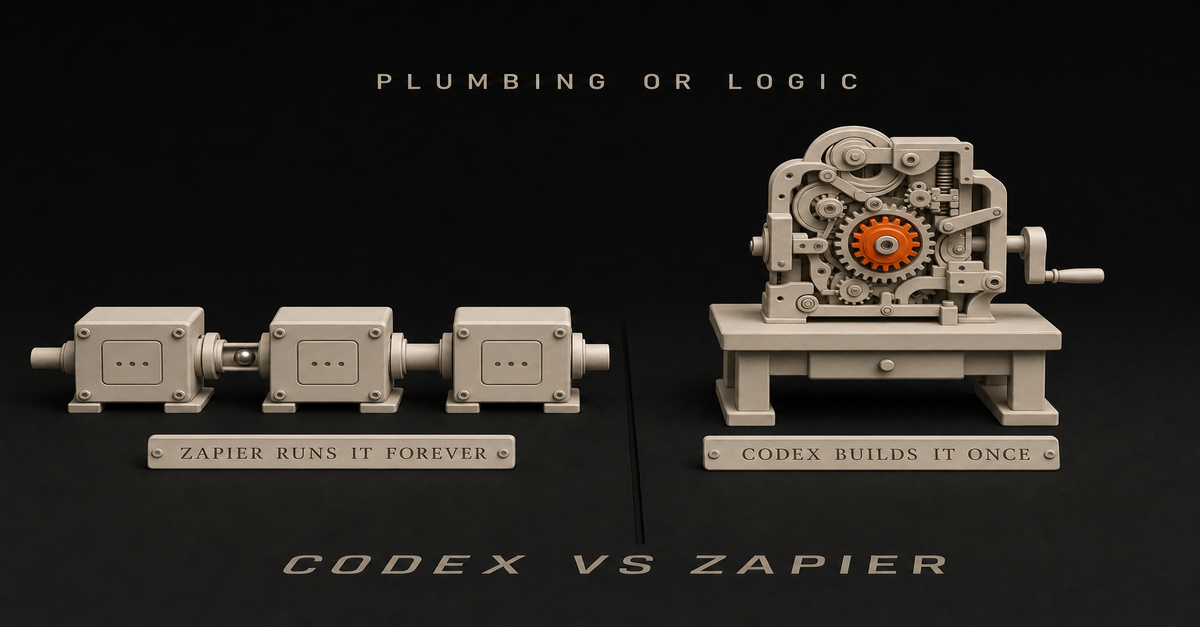
If it truly has to fire on a trigger forever, with stored credentials and retries and a run history when it breaks, that is connector work. Everything else is agent work.
And here is my actual answer, which is not the one most comparison pages give: for most people asking this in 2026, I would point at Codex. Even if you are new. Even if you think you need something visual.
I moved about 47 automation steps out of a visual builder and into code. I kept exactly one workflow running. That experience is why I answer this the way I do, and why the one I kept matters as much as the 46 I did not.
The actual difference, in plain EnglishConnector tool (Zapier, Make, n8n)
Coding agent (Codex, Claude Code)What the work looks like
Trigger in app A to action in app B
"Build me the thing that does X"Runs when
On a schedule or trigger, without you
When you run itWhat you get
Runs, logs, retries, credential handling
Files, code, working output you ownWho handles failures
The platform surfaces the failed step
You doApp coverage
9,000+ apps out of the box
Whatever has an APIBest at
Repetitive plumbing, forever
One-off or complex logicThe clearest statement of this I've seen wasn't from either vendor. It was a Reddit comment that Google now features at the top of this exact search. u/ergod_dev on r/automation: "Connector tools (Zapier, Make, n8n) are best when the work is 'trigger in app A causes action in app B.' … Code-and-deploy tools (Replit Agent, Cursor, Claude Code) are best when the task is 'write me an actual script that does X' and you're okay running it yourself. What kills people is trying to do agent-shaped work in a connector tool or vice versa."
That last sentence is the whole failure mode.
Why I'd still say Codex, even to a beginner
This is where I part ways with most of the advice on this topic.
The standard answer is: beginners need something visual, so send them to the connector. I do not think that is true anymore.
If you are staring at this going "I don't know what to do, I need something I can see," I would still tell you Codex. It is not as intimidating as a full coding terminal. It looks almost like a chat window.
At that point it is honestly not even Codex versus Zapier. It is a smart assistant that knows how to code versus Zapier. You talk it out, and it gets things done a lot faster than clicking through a canvas.
Because here is the thing nobody selling connector tools mentions: the visual builder is only simple until the logic is not.
I was in an interview once where the Zapier workflow would not work. We were pulling the wrong record for the test. If you have built in these tools you know the dance: you need to pull a sample record that passes certain criteria so you can continue building the steps downstream. That is not simple. That is fighting the tool's model of the world instead of doing the work.
It is clunky. In my opinion it does not hold up for how I build now.
And if you genuinely want a visual workflow tool, I would not pick Zapier at all. I would use n8n. It is more fluid, and the same logic that takes twenty if-then conditions in Zapier is often about five nodes in n8n.
A little more daunting to look at. Easier once you are in it.
But if you are going to build, the coding agent wins hands down.
The honest caveat in Zapier's favor
I do not want to sell you a clean story, so here is the strongest point on the other side.
Zapier has far more app connectors out of the box. Zapier MCP advertises 30,000+ actions across 9,000+ apps. That is a genuinely large surface you do not have to build.
With a coding agent, when there is no connector, you connect via API instead. In practice that ends up being about the same thing, with more control and a bit more setup.
Where Zapier is properly ahead is the boring, unglamorous layer: managed credentials, retries, and a run history that tells you which step failed at 3am. That is real infrastructure and an agent does not give it to you for free.
Which is exactly why I kept one workflow instead of zero.
What I actually did: 47 steps out, one kept
Here is my migration, and it does not end the way these stories usually do.
I ran a serious setup in a visual builder. To be precise about what tool: it was n8n, not Zapier. For content it was genuinely good. It would write, it would post, it would call APIs.
The reason I left is the 47-node problem. A complex process might be 47 steps on a canvas. Step one is "scrape this," fine. But then it is do this, then do that, and now you are embedding complex prompts inside an agent node and wiring specific tools to it. It takes an hour to build something you could have tested and shipped in that same hour as a skill.
Those 47 nodes became one file, with far less to maintain.
But I kept one workflow running, and I still have it. It is a scheduled scraper experiment on a Mac mini: deterministic, on a timer, dirt cheap. Code would not make it better. It would just make it mine to maintain.
That survivor is the honest boundary of this whole argument. My work moved to code because it was agent-shaped, not because connectors are obsolete. My automation was mostly "think, then write, then decide," which is terrible connector work and great agent work.
If your automation is "when a form comes in, add a row and send a Slack message," you would be moving in the wrong direction by rebuilding that in code. That job is plumbing, and plumbing belongs in a connector.
I moved because of what my work was. Check what yours is before you copy me.
Should you wire a coding agent to a connector?
Usually, no. I would talk you out of it.
If the app has an API, connect to it directly from the agent. Adding a connector layer in between gives you a middleman for something the agent can already reach, and now you are maintaining two systems and a subscription instead of one.
That said, the pattern is real, documented, and mainstream. It is not a fringe hack, and if you are already deep in Zapier it is a reasonable way to get the agent talking to your existing stack.
So here is how to do it if you decide the middleman is worth it.
How to use Zapier with Codex, step by step
Per Zapier's own guide, the setup is three steps:Open the Zapier MCP dashboard and select + New MCP Server.
Choose "Other" as the client when asked what you are connecting.
Configure your first action, which is the specific app-and-verb pair the agent is allowed to call.That gives Codex what Zapier describes as "governed access to 9,000+ apps and 30,000+ actions."Zapier's own guide, captured August 14, 2026. Note who is describing whom: the connector vendor is the one documenting that the coding agent borrows its app layer.
Two things worth knowing before you build on it. Zapier draws its own line between the products: Zapier MCP "runs in chatbots like Claude and ChatGPT," while the SDK "runs in code files." And every worked example in Zapier's Codex guide is a developer example: filing a GitHub issue from a failed test run, turning a Jira ticket into a scoped plan, logging deployments to a spreadsheet.
The version for a solo operator who is not shipping to a Jira board now lives on its own page: how to use Zapier with Codex, with the full click-through steps, the scoping safety trick, and the one-direction catch (Codex can reach into Zapier; Zapier cannot start Codex).
Which one you need
Use a connector tool when:the work has to happen on a trigger or schedule, without you present
it moves data between apps you already pay for
it needs credentials, retries, and a run history when something breaks
the logic is simple but the reliability mattersUse a coding agent when:the task needs judgment across files and context
the logic is genuinely complicated, the kind that turns into a mess of branches in a visual builder
you want to own, version, and read the thing afterward
it's one-off or occasional, and you're fine running it yourself
you are learning, and you would rather talk the problem out than click it outIf you need both, that's normal. Build with the agent, run the repetitive part on the connector, and keep a human approving anything public.
The mistake: making one tool do both jobsMistake
What happensComplex reasoning stuffed into workflow nodes
Hard to version, review, and debug: the 47-node problemA coding agent used as a permanent scheduler
Weak run history and credential handling, fragile recurrenceAutomation publishing straight to the public
Fast mistakes with real consequencesAn agent step added to every workflow
Higher cost, slower runs, harder debuggingThe r/n8n version of this, from u/tesslate after testing the same workflow four ways: n8n is for "trigger → call → write somewhere" flows, while agent work needs "a real workspace." The tool "wants to be a flow, not an environment." The top reply put it plainly: "The mistake is trying to make one tool do both."
The decision rule
Ask one question: does this need to run without me, or does it need to think?
Runs without you, on a trigger → connector tool.
Needs to think, across context → coding agent.
Both? Build it with the agent, schedule the boring part on the connector, and approve anything public yourself.
Codex builds. The connector runs. A human approves. That is my split, and it is the one that survived my migration.
And if you are new and just want one thing done this week: pick the task you keep redoing by hand because it needs a judgment call each time, and build that with the agent. If instead your task is pure app-to-app plumbing, start with the connector. Either way you will know within days, which beats another month of comparing tools.
FAQ
Is Codex a replacement for Zapier?
Not structurally. Zapier's own docs describe Codex as focused on code and a small set of built-in integrations, reaching other apps through Zapier MCP. Codex does not remove the need for triggers, credentials, or run history. It does replace most of the logic people used to build on a canvas.
Can Codex do what Zapier does?
Mostly. Zapier has more connectors out of the box, and where one does not exist you connect via API from the agent instead, which works out about the same. What you give up is managed credentials and run history.
Do I need both?
Many people don't. If your automation is app-to-app plumbing, a connector alone is fine. Add a coding agent when you're building something with real logic in it.
Is AI automation dead now that Codex exists?
No. Coding agents changed who writes the logic. They didn't remove the need for scheduled, credentialed, retryable plumbing between apps.Next, compare the two concrete tools in more depth: Codex vs n8n. If you're picking your whole toolset, see the AI stack for solo founders.
Published July 24, 2026. Last reviewed and updated August 14, 2026: corrected the migration receipt to "kept one workflow" from the earlier "kept nothing" phrasing and made clear it was an n8n migration, rewrote the title and opening verdict, and added the step-by-step Zapier-with-Codex setup. Zapier MCP setup steps and app counts verified against Zapier's own documentation that day, linked inline. Zapier pricing was not verified for this update and is deliberately not quoted.
Quick answer: If you do not write code, use Cowork. But the reason everybody gives for that answer is now wrong, so it is worth thirty seconds of your time to get the real one.
The rule I give people: Chat answers. Cowork does your office work. Claude Code builds software.
Searching for "cowork vs code", "Claude Code vs Cowork", or "when to use Claude Cowork vs Claude Code"? You are in the right place. The fork is not the interface. It is what you are handing over.
The correction: the terminal fork is dead
The earlier version of this page told you the answer came down to one question: do you want to click, or do you want to type commands.
That was the whole thesis and it is no longer true.
Claude Code ships in the desktop app. From Anthropic's own Cowork FAQ: Claude Code "is available in the terminal, in the desktop..." It is not a terminal product with a GUI cousin. It is a product with two front doors.
Here is what that looks like on my own machine.My Claude desktop app, September 5, 2026. Claude Code and Cowork are sibling tabs in the same settings window. There is no terminal in this picture.
So if you have been avoiding Claude Code because you do not want to live in a command line, that reason has expired. You may still not want it. Just not for that reason.
The difference in one tableClaude Cowork
Claude CodeWhat you hand it
A job to finish
A codebase to buildWhere it lives
Claude desktop app, with a phone beta
Terminal and desktop appWhere tasks run
Anthropic's servers; the desktop app bridges your local files
SameBuilt for
Files, docs, email, reports, browser work
Software: code, projects you are building, custom systemsSetup required
None. It is in the app on every paid plan
None on desktop; a terminal install if you want the CLIBest at
Delegated and recurring work, scheduled tasks
Complex builds, custom scripts, full step-by-step visibilityIncluded on
Pro, Max, Team, Enterprise
All paid plansSame AI engine?
Yes
YesYou are not choosing what to buy. Both come with your paid plan. You are choosing which door to open.
Same engine, different job
People treat Chat, Cowork, and Claude Code like a power ladder: Chat is the starter tier, Code is the pro tier, Cowork sits in the middle. That model is wrong and it is the single biggest source of confusion I see.
Anthropic could not be more direct about it:"Cowork and Code run on the same engine. Both are Claude Code underneath."And the replacement fork, in Anthropic's own words: "Cowork is for delegating to Claude. Code is for building software with Claude. Most knowledge workers will live in Chat and Cowork."
This gets debated constantly. u/SilverConsistent9222 on r/Anthropic put the trap well: "They're often discussed as if one is an upgrade over the other. That's not really accurate. They operate in different environments."
The loudest version of the confusion is a thread titled "What's the point of Cowork when you have Claude Code?", which pulled 316 upvotes and 149 comments on r/ClaudeAI. That question gets asked because the interface answer never satisfied anyone.
The cleanest rule of thumb I have seen came out of u/Talley-Ho's thread on the same question: codebase goes to Code, everything else file-based goes to Cowork.What Cowork gives you out of the box
This is the list that should have been on this page all along, and almost no ranking page reproduces it. Per Anthropic's current Cowork documentation:Access local folders with no upload step
Navigate your logged-in browser through Claude in Chrome
Reach desktop apps via computer use
Delegate parallel work, several jobs at once
Run tasks on a scheduleOne honest caveat, because Claude Code Desktop has been catching up fast: several of these are no longer strictly exclusive to Cowork. The distinction that holds is that in Cowork they are the product, ready without configuration, while in Claude Code they are things you can set up. Check Anthropic's current docs for both before you treat any single row as a hard gate.
And one that post-dates this page's last rewrite: since August 26, 2026, Cowork has its own browser built into the desktop app.
That computer-use row is the one to sit with, because it is the capability that has nothing to do with avoiding a terminal.
To be precise about my own setup: I have a shorts pipeline that logs into my Mac mini, takes screenshots, clicks around and opens real apps to run experiments. That one runs in Claude Code, not Cowork. I mention it because it is the kind of work Cowork's computer use puts within reach of someone who never opens a terminal, not because Cowork ran it.
Scheduled tasks are the least-hyped item on that list and probably the most useful. You set the schedule once and it just runs.Real people use this for unglamorous, valuable things. A product manager, u/RusticGroundSloth on r/ClaudeCowork, described his setup:"there's a 'director' cowork project that pulls all of my Teams and Email from the last 24 hours every morning at 6:00 a.m... Claude Cowork has essentially become my project/program manager and is saving me HUGE amounts of time... I realize a bunch of this could probably be done in Claude Code but it was extremely easy to set up in Cowork and I haven't had to think about it since."That last part is the whole point. Could have been done in Code. Was not worth doing in Code.The 60-second version, from my Shorts: You don't need Claude Code. Cowork does 90% of it.Everything Cowork hands a non-coder lives behind this one plus button: files, a screen recording that becomes a skill, your skills, your connectors, plugins. None of it is a terminal.
Where Claude Code still wins
Code is for building things. That is the line, and it holds.
If you use Cowork every day, you are going to do most things. You will get your job done, you will build skills, you will run genuinely powerful workflows. That covers the large majority of knowledge work.
But if you want to code, hence the name, that is where Claude Code starts. Build a game. Build an app.
And "an app" is broader than it sounds. I have a skill that edits my videos. That is not an app in the App Store sense, but it is a real piece of software with many moving parts, and that is Claude Code work.
The other thing Code gives you is visibility into every step the agent takes. That is why developers will not give it up, and it is a legitimate reason for a non-developer to graduate too, eventually.
Which is why you should ignore a whole category of online takes. Developers keep posting some version of what u/gatsbtc1 wrote: "Everything cowork can do, so can code. And code is so much more robust."
True. And irrelevant. Everything a car does, a manual transmission race car also does. You still should not learn to heel-toe shift to get groceries.
How I actually split them, and why I am the wrong model
Here is the honest version, including the part that does not flatter me.
I do not switch between them mid-job. I want to be straight about that, because "tell me about a job that moved from one to the other" is a great question and I do not have a story for it. I use both. I do not toggle.
For me, it is Claude Code, because it does everything I need and I am already fluent in it. Going from Claude Code back to Cowork would feel like a downgrade from what I am used to.
But that is a fact about my history, not about the products.
The reason I got good at Claude Code is that I decided to, so I could make YouTube videos about it. And getting there was genuinely rough. I would see the hype, watch technical people using it, and think: I am pretty technical, why can I not get into this?
I did not even know what Claude Code was. I knew it was in the terminal. Did I have to install something? I did not know what a CLI meant.
This was over a year ago, maybe six months after it first came out, when I was mostly living in n8n.
When it finally clicked, it clicked hard. It just made sense to me. But I am comfortable staring at a terminal window, and I do not recommend that path for everybody.
Here is the part I would want you to take from this: if I were starting today, and Cowork existed, I would probably have started there. The transition I made was painful and it was only worth it because I had a specific reason.
You probably do not need to repeat it.
The intention behind having both seems clear enough: if Cowork is your main driver, Claude Code is there for when something gets serious. It is the same shape as ChatGPT Work and Codex on the other side of the market. Nobody thinks that pairing is strange.
The usage gotcha nobody warns beginners about
Anthropic prints this in plain sight on its Cowork documentation and almost no comparison article mentions it: Cowork consumes your limits faster than Chat does.
Agentic work is multi-step work. One Cowork task that sorts a folder of 30 files is not one message; it is dozens of steps, each drawing on your allowance.
Claude Pro caps you two ways: a rolling five-hour session limit plus a separate weekly cap. On the $20 plan, heavy Cowork use will hit that, and it will feel like the product is broken.
It is not. The $20 tier is sized for chat-first use with some agent work on the side.
On the narrower question people keep asking, whether Cowork and Claude Code burn your plan at different rates, there is a 27-upvote thread asking exactly that. I am not going to give you a ratio, because Anthropic publishes no multiplier and every number circulating is somebody's estimate from their own usage. What is documented is that both draw from the same pool as your chat.
If either one becomes your daily workhorse, that is what Claude Pro vs Max is about.
If you are choosing between Chat and Cowork instead
A lot of people who land here are actually asking the earlier question: when does a job leave the chat window at all?I walk through that one on camera in the Chat vs Cowork video (11 min).Anthropic's own distinction is a good one: Chat is a conversation you steer turn by turn; Cowork is a delegation. Chat gives you text you will read. Cowork gives you a finished file or an action taken.
Which one should you open?You do not write code: Cowork. It is already in your Claude desktop app on every paid plan.
Your work is documents, email, spreadsheets and reports: Cowork. That is what it was built for.
You want a chore to just happen every morning: Cowork scheduled tasks.
You want Claude to click around real apps or your browser without setting anything up: Cowork. Claude Code can be driven to do this too, but Cowork is where it is a built-in feature rather than something you wire together.
You are building software, a game, an app, or a complex reusable skill: Claude Code.
You want every step the agent takes to be visible: Claude Code, terminal or desktop, your choice now.
You avoided Claude Code because of the terminal: that reason is gone. Try the desktop tab before you decide.How I checked this
The shared-engine architecture, the desktop availability of Claude Code, the Cowork-only capability list and the Chat-versus-Cowork distinction come from Anthropic's current Cowork and model documentation, read September 5, 2026. The built-in browser date comes from Anthropic's own announcement. Plan inclusion comes from claude.com/pricing, read the same day. The settings screenshot is my own machine on that date.
I run both daily, so the preference above is mine. The capability lists themselves are Anthropic's documentation, not my testing. What is not lived: I have not measured usage consumption between the two, and I have deliberately left that number out rather than repeat an estimate.
If you want somewhere concrete to start today, grab the 15 workday AI prompts at /start: they are built for exactly the kind of tasks Cowork eats for breakfast.
For adjacent decisions: Claude Cowork vs ChatGPT Work for the cross-vendor version, Claude Cowork use cases for what to actually run first, and Claude Cowork scheduled tasks for the recurring-work setup.
Published July 9, 2026. Last reviewed and updated September 5, 2026: replaced this page's central thesis, which claimed the fork was clicking versus typing commands, after Anthropic made Claude Code available in the desktop app. Added the Cowork-only capability list, the built-in browser that shipped August 26, 2026, an honest account of why I personally live in Claude Code and would not recommend that path, and the usage question with no invented ratio. Moved the Chat versus Cowork video out of the introduction to the section it actually answers. Product facts checked that day against Anthropic's own documentation and pricing page, linked inline.This post is part of Claude at Work, the hub with every plan decision, task comparison, and setup guide for using Claude at your job without code.
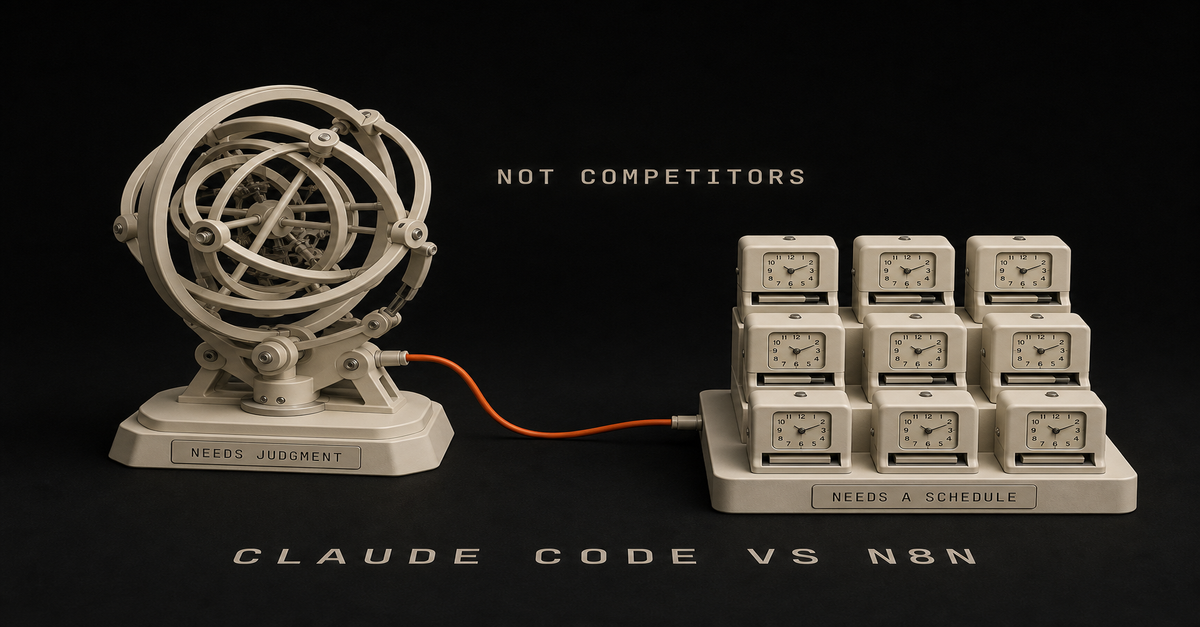
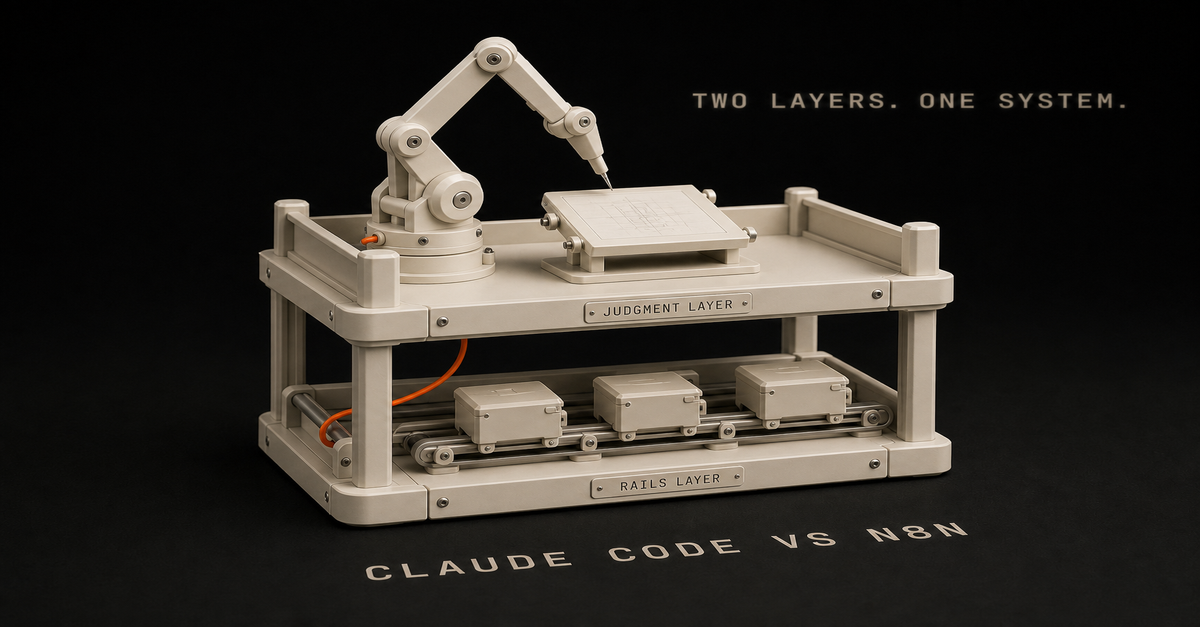
Whether you search it as "Claude Code vs n8n" or "n8n vs Claude Code," the answer is the same: they are not competitors. They are different parts of the same operating system.
Use Claude Code when the task needs judgment, file edits, writing, reasoning, or codebase awareness.
Use n8n when the task needs triggers, data movement, scheduled runs, retries, and integrations.
Heads up: some links in this post are affiliate links — a small kickback to me at no cost to you. I only recommend tools I've actually run.
The boring answer is the useful answer: Claude Code builds and thinks. n8n runs and routes.
Quick comparisonUse case
Claude Code
n8nEdit website files
Best
WeakBuild an internal script
Best
PossibleTrigger when a form is submitted
Possible
BestMove data between tools
Possible
BestWrite content in your voice
Best
Needs LLM nodeSchedule a daily workflow
Possible
BestInspect a repo and make changes
Best
WeakRoute content through approvals
Possible
BestThe 10-second decision rule
Ask this:
Does the task need context and judgment, or does it need a reliable trigger?
If it needs context and judgment, use Claude Code.
If it needs a reliable trigger, use n8n.
If it needs both, use both.
That sounds too simple, but it prevents the common mistake: trying to make n8n think like an operator or trying to make Claude Code behave like a durable scheduler.Save this one. It settles the argument in ten seconds.
When to use Claude Code: messy work with context
Use Claude Code for work where the prompt is the product.
Examples:writing a blog draft from a real build log
refactoring a site page
creating a new Astro page
reviewing a workflow
generating a script
turning a messy idea into an implementation planClaude Code is strongest when it can read the surrounding context and make decisions.
Claude Code is especially strong for solo builders because your business context often lives in files:site copy
product docs
workflow notes
analytics exports
newsletter drafts
messy markdown docs
code and configThat is not a clean API problem. That is an "understand the room before touching things" problem.I walk through this on camera in How I Actually Use Claude Code in 2026 (Not Just Apps) (18 min).When to use n8n: repeatable work with triggers
Use n8n for the plumbing.
Examples:when a YouTube video is uploaded, create content tasks
when a Notion status changes, trigger a writing workflow
when an RSS item matches a topic, save it for review
every Friday, prepare the newsletter draft queue
when a form is submitted, add the person to MailerLiten8n is strongest when the workflow has a clear trigger and repeatable steps.
It also gives you visibility. When a workflow fails, you can inspect the run, find the bad node, fix the credential, retry the step, and keep moving.
That matters once the workflow touches real business operations.
The best pattern: Claude Code plus n8n plus human approval
The clean pattern is:n8n detects the event.
n8n gathers the inputs.
Claude handles the judgment-heavy step.
n8n saves the output.
A human approves.
n8n publishes or routes the result.That is the Ship Lean pattern: automation for the boring parts, human review for the parts with consequences.
Here is what that looks like for content:Step
Owner
Job1
n8n
Detect new video, build log, or GSC CSV2
n8n
Gather transcript, URL, notes, metadata3
Claude Code
Create brief, draft, edit, and file diff4
Human
Approve quality and positioning5
n8n/GitHub
Route PR, deploy, notifyThat is the version I trust. Not "AI posts directly to production while you sleep." That sounds good until it publishes something stale, generic, or wrong.
What should solo builders choose first?
If your problem is "I need to build or improve the system," start with Claude Code.
If your problem is "I keep copying data between apps," start with n8n.
If your problem is "I shipped a thing and nobody knows it exists," use both. Claude Code turns the proof into assets. n8n routes and schedules them.
Common mistake: using n8n as the whole brain
n8n can call LLMs. That does not mean the whole system should live inside n8n.
Once prompts, examples, brand rules, page templates, and content logic get serious, they become easier to maintain in a repo. That is where Claude Code shines.
Use n8n to collect inputs and trigger the run. Use the repo for durable instructions. Use Claude Code to operate on the repo. Use n8n again to notify and route the result.
Common mistake: using Claude Code for recurring ops
Claude Code can write a script. It can run a command. It can help you publish.
But recurring business operations need:schedules
retries
run history
credential handling
webhook triggers
alerts
handoff to other appsThat is n8n territory.
The Ship Lean setup I would run
For a solo builder trying to grow traffic:Claude Code owns the content system in the repo.
n8n watches for inputs: Search Console exports, YouTube videos, build logs, and newsletter notes.
Claude Code creates the page/tool/workflow draft.
The editor skill checks for thinness, reader fit, and whether the page actually helps.
Visual skill generates a diagram or comparison asset.
Human approves.
GitHub/Vercel ships.Want to estimate whether an automation is worth building? Run the automation priority audit. Want the stack cost? Use the AI stack cost calculator.
If your specific question is whether n8n should run an agent workflow, read what an n8n AI agent is and then map it with the n8n AI Agent Workflow Builder.
If you use Codex instead of Claude Code, the decision rule is almost the same. Read Codex vs n8n for the repo-agent version, or AI coding agent vs workflow automation for the broader split.
And if you have never opened a terminal at all, start one door earlier: Claude Cowork vs Claude Code - the same engine without the command line.
FAQ
Can n8n replace Claude Code?
No. n8n can call an LLM, but it does not replace a code-aware agent working inside your repo.
Can Claude Code replace n8n?
Sometimes for small scripts. But for recurring workflows with integrations, triggers, and retries, n8n is cleaner.
What is the best first workflow?
A content repurposing workflow is usually a strong first build because it turns work you already did into distribution.
Should I learn n8n if I already use Claude Code?
Yes, if you want recurring workflows that touch multiple apps. Claude Code helps you build and maintain the system. n8n helps the system run on schedule.
Last reviewed: July 2026.This post is part of the n8n AI agents hub: definitions, tutorials, workflow patterns, and the build-vs-run decision pages in one place.
Quick answer: An n8n AI agent is a workflow built on the AI Agent node, connected to tools (HTTP, database, code, APIs, or MCP servers) so an LLM can read context, call those tools, and pick the next step on its own. Without tools, it is just a chatbot in a workflow. Build one scoped agent: pick a single decision, attach the AI Agent node, wire tight tools, force structured output, test on real data, and put a human on anything that ships.
As of mid-2026, n8n also adds the MCP Client Tool (use any MCP server's tools) and the AI Agent Tool node (one agent supervising others on a single canvas). The Ship Lean pattern stays the same: Claude/Codex builds, n8n runs, a human approves anything risky.
Published June 2026. Last reviewed 7 August 2026 against the current AI Agent node docs and the n8n changelog through the 2.34 release.
If you're trying to figure out whether you even need an agent, start with what an n8n AI agent is and n8n AI agent vs workflow automation. Short version: agents are for judgment calls, not every automation.
If you want the whole path in one place, start with the n8n AI Agents hub. It links the definition, workflow pattern, builder tool, and Claude Code handoff.
If your search is specifically for an n8n ai agent workflow or n8n agentic workflow, the canonical workflow page is n8n AI agent workflow for solo builders. Use this tutorial when you want the build sequence: node setup, tools, structured output, testing, and approval.This page owns the build tutorial. The related pages own the shorter definition and workflow-example intents:Query intent
Best owner
Direct answern8n ai agent tutorial
This tutorial
Build one scoped agent around the AI Agent node, tools, structured output, testing, and approval.n8n ai agent workflow
Workflow pattern
Trigger in n8n, let the model make one scoped decision, route the result, then approve risky output.n8n agentic workflow
Workflow pattern
The agentic part is tool use plus structured decisions, not just an LLM prompt.n8n ai agent node
This tutorial
The node is the reasoning step; n8n still owns triggers, credentials, routing, retries, and run history.what is n8n ai agent
Definition page
It is an LLM-powered workflow step that can use tools and return a decision inside automation.n8n ai agent documentation 2026
This tutorial + n8n docs
n8n's docs cover the node reference; this page covers the build sequence and the decisions the docs skip.I built my first "agent" in n8n and felt very smart for about ten minutes.
Then I realized I'd just made a fancy ChatGPT call. Input went in. Output came out. Nothing decided. Nothing checked. No tools.
That's the gap nobody flags in the tutorials: dropping the AI Agent node into a workflow doesn't make it agentic. It makes it an LLM with a trigger.
This post is the version I wish I'd had when I started: what an n8n AI agent actually is, when to use one instead of a normal workflow, and the pattern I use now that keeps me out of multi-agent spaghetti.I walk through this on camera in n8n AI Agent: Build One That Actually Works (Not Theory) (12 min).Before the Node: Plan, Plan, Plan
After two years of running self-hosted n8n, the mistake I see people make most is not a wiring mistake. It is starting in n8n at all.
Figure out what you want to build an agent for before you open the canvas. This is where a chat model earns its keep - brainstorm the use case with Claude, ChatGPT, Gemini, whatever you already pay for. n8n is a time commitment. You do not want to spend hours, days, or weeks building something you will use a little bit, and you want to end up with something you can actually maintain and understand.
Once you land on one, two, or three concrete use cases: do one at a time. Build the simplest version first, then scale. If you build something complex and you are not using it a week or two later, you did not build an agent - you wasted a weekend.
The other half of the mistake is overcomplication at the node level. People hear "AI agent" and reach for the most elaborate thing on the canvas. Strip it back: an AI agent is an LLM call. What makes it interesting is giving it tools - access to your calendar, your database - so it can query and act instead of just answering.
But here is the part that will save you the most time: simpler is better, and most of the time you do not even need the tools. If a plain LLM step solves your problem, ship that. Do not rush toward the agent architecture because it sounds more impressive. More nodes does not make you smarter.
One current product detail worth knowing, because it changed: n8n's AI Agent node now requires at least one tool sub-node to be connected. Separately, as of v1.82.0 the old agent-type selector is gone - every agent is a Tools Agent. So if your use case genuinely needs no tools, the node you want is the Basic LLM Chain, not the AI Agent.
Reach for tools when the job needs them, not because the node is called "agent."
What Changed for n8n AI Agents in 2026?
n8n is no longer just "Zapier, but flexible." It is moving toward a durable AI workflow layer: agent nodes, tools, memory, structured output, retries, credentials, and run history in one canvas.
That matters because the winning pattern is not "let the model do everything." The winning pattern is:Layer
Best owner
WhyPrompt, schema, tool design
Claude Code or Codex
Repo context, writing, code, and judgmentTrigger, credentials, retries
n8n
Durable workflow operationsFuzzy decision
AI Agent node
Reads context and chooses a tool or answerPublic/customer action
Human approval
Keeps trust where it belongsAs of this refresh, n8n's AI Agent node is a versioned node with current support for tools and output parsers. n8n's own Tools Agent docs describe the agent as the piece that can choose external tools and return a standard output format. That is the part solo builders should care about: not "AI magic," but repeatable decisions with visible runs.
Two mid-2026 additions actually matter for solo builders:MCP Client Tool. The AI Agent node can now use tools exposed by remote MCP servers directly. There's also a standalone MCP Client node, so any step in the workflow — not just an agent — can call an MCP server. In plain terms: instead of hand-wiring an HTTP node for every API, you can point the agent at an MCP server that already exposes a clean set of tools.
AI Agent Tool node (single-canvas multi-agent). You can connect multiple AI Agent Tool nodes to one primary AI Agent, letting it supervise and delegate across specialized agents in a single execution, on one canvas. This is the sanctioned way to do "multiple agents" without the multi-workflow spaghetti most tutorials walk you into.Three things shipped since the last review that change the build (all from n8n's changelog):Human-in-the-loop for AI tool calls (v2.6, January 2026). You can now require explicit human approval before an agent executes a specific tool. Wherever this guide tells you to route risky output through a Slack or Telegram approval step, check this native gate first - it is built into the tool call now, so you may not need to wire the approval hop yourself.
One-click MCP servers (v2.22, May 2026). Apify, Linear, monday.com, Notion, and PostHog can be connected by picking the server from a panel and signing in. Where the MCP notes above describe pointing an agent at a server, that setup is now closer to installing an app than hand-wiring a connection.
Native web search for agents (v2.25, June 2026). An Advanced-panel toggle, rather than bolting on a search API as a custom tool.New since the July review (2.29–2.34, from the changelog):The autonomous AI Assistant (2.29.9, July 2026) is NOT the AI Agent node — don't confuse the two. The Assistant is n8n's build-time copilot: you describe a workflow in plain language and it plans, builds, test-runs, and fixes errors until the automation works. Cloud-only for now, self-hosted support promised. The AI Agent node is the runtime piece — the node inside your workflow that makes a decision on every execution. Plain rule: the Assistant helps you BUILD the workflow once; the Agent node RUNS inside it forever. Everything in this guide is about the second one, and the Assistant doesn't change a single step of it — though it's now a legitimately fast way to scaffold the boring parts around your agent.
MCP got sturdier (2.29–2.29.9): dynamic field resolution (live Slack channels, Sheets tabs, not stale lists), custom and community nodes usable in MCP workflow builds, and version history you can browse and restore. If the MCP Client Tool felt beta when you last tried it, it's grown up.
2.34 (August 2026) is plumbing, not AI: large webhook responses offload to binary storage. Only matters if your agent workflows return big payloads.The changelog as of this review (August 7, 2026): stable 2.33.6, beta 2.34.3 — the AI Assistant and MCP server updates are the entries that touch agent builders.
A note on n8n 2.0: it was a security/reliability/performance release (sandboxed Code-node execution by default, a Publish/Save workflow paradigm) - not an AI-feature release. Worth upgrading for the platform maturity; don't expect it to change how you build agents.
Use current language when you build:AI Agent node for the reasoning step
Tools for API/database/app actions — or an MCP Client Tool when a server already exposes them
AI Agent Tool node when one agent genuinely needs to delegate to another (not before)
Structured Output Parser when downstream nodes need clean fields
Memory only when the task needs prior conversation or prior user state
Retries and run history for boring reliabilityIf you only remember one thing, remember this: n8n is the runner, not the whole brain. The AI Agent node should own one fuzzy decision. Everything before and after that should be boring workflow automation — and MCP tools don't change that rule, they just make the tool layer faster to wire.
What Is an n8n AI Agent, Exactly?
An n8n AI agent is a workflow built around the AI Agent node with tools attached: usually HTTP Request, a database, Airtable, code, or other n8n nodes. That lets the LLM do three things in a loop:Read the input and current context
Decide whether to call a tool (and which one)
Use the tool's output to pick the next action or final answerThe "agentic" part is the loop. The model isn't just generating text. It's choosing actions based on what it finds.n8n's own docs, captured August 2026: the AI Agent node requires at least one tool sub-node, and the old agent-type picker is gone — everything runs as a Tools Agent now.
Without tools, the AI Agent node is a fancy LLM call. With tools, it can look things up, write to a database, hit an API, and reason about the result before answering.
For AEO purposes, this is the clean definition:An n8n AI agent is a workflow where the AI Agent node can use tools, memory, and structured output to make a judgment step inside a larger automation.n8n AI Agent vs Regular Workflow Automation: When to Use Which
I default to plain workflow automation. Agents are the exception, not the rule.Situation
Use a regular workflow
Use an AI agentInputs are predictable (form fields, structured webhook)
✅Logic fits a clean if-then tree
✅You need messy text classified or summarized✅You need it to look something up before deciding✅Output has to be structured every time, no surprises
✅Edge cases keep slipping through your filters✅Cost per run matters and volume is high
✅Rule of thumb I use:If I can write the rules in 10 minutes, it's a workflow. If I'd need 50 if-statements and still miss cases, it's an agent.A workflow that classifies email tone with keyword matching will miss "I've been waiting three weeks and this is getting ridiculous." An agent reads it and routes it correctly. That's the kind of decision worth paying tokens for.One of mine: a Reddit idea scraper I ran for months. Everything around the edges is boring workflow — the ONE agent (with its model, memory, and output parser hanging off it) exists because "is this post actually a content idea" is exactly the messy-text judgment a filter can't make. Note the Error Trigger → Gmail alert in the corner: boring reliability, wired first.
If the decision is "did the Stripe webhook fire? then send the receipt," don't put an LLM in the path.
For a deeper split, read n8n AI agent vs workflow automation. If the question is whether Codex, Claude Code, or n8n should own the work, use AI coding agent vs workflow automation.
How Do You Structure an n8n AI Agent Workflow?
Here's the layout I use now. It's not clever. That's the point.1. n8n handles the trigger and routing.
Webhook, RSS, schedule, Airtable change: n8n is good at this. Don't make the LLM do it.
2. The LLM handles judgment.
This is the AI Agent node (or a Claude Code call via HTTP). It reads context, calls tools, returns a structured decision. One agent, one job.
3. Tools are scoped tight.
Read-only when possible. Pre-filtered queries, not "here's the whole database." Every tool is one more thing you have to trust.
4. A human approves anything that ships.
Sends an email to a customer, charges a card, posts to a public account, deploys code: that goes to a Slack/Telegram approval step before it executes. The agent drafts; you click yes.
5. Claude Code does the building, n8n does the running.
I draft prompts, tool definitions, and workflow logic in Claude Code or Codex. n8n runs the workflow on a schedule. GitHub holds the workflow JSON. Vercel hosts anything customer-facing. Each tool does what it's good at.
That's the whole stack. No swarm of sub-agents. No "AI orchestrator" picking other agents. One agent, scoped tools, human in the loop where it matters.
Still deciding which side of that build/run line your work belongs on? Read Claude Code vs n8n for solo builders: short version, Claude Code owns the judgment and the code, n8n owns the trigger and the repeat.
The 2026 Build Checklist
Before you touch the n8n canvas, write these five things down:Decision
Good answerAgent job
"Score this Search Console query as BUILD, REFRESH, or IGNORE."Input
Query, URL, impressions, clicks, position, current page summaryTools
Read page content, inspect sitemap, write row to task tableOutput
JSON with decision, reason, priority, next_actionApproval
Human approves new public pages and page refreshesIf you cannot fill in that table, the workflow is not ready. You do not have an agent problem yet. You have a scope problem.
What Do You Need Before Building an n8n AI Agent?An n8n instance. When I ran n8n I self-hosted on Hostinger to skip per-execution fees — a Mac mini at home does the same job free.
An API key. I use Claude Sonnet for most agent work because the structured output behaves.
A clear, single decision you want automated
Airtable or a database if your agent needs memoryHeads up: some links in this post are affiliate links — a small kickback to me at no cost to you. I only recommend tools I've actually run.
If n8n is new to you, run through the n8n tutorial for beginners first.
Use a manual trigger while you're building. You'll run the thing 30+ times tweaking prompts, and you don't want an RSS feed or webhook firing each time.The 60-second version, from my Shorts: Build your first AI agent (no code, under an hour).Step 1: Pick One Decision
Every agent needs one job. Not three. One.
Bad: "Read my inbox, write replies, schedule meetings, and update the CRM."
Good: "For each new RSS post, decide if it's worth sharing with my list. Output SHARE or SKIP and a one-line reason."
The narrower the scope, the easier it is to prompt, test, and trust. If you can't describe the agent's job in one sentence, the agent isn't ready to be built.
Step 2: Trigger and Input
For the example, we'll keep using the content filter: an RSS feed pulls new posts, each post becomes input.
The trigger's job is to give the agent enough context to make the call: title, link, full text, source. If your input is thin, the agent's decisions will be thin too.
Step 3: Add the AI Agent Node
Drop in the AI Agent node. Connect the trigger.What the node looks like placed in a real build (a LinkedIn lead scraper I used to run): the agent sits mid-flow, and the Chat Model / Memory / Tool sockets underneath are where everything from Step 4 attaches.
Configure:Provider/model: Claude Sonnet is my default for judgment work
System prompt: define the job, the criteria, and the output format
Output parser: use structured output when another node needs reliable fields
Memory: add it only if the workflow needs prior conversation or prior user stateExample system prompt:
You are a content relevance filter for a newsletter aimed at solo AI builders
who use Claude Code, n8n, and ship products on the side.For each post, decide:
- Relevance: High / Medium / Low (does it help this audience build or ship?)
- Quality: High / Medium / Low (is it specific and actionable, or generic?)
- Decision: SHARE or SKIP
- Reason: one line, plain languageDefault to SKIP when uncertain. We'd rather miss a marginal post than share a weak one.This alone is not an agent yet. It's an LLM with a prompt. It reads, it answers, that's it.
The next step is what changes that.
Step 4: Attach Tools and Structured Output
Tools are how the agent does things instead of just saying things.
In n8n, common tool options:HTTP Request: call any API
Database / Airtable / Postgres: look up or write history
Code: custom logic when needed
Other n8n nodes: wrapped as toolsFor the content filter, attach an Airtable tool pointing at a "Shared Posts" table. Update the prompt:
Before deciding, use the Airtable tool to check the "Shared Posts" table for
posts shared in the last 30 days. If a similar topic was already covered,
lean toward SKIP unless this post is meaningfully better or newer.Now the agent isn't analyzing a post in a vacuum. It's checking history, comparing, and using that to decide. That's the loop.
You don't need n8n's sub-agent feature for this. I almost never reach for it. One agent + a few tools handles most things I've thrown at it.
When the next node expects clean data, do not make it parse paragraphs. Require structured output:
{
"decision": "SHARE",
"reason": "Specific walkthrough for solo AI builders.",
"confidence": 0.82,
"approval_required": true
}This is the difference between a demo and a workflow you can run every week.
Step 5: Wire the Decision to Action
The agent returns something like:
Decision: SHARE
Reason: Concrete walkthrough of building a Claude Code subagent. Fits the audience.Downstream, you don't need a 12-branch if-then. You need one router checking Decision === "SHARE". The complexity lives in the agent's reasoning, not in the canvas.
For anything that goes out the door, like a tweet, an email, or a published post, route it to a human approval step. A Slack message with Approve/Reject buttons works fine. The agent drafts. You ship.
If you are building this for Ship Lean-style traffic work, the approval step matters even more. New pages, refreshed titles, comparison claims, and public recommendations should not publish automatically. The workflow should prepare the draft and evidence. A human should approve the point of view.
Step 6: Test on Real Data, Not Your Imagination
Your first version will be wrong. That's fine. Plan for it.
What I run into most:Vague prompts: agent makes inconsistent calls because the criteria are fuzzy
Tool not actually wired: agent "tries" the tool but the connection is broken
Output drifts: sometimes structured, sometimes prose
Real inputs are messier than your test inputsFix loop is always: tighten the prompt, add an example or two of correct output, narrow the tool's scope.
Step 7: Add the Boring Reliability
This is where n8n earns its keep.
For any workflow you plan to keep:Log every run somewhere boring: a Sheet, Airtable table, Postgres row, or Notion database.
Save the input, decision, model, cost estimate, and approval result.
Add retries where the failure is likely temporary.
Alert yourself when the workflow fails or the output parser breaks.
Keep credentials in n8n, not pasted into prompts.AI builders love the agent part. Operators love the run history. Organic traffic comes from writing about the version that actually survives contact with real inputs.
What Does a Real Production n8n AI Agent Look Like?
When I checked my own n8n workspace, the pattern was obvious: lots of experiments, one production workflow doing a clear job.
The active workflow is not a mystical multi-agent swarm. It is a content scheduling runner:A Notion trigger starts the run.
n8n grabs the page, length, and assets.
A filter, code step, and switch route the item.
Blotato nodes send the asset to YouTube, Instagram, X, TikTok, and LinkedIn.
n8n updates the status back in Notion.The actual canvas. Notice what's NOT in it: no AI Agent node anywhere. Scheduling posts is deterministic — trigger, grab, switch, post, update. This ran my whole distribution and it's plain workflow automation end to end, which is exactly the point of the table earlier.
That is the lesson. The workflows that survive are not always the flashiest ones. They are the ones with a narrow trigger, clear routing, visible status, and boring handoffs.
Most of the other workflows in my account are paused experiments: idea engines, social research, lead routing, newsletter systems, job prep, payment reminders, and old tests. That is normal. n8n becomes more valuable when you label the experiments, retire the stale ones, and keep production workflows boring enough to trust.
The best public example from that inventory is not the active content scheduler. It is the lead qualification pattern.
The private workflow has the shape that actually teaches the idea:A webhook receives a lead.
n8n enriches the lead data.
An AI step qualifies the lead.
A structured parser turns the model response into fields.
n8n routes the result into hot lead, nurture, Slack, and email paths.That is the useful proof: the model makes one judgment call, then n8n routes the outcome. For a public template, I would not publish the private workflow raw. I would publish the cleaned pattern instead, with fake sample data and no credentials.
You can download that starter pattern here: n8n human approval workflow JSON. I also published the proof asset on GitHub: n8n AI lead qualification workflow with human approval.
What I Got Wrong Early
My first n8n agent system was a faceless YouTube pipeline: Reddit scrape to script to 11Labs voiceover to Creatomate render. Took me a couple weeks. Had four agents where one would've done.
It worked. The output wasn't great, but it ran. The lesson wasn't "agents are powerful." It was: I built before I validated, and I overcomplicated every step.
The rewrite was always the same: collapse to one agent, scope its tools, put a human at the publish step.
That's the version I'd build today, and it's the version above.
What Are the Most Common n8n AI Agent Mistakes?
1. Using the AI Agent node with no tools.
You built a chatbot. Tools = autonomy. No tools = no decisions worth calling agentic.
2. Multi-agent setups before you need them.
Sub-agents and agent loops exist. Skip them until a single agent has clearly hit its ceiling. It usually hasn't.
3. Vague system prompts.
"Make good decisions" isn't a prompt. Spell out criteria, output format, and what to do when uncertain.
4. No human approval on outbound actions.
The first time an agent emails a customer something weird, you'll wish you had this. Add it before you need it.
5. Testing only on data you wrote.
Real inputs break things synthetic ones don't. Test on actual feeds, actual emails, actual rows.
6. Adding memory because it sounds advanced.
Memory is useful for ongoing conversations. It is usually unnecessary for one-shot scoring, routing, enrichment, and drafting workflows. Start stateless, then add memory only when the missing context is actually hurting results.
7. Treating structured output as optional.
If n8n needs to route the result, make the agent return fields. Prose is for humans. JSON is for the next node.
n8n AI Agent FAQ
What is the n8n AI Agent node?
The AI Agent node is the reasoning step in an n8n workflow. It connects a model to tools, memory, and an output parser so the workflow can make a decision instead of only moving data. n8n still owns the trigger, credentials, routing, retries, and run history around it.
What's the difference between the n8n AI Assistant and the AI Agent node?
The AI Assistant (July 2026, Cloud) builds workflows for you: describe what you want in plain language and it plans, wires, test-runs, and fixes the workflow until it works. The AI Agent node runs inside a workflow and makes a decision on every execution. Use the Assistant to scaffold; use the Agent node when the workflow itself has to think. They're complementary, not competing.
What makes an n8n workflow agentic instead of just an LLM call?
The workflow is agentic when the AI Agent node can choose a tool, inspect the result, and return a structured decision. A plain prompt with no tools attached is a chatbot in a workflow, not an agent. The agentic part is the loop: read context, call a tool, use the output to pick the next action.
Can an n8n AI agent use MCP tools?
Yes. As of mid-2026 the AI Agent node supports the MCP Client Tool, so the agent can call tools exposed by a remote MCP server without hand-wiring an HTTP node for every API. There is also a standalone MCP Client node so any step in the workflow, not just the agent, can hit an MCP server.
How do you run multiple agents in n8n?
Use the AI Agent Tool node. You connect one or more AI Agent Tool nodes to a primary AI Agent so it can supervise and delegate across specialized agents in a single execution on one canvas. Reach for this only after one well-scoped agent has clearly hit its ceiling, which is rare.
When should you use an n8n AI agent instead of a normal workflow?
Use a normal workflow when the logic is predictable and rule-based. Use an AI agent when the work needs judgment: messy text classification, summarization, or looking something up before deciding. If you can write the rules in ten minutes, it is a workflow, not an agent.
Does an n8n AI agent need memory?
Usually no. Add memory only when the workflow needs conversation history or prior user state. For stateless tasks like scoring a lead or classifying a query, structured input plus a tool is cleaner and cheaper. Start stateless, then add memory only when the missing context is actually hurting results.
Where to Go From Here
Pick one decision you make repeatedly that's annoying because it requires reading something: inbox triage, lead scoring, content filtering, support routing.
Build that. One agent, one tool, one decision. Run it manually for a week. Watch where it gets confused. Tighten the prompt.
Once that's working, the second one takes half the time. The third feels normal.
For more patterns, see 7 n8n workflow examples, what an n8n AI agent is, n8n AI agent vs workflow automation, and n8n vs Make for AI agent workflows. If you're still deciding which tool should own the work, Claude Code vs n8n for solo builders and Codex vs n8n draw the line clearly.
The AI Agent node is a building block, not the whole building. Tools are what turn it into something that decides. Keep the rest of the stack boring: n8n for plumbing, Claude Code for judgment, GitHub and Vercel for everything that ships. Then you can spend your time on the decisions, not the wiring.
Direct Answer
Package the offer as a small website project plus a monthly retainer that owns one automation. The AI coding part is delivery, not pitch.
Local owners do not buy AI. They buy more booked jobs, faster lead responses, fewer no-shows, and a site that does not embarrass them. You sell that. You deliver it with Claude Code drafting the site and n8n owning the workflow that produces the result. The offer reads: a flat-fee site, then a monthly fee for one workflow you own end to end. One scope, one outcome, one invoice.
Heads up: some links in this post are affiliate links — a small kickback to me at no cost to you. I only recommend tools I've actually run.
Use This When And When To Skip ItUse this
Skip thisYou can ship a small site and one working n8n workflow in a weekend
You have never deployed either and want to learn on a paying clientYou will answer the phone, drive to a meeting, and fix a broken Zap on a Saturday
You want a fully remote, faceless buyerYou want predictable monthly revenue from 3 to 8 clients
You want one $100k contract and no support loadYou like scoping in plain English and writing one-page proposals
You need a brand, a deck, and a sales team to feel readyTradeoff: this is a feet-on-the-ground offer. The reward is fast cash and a real reference. The cost is showing up.
The System
Trigger -> referral, local search, in-person ask, or a clear pain ("we miss calls")
Inputs -> one decision-maker, current website, current lead flow, one number they want to move
Decision -> site project + which single workflow gets the retainer
Claude step -> drafts site, intake form, and n8n workflow JSON inside your repo
Artifact -> deployed site, one live workflow, a 1-page operating doc the owner can read
Approval -> owner reviews the workflow output for one week before it runs unattended
Output -> monthly retainer invoice, monthly result note (what ran, what failed, what changed)
Feedback -> the one number they wanted to move, checked monthlyThe model writes the code. The workflow owns the result. You own the relationship and the gate.
Steal This Workflow
Here is the offer, broken into pieces you can copy.
1. Pick one outcome per client. Not "we will do your marketing." Pick one of: faster reply to inbound leads, automated review requests after a job closes, appointment reminders that cut no-shows, or a seasonal offer that fires on a weather trigger. One outcome means one workflow.
2. Scope the entry project. A 5 to 7 page site, a contact form that posts to a webhook, and one CRM or sheet as the source of truth. Fixed price. Two-week delivery. Written scope, written exclusions.
3. Draft with Claude Code in a real repo. Open Claude Code inside the client repo, hand it the brief, and let it write the Astro or Next pages, the form handler, and the n8n workflow JSON. Read the diff. Reject the parts that drift. Do not paste from a chat tab into production.
4. Run the workflow JSON through a real audit. Community templates and AI-generated JSON both ship credentials, webhooks, and code nodes you did not write. Pass anything before it goes live through the n8n workflow JSON auditor.
5. Build and QA before you hand it over.
npm run build
npm run qa:searchThe site is the proof. A broken sitemap or missing title tag tells the owner the work is sloppy.
6. Sign the retainer on one workflow. Monthly fee. One workflow owned. The contract names the workflow, the trigger, the input source, the output, and what counts as a failure. If they want a second workflow, that is a second retainer.
7. Send a one-page monthly note. Three lines: what ran, what failed, what you changed. The note is the renewal mechanism. Most local owners never get this from a vendor.
8. Use a planner to keep scope honest. When the owner asks for a second workflow inside the same fee, open the Claude Code n8n workflow planner and show them the node map. A picture turns "one more thing" into "that is a second project."
What This Looked Like For This Page
This page started as a Reddit source signal in the weekly AEO run, not as an idea I had in the shower.
The run pulled 936 raw Reddit RSS entries, scored 314 candidates, generated 25 AEO briefs, and marked 9 of those as publish_now. This topic passed because:Gate
Why it passedSource language
The thread used "first real AI coding income" and "local service business" instead of abstract "AI consulting" languageArtifact
The answer maps cleanly to one project plus one workflow plus one monthly note, which a reader can copyCluster fit
It links into Claude Code, n8n, the workflow planner, and the AI stack post without forcingThe page is research-inspired by the thread, not a claim that I ran these specific clients.
What Most People Get Wrong
The mistake is leading with "AI" in the sales conversation.
The owner is trying to decide if their phone will ring more next month. They do not care about Claude versus GPT. They care if the new system breaks their existing scheduling. The pitch should sound like "you are losing 4 leads a week because nobody replies in under an hour, here is what I will do about it for a fixed fee" and not like a feature list.
Three more breakages that show up in the threads:Scope creep eats the retainer. Owners ask for "just one more thing" until the monthly fee becomes a part-time job. Name the workflow in the contract. Anything else is a new project.No approval week. The workflow goes live on day one, fires on the wrong record, and the owner cancels. Give it a one-week review window where every output gets manually read before it sends.The retainer has no artifact the owner can read. They cannot see what they are paying for. The monthly one-page note is the artifact.How I Would Build This In Ship Lean
The Ship Lean version uses Claude Code for the build, n8n for the running workflow, and the repo for the audit trail.
Claude Code in the client repo. Each client gets a small Astro or Next repo with the voice and brand notes as files Claude Code reads on every run. The model never re-negotiates tone, link structure, or schema.
n8n owns the running workflow. The n8n AI agent workflow pattern handles trigger, decision, and approval. The lead intake or review request runs through the same shape as the n8n AI agent tutorial. One human gate before anything customer-facing fires.
Audit anything you did not write. Community JSON and AI-generated JSON both need a pass through the n8n workflow JSON auditor before activation.
The stack stays small. Repo, Claude Code, n8n, one CRM or sheet, one site host. The longer AI stack for solo founders writeup goes deeper on what to keep and what to cut.
The SEO layer for your own offer. Use the same workflow you use for clients on yourself. The Claude SEO workflow post explains how to wire Claude as a workflow step instead of a chat tab so your own service page is not the weakest part of the funnel.
Next Step
If you are sitting on AI coding skills and no offer, do one thing this week. Pick a local business you already know, write the one-page proposal as a fixed-fee site plus a one-workflow retainer, and send it.
If you want to map the workflow before the conversation, the Claude Code n8n workflow planner sketches the trigger, intake, decision, approval, and result so you walk in with a node map instead of a vibe.
Source Signal
Research-inspired by a Reddit thread describing a builder's first real AI coding income from a local service business: a website project, a monthly growth retainer, and a larger internal automation. Treat the thread as one operator's note, not as Chris's results. Original: the r/SaaS thread, "My first real AI/coding income case."
Related AEO PagesClaude SEO workflow
Weather-triggered HVAC booking workflow
Learning AI workflows from scratch
Pre-launch social media automationFAQ
Why pitch local service businesses instead of SaaS customers?
Local owners pay for outcomes they can see this month. They are the right buyer for an operator who is still learning the sales motion.
What is the actual offer shape?
A fixed-fee site project as the entry, then a monthly retainer that owns one workflow end to end.
Where does Claude Code fit?
Claude Code drafts the site and the workflow JSON inside your repo. You read the diff and approve the deploy.
How do I price it without guessing?
Flat fee for the site, flat monthly fee for one workflow. Skip hourly until you know how long the work takes.
When should I skip this offer entirely?
Skip it if you will not answer the phone, drive to one meeting, or maintain a workflow you shipped six months ago.
Direct Answer
Use Claude as one step inside a defined workflow, not as a chatbot you re-prompt every week.
A chatbot has no memory of your site, no schema rules, no internal-link map, and no approval gate. A workflow has a trigger, inputs, a decision rule, an artifact, and a review step. Claude only sees the inputs you load. The output is the same shape every time. The system improves because you fix the workflow, not the prompt.
The smallest version: pull Search Console data on a schedule, score the query, brief the page in a file in your repo, draft in Claude Code with the repo as context, edit against a checklist, build, QA, publish. Same path every run.
Use This When And When To Skip ItUse this
Skip thisYou publish 2+ pages a month and they keep drifting in voice
You are writing one-off pages with no clusterYou have a repo with existing posts, voice notes, schema, and an internal-link map
You have fewer than five existing postsGSC is connected and showing impressions you are not converting
You have no GSC data yet. Fix that firstYou want the same shape every week without re-explaining tone
You enjoy the chat-window flow and only ship monthlyTradeoff: a workflow takes one weekend to wire. A chat window takes zero. The workflow pays back the second week.
The System
Trigger -> weekly cron or new GSC opportunity
Inputs -> GSC query, target page, internal-link map, schema rules, voice profile
Decision -> answer page, comparison, workflow, tool, or refresh?
Claude step -> draft against the brief with the repo as context
Artifact -> markdown file, frontmatter, internal links, FAQ schema
Approval -> human read for voice, claims, and receipts
Output -> commit, build, deploy, ping IndexNow
Feedback -> GSC impressions, CTR, position at 14/30/50 daysClaude owns: writing the draft, expanding the brief, drafting the FAQ, proposing internal links.
Claude does not own: deciding what to publish, approving claims, hitting publish, measuring results.
That split is the whole point. The model is one node. The workflow is the system.
Steal This Workflow
This is the actual shape that runs on this site. Copy the file paths, swap your repo.
1. Pull the data weekly.
npm run gsc:refresh
npm run reddit:aeo-scout
npm run aeo:weeklyOutput: a ranked list of real questions and queries with enough signal to become an answer page.
2. Pick the page type by query shape.Query shape
Asset"what is X"
Answer page + FAQ schema"X vs Y"
Comparison page"how to X"
Tutorial or workflow page"X calculator / template / planner"
Free tool"best X for Y"
List or stack page3. Write the brief as a file in the repo, not a chat message.
outputs/aeo-page-briefs/<run>/briefs.mdThe brief must contain the source query, the exact source language, the direct-answer angle, the artifact the page will ship, and the internal links it should hit.
4. Hand the brief to Claude with the repo as context.
claude --model opus -p "Read the brief at outputs/aeo-page-briefs/<run>/briefs.md. Read the voice profile. Read existing posts in src/content/posts/ so you do not duplicate angles. Draft the page per the AEO standard. Return markdown only."Claude reads voice, existing posts, schema rules, and the internal-link map from the repo. It does not re-negotiate tone.
5. Run the deterministic QA gate before you touch the build.
python3 /Users/chrisalarcon/Documents/Productivity/.claude/skills/ship-lean-aeo-page-factory/scripts/score_aeo_page.py path/to/draft.mdIf it returns below 8.5, revise. If any category scores 0, the page fails even at a high total.
6. Build, QA, deploy.
npm run build
npm run qa:searchCheck: title and meta unique, sitemap includes the URL, canonical correct, schema present, no broken internal links.
7. Ship and inspect.
After deploy, submit the URL to IndexNow and inspect it in GSC:
node scripts/gsc-inspect.mjs https://yourdomain.com/blog/<slug>8. Measure at 14, 30, and 50 days. Refresh the pages with impressions but weak CTR before writing new ones.
Every step has an owner, an input, an output, and a gate. The Claude step is one row in that table.The 60-second version, from my Shorts: My Dead Blog Hit 22-Click Days and Hosting Costs $0.What This Looked Like For This Page
This page did not start with "write me an SEO post about Claude."
It started as a recent Reddit source signal, then moved through the same page-factory path:
npm run reddit:aeo-scout -- --run-name 2026-05-14-weekly-aeo
npm run aeo:weekly -- --run 2026-05-14-weekly-aeo --run-name 2026-05-14-weekly-aeoThat run pulled 936 raw Reddit RSS entries, scored 314 candidates, generated 25 AEO briefs, and marked 9 as publish_now.
This topic won because it had the three things a real AEO page needs:Gate
Why it passedSource language
The question was not abstract. People were talking about using Claude for SEO work, not "AI content strategy" as a vague categoryArtifact
The answer could become a workflow map with commands, repo paths, QA gates, and a skip ruleCluster fit
It naturally links into Claude Code, n8n, GSC, AEO pages, and Ship Lean's content systemThe draft then went through an Opus pass, a Codex QA pass, and this local gate:
python3 /Users/chrisalarcon/Documents/Productivity/.claude/skills/ship-lean-aeo-page-factory/scripts/score_aeo_page.py src/content/posts/how-to-use-claude-as-an-seo-workflow/index.mdThat is the part most "AI SEO" content skips. The model can write the page, but the workflow decides whether the page deserved to exist.
What Most People Get Wrong
The mistake is treating Claude like a search assistant.
Open a fresh chat. Paste a keyword. Ask for an outline. Ask for a draft. Ask it to rewrite the intro. Next week, do it again with a different keyword. The output is fine. Nothing compounds.
Three specific things break.No memory of your site. Claude does not know what you already published, what you internally link, or what your schema looks like. You end up with thin pages that compete with each other for the same query.No decision rule. Every chat is a fresh negotiation about angle, length, and tone. You re-explain your voice on Monday and again on Friday.No approval gate. A chat window encourages "looks good, ship it." A workflow forces a checklist read: direct answer up top, no invented metrics, internal links present, schema correct.The fix is not a better prompt. The fix is a workflow that uses the prompt as one step.
How I Would Build This In Ship Lean
The Ship Lean version uses Claude Code for judgment steps and n8n for routing.
Inputs live in the repo, not in chat.Voice profile and brand rules as files Claude Code reads on every run.
A list of existing posts and their primary queries so the model does not propose duplicate angles.
A schema reference for BlogPosting and FAQPage so the FAQ block is always valid.
An internal-link map of tool, workflow, and pillar pages.Claude Code as the draft step. Use the Claude Code n8n workflow planner to sketch where Claude sits in the pipeline. The model reads the brief and the repo. It writes one draft. It does not pick the topic.
n8n as the router. Use the n8n AI agent workflow pattern for triggers and routing. n8n pulls GSC data on a schedule, queues briefs, posts drafts to a review channel, pings IndexNow after deploy. The same approval pattern from the n8n AI agent tutorial keeps a human in the loop before anything goes live.
Heads up: some links in this post are affiliate links — a small kickback to me at no cost to you. I only recommend tools I've actually run.
Importing community workflow JSON safely. If you grab community n8n workflows for SEO tasks, run them through the n8n Workflow JSON Auditor before activating. Unknown JSON can include credentials, webhooks, and code nodes you did not write.
The stack stays small. Claude Code, n8n, GSC, the repo. That is enough. The full AI stack for solo founders post goes deeper on what to keep and what to cut.
Next Step
If you are still pasting prompts into a Claude chat for SEO work, do one thing this week. Pick the next page you plan to write. Build the brief in a file in your repo. Open Claude Code in that repo. Run the draft step there instead of in a chat tab.
If you want the same routing layer Ship Lean uses, the Claude Code n8n workflow planner maps the trigger, brief, draft, approval, and publish nodes for you. The model did not change. The workflow did.
Source Signal
Research-inspired by a Reddit thread where an operator described moving SEO work out of Claude chat and into a defined workflow. Treat the thread as one builder's note, not as proof of Chris's results. Original: the r/ClaudeCode thread, "Guys, I stopped using Claude as a chatbot for SEO work."
The pattern matches the broader Ship Lean rule: the model is one step, the workflow is the system, and the approval gate is non-negotiable.
Related AEO PagesAI coding local service offer
Weather-triggered HVAC booking workflow
Learning AI workflows from scratch
Pre-launch social media automation
Self-hosted n8n Zapier gotchasFAQ
What does it mean to use Claude as an SEO workflow?
Treat Claude as one step in a defined pipeline: GSC query in, brief in, repo context in, one draft out, human approval before publish.
Do I need Claude Code or will Claude.ai work?
Claude.ai is fine for one-off drafts. Claude Code is stronger because it reads your repo, voice profile, and internal-link map on every run.
Where does n8n fit?
n8n owns triggers and routing: pull GSC on a schedule, queue briefs, post drafts to review, ping IndexNow after deploy. Claude owns the judgment steps.
Can I automate the whole thing end to end?
No. Keep a human approval gate. Automate the boring steps. Approve the taste calls.
When should I skip this entirely?
Skip it if you publish under one page a month, have no existing cluster, or have no GSC data yet. Wire the data first.This post is part of Claude at Work, the hub with every plan decision, task comparison, and setup guide for using Claude at your job without code.
Claude Code and n8n are not replacements for each other.
They are two layers of a solo-builder operating system.Layer
Tool
JobBuild and judgment
Claude Code
Read context, edit files, draft, review, implementTrigger and routing
n8n
Detect events, gather inputs, retry, notify, routeApproval
Human
Protect quality, voice, brand, money, productionIf your workflow needs repo context, use Claude Code.
If your workflow needs a recurring trigger, use n8n.
Heads up: some links in this post are affiliate links — a small kickback to me at no cost to you. I only recommend tools I've actually run.
If your workflow needs both, use both.
Why solo builders confuse them
Both can touch AI.
Claude Code can run commands and make changes. n8n can call an LLM. So it is tempting to ask, "Which one should run the business?"
Wrong question.
The better question is:
Which part of the workflow needs judgment, and which part needs reliability?
Claude Code is for judgment.
n8n is for reliability.
A practical example
Say you want to turn a Search Console export into a new search asset.
n8n should:detect the export
save the file
notify the system
route the final outputClaude Code should:read the repo
score opportunities
create or update the page
add internal links
run the buildYou should:approve before publishingThat is the Ship Lean pattern.
Start with the planner
Before building, use the Claude Code + n8n Workflow Planner.
If the workflow is agent-heavy, use the n8n AI Agent Workflow Builder.
If you are building the full workflow stack, start with the n8n AI Agents hub. The rule is simple: Claude Code builds, n8n runs, a human approves.
I also keep a public starter repo for this split: Claude Code Systems Kit. It has the decision matrix, Claude routines, OpenClaw runner pattern, n8n approval notes, and workflow spec templates.
FAQ
Should solo builders use Claude Code or n8n?
Use Claude Code for codebase work, repo context, writing, and judgment. Use n8n for triggers, routing, integrations, retries, and schedules.
Can Claude Code and n8n work together?
Yes. n8n can detect the event and gather inputs; Claude Code can create the draft, plan, script, or diff; then n8n can route it for approval.
One YouTube video should not stay one YouTube video.
If you are a solo builder, every long-form video is proof. It can become Shorts, X threads, LinkedIn posts, a newsletter draft, and search pages.
The baseline Ship Lean flywheel is:Output
CountYouTube Shorts
7LinkedIn posts
3X threads/posts
2Newsletter draft
1Total
13The key is not "make more content." The key is to turn one real proof asset into multiple useful surfaces without flattening it into generic AI mush.I walk through this on camera in How I Batch a Full Week of Content in a Few Hours (15 min).The workflow in one screenStage
Input
OutputCapture
YouTube video
transcript, timestamps, screenshotsExtract
transcript + notes
proof moments, claims, examplesPackage
proof moments
Shorts, posts, newsletter, search page ideaReview
drafts
approved assets onlyPublish
approved assets
social, email, siteMeasure
analytics
next topics and refreshesThat review step is not optional. It is what keeps the system from becoming an automated content landfill.
Step 1: Pull the transcript and receipts
Start with the transcript, not the video file.
You need:the raw transcript
timestamps
title
description
any notes or screenshots from the buildThe transcript becomes the source of truth. The screenshots and notes become the receipts.
Do not skip the receipts. They are the difference between "here is some advice" and "here is what I actually built."
Step 2: Find the proof moments
Do not clip randomly.
Find moments where something useful happens:a mistake gets fixed
a tool choice is explained
a cost is revealed
a workflow is shown
a before/after is obvious
a decision is madeThose moments become Shorts and social posts.
Use this filter:Moment type
Why it works
Asset fitMistake
People trust honest friction
Short, X postDecision
Helps builders choose faster
LinkedIn, comparisonBefore/after
Shows concrete progress
Short, newsletterCost/time
Makes the system real
Short, SEO sectionWorkflow
Gives them something to steal
Blog, workflow pageStep 3: Create the 7 Shorts from one idea each
Each Short needs one idea.
Good Short angles:"I tried X so you do not have to"
"This saved me Y hours"
"The mistake was not the tool"
"Here is the stack"
"Most builders skip this step"Do not end every Short with a CTA. Often the strongest ending is the verdict.
Good Short structure:First line names the pain or surprise.
Middle shows the proof moment.
Last line gives the verdict.Example:I thought the tool was the bottleneck. It was not. The bottleneck was that I had no approval step, so every automation either stalled or published junk.Step 4: Create 3 LinkedIn posts with different jobs
LinkedIn should not be a transcript summary.
Use:one tactical post
one lesson post
one build-in-public postThe tactical post teaches the workflow. The lesson post explains what changed your mind. The build-in-public post shows what you shipped.
Those are three different angles, not three rewrites of the same paragraph.
Step 5: Create 2 X posts or threads with sharper edges
X is the sharpest version.
Use:one atomic takeaway
one short thread with stepsIf it does not have a strong first line, it will die.
For X, cut the setup. Start at the tension:"Most content automation fails because it automates before it understands the workflow."
"Claude Code should not replace n8n. It should make n8n less painful to build."
"The best AI stack is usually the one with fewer tools and better handoffs."Step 6: Create the newsletter draft as a field note
The newsletter should feel like a field note:What I built
Why I built it
What broke
What worked
What you can stealThat format matches builders because it respects their time.
Step 7: Create one search page or tool idea
Every video should create at least one searchable page idea.
Examples:"Claude Code vs n8n"
"Best AI stack for solo founders"
"How to automate content repurposing"
"How much does an AI content system cost?"This is how your YouTube work becomes long-term search inventory.
Sometimes the search asset should be a tool instead of a post:cost calculator
automation priority audit
content flywheel ROI calculator
workflow checklist
stack selectorThat is why I like this system. Social gives you feedback fast. Search tools and workflow pages compound slowly.The 60-second version, from my Shorts: I turned one script into 5 platforms of content.The semi-automated version
Here is the version I trust:n8n detects a new YouTube video.
n8n saves the transcript, title, description, and URL.
Claude Code extracts proof moments and drafts assets.
The editor skill removes weak or generic assets.
A human approves the final pieces.
n8n routes approved assets to the scheduler/newsletter/site queue.Fully automated publishing sounds attractive. Semi-automated publishing is how you keep quality while still moving fast.
Want to sanity-check the value of the workflow? Use the content flywheel ROI calculator. If you are deciding whether this should be your first automation, run the automation priority audit.
Want help wiring this flywheel into your actual stack? Start here.
FAQ
How many assets should one YouTube video create?
Thirteen is a strong baseline: 7 Shorts, 3 LinkedIn posts, 2 X posts, and 1 newsletter draft.
Should AI fully automate content repurposing?
No. AI should draft, format, and route. A human should approve the final asset before publishing.
What tools do you need?
Claude Code for judgment-heavy drafting, n8n for routing and triggers, Notion or Obsidian for storage, and a scheduler for publishing.
Should every video become a blog post?
No. Every video should create a search idea, but not every idea deserves a full post. Some should become tools, workflow pages, refreshes, or internal notes.

 Chris Alarcon