-
 Chris Alarcon
 - 29 Aug, 2026
Claude vs ChatGPT for Coding: I Pay for Both. Here Is the Real Split (2026)
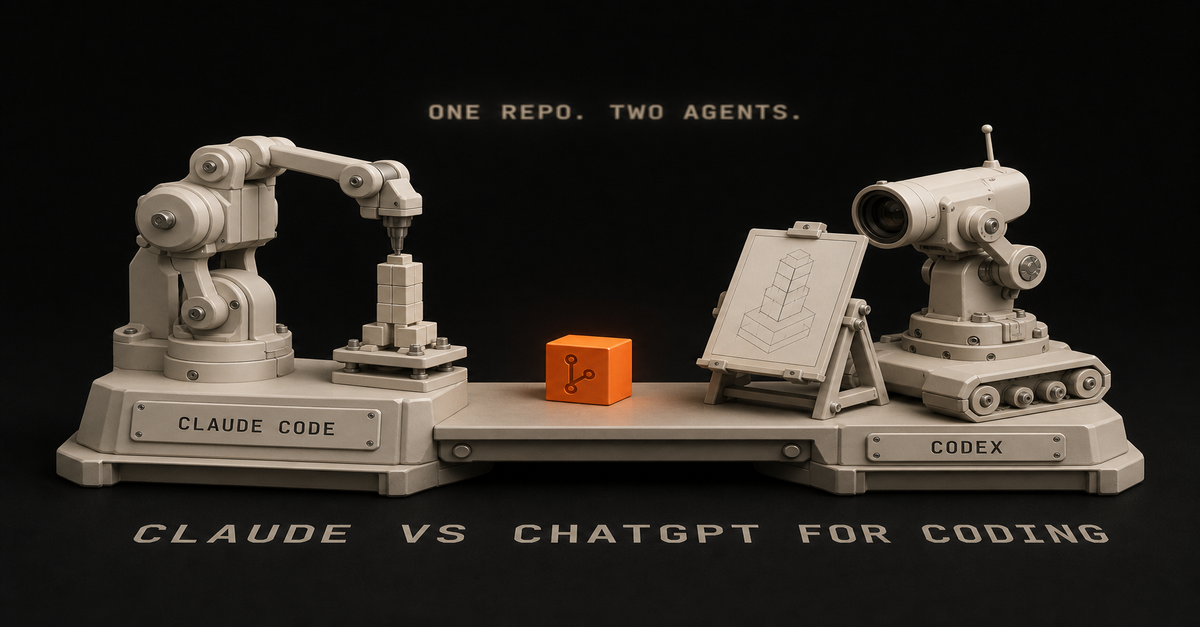
Quick answer: stop comparing chatbots. The real 2026 decision is which coding agent you live in: Claude Code or Codex, and both now come inside the normal subscriptions, starting at $20 a month each. I pay for both stacks. My serious builds happen in Claude Code. My research, sparring, and everything around the code happens in ChatGPT. If you can afford both, get both. If you can only pick one, the split below tells you which. My split, in one line: Claude Code builds it, Codex challenges it, and the boring work goes to whichever one is not busy. Searching this as "ChatGPT vs Claude for coding"? Same answer, both directions. And if you are comparing the $20 chat plans themselves, that is a different page: Claude Pro vs ChatGPT Plus.I walk through this on camera in Claude Design + Codex = The Real Website Rebuild Workflow (14 min).What "Coding" Means for You Decides the PickWhat "coding" means for you PickSerious multi-step builds, agents, real systems Claude CodeCreative output: web design, visuals, writing code that touches words Claude CodeResearch before you build, competitor teardowns ChatGPT (Codex)A second opinion on your plan before you execute The one you did NOT build withEveryday questions, brainstorming, on-the-go voice ChatGPTExtracting data from a web dashboard with no export button Codex, it drives the browserYou can afford $40/month total Both. Not a luxury, a setup.Both Agents Now Ship Inside the $20 Plans Most comparison pages miss this, because most of them were written when coding AI meant pasting snippets into a chat window. Claude Code is included with Claude's paid plans from Pro at $20 a month, and I keep the live numbers on my AI plan tracker. Codex is included with paid ChatGPT plans, per OpenAI's tier page. No API keys, no per-token bills. The agent works inside your actual project folder, runs commands, and keeps working while you do something else. So the question is which agent you trust in your repo. My answer depends on the job. This is also why the Cursor and GitHub Copilot comparison misses now: those are editors you code inside. Claude Code and Codex are agents you hand a job to and walk away from. Where Claude Code Wins for Me: The Serious Builds I have not built anything serious with Codex. Every system I actually rely on was built in Claude Code. That is just my scoreboard. The clearest example is my video editor. It is an agent pipeline that polishes my shorts. It does the cuts, but what sold me is the creative judgment. When I run it, Claude (Opus, on high effort) chooses the visual aids, picks the screenshots, and even generates its own infographics. It has access to a Mac mini that acts as its hands, so it can screenshot any app, browse the web, and capture whatever the edit needs. It handles maybe 90 percent of that capture work on its own.The output folder from a real run of my Claude Code video editor. One render takes 30 to 60 minutes; I am involved for maybe an hour and a half total, mostly approving plans. It feels like I hired a senior editor. I do not say that lightly. A render takes 30 to 60 minutes per video and I do not wait on it, I just run it. I check in here and there, roughly an hour to an hour and a half across the whole batch, mostly approving the plan at a few checkpoints. It is not 100 percent passive. It is still better than any editor I could hire right now. The other place Claude wins is anywhere code touches words. It writes in my voice better than anything else I have used. My whole content system runs on Claude Code, one recording out, fourteen shorts plus a newsletter and LinkedIn back. People online argue about whether AI-written text is detectable. I do not really care, as long as my vision and my voice survive into the output. So far they do. Where ChatGPT Genuinely Wins: Everything Around the Code The Claude fan pages skip this part, and it matters, because this is half my day. Research. When I want to study competitors or go deep on a topic before building, ChatGPT is my default now. It takes longer, but the quality is there, and it presents the result like a mini masterclass: charts in the output, tables, a real interface instead of a wall of terminal text. With Claude I invented workarounds for this, asking for a "buddy version" instead of twenty blocks of analysis, or an HTML page instead of terminal output. Codex gives me the readable version right out of the gate. It runs a bit verbose, which you can tune in its agent config, and I take that trade. The sparring partner. This is my favorite pattern and nobody ranking for this query talks about it. Both agents have access to the same repo. So when Claude Code produces a plan, I have Codex challenge it, and it is smart about it, routing to a heavier model when the review deserves one. One agent builds, the other pokes holes, and I only step in to break ties. You can run it in either direction: plan with Claude, execute with Codex, or the reverse. On-the-go voice. I take walks and review my analytics by talking to ChatGPT: why did this flop, what changed, what should I test. When we land on something, it writes the findings into a Markdown file, and I take that file straight to Claude Code to execute. Hands down the best working loop I have found. The voice mode has real bugs. Mine has timed out on me around the 10-minute mark more than once and made me log back in. But when it holds, a 30 to 60 minute working session on foot is a phenomenal experience. Browser work and images. Codex driving a browser just works for the annoying manual stuff, like logging into a dashboard and pulling data that has no export API. And image generation on the ChatGPT side is, in my opinion, the best available, full stop. I am not alone on the split. The top result for this exact query is a six-month-old r/ChatGPTCoding thread whose top take is that "Claude wants to make a more compact, more ergonomic code, ChatGPT/Codex tends to modularize sometimes to the extreme." And a 100-hour Claude Code vs Codex test on YouTube landed where I did on the creative half: "for front-end work, especially anything with real interactivity and design polish, Claude was the clear winner."The 60-second version, from my Shorts: Claude Code and Codex together: how I 10x my output.The Setup I Would Actually Run If you are starting from zero and the $40 for both is fine:Put your project in a folder and give Claude Code the build work: the multi-step stuff, anything with creative judgment, anything that touches your writing. Give ChatGPT the surrounding work: research before the build, data pulls, brainstorming, and voice sessions away from the desk. Before any expensive or irreversible step, have the other agent review the plan. Same repo, a fresh set of eyes. Route the output of thinking sessions into Markdown files so either agent can pick up where the other stopped.That last one matters more than it looks. The two stacks do not talk to each other on their own, so a shared repo full of plain files is what connects them. Both Stacks Cost $40 Together, and Both Break in Predictable Ways I pay for the top of both ladders, but you do not have to.My actual Claude billing. The same Claude Code agent is included from the $20 Pro tier; Max just raises the ceiling.And the other side of the split: my ChatGPT subscription. Codex comes with the paid plans; the $100 tier is 5x the usage of Plus. The failure points, honestly:What you pay more for is capacity. Heavy agent work burns the allowance on either side. On Claude, the fix is a bigger tier, not a different model. Claude Pro vs Max covers when that jump is worth it. Codex runs verbose by default, and its deep research mode is slow. I do not time it, but I never send it something deep when I need the answer in the next ten minutes. ChatGPT voice sessions can drop. Mine has timed out around 10 minutes in and forced a re-login. Annoying, but you live with it. Two subscriptions is real money. $40 a month minimum for the both-agents setup. If that is not obviously worth it for what you build, start with one.Who Should Pick Which Pick Claude (from $20) if coding for you means building real things: agents, pipelines, a product, anything where taste and multi-step execution decide the outcome. My most serious builds live here, and I would start here again. Pick ChatGPT (from $20) if coding is one of ten things you do. It builds impressive things too, websites are easy for it, and it is the better everyday companion: research, voice, browsing, images, quick answers. Pay for neither if you have not yet hit the wall where a chat window stops being enough. The free tiers will tell you when you are ready for an agent. Pay for both if you build weekly. One builds while the other reviews or researches. If either is your bottleneck at work, the Claude guides hub covers the non-coding half of this decision, Claude Cowork included. If your real question is agents versus automation platforms, that is AI coding agent vs workflow automation, and if Gemini is in your bracket, start with Claude vs Gemini. How I Tested This I did not run a benchmark for this page. The split comes from paying for both stacks (Claude Max and ChatGPT Pro), running Claude Code and Codex on the same repos as a daily habit, and shipping real systems with them: a video-editing agent, a content pipeline, this website. Billing screenshots above are mine. Where I state a plan fact, it links to the official page, and the live numbers stay current on my AI plan tracker. Published August 29, 2026. Last reviewed August 2026.