In this article
- 1 The short answer, by who you are
- 2 The math, with today’s numbers
- 3 What the internet still gets wrong
- 4 What Team actually buys you: administration
- 5 Fable on Team: Anthropic’s own two pages disagree, and one is clearer
- 6 Take the money. Just spend it well.
- 7 When Team is genuinely the right call
- 8 How I checked this
- 9 So should you buy it?
Which plan should you buy? Tap 3, get the verdict
Quick answer: If your boss is offering to pay, take the money. Then spend it on capability per person rather than on an admin console. For two to five people, three individual Pro plans cost less than three Team seats, and a Team Standard seat treats Fable exactly the way Pro does (on usage credits), so the extra $5 a seat buys admin, not model access. Team is worth buying when billing, access control and shared projects have become a real problem, not before.
Two things the internet still gets wrong about this, both verifiable in thirty seconds: Team does not require five seats, and Premium seats are not $150.
Here is the math nobody on the first page of results has actually done.
The short answer, by who you are
| You are | Buy this | Why |
|---|---|---|
| Two or three people, no IT department | Individual Pro plans | $5 per seat cheaper, same model access |
| Someone whose boss will expense it | Individual plans, and ask for more | Spend on capability, not seats |
| Handling client material under contract | Team | Model training is none by default, not opt-out |
| Chasing expense reports around the office | Team | Central billing is the actual product |
| Needing shared projects across people | Team | Individual plans do not have project sharing |
| A whole department, 10 or more | Team, mixed seats | This is where the admin genuinely pays for itself |
The math, with today’s numbers
Three people. Every figure from Anthropic’s pricing page, read September 5, 2026.
| Option | Monthly | Annual equivalent | Fable treatment |
|---|---|---|---|
| 3 × Pro | $60/mo | $51/mo | Usage credits |
| 3 × Team Standard | $75/mo | $60/mo | Usage credits, same as Pro |
| 3 × Max 5x | $300/mo | monthly only | Included, up to 50% of weekly limits |
| 3 × Team Premium | $375/mo | $300/mo | Included, same as Max |
Look at the first two rows. Three individual Pro plans cost $15 a month less than three Team Standard seats, and the model access on both is identical.
That is the whole contrarian case on this page, and it is just subtraction.
What the internet still gets wrong
The top Reddit thread on this query is a good record of what people believed, and most of it has since changed. Worth reading in that spirit rather than as current fact.
The original poster, u/Abeck72, talked himself out of Team like this:
“At first I thought, ‘easy, I’ll just get a Team plan,’ but then I realized the Team plan doesn’t include Claude Code. To get access, you need Premium seats… Given that, wouldn’t it make more sense to just get three individual 5× accounts?”
He reached a reasonable conclusion from a premise that is no longer true. Anthropic’s pricing page today lists “Includes Claude Code and Claude Cowork” directly under the Team plan, and the Team column of the feature table marks Claude Code as available.
A reply from u/kondadotm captured the other half of the folklore:
“It is absurd that Claude Code is behind a SECOND paywall on the Team plan. It is absurd, too, that the MINIMUM for the Premium seats is 5 users. Why the f? It’s like ‘I don’t want your money if it isn’t a lot of money.’”
Both halves of that are now wrong. Anthropic’s page reads “For teams of 2 to 150.” Two.
Here is Anthropic’s Team card as it actually renders today. Three of the four corrections below are visible in this one image.
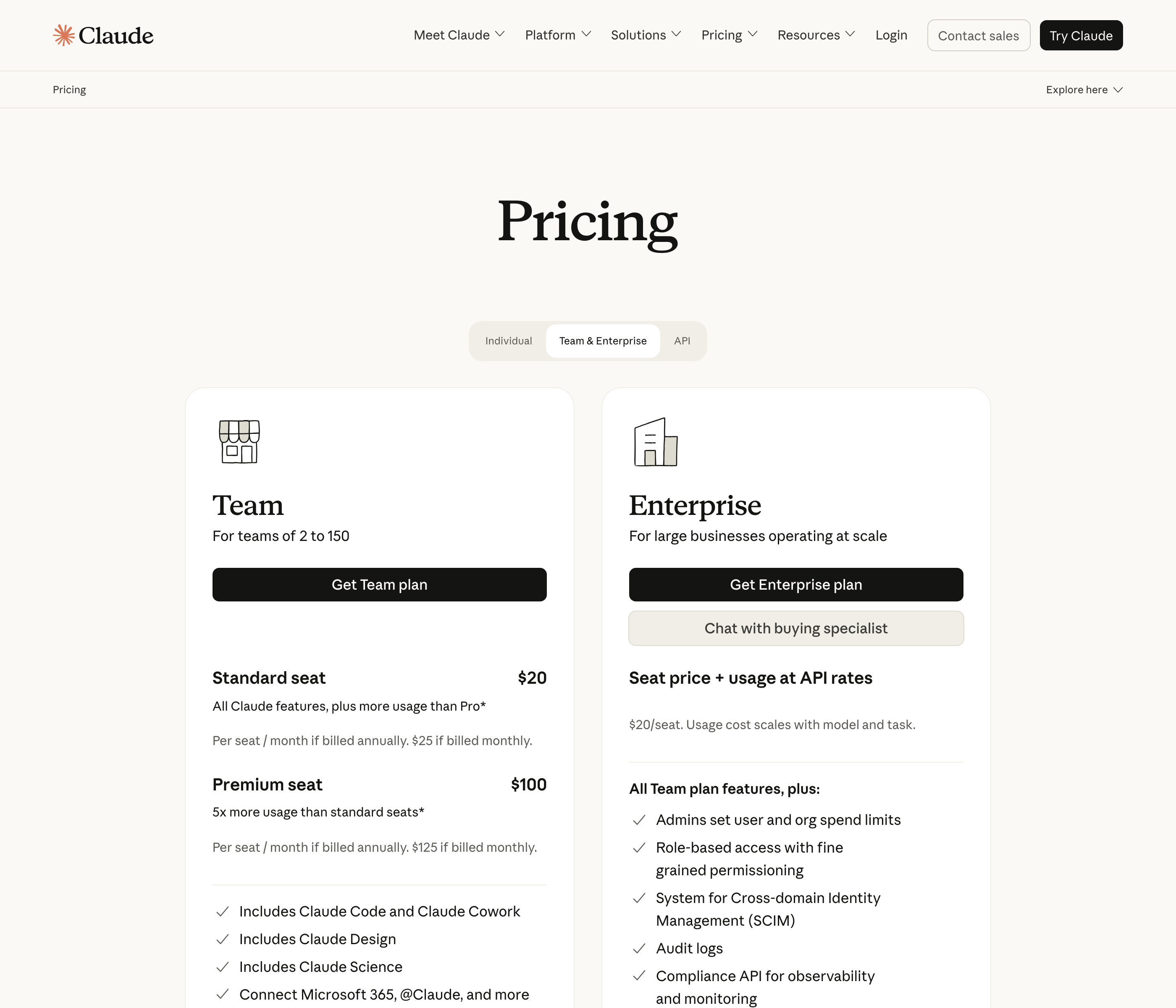 Anthropic’s Team pricing, captured September 5, 2026. “For teams of 2 to 150”, both seat prices, and “Includes Claude Code and Claude Cowork” are all in frame.
So here is the corrected scoreboard, as of September 5, 2026:
| The claim you will read | What Anthropic’s page says today |
|---|---|
| “Team requires 5 seats” | “For teams of 2 to 150” |
| “Premium seats have a 5-user minimum” | No minimum stated beyond the 2-seat floor |
| “Premium seats are $150” | $125 monthly, $100 annually |
| “Team doesn’t include Claude Code” | “Includes Claude Code and Claude Cowork” |
| “You pick one seat type for everyone” | “Mix and match seat types” |
If you were talked out of Team by any of those, the reason you were given has expired. You may still not want it, but you should decline it for a current reason.
What Team actually buys you: administration
Here is the thing to hold onto, and it is my rule for this one: Team does not make Claude better. It makes Claude manageable.
The capability rows are identical. Same models, same 200K context window, same Claude Code, same Cowork. What Team adds sits in a different category entirely:
- Central billing and administration, instead of five people expensing $20
- Single sign-on and domain verification
- Admin controls for remote and local connectors
- Usage analytics across the organisation
- Enterprise search across your team’s content
- Organisation-wide skills deployment
- Project sharing and collaboration, which individual plans do not have
- Adding seats midterm
That project-sharing row is easy to miss and matters more than it looks. On individual plans, projects are yours alone. Team is where a project becomes something a colleague can open.
And one row that a consultancy should read twice: model training is “None by default” on Team, against “Opt-out” on individual plans. If you handle client material under contract, that difference is worth more than the seat price, and it is the strongest argument on this page for buying Team early.
Fable on Team: Anthropic’s own two pages disagree, and one is clearer
This one is worth slowing down for, because it is easy to get wrong and I nearly did.
On the pricing page’s feature comparison, the Fable row shows a bare No in the Team column. Read alone, that says Team seats cannot use Anthropic’s most capable model at all.
That is not what happens.
Anthropic’s Fable plan article is more precise, and it sorts by seat type rather than by plan:
- Pro plans and standard seats on Team plans: Fable “aren’t included in your plan’s usage limits. You can use them with usage credits.”
- Max plans and premium seats on Team plans: Fable is “included as a standard part of your plan,” up to 50% of weekly usage limits.
So a Team Standard seat behaves exactly like Pro on Fable, and a Team Premium seat behaves exactly like Max.
Which actually makes the math cleaner rather than messier. A Team Standard seat costs $5 a month more than a Pro plan for identical model access. You are paying that $5 for administration, and nothing else.
If you see a page telling you Team cannot touch Fable, it is reading the pricing grid and not the help article.
Take the money. Just spend it well.
Now the part I actually believe, because I want to be clear I am not telling you to turn down budget.
If someone told me their boss would pay for three people, I would absolutely take it. That is a no-brainer. Tooling that makes people more productive is the easiest yes in business.
To be clear about what I actually said: that answer is about getting the team onto Claude at all, not about which SKU to buy. The “buy individual plans instead of Team seats” conclusion comes from the seat math above, not from running a Team plan myself, which I have not.
The reason is not “AI is good.” It is that you can take one person and multiply them.
Here is what that looks like in my own work. If I handed an editor my video editing skill, they would save enormous time on every cut. But the saving is not the point. The point is what the saved time becomes.
Say they are editing by themselves and a long-form video takes them three to four hours. Now it takes one to two.
They just got two hours back.
And now those two hours can go into watching the analytics and working out which visuals and which hooks are actually working, and why. That is the superpower. Not “edits faster.” One person who now also does the thinking nobody had time for.
So yes, spend your boss’s money. The only argument this page is making is about the vehicle: three individual plans deliver that same multiplication for less than three Team seats, and you can move to Team the day the admin becomes the bottleneck.
When Team is genuinely the right call
I have spent most of this page arguing the other way, so here is the honest case for buying it.
You have more than five people. The expense-report tax is real and it compounds. Somewhere around five or six seats, central billing stops being a nice-to-have.
Somebody has to leave the company one day. With individual plans, that person’s account and its history walk out with them. With Team, an owner manages the seat.
Your contracts say something about training data. None-by-default beats opt-out when a client asks you to put it in writing.
People need to share work. Project sharing and collaboration is a Team row and there is no individual-plan workaround.
You need SSO or connector controls. These do not exist below Team at any price.
Above Team sits Enterprise, at $20 per seat plus usage billed at API rates, which adds SCIM, audit logs, role-based access and custom data retention. If you are reading this page you are almost certainly not there yet.
One user in that thread, u/frythan, pointed at the commercial terms specifically, noting that they call out that you own your content. That instinct was right, and it is the underrated reason to buy Team early if you do client work.
If you do move, use the mix-and-match rule: put your two heaviest users on Premium seats and everyone else on Standard, rather than buying the expensive tier for the whole room.
How I checked this
Every price, seat band, feature row and the Fable gap come from claude.com/pricing, read on September 5, 2026, including the Team feature comparison table. The seat math is that page’s numbers multiplied by three.
I have never run or administered a Claude Team plan. I pay for Claude individually, so nothing on this page is a first-hand report of the admin console, seat management or how Team usage behaves in practice. What I can tell you is that my recollection of the structure, that each person gets their own account and someone gets an admin layer over the top, checks out against the current feature table.
The Reddit quotes are dated and I have flagged them as historical rather than current. Anthropic changed the seat floor and the Premium price after those threads were written.
So should you buy it?
- Two or three people, no compliance pressure: individual Pro plans. $5 per seat cheaper for the same model access.
- Your boss offered to pay: say yes immediately, then buy individual plans and ask for the difference in something else.
- You handle client data under contract: Team, for the none-by-default training terms alone.
- You need shared projects or SSO: Team. There is no workaround below it.
- More than five people: Team, mixed seats, heaviest users on Premium.
- Someone needs Fable inside their plan limits rather than on credits: that person needs Max, or a Team Premium seat. Both cost $100.
If individual plans are the answer, the next question is which one: is Claude Pro worth it covers the $20 decision, Claude Pro vs Max covers the $20-to-$100 step, and is Claude Max worth it covers whether the top tier earns it. If limits are the reason you are shopping, start with Claude usage limits explained.
Current plans and prices sit on the AI plan tracker.
This post is part of Claude at Work, the hub for using Claude at your job without code.
Published September 5, 2026. Seat prices, the 2-to-150 seat band, Claude Code inclusion, the Fable row and the model-training terms all checked that day against Anthropic’s pricing page, linked inline. Anthropic changes these quietly, so open the live page before you buy.
Plan-change alerts
I read the AI pricing pages so you don't have to.
Get one short email the day any plan on the tracker changes price or limits — Claude, ChatGPT, Gemini, Copilot, Grok, Perplexity. The kind of change I catch: Fable 5 quietly leaving Claude Pro's plan limits, Copilot Pro's consumer plan disappearing — both documented and dated on this tracker's changelog. No schedule, no filler: a change happens, you hear about it.

Written by
Chris AlarconChris Alarcon builds Ship Lean: the boring Claude and AI setups that actually work, handed to people who don’t code. He runs his one-person operation on these systems, around a full-time job, and shares every workflow, prompt, and tool combo in public. Start with the 15 prompts he uses every day.
Work With Me
Setting this up for your team?
I do that. The right plan per seat, the boring setup that makes it stick, and the first three chores handed off. A 2-hour workshop or a done-with-you build, for teams of 2-50.
See how it works →