In this article
- 1 The short answer, by who you are
- 2 The 20x problem
- 3 The September 16 proof: the year’s biggest launch skipped Max entirely
- 4 The two ceilings, and why you are not doing it wrong
- 5 The one real feature gate: Fable
- 6 The “Max unlocks Opus” myth, corrected properly
- 7 The three rungs, and the trigger at each one
- 8 What is NOT the difference
- 9 The real upgrade trigger, from someone who climbed the whole ladder
- 10 Is $200 a month worth it for me today? Yes, and I will show my work
- 11 What has to be happening before you leave Pro
- 12 Three cheaper things to try before $100
- 13 So should a non-coder pay $100?
- 14 One billing warning before you change anything
- 15 If you are still deciding
Which plan should you buy? Tap 3, get the verdict
Quick answer: Same models, different ceilings, and one real feature gate. Max 5x is $100 a month and Max 20x is $200. I am on the 20x tier. You do not buy Max because it is better. You buy it when waiting has started costing you more than the money does.
And you should know before you spend $200 that the “20x” on the tin is the subject of a proposed class action.
That is the part this page was missing, so let us start there.
The short answer, by who you are
| You are | Get this | Why |
|---|---|---|
| Curious, just starting out | Pro, $20 | Nobody should start at $200. You will not know what you need yet |
| Brainstorming, drafting scripts, the odd delegated task | Pro, $20 | This genuinely fits, if your process is dialled in |
| Hitting limits occasionally, can wait it out | Stay on Pro | If waiting is annoying but not expensive, you are not ready |
| Stopped mid-task on work that has a deadline | Max 5x, $100 | The wait is now costing you real time |
| Experimenting constantly, building many skills | Max 20x, $200 | Where I ended up, and only after a long climb |
| Want Fable without credit top-ups | Max | This is the one true feature difference |
Already decided on Max and choosing between the two steps? That is Claude Max 5x vs 20x. Comparing across vendors instead? That is Claude Max vs ChatGPT Pro.
The 20x problem
Anthropic markets Max 20x as “20x more usage than Pro per 5-hour session.” There is real, sustained pushback on whether that is what people actually receive, and it has now gone further than forum complaints.
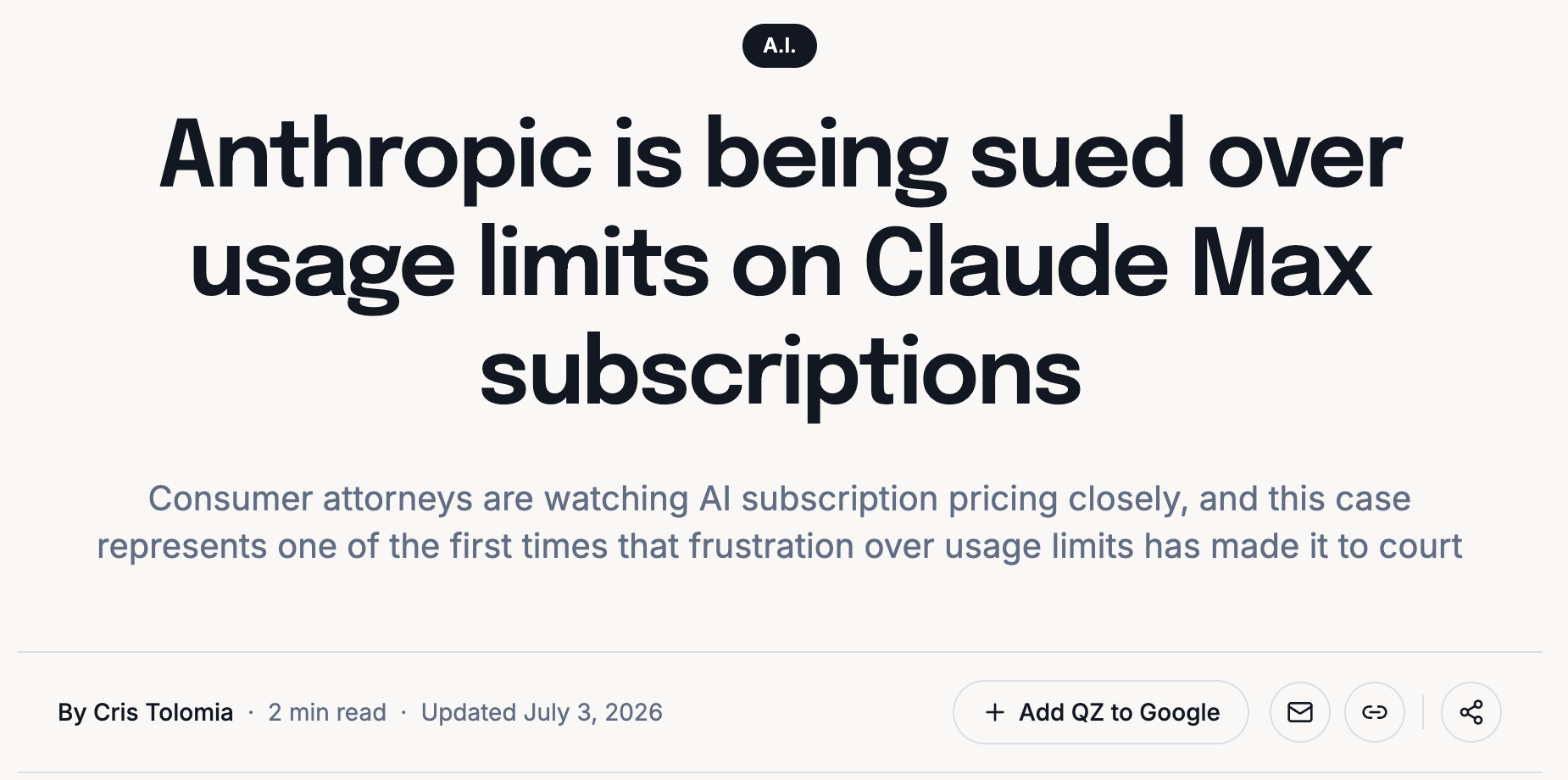 Filed June 14, 2026 and reported that week. Coverage by Quartz, which credits the original reporting to the Wall Street Journal, and by Engadget. These are allegations and nothing has been decided.
A proposed class action, Kahn v. Anthropic, was filed on June 14, 2026 in the Northern District of California on behalf of Washington D.C. resident Karl Kahn, targeting both Max tiers. The complaint states:
“The actual usage provided by the Max 5x and Max 20x plans is far below the advertised amount of usage.”
The detail that made it concrete: after moving up to Max 20x, Kahn alleges a single five-hour work session consumed 15% of his weekly allotment. Anthropic declined the Journal’s request for comment, and has not responded publicly since.
Now let me be careful, because this matters.
Nothing here is proven. A filed complaint is one side’s account. Anthropic has not responded publicly and no court has ruled. I am not telling you the 20x claim is false, and I am not in a position to know.
What I can tell you is my own experience, and it is unremarkable: on the 20x tier I get more usage. It works. But my allowance feels like it drains faster than Codex does, and that is a feel, not a measurement, because Anthropic publishes no number I could measure against.
That is the actual grievance, and I think it is a fair one. The multiplier is a session-usage ratio, not a capability promise and not a queue position.
My own read, and it is only that: it was worded in a way that let people believe they were buying something more definite than they were. You are allowed to be annoyed about that as a consumer, whatever the court eventually decides.
So what does the complaint say the real numbers are?
Per reporting on the filing, it alleges Max 5x delivers roughly three and a half times Pro rather than five, and Max 20x lands somewhere between six and eight times rather than twenty. Kahn also points to Anthropic’s own July 2025 communications about per-model weekly caps, which he says contradict the public marketing.
Again: alleged, not established.
One thing worth flagging against my own instinct. My rough recollection had been that the real figure was somewhere around 10x to 15x. The numbers in the complaint are lower than that, not higher, so if anything I had been giving Anthropic the benefit of the doubt.
You can see why this lands. The most Nico-shaped comment I found on the whole question came from u/needusbukunde on r/ClaudeAI, who had paid and still did not know what he had bought:
“I just upgraded to Claude Pro for $200/year, upfront, and my service has actually gotten worse. My sessions get ‘timed out’ more frequently… What is 5 x account mean?”
That, to me, is the question the marketing should have answered up front.
The September 16 proof: the year’s biggest launch skipped Max entirely
This page has argued from the start that Max sells capacity, not features. On September 16, 2026, Anthropic ran the experiment for me.
That day Anthropic merged Cowork into Claude and shipped Claude Docs, Claude Slides, and Claude Design inside conversations. It was the biggest consumer feature launch Anthropic has done this year.
Where did the line get drawn? Not between Pro and Max. Between Free and paid.
| Plan | Claude Design, Slides, Docs |
|---|---|
| Free ($0) | No |
| Pro ($20) | Yes, beta |
| Max 5x ($100) | Yes, beta |
| Max 20x ($200) | Yes, beta |
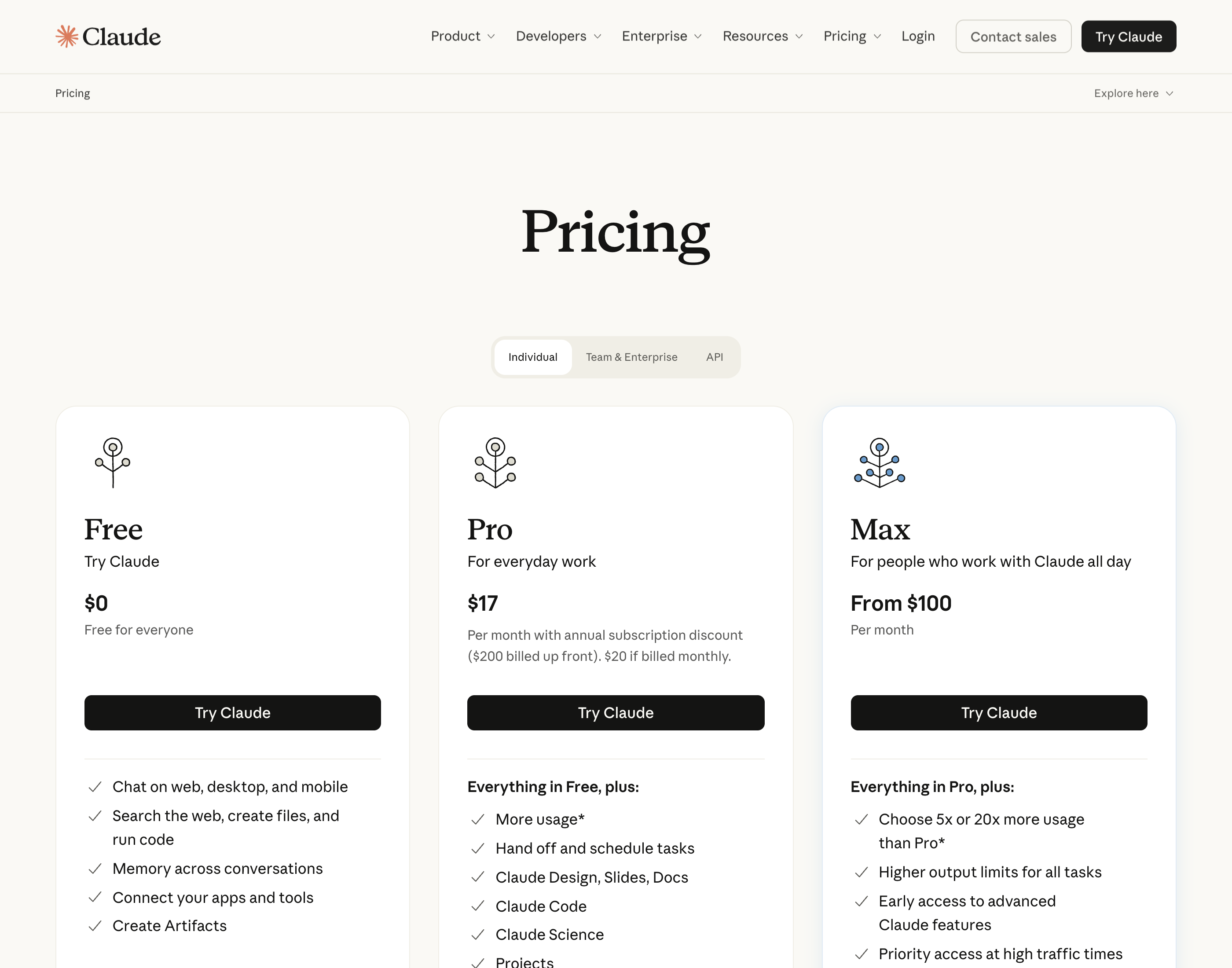 Anthropic’s own pricing page, captured September 18, 2026. Pro lists “Claude Design, Slides, Docs.” Max is literally described as “Everything in Pro, plus” more usage, higher output limits, early access and priority. That is the whole argument of this page, printed by the vendor.
Pro and Max got the same thing on the same day. Paying an extra $180 a month bought exactly zero additional features in the largest feature release of the year.
Worth being precise here, because the phrasing going around is confusing. “The new features landed on Pro” does not mean Max missed out. It means the gate sits at Pro, and everything above Pro clears it.
When I first heard it described as shipping “to Pro rather than Max” my honest reaction was that it made no sense, because Max is the higher tier.
It does not make sense, and it is not what happened. Both paid tiers got it together.
Which is the cleanest evidence this page has ever had for its own thesis. You do not buy Max for features. You buy Max for room. That is the Ship Lean rule on this decision, and Anthropic just underlined it.
The two ceilings, and why you are not doing it wrong
Here is the single most useful mechanical thing to understand, and it is the reason so many people think they broke something.
Claude runs two separate limits at the same time. There is a rolling five-hour session cap, and there is a weekly cap.
You can be nowhere near your weekly limit and still get stopped by the session cap.
That is why lockouts feel random and unearned. They are not random. You hit whichever ceiling arrived first, and Anthropic does not publish a message count you could have budgeted against. The multipliers are all they state.
One more piece: everything shares one pool. Chat, Claude Code, agentic tasks, and now documents and decks all draw from the same allowance, and multi-step agent work burns it faster because those tasks are compute-intensive. Spend an afternoon on an agent task and you have also spent your chat capacity.
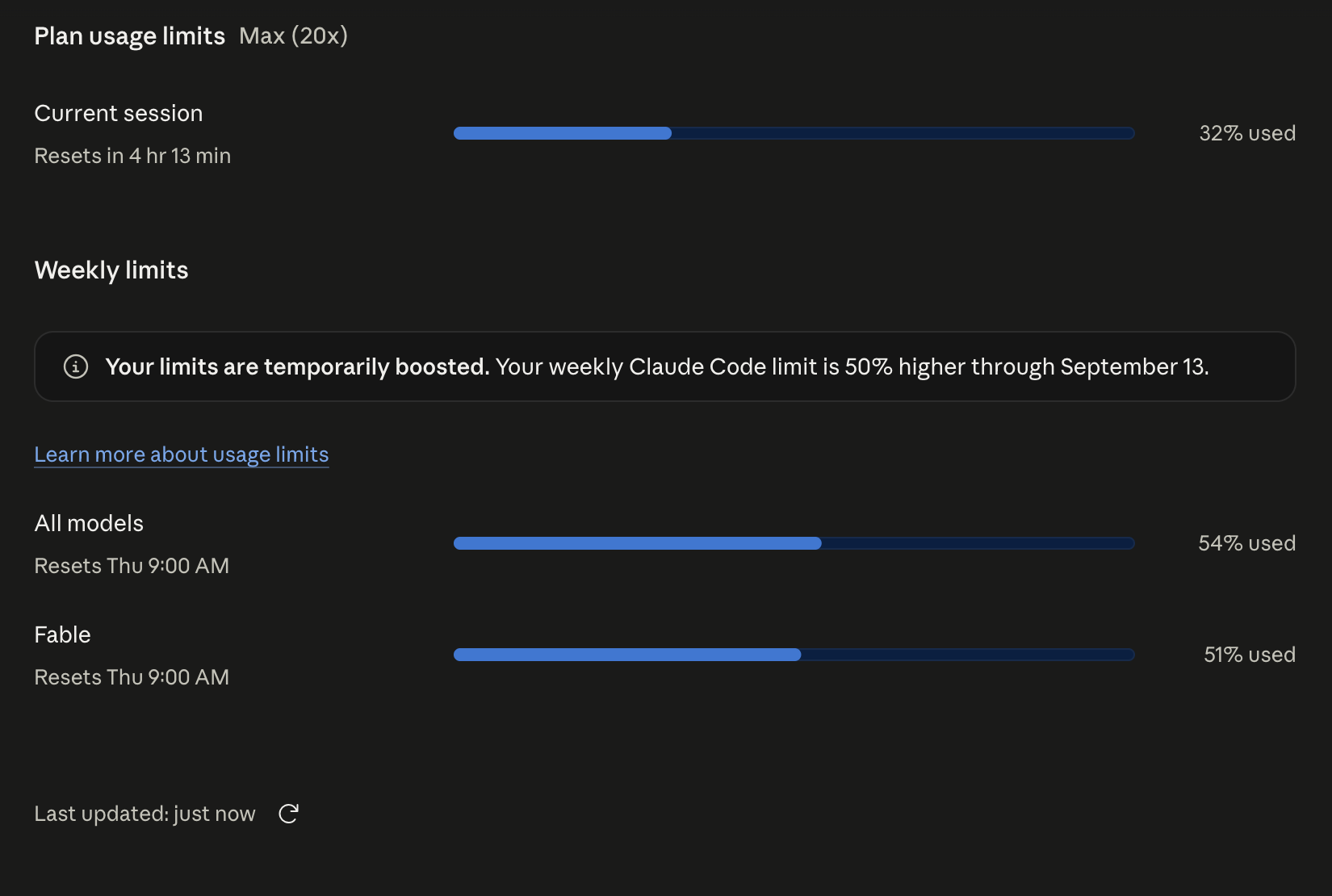
The two ceilings on my own account, mid-Saturday: the 5-hour session bar and the two weekly bars. This is what “20x” looks like in practice: bars, not a message count.
The one real feature gate: Fable
This is the most under-reported fact in the comparison, and it is the only place the tiers stop being the same product at different sizes.
Until July 19, 2026, Fable was included in Pro’s weekly usage limits as a promotion. That ended at 11:59:59 PM PT on July 19. Here is where the tiers landed, per Anthropic’s Fable plan page:
| Plan | Fable access |
|---|---|
| Free | Not available at all |
| Pro ($20) | “Fable 5 and Fable 5.1 aren’t included in your plan’s usage limits. You can use them with usage credits.” |
| Max ($100 / $200) | Included as standard, up to 50% of weekly usage limits at no extra cost |
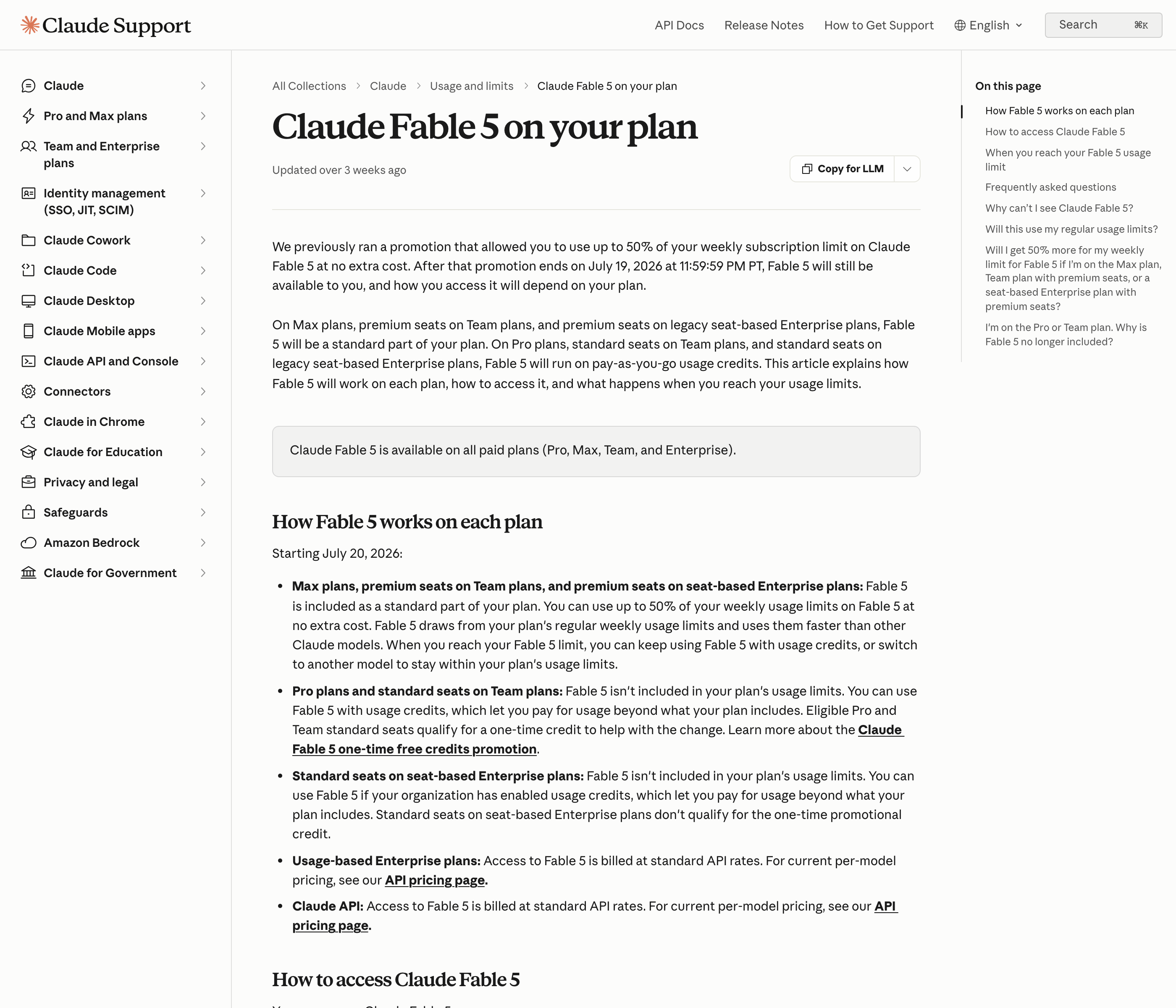 Anthropic’s own Fable plan documentation. This is the sentence that makes the tiers genuinely different rather than just bigger. Still current as of September 5, 2026.
Read that Pro row again, because it is the part people miss: you can still use the newest model on the $20 plan. You just pay for it separately, on top of your subscription.
That makes “core features are identical, only usage differs,” the line nearly every comparison page repeats, no longer true.
I am on Max 20x, so Fable is included for me. That is exactly why I want to flag it clearly rather than let it sit in a footnote: the tier I happen to be on is the one where this change is invisible.
The “Max unlocks Opus” myth, corrected properly
This is the single most repeated claim about these tiers, and it is still wrong.
Here is the sentence the whole myth turns on, from Anthropic’s Opus 5 announcement:
“Opus 5 is the new default model on Claude Max, and the strongest model on Claude Pro.”
Read both halves.
Max gets Opus 5 as its default. Pro gets Opus 5 as its strongest available model. Same model, both tiers. What differs is which one you land on when you do not choose.
So “Max unlocks Opus” is false, and people repeating it are misreading a real sentence rather than inventing one. Anthropic does draw a Pro and Max distinction here. It is a distinction about defaults, not about access.
I previously wrote on this page that no official Anthropic page mentions Opus in the tier context. That was wrong: Anthropic published the sentence above on July 24, and this page went up on July 31. It was already wrong the day I published it.
The current lineup, verified on claude.com/pricing on September 5, 2026, is Haiku 4.5, Sonnet 5, Opus 5 and Fable 5.1. If you are unsure which to reach for, that is Claude Opus vs Sonnet, and picking a lighter model is often cheaper than buying a bigger plan.
The three rungs, and the trigger at each one
The query says “versus” but you have three choices, and the step between them is a different decision each time.
Pro, $20. Stay here if: you brainstorm, generate scripts, hand Claude the occasional multi-step job, and you have your process dialled in. That combination genuinely fits inside $20 and a lot of people talk themselves out of it too early.
Trigger to leave Pro: you are trying to build something serious and you are hitting a stop. Not an inconvenience, a stop, on work with a deadline.
Max 5x, $100. Stay here if: the five-hour wall was your problem and $100 made it go away. For most people who outgrow Pro, this is the end of the ladder.
Trigger to leave Max 5x: you are experimenting constantly rather than executing a known process. Researching competitors, building ten skills, not entirely sure what you are doing yet. That mode burns capacity in a way that dialled-in work does not.
Max 20x, $200. This is where I am. And here is the honest caveat: you are still going to run out of usage. It depends entirely on how complex the thing you are building is. Nobody should buy the top tier expecting the meter to disappear.
That is the answer this page did not previously give, and it is the one I would want if I landed here from a search.
What is NOT the difference
“Claude Code and the agent features are Max-only.” They are included on Pro. Claude’s pricing page lists Claude Code, plus Claude Design, Slides and Docs, as available on both Pro and Max, and unavailable on Free. Cowork is no longer a separate line item anywhere, because Anthropic merged it into Claude on September 16, 2026.
“5x means five times my monthly total.” Anthropic anchors that multiplier to per-session capacity, not a monthly pool.
Annual billing on Max. Anthropic’s own page disagrees with itself here, which is worth knowing. Its billing FAQ says annual subscriptions are available for Pro and Team; its Max FAQ says both Max options are billed monthly; the comparison table lists Max’s billing cycle as “Monthly and annual.” Check what checkout actually offers you.
The real upgrade trigger, from someone who climbed the whole ladder
I did not decide to pay $200. I got walked there.
It started as a sparring partner. I had bugs or I wanted to build something, so I used Sonnet, and honestly I did not even see the power of Opus at the time. Sonnet alone was good enough that I thought, this is better than ChatGPT.
Then I kept hitting the limit. And I still did not upgrade. I just waited it out.
What changed everything was Claude Code. Not because I needed a coding tool, but because it was the first time the thing could take work off my load instead of just answering me.
The clearest version of that is what happened to my video editing, because it shows how the climb actually goes.
It started as “cut my shorts.” Then it became “cut my long form,” which is longer and more resource-hungry. Then it became “do not just cut, add visual aids”: take screenshots of my actual laptop, different apps, so my raw talking-head footage has real material on screen while I talk.
That last version runs for hours to produce 14 shorts. And the same system now generates SEO content for me too.
The point is not the video. The point is that the skill keeps doing more and more while I spend about the same energy.
Every one of those steps raised my usage. That is what walked me up the tiers.
Here is the math that made $200 obvious. If I hired an editor for shorts, that is call it $50 a video on the low end, and realistically $100-plus if I want actual cuts with visual aids. Plus waiting days for turnaround.
So the ROI is not close.
And here is how the wall actually showed up in my day: I was waiting instead of working. That is the whole signal. Not a warning banner. Not a percentage. Just me sitting there unable to continue.
But notice the order of that story: the upgrade was the last step, not the first.
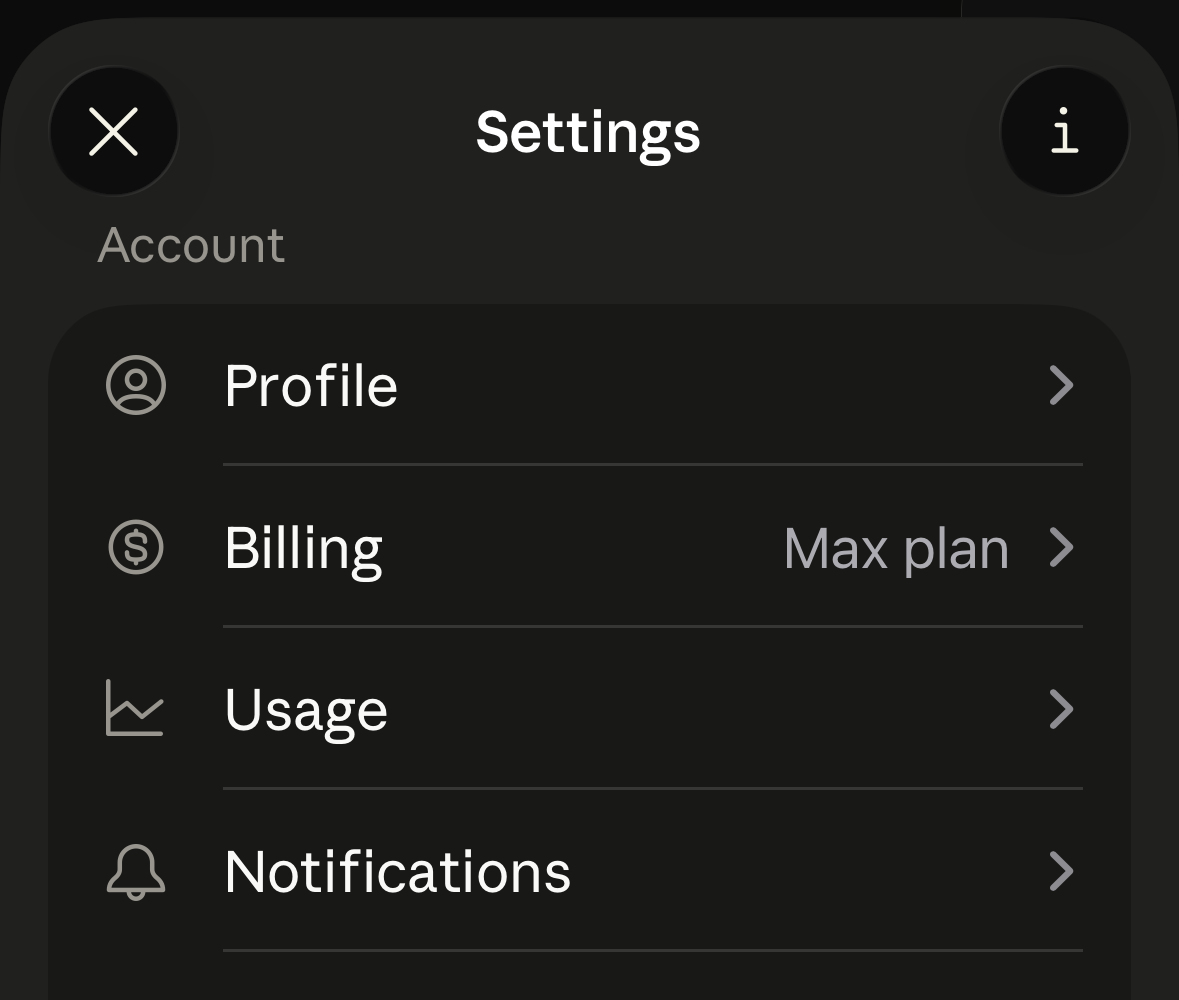 My own Claude billing screen. I am on Max 20x at $200 a month, which is the tier where Fable is included in-plan.
Is $200 a month worth it for me today? Yes, and I will show my work
Updated September 18, 2026, because “is it worth it” deserves a current answer, not a July one.
Yes. For what I do, it is worth it.
I experiment constantly, and I am constantly hitting the ceiling. One day into a fresh weekly window I am already at 20% of it.
I watch the meters, I open new context windows to stay efficient, and I still burn through it, because Fable eats usage and I use Opus heavily.
I could be more efficient than I am. But the smaller models do not give me the output I want, so I do not run them.
That is a specific profile. It is probably not yours.
Here is the part that does not flatter the purchase: I think this stops mattering.
The system I have built has gotten to the point where the model matters less every month. I could run it on ChatGPT or on Claude and get quality output either way, because the system is built around my own ideas, my own input, my own voice.
It is not the model writing for me. It is me talking, and the model organizing the result into decent packaging.
I used to believe Claude was the only one that could write in my voice. The writing is still phenomenal. But ChatGPT with Astra has closed enough of that gap that the belief no longer holds, and I am not depending on any one model to generate my content anyway.
So today, yes, worth it. In a year, I would not bet on it. That is a real answer and the honest version of a $200 line item.
What has to be happening before you leave Pro
Short version: probably nothing.
I do not see why most people would leave Pro. The internet makes this sound more urgent than it is, and a fair amount of the noise is people complaining because complaining is the hobby. Filter it.
You leave Pro when you are constantly hitting limits, in real work, and it is costing you more than the money. That is the whole trigger. Not a feature you saw. Not a benchmark.
The one other honest reason is that you want to do something genuinely different. If the coding is not where you want it and you are ready to try Claude Code properly, that is a real change in what you are asking for, and it comes with a real change in what you consume.
And if you are weighing a different company instead: the thing that would push me is a plan getting stingy. If your usage quietly drops and resets get tighter, that is when you look at whoever is being more generous that quarter. I would not assume it is always the same name.
Three cheaper things to try before $100
If you are getting stopped but not sure the upgrade is earned yet, work through these first.
- Use a lighter model. This is the cheapest fix on the list and most people skip it. Anthropic’s model guide states that running Opus or Fable on a task Sonnet or Haiku could handle uses more of your limit for no gain. There is also an Effort control in the model picker that changes consumption on the model you already chose.
- Buy usage credits instead. Pro and Max subscribers can purchase discounted usage bundles rather than jumping a whole tier. If your overflow is occasional, this is dramatically cheaper than $80 more a month, and it is also how you use Fable on Pro.
- Put your reference material in a Project. Per Anthropic’s usage-limit best practices, content in projects is cached and does not count against your limits when reused. People re-paste the same background documents into fresh chats all week and pay for it every time.
There is a fourth that is really a habit: very long single conversations cost far more than short ones, because every turn re-reads everything before it.
When I measured nine weeks of my own usage, starting a fresh session instead of riding one conversation was the change that moved the number most. Before I fixed it I was burning 20 to 30% of a week’s top-model allowance in a single day.
If you work through all four and you are still getting stopped on work that matters, that is your answer.
So should a non-coder pay $100?
Here is the answer I would actually give you, and it is probably not the one you expect from someone paying $200.
If you have not hit the wall, congratulations. You are good.
If you do not create video, and you write LinkedIn posts, tweets, and Substack drafts with a few skills running on the $20 plan, that is all you need. Do not overcomplicate it.
I have a different use case. I tinker constantly and I create content about AI, so I am naturally tinkering and documenting all day. That is what outgrew the $20 plan, not some general truth about the tiers.
The limits are not a coding thing, though. They bind on any compute-heavy work: long document analysis, research, agentic multi-step tasks, and now documents and decks. Plenty of non-coders hit them.
Here is what I would actually tell you: when it becomes a no-brainer, you will not question it. If you are overthinking the upgrade, that usually just means you have not found a strong enough use case yet. That is my rule for this decision, and it has held for every tier I have moved through.
Start at $20. Let the pain tell you when to move.
One billing warning before you change anything
Users report a real gotcha: changing your subscription through support rather than in Settings can cost you a legacy price you were grandfathered into.
Use Settings then Billing where you can. Upgrades take effect immediately with unused time credited; downgrades take effect at the end of your billing period, and your chats, projects, and files stay with your account either way.
The 60-second version, from my Shorts: I made a $20 AI plan feel like the $200 one (routing, not a hack).
If you are still deciding
- Claude Max 5x vs 20x - if Max is settled and the step is not
- Claude Opus vs Sonnet - if a lighter model would fix this for free
- Is Claude Pro worth it? - if you have not paid for anything yet
- What Claude’s free plan gets you - if you are not sure $20 is earned yet
- Claude Max vs ChatGPT Pro - if you are comparing $100 tiers across vendors
- Claude Cowork vs Claude Code - the one that burns your allowance fastest
If you want to put whichever plan you pick to work on real tasks, start at Claude at Work.
Published July 31, 2026. Updated September 18, 2026: Docs, Slides and Design shipped to Pro and Max together, the cleanest proof yet that Max buys room, not features. Added whether $200 is worth it to me today and the honest trigger for leaving Pro. Plan rows checked on claude.com/pricing that day.
Plan-change alerts
Your plan is gonna change. Nobody emails you when it does.
I pay for Claude, ChatGPT and Grok, so I check the pricing pages every week anyway. When one moves a price or a limit, you get one email that day. No newsletter, no schedule. Last one I caught: Fable 5 quietly dropped out of Claude Pro.

Written by
Chris AlarconChris Alarcon builds Ship Lean: the boring Claude and AI setups that actually work, handed to people who don’t code. He runs his one-person operation on these systems, around a full-time job, and shares every workflow, prompt, and tool combo in public. Start with the 15 prompts he uses every day.
Work With Me
Setting this up for your team?
I do that. The right plan per seat, the boring setup that makes it stick, and the first three chores handed off. A 2-hour workshop or a done-with-you build, for teams of 2-50.
See how it works →