In this article
- 1 The short answer, by who you are
- 2 Max does not unlock a better Claude
- 3 So what does $100 actually buy? Permission to stop rationing
- 4 The Fable 5 mechanic almost everyone gets wrong, including me
- 5 What actually justifies my Max plan: about 14 hours a week
- 6 What my usage actually looks like in a normal week
- 7 Do this before you spend $960 a year
- 8 The likelier mistake is buying too much plan
- 9 Who should actually buy it
- 10 The decision rule: let the pain decide
- 11 Next forks worth reading
Quick answer: Yes, if you make things for other people. No, if you don’t. Max unlocks zero models that Claude Pro lacks. What $100 or $200 a month actually buys you is permission to stop rationing. I pay for Max 20x at $200 and it is worth it, but the reason is not “better Claude.” The reason, by my own rough estimate, is about 14 hours a week I no longer spend editing.
Here is the problem with every page ranking for this question right now.
They are answering it for a developer burning tokens in Claude Code. If that isn’t you, none of their math applies.
The short answer, by who you are
| You are | Do this | Why |
|---|---|---|
| Never paid for Claude at all | Pro, $20 | Everyone should have the $20 plan. Scale from there |
| Post online or run a business | Max is on the table | Content and client work generate enough volume to earn it |
| Average professional who doesn’t post | Stay at $20 | Resume work, job research, career planning fit inside Pro |
| Hit the limit once last week | Wait it out | One wall is not a pattern. Let the pain talk |
| Hitting 50-60% of your weekly usage | Max 5x, $100 | Now the meter agrees with you |
| Stopped mid-task daily on paid work | Max 20x, $200 | Where I ended up, after months |
Max does not unlock a better Claude
This is the fact that should reframe the whole decision, and it comes straight off Anthropic’s pricing page.
The model list is identical on every tier. Free, Pro, Max 5x, and Max 20x all list Fable, Opus, Sonnet, and Haiku.
There is no smarter Claude behind the $100 paywall.
What Max says it gives you is “5x or 20x more usage than Pro” and “higher output limits.” That’s capacity, not capability. Per Anthropic’s Max plan page, Max 5x is $100 a month and Max 20x is $200, and the multiplier language there is worth reading carefully: it says more usage per session, not per month.
Max also carries two weekly ceilings, per that same page: one across all models, and a second one just for Sonnet.
So what does $100 actually buy? Permission to stop rationing
If the models are the same, the upgrade has to buy something else. It does, and it’s this.
When Opus 5 shipped on July 24, 2026, Anthropic described it as “the new default model on Claude Max” and “the strongest model on Claude Pro.”
Read that second half carefully, because most pages misread it. Pro users are not locked out of Opus 5. They get it. It just isn’t their default, so they have to pick it on purpose, and it eats their allowance faster when they do.
That is the entire non-coder upgrade, in one sentence: on Pro you budget which model you deserve, on Max you stop thinking about it. That’s the Ship Lean read on the Max question.
The clearest version of this I’ve seen from an actual non-developer came from r/ClaudeAI:
“I’m currently trying out a max 5x plan and I don’t code. I use Claude for analysis of meeting transcripts, writing documentation, and helping refine copywriting / marketing. … The max plan lets me use Opus without needing to weigh the limit tradeoffs with sonnet.”
- u/redbulb on r/ClaudeAI, May 2025
Date that one honestly: it’s from 2025 and refers to an older Opus, so treat it as evidence about the reason people upgrade, not as testimony about the current model. The reason has only gotten stronger since Opus 5 became Max’s default.
The Fable 5 mechanic almost everyone gets wrong, including me
I want to correct something I believed until I checked the docs for this post.
I had assumed Fable 5 came with its own dedicated pool on Max, separate from everything else, because it certainly behaves like a different animal. It does not.
Per Anthropic’s Fable 5 plan page, on Max, “Fable 5 draws from your plan’s regular weekly usage limits and uses them faster than other Claude models.” What you actually get is a ceiling inside the same pool: you can use “up to 50% of your weekly usage limits on Fable 5 at no extra cost.”
And the FAQ on that page answers “Will I get 50% more for my weekly limit for Fable 5?” with one word: No.
So it’s a cap, not an allowance.
My instinct was half right, which is the useful half: Fable 5 is metered differently from every other model, because it’s the only one with its own ceiling. And it does burn through your week faster than anything else. I max out my Fable ceiling almost every week. That’s what a 50% cap inside one shared pool feels like from the inside, and it’s why “I have Max so I never think about limits” is not quite true even at $200.
What actually justifies my Max plan: about 14 hours a week
Here is my honest answer, and it has nothing to do with code.
I edit a lot of video. Roughly 14 shorts a week.
It used to be just cuts. As someone who is not a professional editor, that alone was revolutionary to me, because cuts were all I knew how to do. Then you start watching your competitors and you notice they’re doing something you’re not: visuals.
Now Claude does the visuals too. Screenshots, real GUI captures, actual ChatGPT and Claude interfaces dropped into the edit.
Picture doing that by hand. Placing visuals one by one across a short is easily a couple of hours of work; let’s round it down to one hour per short to be conservative. Fourteen shorts, one hour each, cutting and adding visuals. That’s about 14 hours a week I no longer spend.
To be precise about that number: it’s my own estimate of what the manual version would cost me, not a stopwatch measurement. I’m telling you how I did the math so you can redo it with your own numbers.
And that time doesn’t turn into free time. It turns into more content, which is the actual point.
I could not do that without my Claude skills and the Max plan. So for me the answer is yes, a hundred percent.
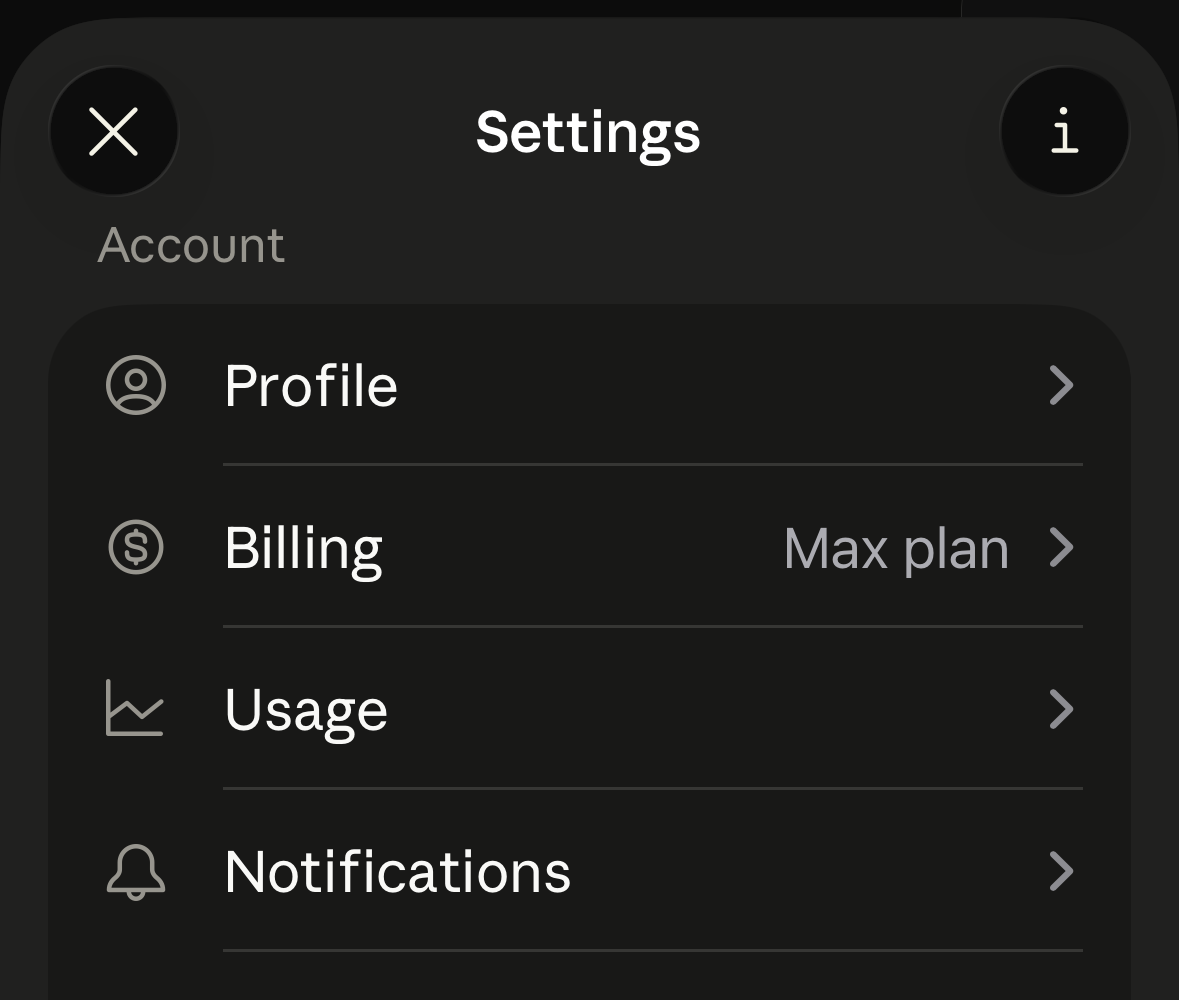 My billing screen. Max 20x, $200 a month. Captured on my own account.
What my usage actually looks like in a normal week
Since nobody on page one will show you a real number, here’s mine.
On Opus and general work I run about 50 to 70 percent of my weekly allowance. Fable is the outlier: I’m maxing that ceiling out almost every week lately.
Am I always hitting my limit? Most of the time, yes. Not always. And I’m okay with that.
That’s an important thing to say out loud, because “Max means never hitting limits” is a myth, and a $200-a-month user hitting the wall collected 1,522 upvotes for saying so. The upgrade doesn’t remove the ceiling. It moves it far enough away that you stop planning your day around it.
Do this before you spend $960 a year
Not one page ranking for this query tells a writing-first user to try the free fixes first. So here they are.
- Check Settings > Usage for two weeks. This is the whole decision, and it’s free. If you never cross 40%, you don’t have a volume problem. If you’re pinned at 50-60% and getting stopped, you do.
- Lower the effort level. Click the model name next to the send button, then click “Effort.” Anthropic documents five levels: Low, Medium, High, Extra high, and Max. Its own wording: “Higher effort means more thorough responses, but they take longer and use more tokens, so you’ll reach your usage limits faster.” Low and Medium “stretch your usage further.”
- Know the Opus 5 caveat. Same page, verbatim: “Extended thinking cannot be turned off in Claude when using Claude Opus 5.” So if you’re on Opus 5 and trying to conserve, effort level and model choice are your levers. Turning thinking off is not one of them.
- Put reference material in a Project so it’s cached instead of re-pasted into a fresh chat every time.
And know this before you trust anyone’s numbers, including the ones in the SERP above this page: Anthropic publishes no concrete limits. No message counts, no hours, no token caps per plan. Its help page says usage depends on conversation length and complexity, which features you use, which model, and the effort level you picked.
Every “you get X messages per 5 hours on Max” figure on page one is invented.
The likelier mistake is buying too much plan
If you’re a non-coder, the failure mode isn’t underbuying. It’s paying $100 for headroom you never touch.
The community evidence on this is unusually consistent. A daily Max user on r/ClaudeAI:
“I have Claude Max right now, and I use it every single day for coding, for also working with text for my work: research, writing, rewriting emails, a reflection coach, and more. I get to about 25% of my weekly limit… It’s crazy, but I might actually try going down to Pro because I literally never get above 30% of my weekly limit and I use it every day.”
- u/RetroUnlocked on r/ClaudeAI, March 2026
That’s someone who codes and writes, using it daily, at a quarter of the plan.
The same thread surfaces the structural problem behind the overbuy: there’s nothing between $20 and $100. u/OrbMan99 put it plainly: “The jump to the next tier is too high… Something like a $50 tier would probably bring a lot of those users back.” That thread isn’t an outlier either; a separate ask for a middle plan pulled 121 upvotes.
There is no $50 rung. So the honest options are Pro plus occasional usage credits, or the full jump.
One option nobody ranking for this query mentions: if you’re using Claude for your actual job, a Team seat starts at $20-25 per seat per month on Anthropic’s pricing page. Ask your employer before you put $960 a year on your own card.
Who should actually buy it
Here’s my segmentation, and I’ll be blunt about where the line falls.
Anybody who creates content online: yes, hands down. Multiple use cases, and the volume is what earns the plan back.
If you have a business: yes, hands down. Same reason.
If you’re the average person who doesn’t post anything online: stay at $20. And I mean that as a real recommendation, not a consolation prize. Pro handles resume optimization, job research, drafting your career goals. Cowork works on the $20 plan too. That’s where it genuinely shines for a normal professional, and it’s plenty.
Where it gets interesting is when you start building custom things: check my email every day, give me the news on these specific topics. Once you adopt it around your life it starts solving different problems, and that’s usually when the usage curve bends.
I’d also gently push most people toward the content side. It’s very low maintenance now. Two or three LinkedIn posts a week sharing what you know from the career you already have, or a Substack. You don’t need to become a creator to benefit from creating.
Everyone should have the $20 plan. That’s my honest opinion, and then you scale from there.
The decision rule: let the pain decide
If you hit your limit once last week and you’re staring at the upgrade button, here’s exactly what I’d tell you.
If you can wait, wait it out.
One wall is not a pattern. It’s a Tuesday.
If you want to try it anyway, fine. Upgrade, then watch your usage. Are you actually hitting the limit? Are you maxing at least 50 to 60% of it? That’s the number that answers this, and it’s the only one that’s yours.
Nobody can tell you whether $100 is worth it, because the answer depends entirely on what waiting costs you. So you have to know your usage. Let the pain decide. That’s Chris Alarcon’s rule for this upgrade, and it’s the same rule I used on every tier I climbed.
The meter is in Settings > Usage. Go look before you spend.
Next forks worth reading
- Claude Pro vs Claude Max - the full tier-by-tier spec comparison if you want the mechanics
- Is Claude Pro worth it? - the $20 version of this exact question
- Claude Max vs ChatGPT Pro - if you’re comparing the $100 tiers across vendors
- Claude usage limits explained - why you got stopped when the meter said you had room
Ready to put whichever plan you pick to work on real tasks? Start at Claude at Work.
Published August 7, 2026, and last reviewed that day. Pricing, tier multipliers, the Fable 5 ceiling, Opus 5’s plan placement, and the effort-level settings were all checked against claude.com/pricing and Anthropic’s own support documentation on the publish date, linked inline throughout. Anthropic changes these often, so open the source pages before you buy.

Written by
Chris AlarconChris Alarcon builds Ship Lean: the boring Claude and AI setups that actually work, handed to people who don’t code. He runs his one-person operation on these systems, around a full-time job, and shares every workflow, prompt, and tool combo in public. Start with the 15 prompts he uses every day.
Work With Me
Run a business or a team?
I build these systems for clients: I turn your calls, demos, and expertise into a steady stream of buyer-facing content. If that's you, the offer is one click away.
See the offer →The 15 AI prompts I actually use every day
I tested hundreds and kept the 15 that survived at my desk. You get them right away, then one short Ship Lean note every Tuesday.