You're paying for Zapier. ChatGPT Plus. Maybe a CRM you barely open.
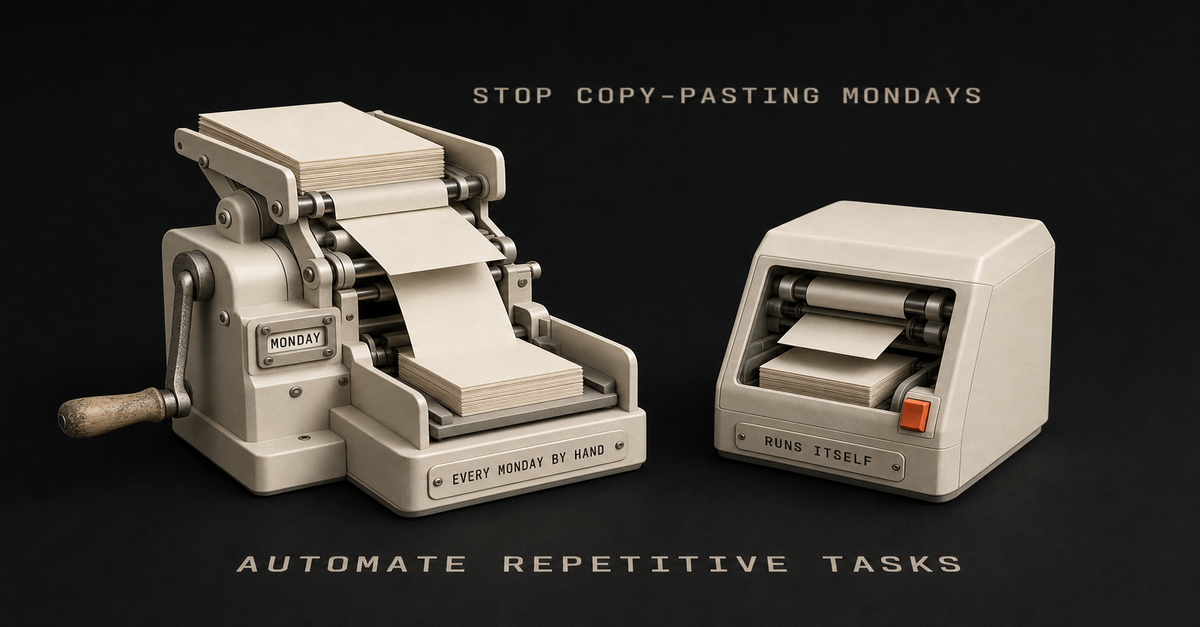
And you're still copy-pasting the same data into the same spreadsheet every Monday morning.
You've got plenty of tools. Nobody showed you how to map what you're actually doing before throwing software at it.
So you keep stacking automation subscriptions that don't talk to each other.
And every Sunday night, you're staring at the week ahead knowing a chunk of it will disappear into the same repetitive tasks you did last week. And the week before.
I know because that was me. Most of what's on this site got built on borrowed time. The workflows, the agents, the content systems - all of it in the margins. Early mornings and late nights.
And the process that actually worked didn't start with a tool. It started with a 30-minute brain dump.
Here's the process I use to figure out what to automate, how to map it, and which tools to pick. No hype. No $500 courses.
Just the system I keep coming back to. It turned a pile of manual work into a content setup that runs while I focus on building. I break it down in my save-time-automation guide.
Let's build yours.
If you already know the workflow is worth automating, the next question is tool fit. Use the Automation Priority Audit to score it, then use Claude Code vs n8n to decide what should handle judgment versus triggers.
Why Most "Automate Everything" Advice Falls Flat
Every automation tutorial starts the same way: pick a tool, connect two apps, watch the magic happen.
But that's like buying a gym membership and expecting muscles to show up.
The advice skips the hardest part: figuring out what you're actually doing all day. Most solo builders can feel the drag, but they can't always name the workflow.
They know they're busy. They know tasks repeat. But if you asked them to write down every step of their content process - from idea to published post - they'd stare at a blank page.
You can't automate what you haven't defined.
I tried. I jumped straight into n8n, started wiring up nodes, and ended up with a tangled mess that took longer to maintain than the manual process it replaced. The tool wasn't the problem. I was building before I understood what I was building.
Turns out, the boring part - documenting your processes - is the part that makes everything else work. Skip it and you'll waste weeks building automations you'll never use.
So start with a notebook, not a tool.
The 30-Minute Brain Dump That Changes Everything
Block 30 minutes. That's it. Grab a notebook, open Notion, use your phone's notes app - doesn't matter. Just start listing every task you do in your business.
Not the high-level stuff like "marketing" or "sales." The actual tasks. The substeps. The clicks.
How to Do ItList every task by category. Content creation. Email. Social media. Admin. Customer service. Sales. Whatever applies to you.
Break each task into substeps. Don't write "create blog post." Write: research topic, outline, write draft, edit, find images, format in CMS, write meta description, schedule, share on social.
Note how long each takes. Even rough estimates help. "45 minutes" is better than "a while."
Mark what repeats. Weekly? Daily? Every time you publish?Pro tip: talking is faster than typing. I use a voice recorder app and walk through my business process out loud. Twenty minutes of rambling surfaces tasks I'd never sit down and type out. Dump the transcript into a doc and clean it up later.
Don't worry about making it perfect. Just get everything out of your head so you can see the full picture.
Most people are shocked by how much they're actually doing. That's the point. You can't fix what you can't see.How to See Your Workflows Before You Build Them
Once you've got your task list, pick the top 3 most time-consuming categories. That's where automation will save you the most.
Now draw them out. Seriously.
Use Excalidraw (free), Miro, or literal pen and paper. For each process, map the flow:Start (what triggers this task?)
Steps (every action in order)
Decision points (if X happens, then Y)
End (what's the output?)I used to jump straight into n8n. Open the canvas, start dragging nodes, figure it out as I go. It worked... until it didn't.
Then I started sketching in Excalidraw first. Sometimes with Claude Code helping me brainstorm. I'd lay out the entire workflow visually before touching a single automation tool.
Here's what I learned: 10 minutes sketching saves 4 hours rebuilding.
You catch the overcomplicated parts on paper. You spot redundant steps. You realize some tasks don't need automation at all. You can just stop doing them.
Spend 10 minutes per workflow. Sketch it rough. It doesn't need to be pretty. It just needs to show what you actually do.
Let AI Find the Patterns You're Too Busy to Notice
Take your brain dump - all those tasks, substeps, time estimates - and feed them into NotebookLM (powered by Gemini). It's a free Google tool that's ridiculously good at spotting patterns.
Upload your notes, your workflow sketches, whatever you've got. Then prompt it:Identify the top 10 most repetitive processes in my business. Rank them by estimated time spent per week.NotebookLM will create visual workflows, raw SOPs, even infographic-style breakdowns of your processes. It sees patterns you're too deep in the weeds to notice.
You can also use Claude Opus or ChatGPT for this. The key is having an AI look at your actual processes with fresh eyes. Not generic "automation ideas" - YOUR specific tasks, analyzed for repetition.
What you'll typically find: a small handful of processes eating most of your repetitive time. Those are your targets.
Once you know what to automate, you need to pick how. This is where most people mess up. They pick tools based on hype instead of what they need. You can also build AI agents to handle more complex tasks once you've got the basics down - see my AI Agent node tutorial.
Pick the Right Tool (Not the Hyped One)
I binge-watched "my tool stack" videos for weeks. Felt like everyone had figured it out except me. Every creator had a different setup, a different "must-have" tool, a different take on what's essential.
Your workflow is yours to build. Here's how I'd choose based on what you actually need, not what's trending.Tool
Best For
Cost
Learning CurveZapier
Simple app-to-app connections
$69+/mo (grows fast)
LowMake
Visual multi-step workflows
$16+/mo
Mediumn8n
Complex workflows, self-hosted
Cost of a small VPS
MediumClaude Code
Content creation, building apps, orchestrating agents
Anthropic plan + API
Medium-HighNotebookLM
Research, SOPs, pattern recognition
Free
LowMy recommendation for solo operators: Start with n8n. Self-hosted on a $5.99/month Hostinger VPS, you get unlimited workflows with no per-execution fees. Compare that to Zapier at $69+/month where costs scale with every automation you add.
Heads up: some links in this post are affiliate links: a small kickback to me at no cost to you. I only recommend tools I've actually run.
n8n is underrated. It handles scraping, data processing, API calls, and repetitive task automation like a champ. For content creation and building websites or apps, Claude Code is where I spend most of my time. Together, they cover about 90% of what a lean one-person business needs.
OpenCanvas is phenomenal for really complex workflows. But it's also complicated and still buggy. I'd wait unless you're comfortable debugging.
Check out these 7 workflow examples to see what n8n actually looks like in practice before you commit.
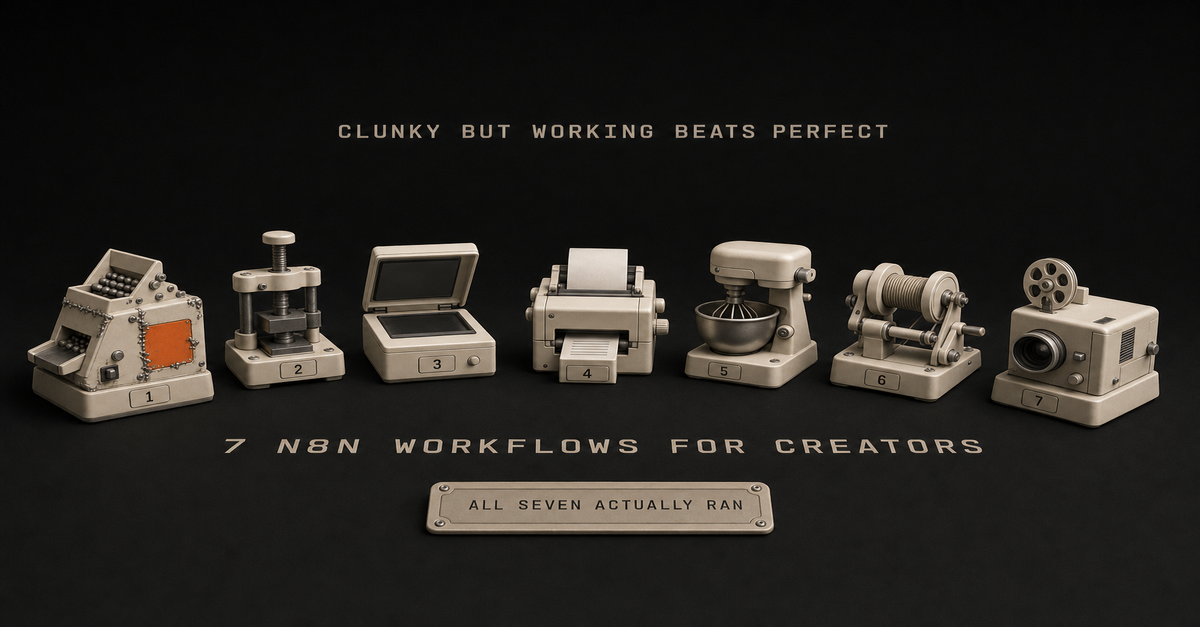
The 7 Tasks Worth Automating First
Some automations pay off way more than others. Here's my rough order, biggest payoff first - your numbers will depend on volume:Email sequences and follow-ups - Welcome sequences, follow-up drips, re-engagement. Usually the one that pays off fastest for a small business.Content repurposing - One blog post or video becomes a LinkedIn post, a thread, a newsletter snippet, and short-form ideas. Build once, run forever.Social media scheduling - Stop manual posting. Build an AI-powered social media workflow that drafts and schedules across platforms.CRM data entry - Every form submission, email reply, or meeting booking auto-populates your CRM. No more copy-pasting contact details.Meeting scheduling - Calendly or TidyCal connected to your CRM and email. Zero back-and-forth.Invoice and payment reminders - Awkward to send manually and easy to forget. Let the system handle it.Data backup and reporting - Weekly dashboards, metrics roundups, and backup routines that run without you thinking about them.Pick one from this list. Just one. Build that first. Then move to the next.The 60-second version, from my Shorts: Stop Hiring VAs. Build These Workflows Instead..What Automation Actually Costs and Saves
Let's set expectations honestly.
The shape, not the magic number:
The savings depend entirely on what you're already doing manually. Two people can both "automate content repurposing" and one saves five minutes a week while the other claws back half a day. Volume and current process drive everything.
What I can tell you from running this stack:Stack cost for a solo operator stays low when you self-host n8n and use APIs you only pay for when they run. Most of the heavy SaaS cost gets replaced by per-token API costs that scale with usage.
Setup is the front-load. Month one is mostly building. Month two is when the saved time starts showing up. By month three, each new workflow is faster because you've learned the patterns.
It doesn't stay saved without maintenance. APIs change. Things break. Set aside a little time each week to fix what broke.If you want to run your own numbers before building, the Automation Priority Audit and the AI Stack Cost Calculator are the tools I'd reach for.I walk through this on camera in 5 AI Automations Running My Business 24/7 (11 min).My Actual Setup: n8n + Claude Code + a Human in the Loop
Most of what's on this site got built in the margins. That matters, because the stack was built for someone with zero spare hours.
Here's how the pieces fit together:The hub: Notion database. Content ideas, task status, publishing schedule all live here.
The automation layer: n8n (self-hosted on Hostinger). Triggers, routing, retries, scheduled checks.
The judgment layer: Claude Code. Where prompts, brand rules, content logic, and code edits live.
The human: me, plus an operations assistant for the parts that still need a person. Anything that ships gets approved.Honestly, it's not set-and-forget. I'm constantly refining the workflows I rely on. They're never "done." If something breaks or slows me down, I fix it the same week.
That's the part of automation nobody talks about. You don't build it once and walk away.
The Mistakes That Cost Me Weeks (So They Don't Cost You)
I've made every mistake on this list. Learn from mine so you don't make your own.
1. Building Before Validating
My first big project was a faceless YouTube channel. Relationship content. Reddit scraping. Auto-generated voiceovers. Took me 2 weeks to build.
I never used it.
I was interested in faceless YouTube as a concept, not passionate about the content. The automation worked perfectly. I just didn't need it. Now I check every idea before I build: "Will I actually use this? Does it solve a real problem in my actual workflow?"
2. Overengineering Everything
That same YouTube automation had 4 agents when it should have had 1. I made it complicated because it felt impressive. It didn't need to be. Your first automation should be simple. One trigger, a few steps, one output. Ship it. Refine later.
3. Skipping Visual Mapping
Every time I've jumped straight into n8n without sketching first, I've regretted it. 10 minutes in Excalidraw saves 4 hours rebuilding. Every time.
4. Not Testing in Small Batches
Don't build a 20-step workflow and hit "execute" for the first time. Build 3 steps. Test. Add 3 more. Test. That way you catch errors before they pile up.
5. Choosing Tools Based on Hype
I watched every "ultimate tool stack" video on YouTube. Felt like I was falling behind because I wasn't using the same 15 tools as everyone else. Turns out most of those creators switch tools every 6 months. Find what works for your workflow and ignore the noise.
Your Monday Morning Is About to Change
You don't need to automate everything this week. Just one thing.
Here's your action plan:Tonight (15 minutes): Pick the one task that eats the most of your time
Tomorrow (30 minutes): Do the brain dump. List every substep.
This week: Feed it into NotebookLM. Let AI find the patterns.
Next week: Build one workflow in n8n. One.That's it. By Week 2, you'll have one automation running and a real read on what it's actually saving you. The number matters less than seeing that your process was the problem all along, not the tools.
You've been working harder than you need to, because nobody showed you this part first. Now you've got it.
Start with the brain dump. The rest gets easier from there.
If you need a place to begin with n8n, start with this beginner tutorial or grab ideas from these 7 workflow examples.
What's the one task you're going to automate first?This post is part of the n8n AI agents hub: definitions, tutorials, workflow patterns, and the build-vs-run decision pages in one place.
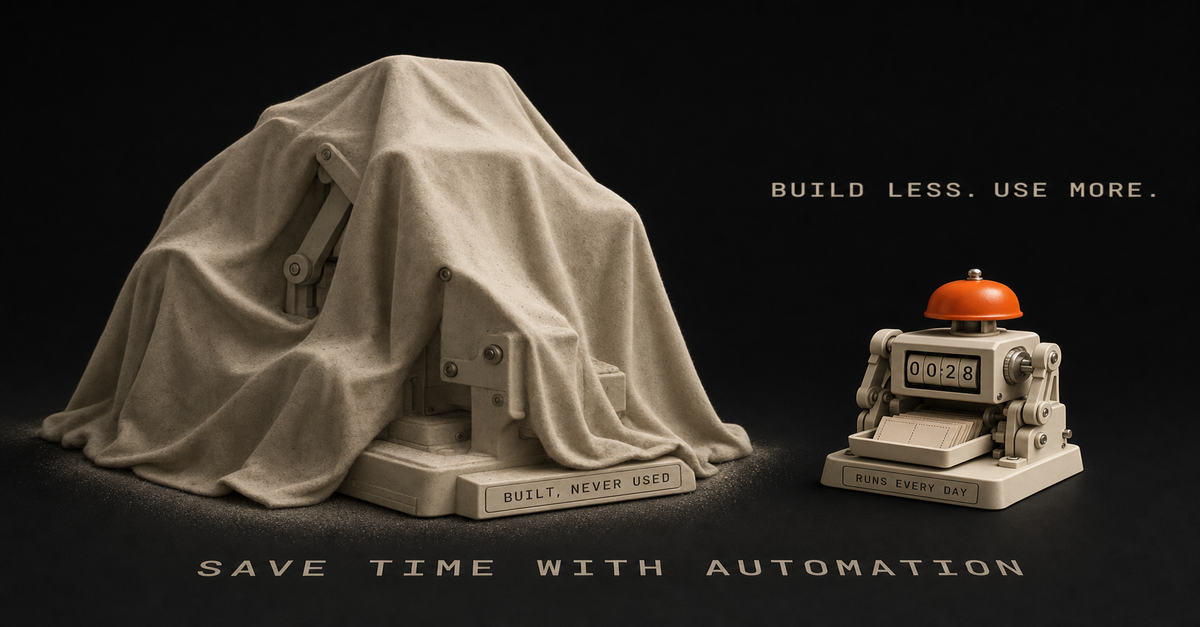
I spent 2 weeks building an automation I never used.
Four agents. Late nights. Reddit scraping, 11Labs voiceovers, Creatomate video stitching - a full faceless YouTube pipeline. The workflow actually worked. Videos would generate automatically from trending relationship posts.
And I never published a single one.
Turns out, I wasn't passionate about relationship content. I was interested in the theory of faceless YouTube, not the content itself. So I built a beautiful machine that sat there collecting digital dust.
Here's what I learned: Automation speeds up whatever you're doing. If you have a broken process, automation just makes it fail faster.
The problem wasn't my n8n skills. The problem was I skipped the part where I figured out if I actually needed this thing.
Sound familiar? Maybe you've spent a Saturday building a workflow that's supposed to save you hours. Then Monday comes, you're back at your desk, and that automation hasn't touched your real work.
That's what this guide is about. Not another "automate everything" tutorial. A way to build automations you'll actually use, instead of weekend projects that just sit there.
Here's the process I use now. I learned it the hard way.
Why Most Automation Advice Fails (And Costs You Weekends)
You've heard the standard automation advice: "If you do something more than twice, automate it."
Sounds reasonable. Except it's not.
Here's the problem. That advice assumes the thing you're doing twice is worth doing at all, and that your process is already good. Automation won't magically make a broken workflow work.
Most people automate broken processes. Then they're confused when automation doesn't save time.
I've been there. I used to admire workflows with 100 nodes. Complex branching logic. Dozens of API calls. "Look at that beautiful automation," I'd think.
Now? I admire the simplest workflows that actually run. The 5-node system you use every week beats the 50-node masterpiece that never gets opened again.
The problem with automation tutorials online is they teach you how to build, not whether to build. Nobody makes viral content about the workflow they decided NOT to create.
So you end up in a loop. Watch tutorial. Get excited. Spend the weekend building. Realize it doesn't fit your actual work. Feel frustrated. Repeat.
Another weekend gone. Nothing shipped.
What you need is a way to decide what to automate in the first place.
The Process-First Framework for Time-Saving Automation
After wasting those 2 weeks on my faceless YouTube system, I changed my approach completely. Now I follow a 4-step process before I ever open n8n.
Step 1: Justify the Use Case
Before building anything, I answer one question: What's the ROI?
Not vague "this would be nice" thinking. Actual numbers.
Here's how I calculate it:How many hours does this task take per week?
How many hours will the automation take to build?
What's the payback period?If a task takes 2 hours weekly and the automation takes 10 hours to build, that's roughly a 5-week payback. Probably worth it.
If a task takes 15 minutes weekly and the automation takes 20 hours to build? You're looking at an 80-week payback. Probably not.
Most people skip this math. They build because building is fun. Then they wonder why their calendar is still full.
Step 2: Document the Manual Process First
This one sounds backwards, but do the thing manually before you automate it.
Not forever. Just long enough to understand what you're actually doing.
I track tasks in a Notion database for 1-2 weeks before automating. I note:What triggers the task?
What are the actual steps?
Where do I make decisions?
What could go wrong?Writing it down shows you what's actually hiding in there. That "simple" task you wanted to automate? It probably has 5 edge cases you'd only discover mid-build.
Finding those edges before building saves hours of debugging later.
Step 3: Sketch It Before Building
What helped most was sketching in Excalidraw before I opened n8n.
I used to jump straight into building. Add a node. Add another. Get tangled in logic. Realize I needed to restructure. Waste 2 hours.
Now I spend 10 minutes sketching first. Just rough boxes and arrows showing:What triggers the workflow
What each step needs to do
Where decisions happen
What the final output looks likeSometimes Claude Code helps me brainstorm the flow. We'll talk through the logic together before I touch any automation tool.
The best part? Sometimes the sketch shows me I don't need automation at all, and I skip the build.
Step 4: Build the Minimum Viable Automation
My first n8n workflow had 4 agents when it should have had 1.
I was so excited about what was possible that I built everything. Reddit scraping AND script writing AND voice generation AND video editing AND publishing. All at once.
That's how you end up with something that never works reliably.
Now I build the smallest version first. One workflow that does one thing. Get it running. Use it for a week. Then add the next piece.
For content repurposing, I didn't start with a 10-step pipeline. I started with: blog post goes in, Twitter thread comes out. One input, one output. Everything else came later.
The 5 Automations That Actually Save Time for SolopreneursSome automations save a few minutes a week. Others give you back real chunks of your day.
These are the five categories I keep coming back to:
1. Content Repurposing
This is one of the automations that saves me the most time.
One piece of content becomes several. A blog post or video turns into a thread, LinkedIn post, newsletter section, and short-form ideas. The ideas stay the same, just reformatted for each platform.
Before automation: an hour per platform of manual rewriting.
After automation: one trigger, multiple drafts, then a short edit pass.
Want a version of this pipeline built for you? Record one long-form video a week, and the Content Flywheel handles drafts, scheduling, and the approval queue in your voice. See Content Flywheel DFY →
Related: How to automate social media posting with AI
2. Social Media Scheduling
Note: I'm not talking about automated engagement or auto-replies. That's a path to getting flagged and annoying people.
I mean scheduling posts you've already drafted. Batch your content, queue it up, let the scheduler handle timing.
Tools like Publer or Buffer make this dead simple. You don't need a custom n8n workflow for this. Sometimes the right tool beats the custom build.
3. Email Triage and Filtering
I don't automate replies. Too risky, too impersonal.
But I absolutely automate sorting. Newsletters go to one folder. Client emails get flagged. Junk gets deleted on arrival. By the time I open my inbox, it's already mostly triaged.
Most email clients have this built in. Gmail filters, Apple Mail rules, whatever. The point is: automate the sorting, not the replying.
4. Meeting Scheduling
The back-and-forth of finding meeting times is pure waste.
Calendly or Cal.com handles this completely. Share a link, they pick a time, it's on the calendar. No "does Tuesday work? How about Thursday?"
This is a solved problem. Don't build a custom solution.
5. Client Onboarding Sequences
When someone becomes a client, there's a checklist: welcome email, project folder, CRM entry, intake form, kickoff call.
Automate that list and every client gets the same onboarding, without you having to remember each step.
Start with the welcome email. Add the rest piece by piece.
Related: n8n workflow examples worth buildingThe 60-second version, from my Shorts: 65% of My AI Automations Were Fake (I Had No Idea).The "Should I Automate This?" FrameworkBefore building any automation, I run through these four questions:
1. Does this task repeat weekly (or more)?
If you do something once a month, the automation probably won't pay off. For monthly tasks, the time you save rarely covers the build.
Weekly or daily tasks? Those are automation gold.
2. Is the process already clear and working?
If you're still figuring out how to do something, don't automate it. You'll bake confusion into the system.
Do it manually until the process is solid. Then automate.
3. Will automation ACTUALLY save time, or just move complexity?
Some "automation" just shifts where you spend time. Instead of doing the task, now you're maintaining the workflow, fixing errors, updating triggers.
Be honest about total time spent, not just time on the original task.
4. Do I need human judgment in the loop?
Some decisions shouldn't be automated. Client communications, creative direction, anything that needs judgment.
Let automation handle the mechanical parts. Keep the judgment for yourself.
If a task passes all four questions, it's a candidate for automation. If it fails any of them, think twice before building.
How to Build Your First Automation (The Right Way)
Ready to build? Here's the process I wish I'd followed from the start.
Pick ONE High-Impact Task
Don't automate five things at once. Pick the one task that:Happens most frequently
Takes the most time
Has the clearest processFor most solo operators, content repurposing or email sorting wins this test. If you're not sure where to start, here are 7 repetitive tasks worth automating first - plus the 30-minute brain dump that helps you find yours.
Sketch the Workflow
Open Excalidraw (it's free) and draw:The trigger (what starts the workflow?)
Each step (what happens next?)
The output (what does success look like?)Spend 10-15 minutes here. It saves hours later.
Choose Your Tool
For most automations, n8n is my go-to. Self-hosted, unlimited workflows, no per-execution fees.
Related: n8n tutorial for beginners - your first workflow in 15 minutes
But sometimes the right answer is a dedicated tool. Calendly for scheduling. Publer for social posting. Don't build what's already solved.
Build the Minimum Version
Start with the smallest version that provides value.
If you're automating content repurposing:Version 1: Blog post → Twitter thread
Version 2: Add LinkedIn
Version 3: Add email
Version 4: Add imagesEach version works independently. You don't need version 4 for version 1 to save time.
Test with Real Data
Don't test with fake examples. Run your actual content through the workflow.
Real data reveals real problems. Edge cases you didn't consider. Formatting issues. API quirks.
Refine Based on What Breaks
Nobody talks about this, but debugging workflows is part of the game.
I run a small set of workflows regularly, and I'm constantly tweaking them. Something breaks, I fix it. Output isn't quite right, I adjust.
Automation isn't set-and-forget. Expect to keep maintaining it and tweaking it.
The good news: each pass makes the system more reliable. After a few weeks of tweaking, you end up with something that mostly runs itself.Want workflows like these delivered weekly?
I share the workflows I'm actually building and refining - what works, what breaks, what I'd do differently. No theory, just systems you can steal.
Start here →Real Automation Workflows You Can Copy
Here are three workflows from my actual system:
Workflow 1: Notion Content Hub → Multi-Platform Publishing
My content operation runs through one Notion database.
The flow:Write draft in Notion
Mark as "Ready to Publish"
n8n detects the status change
Claude reformats for each platform (Twitter, LinkedIn, email)
Content queues in Publer
I wake up to posts scheduledI still review everything before it goes out. Automation does the heavy lifting, but I approve the final output.
Workflow 2: Blog Image Generation with Claude Code
Header images used to be a slog: open the design tool, fight the prompt, drag it into the right folder. Now:Claude Code reads the blog post
Generates image prompt based on content
Calls a Gemini image API
Saves to the right folderI run it, walk away, come back to a header. Most of the wall-clock time is the API.
Workflow 3: YouTube Script → Multi-Format Content
One long-form video becomes multiple assets:Script goes into the system
Pull key points for Twitter thread
Create LinkedIn article summary
Generate newsletter section
Draft TikTok hook ideasI walk through this on camera in The AI Automations That Almost Ruined My Business (11 min).Common Automation Mistakes (I've Made Them All)
I've made every one of these, so you don't have to:
Mistake 1: Automating Before Understanding the Process
This was my faceless YouTube disaster. I automated a process I hadn't validated. Two weeks of work for zero output.
Now I do things manually first. Understand the task. Document the steps. Then automate.
Mistake 2: Building 4 Agents When You Need 1
My first n8n workflow was way overbuilt. Reddit scraping, script writing, voice generation, video creation - all in one system.
Should have been one agent doing one thing well. (If you're building AI agents specifically, I wrote a complete guide to n8n's AI Agent node that shows how to build autonomous, tool-using workflows the right way.)
Start simple. Add complexity only when the simple version works.
Mistake 3: Set-and-Forget Mentality
The myth of "passive" automation. Build once, never touch again.
Doesn't work that way.
APIs change, your needs change, and new edge cases show up. Expect to maintain your workflows, and budget time for it every week.
Mistake 4: Automating Things You Actually Enjoy
Not everything that CAN be automated SHOULD be.
If you enjoy writing Twitter threads, don't fully automate them. Maybe automate the formatting, but keep the creative part.
The point of automating is more time for the work you like. So keep that part for yourself.
Mistake 5: Ignoring Human-in-the-Loop
Full automation sounds great until you send a weird email to a client because an edge case slipped through.
Keep humans in the loop for:Client communications
Final approval before publishing
Anything with real consequencesAutomation handles the grunt work. You handle the judgment calls.
Tools I Actually Use (And Why)
After trying dozens of tools, here's what stuck:
n8n - I ran it self-hosted on a small Hostinger VPS for two years. Unlimited workflows, no per-execution fees. This is where most of my automation used to live.
As of July 2026 that work has moved into Claude Code. But for trigger-based workflows, n8n is still the one I'd hand you. These days you could even run it free on a Mac mini at home.
Heads up: some links in this post are affiliate links: a small kickback to me at no cost to you. I only recommend tools I've actually run.
Claude Code - My most-used tool. Blog writing agents, image generation, workflow brainstorming. If I could only keep one AI tool, it's this one.
Notion - Central hub for all content. Everything flows through Notion databases. n8n watches for changes and triggers workflows.
Publer - Social scheduling. Could I build this in n8n? Probably. But Publer does it better than I could.
Excalidraw - Free workflow planning. Every automation starts as a sketch here.
The point is, use the right tool for the job. Sometimes that's a custom workflow. Sometimes it's a SaaS product. Don't build what's already solved.
Your First Automation Is One Decision Away
Most of what's on this site was built in the margins. Early mornings, late nights, weekends when I could swing it.
You don't need to quit your job to build automation systems. You don't need 40 hours a week. You need a simple process and you need to be willing to start small.
Here's the process again:Justify - Calculate the actual ROI
Document - Do it manually first, understand the process
Sketch - Map it in Excalidraw before building
Build - Start with the minimum version
Refine - Debug, iterate, improveThat's it. Nothing fancy, no expensive course. Just a simple way to build automations you'll actually use.
Pick one task. The one that eats the most time. Run it through the steps above. Sketch it out.
Then build version one. Not the perfect version. The minimum version that works.
You'll save more time with one simple automation that runs reliably than with five complex workflows that never get finished.
The goal is having systems that work while you sleep. You get there by shipping the first one.
Build it this week.This post is part of the n8n AI agents hub: definitions, tutorials, workflow patterns, and the build-vs-run decision pages in one place.
My first n8n workflow was clunky, overcomplicated, and had four agents where one would have done.
But it worked.
That ugly pipeline scraped Reddit, wrote scripts, generated voiceovers, and stitched everything together with Creatomate. A faceless YouTube setup, built by someone who'd never touched n8n before. I never published from it - the real value was learning the tool.
Content work has a catch: the actual creative part is maybe 20% of the time. The other 80% is formatting, scheduling, cross-posting, research. The repetitive tasks that pile up before you even start writing.
n8n is the layer I kept coming back to for that 80% across two years of running it. Self-hosted, unlimited workflows, no per-task fees. (My own automation has since moved into Claude Code, but for trigger-based content workflows like these, n8n is still what I'd point you to.)
Heads up: some links in this post are affiliate links: a small kickback to me at no cost to you. I only recommend tools I've actually run.
Quick caveat before the list: building the right automation matters more than building one well. I've burned plenty of weekends on systems I never used. Here's the framework I use to decide what's worth automating - run any workflow on this list through it before you commit.
What follows are seven workflows worth building. I've run or built most of them myself. Where it's a pattern I'd wire but haven't shipped, I say so in that section.
Treat the time and engagement notes as my own ballparks, not promises - your numbers depend on your volume and audience.
Updated July 2026: n8n's template gallery now lists over 10,000 workflows. That's actually the problem. Nobody needs another list of what you can build. So this is seven worth building, plus two I killed and why - including one on this very list that I no longer think anyone should build.
If you're deciding where n8n should sit next to a coding agent, read my Claude Code vs n8n decision rule first. n8n is best as the reliable trigger/routing layer, not the whole brain.The whole page in one table, including the two workflows this post kills. The frequency test above everything: if you don't do it weekly, don't automate it.
Before you build anything: the frequency test
The most expensive n8n mistake is a well-built workflow you never use.
Plan first. Before you touch the canvas, brainstorm the use case with whatever LLM you already pay for - Claude, ChatGPT, Gemini, whatever. n8n costs you real time, and you do not want to spend hours or days or weeks building something you will barely touch. Build something you can maintain and understand.
The rules I would hold you to:The weekly threshold. If you are not doing the task at least weekly, do not automate it. One r/n8n comment puts the bar well: "if you're doing the same copy-paste or lookup more than 3x a week, automate it. everything else is procrastination disguised as productivity."
The three-hour kill rule. If you are three hours into troubleshooting and still not close to working, that is your signal to stop, not to dig in.
Platform limits are a stop sign, not a challenge. If the API does not support it, that is your answer.
The one-week test. Build the simplest version of one use case. Use it for a week. If you did not touch it, you failed - and you learned that for a week instead of a month.Land on one, two, or three concrete use cases. Then do one at a time and feel it out. Build the simplest version first and scale from there.
More nodes does not make you smarter. Complex workflows are hard to debug, hard to test, take too long to build, and then you do not use them.
That is why two workflows later on this page get killed rather than refreshed.
Why n8n Over Other Automation Tools?
So, the obvious question first: why n8n?
I've tried them all. Zapier's pricing made me do math every time I wanted to automate something. Make (formerly Integromat) is solid, but the visual interface gave me headaches.
n8n hits different:Self-hosted option: Run it on a small VPS and skip per-workflow fees
Unlimited executions: No task counters
Visual workflow builder: See exactly what's happening at each step
Big integration library: Connect to most of the tools you already use
Open source: Community nodes cover the edge casesThe learning curve is real - plan on a weekend to get comfortable. But once it clicks, the per-workflow cost goes near zero. (New to n8n? Start with my beginner's tutorial that walks through the interface and your first workflow.)
Workflow 1: Content Repurposing Engine
What it's for: Stop manually rewriting the same idea into five formats.
This is the workflow that started it all. I write one blog post, and n8n turns it into:3 LinkedIn posts (hook, insight, story format)
5 Twitter/X threads
1 YouTube script outline
1 newsletter sectionHow it works:Webhook triggers when I publish a new post
Claude API extracts key insights and quotable moments
Separate branches format content for each platform
Everything lands in my Notion content calendarWant more powerful AI integration? If you want Claude to make decisions and use tools, not just write content, check out my AI Agent node guide.
The work is in the prompts. Generic "summarize this" prompts produce garbage. I keep iterating on prompts that match my voice and each platform's shape - it's never one-and-done. (Want to see the exact prompts I use? They're in my social media automation tutorial.)
Setup time: About 2 hours for the full pipeline
Key nodes: Webhook Trigger → Claude AI → Multiple branches → Notion APII walk through this on camera in How I Turn 1 Idea Into 7 Days of Posts (n8n Content System) (16 min).Killed: the Engagement-Aware Scheduler (replaced by Workflow 2)
Status: do not build the smart-timing version.
This slot used to hold a scheduler that nudged posting times based on past engagement data. The clever layer is gone. Data-driven scheduling matters less than people think. The bigger win was always just being consistent, so the engagement layer is a lot of nodes for very little.
What survives is the boring half, and that part is worth building.
Workflow 2: Deterministic Stats Pull
What it's for: Getting your real numbers into one place, on a schedule, without touching an API by hand.
The real use case here is pulling raw data into one dashboard.
That's what n8n is best at. It won't make judgment calls, but it will fetch the same data on a schedule, every time.
The pattern I'd wire:Cron trigger, daily or weekly
Query the free YouTube Data API for video stats
Pull LinkedIn numbers via Apify (realistically the only way to get them)
Normalize and write into an n8n Data Table - native structured storage now, no spreadsheet middleman
Read the week-over-week view whenever you want itWhy this one survives the frequency test: you want these numbers every single week, forever, and the task never needs a judgment call. That's exactly the kind of task worth automating.
Honest disclosure: personally I would just do this with Claude, because for me it is easier. But if you want it running on a schedule without you in the loop, this is the version I would build in n8n. Pulling the same data on a schedule is a good use for it.
Setup time: 60-90 minutes, most of it in API credentials.
Workflow 3: Trending Topics Monitor
What it's for: Stop endlessly scrolling for what's blowing up. Let the workflow shortlist it.
How it works:Scheduled trigger every few hours
Pulls from a few sources: subreddits I care about, X/Twitter trends, Google Trends
Claude scores each item for relevance to my audience
Filters by quality
Sends a Slack message with the top few opportunitiesThe real value is catching topics while they're still warm. Most won't be worth covering. The point is to surface the few that are.
Setup time: A couple of hours
Note: Reddit API requires developer access. The X API got expensive. Perplexity, news APIs, or RSS-based sources are reasonable alternatives.
Want a content flywheel built around your videos? If you'd rather skip the wiring entirely - workflow, voice prompts, approval queue - take a look at Content Flywheel DFY.
Workflow 4: Email Newsletter Automation
What it's for: Cut the "blank-page Thursday" panic before sending a weekly newsletter.
My newsletter workflow is embarrassingly simple, but it removed the biggest weekly headache.
How it works:Every Thursday at 9 AM, workflow triggers
Pulls my top-performing content from the week (based on analytics)
Grabs any bookmarked links from my research
Claude drafts the newsletter with my structure
Sends draft to my email for reviewI still edit and personalize. But the 80% that's just assembly? Automated.
Setup time: 1 hour
Key insight: Don't try to fully automate newsletters. The personal touch matters. Let the workflow handle the structure.
Workflow 5: Research and Clipping Pipeline
What it's for: Stop losing the ideas that pop up at random times.
Every content creator has the same problem: ideas pop up at the wrong moment and disappear before you can use them.
This workflow captures everything.
How it works:Multiple entry points: email forwarding, Slack command, browser extension webhook
Everything funnels into a central processor
Claude categorizes, tags, and summarizes
Stores in Notion with full metadata
Weekly digest of unused clipsMy "content ideas" folder used to be a graveyard. With this in place, it's at least searchable and tagged, so I can actually find an idea later.
Setup time: 2 hours
The thing that actually matters: The categorization step. Without it, you just create a different kind of mess.
Killed: YouTube Thumbnail and Title Testing
Status: do not build this. I killed mine.
This page used to recommend it. It generated title variations, made thumbnail text variants, ran YouTube's built-in title test, and logged results to a spreadsheet for pattern analysis.
Two reasons it is gone:It didn't work. The dataset never got big enough or clean enough to tell me anything I could act on.
It costs more than the alternative. Every generated variant burns API credits. I can test the same ideas for free inside the ChatGPT subscription I already pay for.If a workflow costs money and does worse than something you already pay for, it's more of a hobby than an automation.
Keep the habit, though. Testing titles and thumbnails is still worth doing. Just do it in a chat window, for free, when you are about to upload.
Workflow 6: Your n8n Workflows as Tools for Claude (MCP Server Trigger, new in 2026)
What it's for: Letting the AI you already talk to trigger the automations you already built.
This is the newest thing on this list and the one I would look at first if you are starting today. n8n can now act as an MCP server - meaning your workflows become tools that Claude or another assistant can call directly.
The pattern I'd wire:MCP Server Trigger node, which gives you a test URL and a production URL
Bearer or header auth so it is not open to the world
Behind it, the workflows you already trust - the stats pull, the clipping pipeline
Connect it to Claude Desktop, then just ask in plain languageWhy this matters: it fixes the problem this whole page keeps running into. n8n handles the reliable triggers and connections. The model does the thinking. You stop trying to make n8n think, and you stop running your automations by hand.
Setup time: 30 minutes if the workflow already exists.
Workflow 7: Content Performance Dashboard
What it's for: Stop opening five analytics tabs to figure out what's working.
This workflow doesn't create content. It tells me what's working.
How it works:Daily trigger at midnight
Pulls analytics from: Google Analytics, YouTube, Twitter, LinkedIn
Normalizes data and calculates week-over-week trends
Generates a Slack report with insights
Flags posts that need updating or promotionIt's hard to say exactly what this one is worth. But having a single daily report instead of five tabs makes it more likely I'll actually look at the numbers.
Setup time: 3 hours (most complex workflow on this list)
Note: Analytics APIs can be finicky. Expect some debugging.The 60-second version, from my Shorts: Stop Building Complex n8n Workflows.Getting Started: The Practical Path
Don't try to build every workflow on this page in one weekend. You'll burn out.
Here's what I'd recommend:
Week 1: Pick ONE workflow that addresses your biggest pain point. Build the simplest version that works.
Week 2: Refine that workflow. Add error handling. Test edge cases. Make it bulletproof.
Week 3: Add a second workflow. Build on what you learned.
Each workflow you finish makes the next one easier - you reuse credentials, prompt patterns, and debugging instincts. That's where it really adds up.
The Honest ROI Picture
Let me be straight about what to expect:
Upfront investment:n8n learning curve: a weekend, give or take
Each workflow: a few hours to build, more to make reliable
Refinement: ongoingReturns:Less time on the boring 80% (formatting, scheduling, cross-posting)
Faster turnaround on ideas
Less burnout
A system you can keep editing instead of rebuilding from scratchWhat you don't get: a magic ratio. Time savings depend on what you're already doing manually. The real payoff shows up after a few months of running and tweaking, not week one.
Common Mistakes to Avoid
The mistakes I keep seeing (and have made):Over-engineering from day one. Start simple. Add complexity later.No error handling. Workflows break. Build in notifications so you know when they fail.Generic AI prompts. The quality of your AI-powered workflows depends entirely on your prompts. Spend time here.Forgetting the human element. Some things shouldn't be automated. Editorial judgment, relationship building, creative direction - keep those human.Not documenting. Future you will thank present you for leaving notes about what each workflow does and why.What's Next
These are the workflows I keep coming back to. They handle the boring parts so I can spend time on the parts that actually need a human. The two I killed are here because knowing what to skip saves you more time than another template.
The point is to spend the time you actually have on the work that needs you.
Pick one workflow. The one that'll remove the chore you hate most. Build that this week.
Then come back and grab the next one.
More n8n Tutorials
Step-by-step guides with screenshots, prompts, and the patterns I use:Social Media Automation: How to automate social media posts with AI
Agentic workflows: n8n AI Agent tutorial
Stack split: Claude Code vs n8nGet the free prompt pack →This post is part of the n8n AI agents hub: definitions, tutorials, workflow patterns, and the build-vs-run decision pages in one place.
 Chris Alarcon