Quick answer: the best AI stack for solo founders is the smallest one that covers your actual jobs. Mine is five tools, one job each. The rule that keeps it small: if a tool doesn’t earn its keep every week, it’s a candidate to cut.
Most stack posts hand you twenty ranked tools. That’s not a stack, that’s a shopping list. Here’s what I actually run.
What I actually run
| Tool | Its one job |
|---|---|
| Claude | Everyday content, thinking, and the actual work |
| Blotato | Scheduling and distribution |
| ChatGPT ($20) | General-purpose second opinion |
| Kit | Newsletter and owned email |
| VidIQ | YouTube, and only if you post on YouTube |
That’s it. Two AI subscriptions at $20 each, a scheduler, an email platform, and one channel tool I’d drop tomorrow if I stopped posting video.
The Blotato, Kit, and VidIQ links are affiliate links — a small kickback to me at no cost to you. Every tool in this table is one I pay for and run; nothing is here for the commission.
On paying for both Claude and ChatGPT: it’s not indecision. If you max out your usage on one, paying $20 on the other is a cheap way to keep working instead of waiting out a limit. Two $20 subscriptions solve a real problem. A fifth AI subscription solves a feeling.
VidIQ has the honest asterisk: it’s in my stack because I post on YouTube. If you don’t, that row doesn’t exist for you. That’s how a stack should work: every tool traces to something you actually do.
The 60-second version, from my Shorts: 10 AI tools I use to ship as a one-person operator.
The rule: one job per tool
The failure mode isn’t picking the wrong tool. It’s collecting five tools that each do 40% of one job.
This is the loudest complaint in every founder thread on the subject. As u/CellCog put it on r/AI_Agents: “Most people evaluate tools feature-by-feature and end up with five overlapping subscriptions doing 40% of one job each.” The fix in the same comment is the right one. Pick your most repetitive multi-step workflow, write down how you’d explain it to a new hire, then evaluate tools against that document.
Workflow first, tool second. Almost everyone does it backward.
Cut this
Here’s the section the ranked listicles won’t write, because they’re affiliate-linked to everything they mention.
Next on my cut list: Notion. I don’t really use it beyond the basic features. Paying for a database platform to store notes I could store anywhere is exactly the kind of quiet overlap that survives because you never audit it.
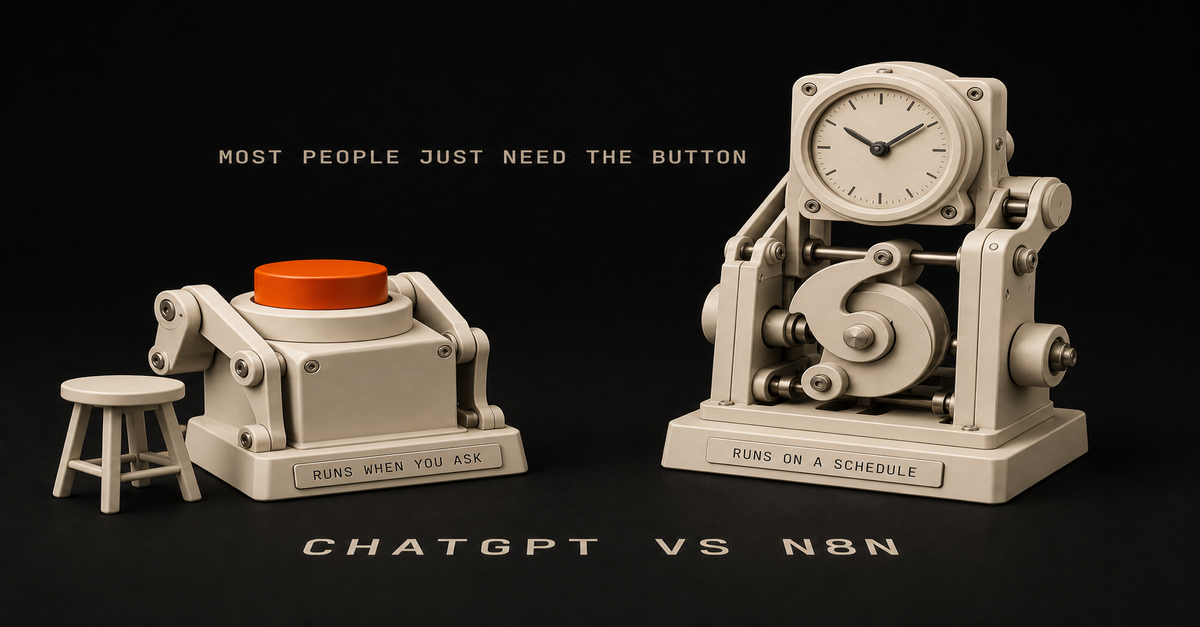
Already gone: n8n. I used to run a large n8n setup, and for a while it was genuinely brilliant. It would write, it would post, it would call APIs, and it was impressive. I don’t use it at all anymore, including the self-hosted instance. Not because it’s a bad tool. Because the work moved.
The thing that killed it for me: a complex process might be 47 nodes in a workflow builder. Step one, scrape this. Fine, that’s easy. But then it’s do this, then do that, and you’re embedding complex prompts into an agent node, wiring up specific tools, and it just becomes a little complex. It takes more time. It’ll take you an hour to build something you could have tested and delivered in that same hour as a skill.
Those 47 nodes become a simple skill. That’s the whole migration in one sentence.
I’m not telling you to cancel your automation tool. I’m telling you that “I built it, so I keep it” is not a reason, and that the honest audit question is: did I use this last week?
The four questions your stack has to answer
Before you add anything, make it answer one of these:
| Question | The job | Good answer |
|---|---|---|
| What am I making? | Creation | One AI that can do the real work, not just chat about it |
| How does it get out? | Distribution | A scheduler, plus the channels you actually post to |
| Who hears about it? | Owned audience | An email platform you control |
| What do I remember? | Memory | One place for decisions and reusable prompts, not two |
If a tool doesn’t answer one of those, it’s not part of the stack yet. If two tools answer the same one, you’re paying twice.
What $20 now buys that it didn’t in May
Two changes worth knowing about, because both reduce the number of tools you need rather than adding to it:
Claude Cowork gives non-coders agentic execution in the app: you hand it a task instead of a prompt. You still review the output; it isn’t a set-and-forget employee. It’s included at the Pro tier.
Voice mode with connected apps (updated July 23, 2026) means light ops, like moving a calendar item or capturing a note, can happen by talking. I spent a while testing it by booking calendar items out loud. Worth knowing the limits before you plan around it: the free plan gives you Haiku and a single connected tool, and the underlying voice model didn’t change. I wrote up what Claude voice mode can actually do in my voice mode breakdown.
Both of these are the $20 tier absorbing jobs that used to need extra tools. That’s the direction you want your stack moving.
The $20 / $100 / $200 question
| Tier | Cost | Who it’s for |
|---|---|---|
| One AI subscription | $20/mo (Claude Pro is $20 monthly; annual billing is listed as $17/mo, $200 up front) | Almost every solo founder starting out |
| Two AI subscriptions | ~$40/mo in AI alone, before your scheduler and email tools | You hit usage limits during real work and don’t want to stop |
| Max / Pro tiers | From $100/mo | You live in an AI tool all day, every day |
Pricing from claude.com/pricing, checked July 27, 2026.
Most solo founders do not need the $100 tier. The upgrade trigger is hitting limits repeatedly during work that matters, not ambition. If you want to compare the top tiers honestly, I broke that down in Claude Max vs ChatGPT Pro.
Use the AI stack cost calculator if you want to model your own number.
What to automate first
Don’t automate your business. Automate the loop that turns work you already did into distribution:
- Do the task manually once.
- Write down the steps.
- Delete the steps that shouldn’t exist.
- Hand the repeatable part to your AI tool.
- Keep yourself in the approval seat anywhere quality matters.
Step three is the one everyone skips, and it’s the one that saves you from automating a mess. Half of what looks like an automation problem is a process that shouldn’t exist.
For deciding what’s worth automating at all, use the automation priority audit.
FAQ
What is the best AI stack for solo founders?
The smallest one that covers your real jobs. Five tools with one job each beats twenty overlapping subscriptions.
What is the cheapest AI stack for solo founders?
Around $40 a month: one or two AI subscriptions at $20, email on a free or starter tier, and a static site on a free host.
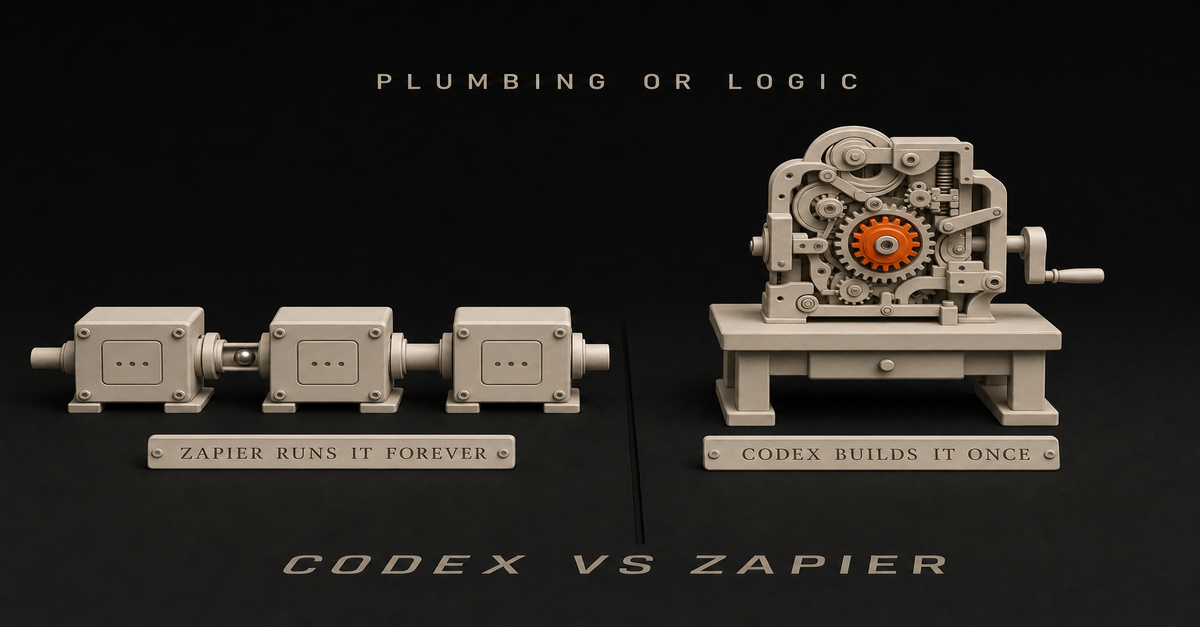
Do I need n8n or Zapier?
Only if something must run on a trigger without you. I ran a large n8n setup and stopped using it entirely once the work was easier to run directly through an AI agent. Plenty of solo founders never need one.
Do I need a vector database?
Almost certainly not at the start. Cleaner files and searchable notes solve the problem you actually have.
How do I know a tool is worth keeping?
Ask whether you used it last week. Not last quarter. If you can’t name what it did for you in the past seven days, it’s a candidate to cut.
Want help mapping the lean stack to your actual workflow? Start here.
This post is part of Claude at Work, the hub with every plan decision, task comparison, and setup guide for using Claude at your job without code.

Written by
Chris AlarconChris Alarcon builds Ship Lean: the boring Claude and AI setups that actually work, handed to people who don’t code. He runs his one-person operation on these systems, around a full-time job, and shares every workflow, prompt, and tool combo in public. Start with the 15 prompts he uses every day.
Work With Me
Setting this up for your team?
I do that. The right plan per seat, the boring setup that makes it stick, and the first three chores handed off. A 2-hour workshop or a done-with-you build, for teams of 2-50.
See how it works →The 15 AI prompts I actually use every day
I tested hundreds and kept the 15 that survived at my desk. You get them right away, then one short Ship Lean note every Tuesday.