In this article
Most people asking this question do not need n8n.
Here is the test. If a task happens when you ask for it, and you are sitting there while it happens, a good reusable prompt covers it. n8n earns its place in exactly one situation: the same task has to run on a schedule or a trigger, without you, across two or more apps. That describes far fewer tasks than YouTube makes it sound.
I use both tools every week, so this is not tool loyalty. It is more like “do not buy a forklift to carry groceries.”
What is the actual difference between ChatGPT and n8n?
They are not competitors. They do completely different jobs.
ChatGPT (or Claude) is a thinking tool. You give it something, it gives you something back. Summarize these meeting notes. Draft this awkward email. Turn 40 survey responses into the five complaints that actually matter. You are present for every exchange, and that is fine, because the task only exists when you ask for it.
n8n is plumbing. It moves data between apps when something happens. A form gets submitted, so a row lands in a spreadsheet and a Slack message goes out. Nobody is sitting there. That is the entire point of it.
The confusion comes from demo videos where n8n has an AI step in the middle, so it looks like “ChatGPT, but automated.” True as far as it goes. But that AI step does the same job ChatGPT does in your browser tab. The real question is never which tool is smarter. The question is whether the task needs to happen without you.
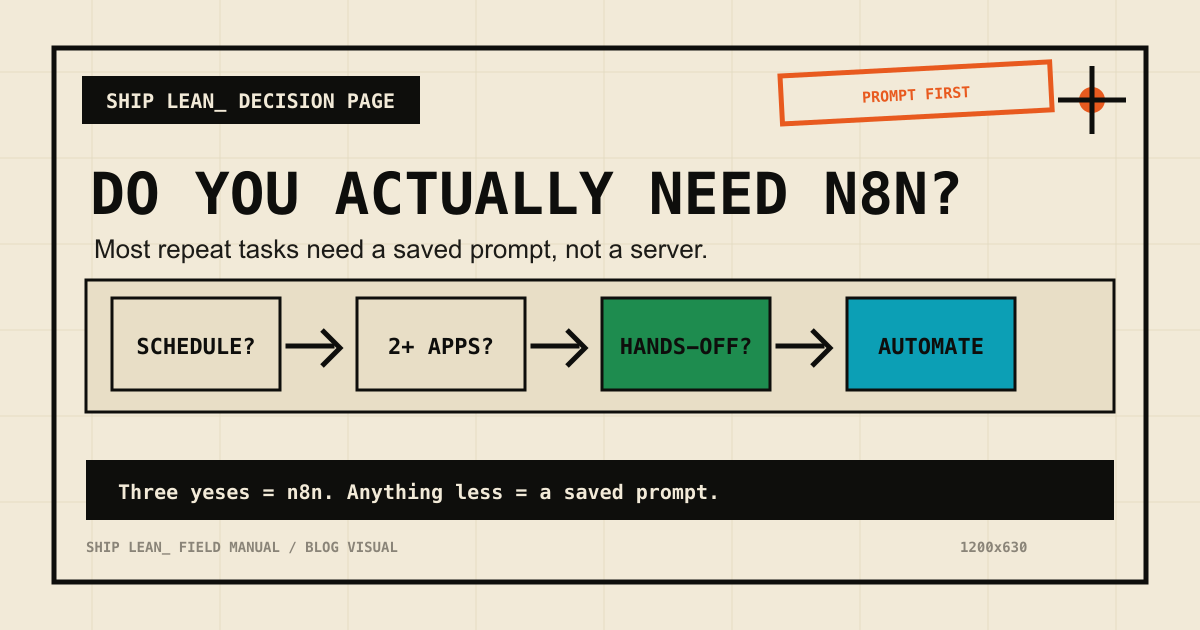
How do you know if you need n8n? Ask 3 questions
Run any task you are thinking about through these:
- Does it repeat on a schedule or a predictable trigger? Every Monday morning. Every time a form comes in. Every new invoice.
- Does it cross two or more apps? Form to spreadsheet to email. Inbox to tracker to Slack.
- Does it need to run when you are not watching? Overnight, during meetings, while you are on leave.
Three yeses: automation software is worth a look. Two or fewer: a saved prompt almost certainly covers it, and it covers it today, for free, with nothing to maintain.
Real examples:
- “Summarize my meeting notes into action items.” You are present, one app, on demand. Prompt.
- “Help me draft replies to difficult parent emails.” On demand, you review every word anyway. Prompt.
- “Every Friday at 4pm, pull this week’s form responses, summarize the complaints, and email me the digest.” Scheduled, three apps, runs alone. That is a real n8n job.
- “When a new applicant submits the intake form, score them against the role requirements and add the score to my tracking sheet.” Triggered, multiple apps, unattended. Also a real n8n job.
Notice the pattern. The prompt tasks are about judgment and wording. The automation tasks are about moving the same data the same way, over and over, with nobody watching.
ChatGPT vs n8n: quick comparison
| The task | Use |
|---|---|
| Summarize notes, docs, or transcripts on demand | ChatGPT prompt |
| Draft or rewrite emails in your voice | ChatGPT prompt |
| Turn messy feedback into clear themes | ChatGPT prompt |
| Prep for a meeting from an agenda and past notes | ChatGPT prompt |
| Move form responses into a sheet automatically | n8n |
| Send a weekly report without touching it | n8n |
| Watch an inbox and route requests to the right person | n8n |
| Score or sort new entries the same way every time | n8n with an AI step |
| Anything you do once or twice, ever | Neither. Just do it. |
If your whole list lands in the top half of that table, you have your answer. Save your prompts and skip the software.
What does n8n really cost if you cannot code?
This is the part the tutorials skip, so let me be the honest friend here.
Money. n8n Cloud starts around $25 a month. The “free” self-hosted version needs a server, usually $5 to $10 a month, plus you become responsible for installing it, updating it, and backing it up. If words like Docker mean nothing to you, self-hosting is not free. It is a part-time hobby.
Setup time. Your first real workflow takes an afternoon, not the 8 minutes the video showed. Most of that time is not building. It is connecting accounts: API keys, permission screens, and figuring out why Google says no. Plan 3 to 4 hours for workflow number one.
Debugging. Workflows break silently. A password-like credential expires. An app changes how it sends data. The workflow you built in March fails quietly in June, and you find out because the Friday report never showed up. Then you are staring at a red error node and a message written for engineers.
Maintenance. Every workflow you build is a small machine you now own. A few simple ones might need an hour a month. But it never goes to zero, and you are the repair person.
None of this means avoid n8n. It means n8n has to earn that overhead. A saved prompt has zero of these costs, which is why it should always be your first move.
When is a reusable prompt all you need?
If you are present when the task happens, the prompt is the automation.
The trick is writing it once, properly, and saving it, instead of improvising a new mediocre prompt every time. A reusable prompt spells out four things: who the AI should act as, what input you will paste in, the exact format you want back, and one example of a good output. That takes 15 minutes to write and pays you back every week after.
Then keep your prompts somewhere you can grab them: a doc, a notes app, whatever you will actually open. If you want a starting set, I keep 15 reusable work prompts here, built for exactly this kind of on-demand work.
The honest comparison: a prompt like this saves you 20 minutes every time you use it, costs nothing, and cannot break while you sleep. That is a high bar for automation software to clear.
When does n8n actually make sense?
Volume and absence. Those are the two things that flip the answer.
If 30 form submissions arrive every week and each one needs the same three steps, you are not doing judgment work anymore. You are being a conveyor belt. Same if the task has to fire at 6am or while you are on vacation. No prompt fixes “I was not there.”
If a task passes the 3-question test, the pattern that holds up is boring: a trigger, a step that gathers the data, an AI step for any judgment call, a human approval for anything customer-facing, then route the result. I wrote up that exact pattern in the n8n AI agent workflow if you get to that point.
Also, an option nobody mentions: you do not have to build it yourself. If the task clearly qualifies but the setup sounds miserable, ask IT, or pay a freelancer for a day. A capable n8n freelancer can build a clean first workflow in a day. The building is the cheap part. The maintaining is what you are really signing up for, so decide who owns that before anything gets built.
One more fork in the road: if you or a technical coworker work in code all day, the comparison changes shape. That version of the decision is in Claude Code vs n8n.
What I would do first
Skip the software question for one week and do this instead:
- List every task you repeat weekly. Most people find 8 to 12.
- Run each one through the 3 questions: schedule or trigger, 2+ apps, runs without you.
- For everything that fails the test, write and save the prompt today. That is 15 minutes per task.
- For the one or two that pass, score them with the automation priority audit before you sign up for anything. It forces the time-saved versus time-spent math that the excitement skips.
When I run this with people, the usual result is nine prompt tasks and one genuine automation candidate. That ratio is normal. It is also good news: you can fix most of your repetitive work this afternoon, without buying, hosting, or maintaining anything.
The boring answer wins here. Prompts first. n8n only when a task proves it deserves a machine.
FAQ
Is n8n better than ChatGPT?
Neither is better. They do different jobs. ChatGPT answers when you ask it something. n8n moves work between apps on a schedule or trigger, without you present. Most people only need the first one.
Can ChatGPT replace n8n?
For on-demand tasks where you are present, yes. A saved prompt covers summarizing, drafting, and rewriting. ChatGPT cannot replace n8n for tasks that must run unattended across multiple apps.
Do I need to know how to code to use n8n?
You can build simple workflows without code, but it gets technical fast: API credentials, error logs, and data formats. Budget real time for setup and debugging, or pay someone to build it.
Is n8n free?
The software can be self-hosted free, but you pay for a server, plus your time for setup, updates, and fixing broken workflows. n8n Cloud starts around $25 a month and removes the server work.

Written by
Chris AlarconChris Alarcon builds Ship Lean: practical AI systems for people running one-person businesses who need their real work to turn into distribution and revenue. He shares the exact Claude Code, n8n, content, and workflow systems he uses in public.
Work With Me
Turn proof into distribution
If the article exposed a bottleneck, I can help map the system, build the assets, and route it into tools, workflows, AEO content, newsletters, and short-form distribution.
See the offer →Want more workflows like this?
Every Saturday I send one automation workflow you can steal. Real systems, not theory. Join builders turning product work into distribution.
Get Saturday's Workflow →