In this article
- 1 One recording feeds seven stages, and I only own two of them
- 2 Stage by stage, in plain English
- 3 Approving beats producing: my weekly clock
- 4 What breaks, because something always does
- 5 Steal this: the minimum version
- 6 This costs me subscriptions and one upfront month of evenings
- 7 How I know what is on this page
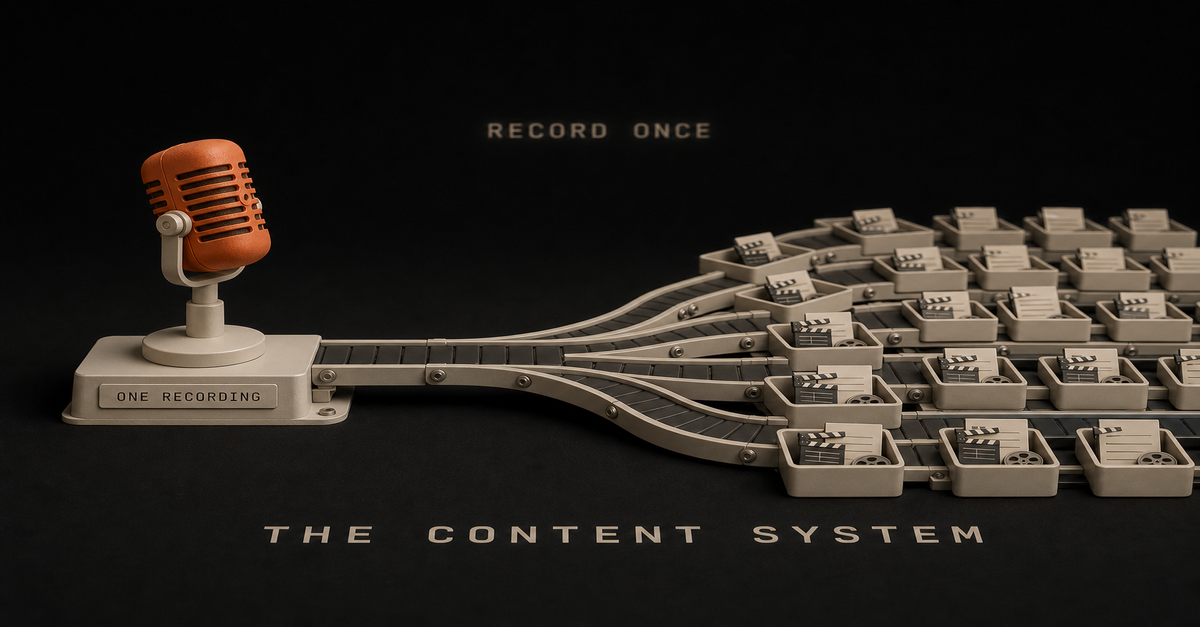
Quick answer: my whole content operation runs on one rule: record once, systematize everything after. One talking-head session becomes a batch of 14 shorts.
The same week’s thinking becomes blog posts, a Tuesday newsletter, and LinkedIn posts. I built the systems that run it using Claude Code for content creation, in plain English.
This page is the actual system, documented: the pipeline, the weekly clock, what breaks, and the smallest version worth stealing.
Call it my rule: record once, systematize after. It’s how one person keeps up on five platforms.
Published August 28, 2026. Last reviewed August 2026, against the pipeline I am running this week.
I would not survive without this. Just do the math. A single person working full time cannot manually produce daily shorts, weekly long-form, a newsletter, LinkedIn, and a blog. With systems, I do.
I walk through this on camera in How I Run a 14 Shorts/Week Content Op in 5 Hours (26 min).
One recording feeds seven stages, and I only own two of them
| Stage | What happens | Who does it |
|---|---|---|
| 1. Record | One talking-head session on my phone, handheld mic | Me, the only unautomatable part |
| 2. Cut | Transcribe, strip retakes and dead air, render clean cuts | Claude Code system |
| 3. QA | The cut’s transcript is compared against the original; ship or fix | System checks, I approve |
| 4. Polish | Title overlay, captions, proof screenshots, color, audio mastering | System, with my review |
| 5. Schedule | Batch-upload to TikTok, YouTube Shorts, Instagram | System via a scheduler |
| 6. Repurpose | Newsletter and LinkedIn get native rewrites of the week’s ideas | System drafts, I edit |
| 7. Learn | Weekly analytics review decides next week’s topics | System pulls, I decide |
You can check it yourself. This is what comes out the other end:
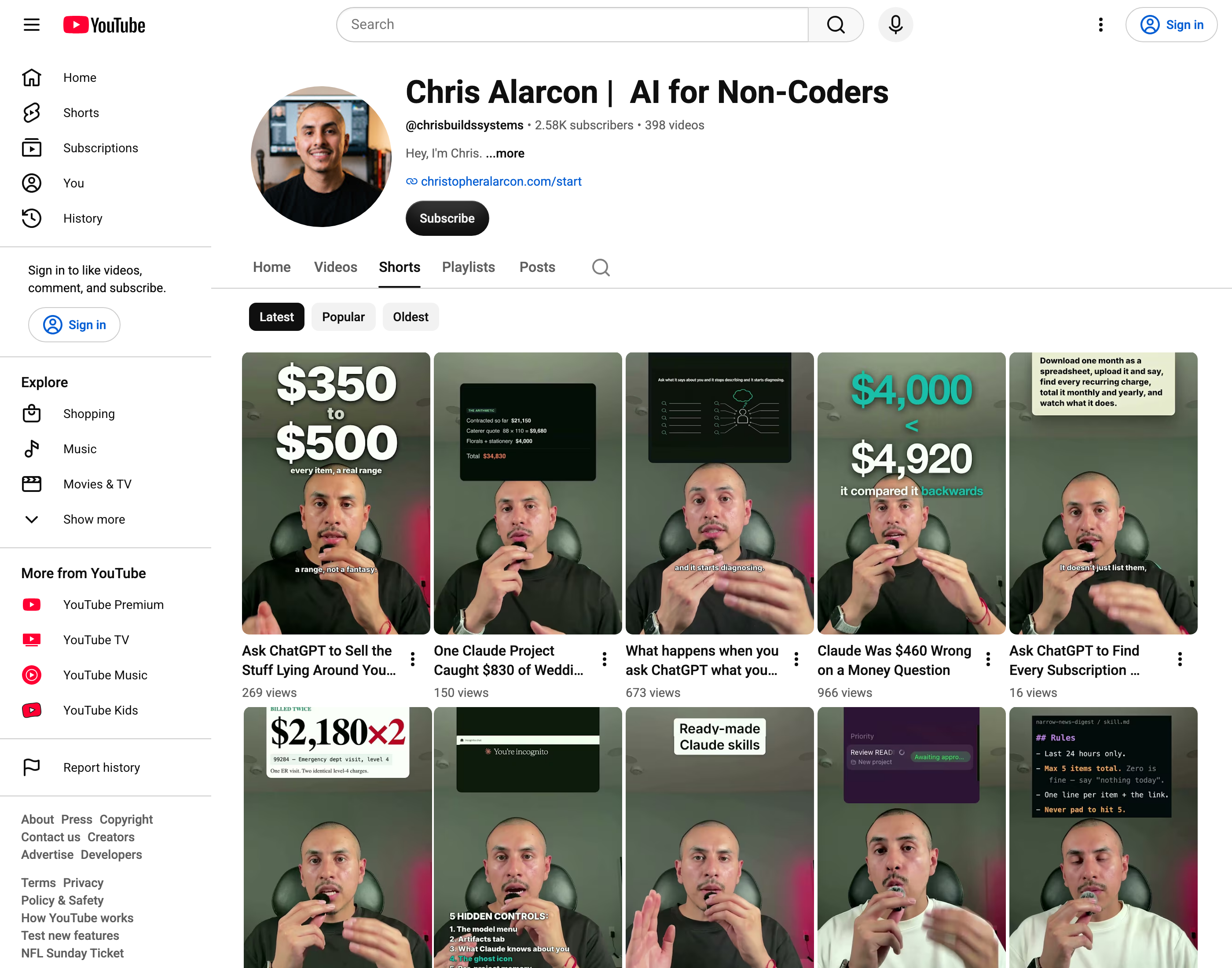 My actual shorts page. The price overlays, captions, and proof cards on these are stages 4 and 5 of this system doing their job. Check the channel and compare recent videos with four months ago; the difference is the system maturing.
Stage by stage, in plain English
Recording is sacred; everything else is negotiable. I batch one recording session and speak every short in it, retakes and all, because the system’s first job is cleaning up after me. Handheld mic, phone camera, no crew.
The cut. A Claude Code system transcribes the raw footage, finds my retakes and rambles, and produces clean edit decisions before rendering. This used to be my evenings. The key part: it keeps my words instead of “improving” them, because the voice is the product.
The QA gate. Every cut gets re-transcribed and compared to the original, and the system has to answer one question: did the edit clip a word or break a sentence? Ship or fix, with timestamps. Without gates like this, the whole thing is a slot machine.
Polish. Titles get placed in the safe zone, captions get styled and checked against the transcript, real screenshots get captured for any claim that needs proof on screen, and audio gets mastered to broadcast loudness. Every step here started as something I did badly by hand at midnight.
Repurposing is a rewrite, never a copy-paste. The newsletter takes the week’s idea and rebuilds it for email instead of dumping the transcript. LinkedIn posts get rebuilt for LinkedIn. Same idea, different format.
Copy-pasting is the most common mistake in repurposing advice, and skipping it is why my other channels actually work. My older post on the fan-out idea, one YouTube video into 13 content assets, covers the map. This page is the machine that runs it.
Approving beats producing: my weekly clock
- One sitting: topic selection, driven by last week’s numbers, not vibes.
- One sitting: the recording batch.
- Unattended: cutting, QA, polish runs.
- Short gates through the week: I approve cuts, titles, and the final schedule. Approving is way faster than producing, and that’s the point.
- Tuesday: newsletter ships.
- Friday: the blog engine publishes its batch, and this post came out of that same system.
All in, it’s a few focused hours a week on content that used to eat all of them.
What breaks, because something always does
If I showed you this system without what breaks, it’d just be an ad. On r/NewTubers, the question “How are people pumping out edited YouTube videos so fast?” pulled 110+ comments in four weeks (the thread). In my case, the answer is the gates.
What broke for me this month: a captioning step once spliced in the wrong video’s captions because two jobs shared a folder. The QA gate caught it. The editor occasionally proposes a cut that clips a word, which is why the transcript-compare gate exists.
An automated pacing pass got rejected three times in one week and we shipped the un-paced versions, because the gate said the “improvement” was not one. And my newsletter ran with broken links for longer than I want to admit, which is why analytics review is now a scheduled stage instead of a guilty thought.
Same point in all four: automate without a checking step and you just make mistakes faster.
The 60-second version, from my Shorts: This Claude Code Skill Ships 14 Shorts a Week for Me.
Steal this: the minimum version
You don’t need my whole machine. Build this version first. It works on one $20 AI plan with zero code:
- Write your process as numbered steps. If you can’t, stop here. That’s the real blocker.
- Automate the transcript. Record once, get text. Every downstream asset starts from text.
- Build one rewrite lane, not five. Pick the platform you care about second-most and have Claude rewrite your recording’s idea natively for it, with your three best posts as the style reference.
- Add one QA question per stage. “Did it clip words?” “Does this sound like me?”
- Only then add platforms. Each new surface is a new rewrite lane on the same recording, not new work.
If you are non-technical and post weekly, build steps 1-3 and stop. If you already record long-form, start at step 3 and add one rewrite lane. If you have no consistent recording habit, none of this helps yet; fix that first.
The deeper walkthrough of that starter shape is in the content repurposing workflow, and if you are deciding which AI subscription carries it, start with Claude Pro vs ChatGPT Plus. Everything else I run is on my AI systems page.
This costs me subscriptions and one upfront month of evenings
Subscriptions: I run the heavy stack because the machine earns it, Claude at the top tier plus two $100 plans I compared here, and a scheduler (I use Blotato; the tool matters less than having one).
I skip the repurposing SaaS tools on purpose, the Opus Clips and Repurpose.ios of the world. A clip-cutter without my gates is just faster slop. Same logic for wiring this through Zapier or n8n before the process itself is solid.
A leaner copy runs on one $20 plan and patience. The real cost was upfront: weeks of evenings building stages with Claude Code in plain English and teaching the gates my taste. I wrote up what that cost me in my real Claude Code usage.
How I know what is on this page
Everything here comes from my own operation. You can check the output yourself on the shorts channel, this blog’s weekly schedule, and the newsletter.
The failure stories are from my own logs this month. I kept them in on purpose, since a system page with no failures is basically fiction. Where a number is fuzzy, like hours per week, I gave you the honest range instead of a marketing one.

Written by
Chris AlarconChris Alarcon shows people who don’t code the boring Claude setup that actually works. He runs his one-person operation on these systems and shares every workflow, prompt, and tool combo in public. Start with the 15 prompts he uses every day.
The boring setup
It still won't know you tomorrow.
The Setup is one folder. Drop it into a Project, answer three questions, and Claude or ChatGPT writes your memory file and your voice file itself. It stops forgetting you, stops sounding like AI, and runs three real jobs by name. Twenty minutes tonight. No code. $39, 30-day refund.
See The Setup →The 15 AI prompts I actually use every day
I tested hundreds and kept the 15 that survived. You get them right away, then one short email from me every Tuesday.