In this article
- 1 Quick comparison
- 2 The 10-second decision rule
- 3 When to use Claude Code: messy work with context
- 4 When to use n8n: repeatable work with triggers
- 5 The best pattern: Claude Code plus n8n plus human approval
- 6 What should solo builders choose first?
- 7 Common mistake: using n8n as the whole brain
- 8 Common mistake: using Claude Code for recurring ops
- 9 The Ship Lean setup I would run
- 10 FAQ
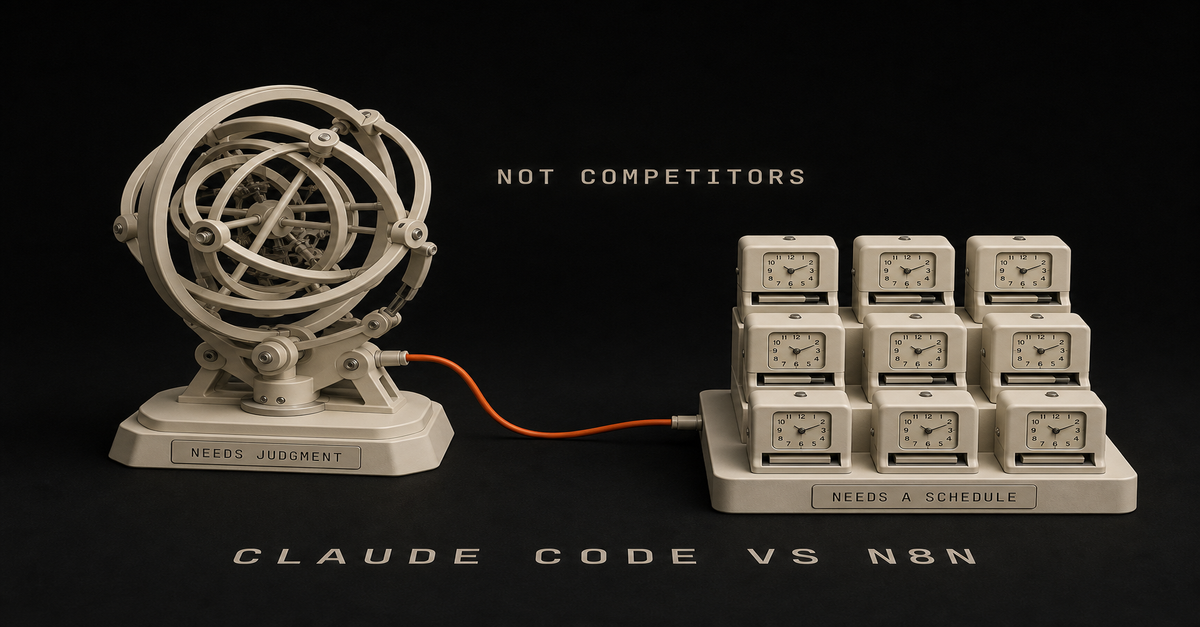
Whether you search it as “Claude Code vs n8n” or “n8n vs Claude Code,” the answer is the same: they are not competitors. They are different parts of the same operating system.
Use Claude Code when the task needs judgment, file edits, writing, reasoning, or codebase awareness.
Use n8n when the task needs triggers, data movement, scheduled runs, retries, and integrations.
Heads up: some links in this post are affiliate links — a small kickback to me at no cost to you. I only recommend tools I’ve actually run.
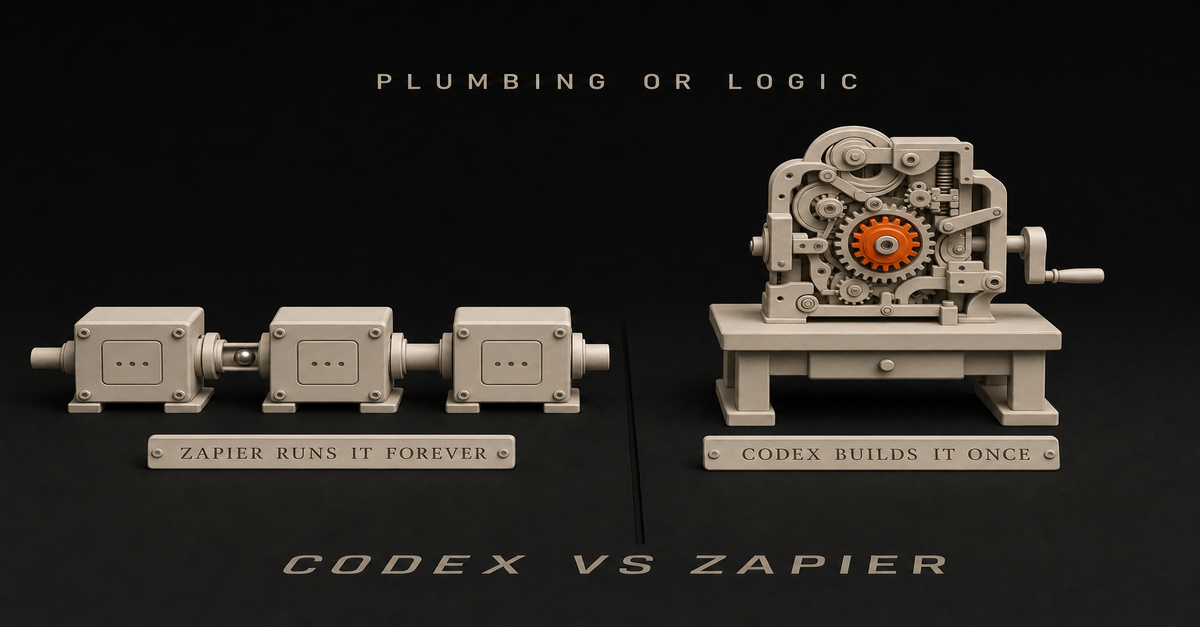
The boring answer is the useful answer: Claude Code builds and thinks. n8n runs and routes.
Quick comparison
| Use case | Claude Code | n8n |
|---|---|---|
| Edit website files | Best | Weak |
| Build an internal script | Best | Possible |
| Trigger when a form is submitted | Possible | Best |
| Move data between tools | Possible | Best |
| Write content in your voice | Best | Needs LLM node |
| Schedule a daily workflow | Possible | Best |
| Inspect a repo and make changes | Best | Weak |
| Route content through approvals | Possible | Best |
The 10-second decision rule
Ask this:
Does the task need context and judgment, or does it need a reliable trigger?
If it needs context and judgment, use Claude Code.
If it needs a reliable trigger, use n8n.
If it needs both, use both.
That sounds too simple, but it prevents the common mistake: trying to make n8n think like an operator or trying to make Claude Code behave like a durable scheduler.
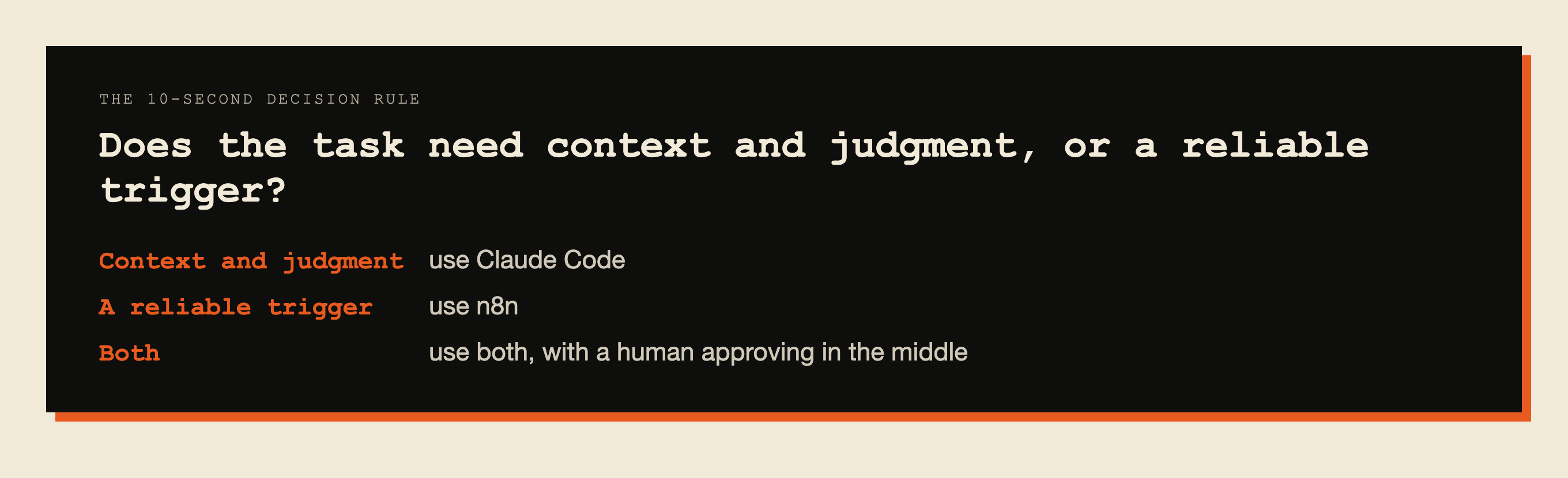 Save this one. It settles the argument in ten seconds.
When to use Claude Code: messy work with context
Use Claude Code for work where the prompt is the product.
Examples:
- writing a blog draft from a real build log
- refactoring a site page
- creating a new Astro page
- reviewing a workflow
- generating a script
- turning a messy idea into an implementation plan
Claude Code is strongest when it can read the surrounding context and make decisions.
Claude Code is especially strong for solo builders because your business context often lives in files:
- site copy
- product docs
- workflow notes
- analytics exports
- newsletter drafts
- messy markdown docs
- code and config
That is not a clean API problem. That is an “understand the room before touching things” problem.
I walk through this on camera in How I Actually Use Claude Code in 2026 (Not Just Apps) (18 min).
When to use n8n: repeatable work with triggers
Use n8n for the plumbing.
Examples:
- when a YouTube video is uploaded, create content tasks
- when a Notion status changes, trigger a writing workflow
- when an RSS item matches a topic, save it for review
- every Friday, prepare the newsletter draft queue
- when a form is submitted, add the person to MailerLite
n8n is strongest when the workflow has a clear trigger and repeatable steps.
It also gives you visibility. When a workflow fails, you can inspect the run, find the bad node, fix the credential, retry the step, and keep moving.
That matters once the workflow touches real business operations.
The best pattern: Claude Code plus n8n plus human approval
The clean pattern is:
- n8n detects the event.
- n8n gathers the inputs.
- Claude handles the judgment-heavy step.
- n8n saves the output.
- A human approves.
- n8n publishes or routes the result.
That is the Ship Lean pattern: automation for the boring parts, human review for the parts with consequences.
Here is what that looks like for content:
| Step | Owner | Job |
|---|---|---|
| 1 | n8n | Detect new video, build log, or GSC CSV |
| 2 | n8n | Gather transcript, URL, notes, metadata |
| 3 | Claude Code | Create brief, draft, edit, and file diff |
| 4 | Human | Approve quality and positioning |
| 5 | n8n/GitHub | Route PR, deploy, notify |
That is the version I trust. Not “AI posts directly to production while you sleep.” That sounds good until it publishes something stale, generic, or wrong.
What should solo builders choose first?
If your problem is “I need to build or improve the system,” start with Claude Code.
If your problem is “I keep copying data between apps,” start with n8n.
If your problem is “I shipped a thing and nobody knows it exists,” use both. Claude Code turns the proof into assets. n8n routes and schedules them.
Common mistake: using n8n as the whole brain
n8n can call LLMs. That does not mean the whole system should live inside n8n.
Once prompts, examples, brand rules, page templates, and content logic get serious, they become easier to maintain in a repo. That is where Claude Code shines.
Use n8n to collect inputs and trigger the run. Use the repo for durable instructions. Use Claude Code to operate on the repo. Use n8n again to notify and route the result.
Common mistake: using Claude Code for recurring ops
Claude Code can write a script. It can run a command. It can help you publish.
But recurring business operations need:
- schedules
- retries
- run history
- credential handling
- webhook triggers
- alerts
- handoff to other apps
That is n8n territory.
The Ship Lean setup I would run
For a solo builder trying to grow traffic:
- Claude Code owns the content system in the repo.
- n8n watches for inputs: Search Console exports, YouTube videos, build logs, and newsletter notes.
- Claude Code creates the page/tool/workflow draft.
- The editor skill checks for thinness, reader fit, and whether the page actually helps.
- Visual skill generates a diagram or comparison asset.
- Human approves.
- GitHub/Vercel ships.
Want to estimate whether an automation is worth building? Run the automation priority audit. Want the stack cost? Use the AI stack cost calculator.
If your specific question is whether n8n should run an agent workflow, read what an n8n AI agent is and then map it with the n8n AI Agent Workflow Builder.
If you use Codex instead of Claude Code, the decision rule is almost the same. Read Codex vs n8n for the repo-agent version, or AI coding agent vs workflow automation for the broader split.
And if you have never opened a terminal at all, start one door earlier: Claude Cowork vs Claude Code - the same engine without the command line.
FAQ
Can n8n replace Claude Code?
No. n8n can call an LLM, but it does not replace a code-aware agent working inside your repo.
Can Claude Code replace n8n?
Sometimes for small scripts. But for recurring workflows with integrations, triggers, and retries, n8n is cleaner.
What is the best first workflow?
A content repurposing workflow is usually a strong first build because it turns work you already did into distribution.
Should I learn n8n if I already use Claude Code?
Yes, if you want recurring workflows that touch multiple apps. Claude Code helps you build and maintain the system. n8n helps the system run on schedule.
Last reviewed: July 2026.
This post is part of the n8n AI agents hub: definitions, tutorials, workflow patterns, and the build-vs-run decision pages in one place.

Written by
Chris AlarconChris Alarcon builds Ship Lean: the boring Claude and AI setups that actually work, handed to people who don’t code. He runs his one-person operation on these systems, around a full-time job, and shares every workflow, prompt, and tool combo in public. Start with the 15 prompts he uses every day.
Work With Me
Setting this up for your team?
I do that. The right plan per seat, the boring setup that makes it stick, and the first three chores handed off. A 2-hour workshop or a done-with-you build, for teams of 2-50.
See how it works →The 15 AI prompts I actually use every day
I tested hundreds and kept the 15 that survived at my desk. You get them right away, then one short Ship Lean note every Tuesday.