In this article
- 1 Quick decision: pick by the spreadsheet job in front of you
- 2 The add-ins do the same job, and the price gate is the real difference
- 3 Copilot is a third tool, and it can even run Claude
- 4 Claude wins the chart and the build
- 5 ChatGPT wins the free start and the research
- 6 Neither one is safe alone, so make the other one check it
- 7 The limits you’ll hit first are plan, device and downloaded files
- 8 My working rules for spreadsheets and AI, either app
- 9 Let one build it and the other check it
- 10 Where this comes from
Quick answer: Both work inside Excel now through official add-ins. ChatGPT for Excel is open from Free up, with limited use on Free and Go. Claude for Excel starts at Claude Pro ($20 a month, $17 billed yearly).
The habit that decides whether you can trust either one is the same for both: one does the work, the other checks it.
Straight up: I’ve never used either add-in inside Excel. I don’t even use it as Excel. I just download stuff from exports pretty much, like from LinkedIn and X.
Even then, if we can pull it from the API, we don’t even pull CSVs. So this page tells you what each add-in does from the vendors’ own docs, and how I split my spreadsheet work between the two chat apps I pay for.
My model verdict, from paying for both: before Sol 6.1, I will tell you Opus 5.5 wins flat out. 6.1 is pretty good. It’s like 90% there, and then with Opus you get like a 95%.
That’s my gut, not a benchmark. GPT-6.1 Sol is the model OpenAI announced at DevDay on September 29.
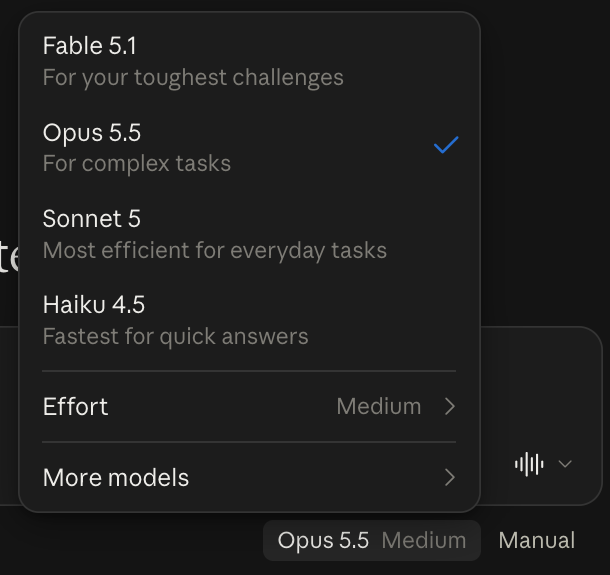 My Claude model picker on Opus 5.5, September 22, 2026.
Published July 17, 2026. Updated October 2, 2026 against Anthropic’s and OpenAI’s add-in docs, linked inline.
Quick decision: pick by the spreadsheet job in front of you
| Your job | Pick |
|---|---|
| Try AI inside Excel for $0 | ChatGPT for Excel (Free, limited) |
| You already pay for Claude Pro and want it in the sheet | Claude for Excel |
| Turn an export (LinkedIn, X, a bank CSV) into a chart | Claude in the chat app, no add-in needed |
| Research on top of that analysis: competitors, gaps, ideas | ChatGPT |
| Macros or VBA | Neither add-in. Draft it in chat, then test it yourself |
| A number someone will act on | Both: one builds it, the other checks it |
My split in one line: Claude draws it, ChatGPT digs into it, and neither one grades its own homework.
The add-ins do the same job, and the price gate is the real difference
The old line was “Claude makes files, ChatGPT works in Excel.” That’s dead. Both sit in a sidebar inside your workbook now, and both can also build a real .xlsx from a chat.
| Claude for Excel | ChatGPT for Excel | |
|---|---|---|
| Plans | Pro, Max, Team, Enterprise | Free, Go, Plus, Pro, Business, Enterprise, Edu, K-12 |
| Cheapest way in | Claude Pro, $20 a month ($17 billed yearly) | $0, limited usage on Free and Go |
| Where it runs | Excel on the web, Windows (Microsoft 365), Mac 16.46+. Not iPad, Android, Excel 2016 or 2019 | Excel desktop or web, plus a Google Sheets version |
| Usage | Same usage limits as your Claude account | Plus and Pro: your plan’s agentic usage limit |
| Shows its work | Answers with cell-level citations | Tells you to review formulas, citations and changed cells |
| Macros and VBA | Unsupported | “May not be fully supported” |
| A real .xlsx from chat, no add-in | Yes, every plan including Free | Yes |
Sources for every row: Anthropic’s Claude for Excel docs and pricing page, and OpenAI’s ChatGPT for Excel help article and ChatGPT Work files article, all checked October 2, 2026.
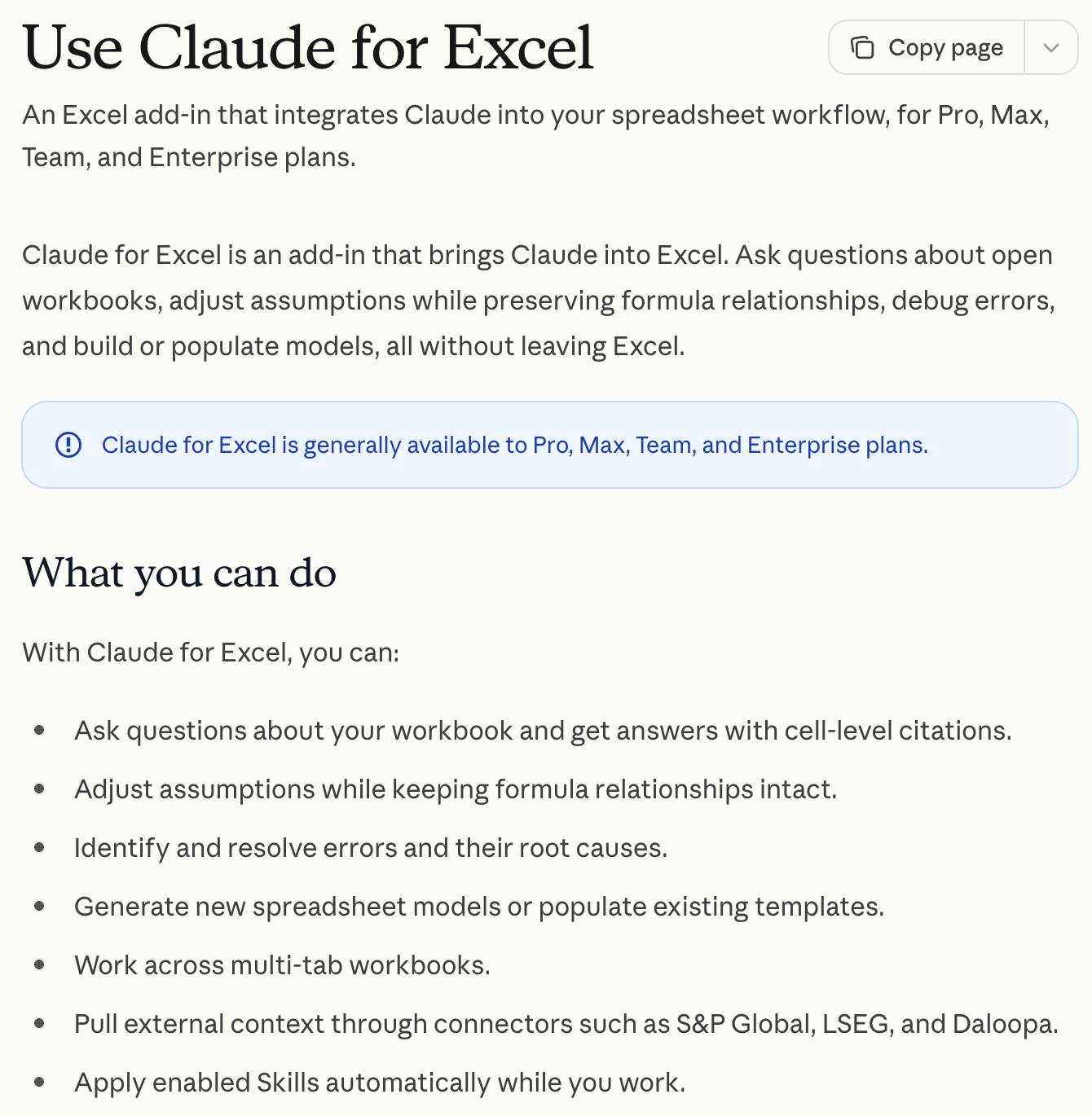 Anthropic’s Claude for Excel docs, captured October 2, 2026.
The ChatGPT side is wider. OpenAI’s article lists Free first, and says Free and Go “include limited usage access.”
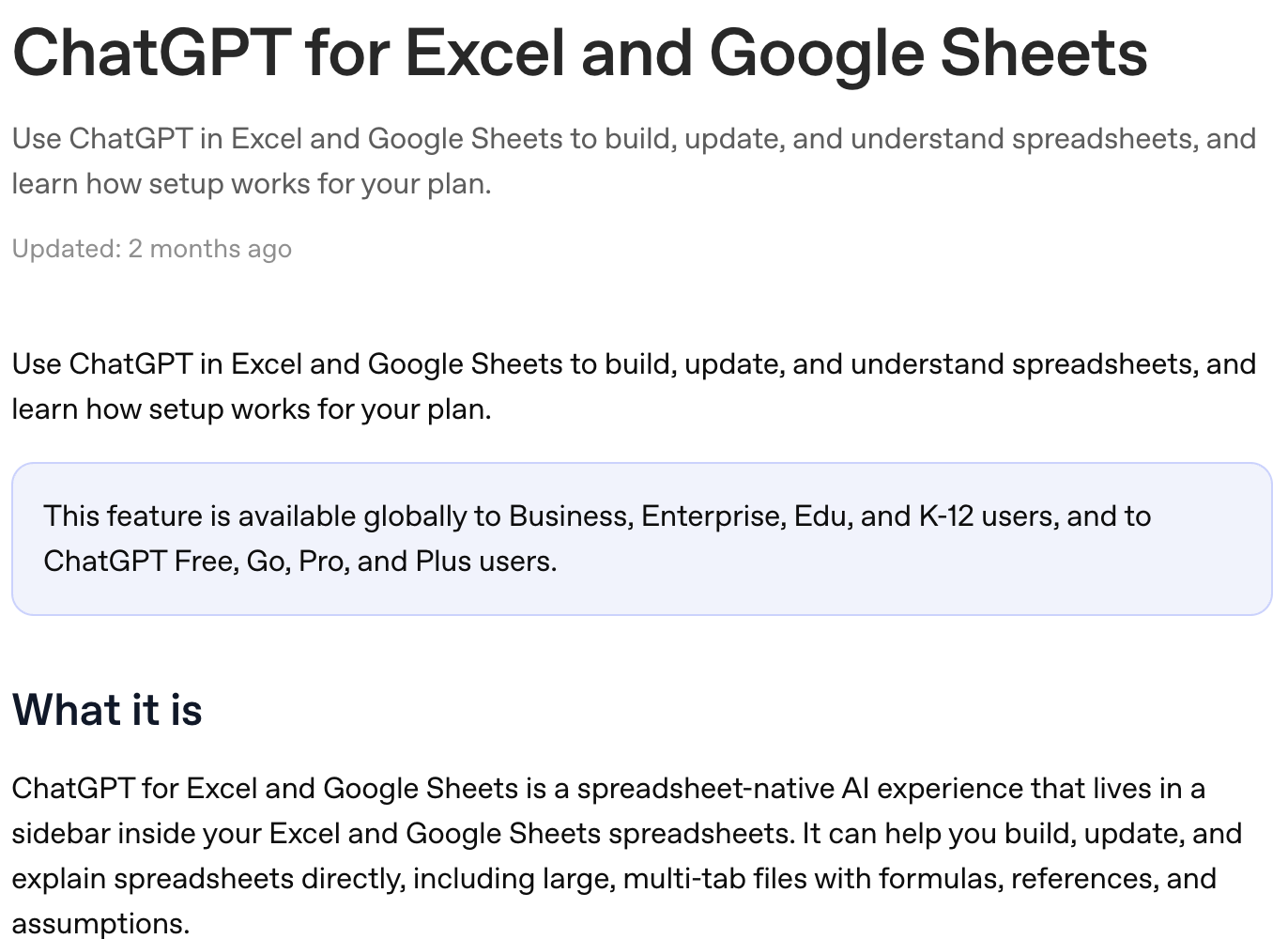 OpenAI’s ChatGPT for Excel help article, captured October 2, 2026.
The gates flip the same way for slides. If you also make decks, Claude vs ChatGPT for PowerPoint has that map.
If you’re deciding which subscription to hold at all, the Claude Max vs ChatGPT Pro breakdown covers what each plan’s limits feel like when you pay for both.
Copilot is a third tool, and it can even run Claude
Excel Copilot is Microsoft’s assistant, not ChatGPT. It lives in Microsoft 365 and bills through Microsoft.
It gets weirder. Microsoft’s Copilot in Excel support page shows a model picker in the upper right of the Copilot pane that can switch to Claude, and on work accounts an admin has to allow Anthropic first.
So keep three names straight: Claude for Excel, ChatGPT for Excel, and Copilot. If your company already pays for Copilot, read Claude vs Copilot before you add a second bill.
Claude wins the chart and the build
Here’s the job I hand Claude, in my words:
“Claude, give me something visual. Look at my analytics from LinkedIn. I want to see how I’m performing week over week or month over month.”
That’s an export plus a picture, and Claude in the chat app handles it with no add-in. Anthropic’s file creation article says Claude can create Excel files with working formulas on every plan, Free included, up to 30MB per file.
The 60-second version, from my Shorts: Claude Hands You a Real Spreadsheet, Not a Chat Answer.
Other people doing heavier number work land in the same place. An accountant, u/MrNariyoshiMiyagi on r/ClaudeAI, uploaded real tax work to both chat apps: “Claude was phenomenal. The calculations were clean, the new Act was applied correctly, and the MS Excel formatting was genuinely brilliant.”
That was chat uploads, not the add-ins. One person, one job, but it matches my take on Opus.
ChatGPT wins the free start and the research
ChatGPT is the one you can open inside Excel tonight for $0. For a lot of people that settles it.
It’s also where my analysis goes next. Once Claude makes the chart, I hand it over: “Take this analysis Claude did. Research our top three competitors and see what they’re doing that I’m not.”
That’s my play. ChatGPT is phenomenal for the research.
If you’re on ChatGPT Pro, you can take it a step further and do it on the fly with a dot. That’s what I would do.
A dot is OpenAI’s always-on agent that keeps working between chats. Per OpenAI’s dots page it comes with Pro (not in the EEA, UK or Switzerland), Business Premium and Enterprise.
A construction estimator, u/Medium-Resort-8048 on r/ClaudeAI, made the other half of the case from his upload work: “I upload the full plans and ask too many questions. Claude would run out of tokens by lunch. As of right now Chat is the way to go.”
Both apps have usage walls today, so read that as one heavy user’s experience, not a rule.
Neither one is safe alone, so make the other one check it
Even the vendors say don’t trust the output blind. Anthropic says Claude for Excel isn’t recommended for “audit-critical calculations without verification.” OpenAI’s article says outputs “may be incomplete or incorrect.”
The tools also show their work differently. Ethan Mollick of Wharton posted on X about giving both add-ins a workbook with more than a hundred tabs.
ChatGPT built formulas in the sheet like a person would; Claude often ran Python and pasted the results, which made them harder to trace. His read: ChatGPT is easier to audit.

@emollick · Mar 7, 2026
I gave ChatGPT for Excel and Claude for Excel a try on a very hard Excel file: macro-economic data from 1,000 years of English history across over a hundred tabs.
…ChatGPT tended to stick within the Excel app, building formulas and manipulating the data in the way a person would. On the other hand, Claude used Python and often pasted material into Excel for display purposes only, making it harder to trace or edit.
Claude has its critics on the add-in side too. Data writer Olga Berezovsky wrote in April: “It is still too willing to overcomplicate formulas, too inconsistent on multi-step requests, and too capable of making mistakes.”
So here’s the one habit. When a number matters, paste the output into the other app: if ChatGPT did the analysis, ask Claude to QA it, and the other way around. AI is already smarter than us at plenty of things, and it can still be wrong.
Steal this ask for whichever one builds the sheet:
Use live Excel formulas, not pasted values. When you're done,
list every cell you changed and the formula behind each total.
Then paste that list into the other app with: “Check these totals and tell me what doesn’t match.”
The limits you’ll hit first are plan, device and downloaded files
- No iPad. Claude for Excel doesn’t run on iPad or Android. It needs Excel on the web, Windows or a recent Mac build.
- Big files. Anthropic’s performance page says one Claude read covers 2,000 cells with data, and it works best under 1 million used cells.
- Downloaded templates. Anthropic warns: “Only use Claude for Excel with trusted spreadsheets.” Files from outside can hide instructions. If you grabbed a budget template off the internet, check it before you hand it to the add-in.
- No memory in the sidebar. OpenAI says spreadsheet chats don’t sync with your main ChatGPT history and don’t use ChatGPT memory. Claude’s add-in keeps chat history in your browser, not synced across devices.
My working rules for spreadsheets and AI, either app
Know your format first. LinkedIn hands you a CSV, X hands you an XLSX or CSV. Decide how you want it back before you ask: a chart, three short insights, one combined file.
One job per session. Don’t dump twenty spreadsheets about twenty different things and ask ten questions across ten topics. It gets confusing fast, for you and for the model. Same-domain consolidation is the exception, like every platform’s analytics into one file.
Do the manual reps before you build the skill. I can’t tell you how many times I tried to build the automation before I’d even tested the workflow. You’re going to change your mind. Ask for the thing until it comes back the way you want, for a few weeks, then make it repeatable.
Being technical doesn’t matter anymore. Charts and data interpretation are the commodity now. Your taste and your procedure are the part AI can’t copy.
Let one build it and the other check it
I’ve never opened either add-in, and my play still runs through two AIs. One export, one chart from Claude, one research pass from ChatGPT.
My rule: one AI does the work, the other one checks it. That’s how either one earns your trust.
Start with one export you already download, LinkedIn, X or your bank. Ask Claude for the chart, hand it to ChatGPT, and see what it finds.
Where this comes from
The plan, device and limit facts come from Anthropic’s and OpenAI’s own docs, captured October 2, 2026. The model verdict and the chart-then-research split are mine, from my riff that day.
I have not used either add-in inside Excel, and I haven’t published my LinkedIn chart yet. The Reddit, Mollick and Berezovsky lines are theirs, linked where quoted.
This post is part of Claude Guides, the hub with every plan decision, task comparison, and setup guide for using Claude without code.

Written by
Chris AlarconChris Alarcon shows people who don’t code the boring Claude setup that actually works. He runs his one-person operation on these systems and shares every workflow, prompt, and tool combo in public. Start with the 15 prompts he uses every day.
The boring setup
It still won't know you tomorrow.
The Setup is one folder. Drop it into a Project, answer three questions, and Claude or ChatGPT writes your memory file and your voice file itself. It stops forgetting you, stops sounding like AI, and runs three real jobs by name. Twenty minutes tonight. No code. $39, 30-day refund.
See The Setup →The 15 AI prompts I actually use every day
I tested hundreds and kept the 15 that survived. You get them right away, then one short email from me every Tuesday.