In this article
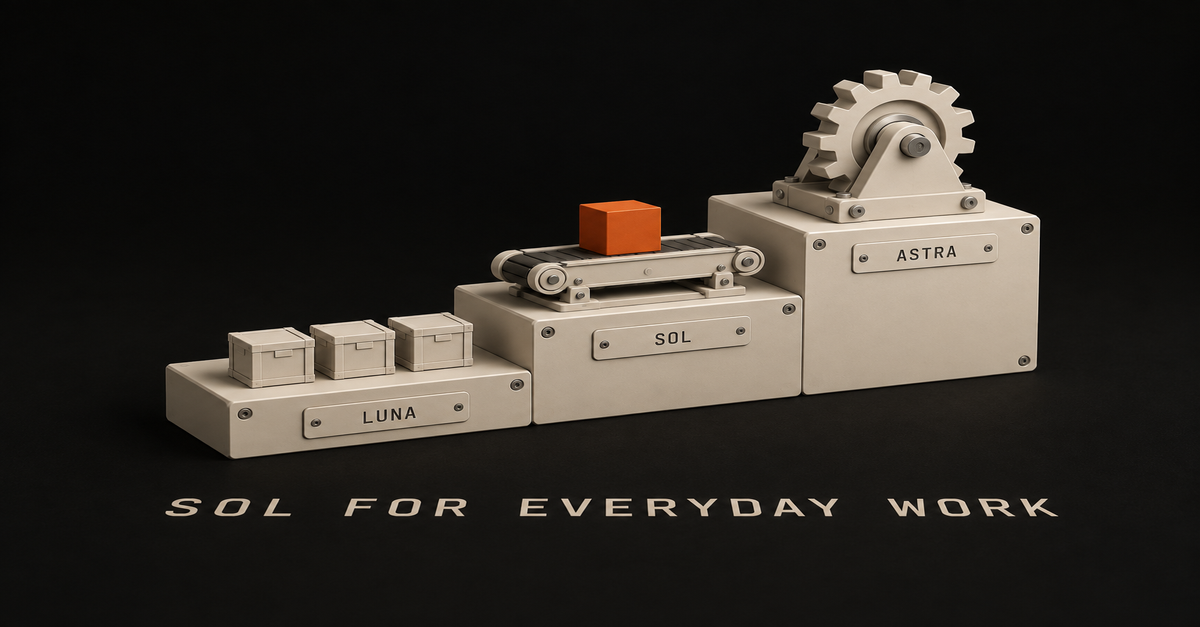
- 1 Astra is the top rung, Sol is the middle, Luna is the bottom
- 2 Sol and Luna live in Work and Codex, not in the Chat tab
- 3 Leave Plus on Sol for everyday work and save Astra for the hard jobs
- 4 Sol’s real wins are price and a reliability claim
- 5 OpenAI compared Sol to Opus 5 at medium effort, and Opus 5.5 shipped the same day
- 6 Sol is a sidekick for grunt work, not my main model
- 7 What nobody knows yet
- 8 Which one to pick depends on what you pay for
- 9 Frequently asked questions
- 10 Where this comes from
Quick answer: GPT-6 Sol and Luna are OpenAI’s two cheaper GPT-6 models, released September 22, 2026, sitting under GPT-6 Astra.
Three names, one ladder, one rule: Astra for the hard jobs, Sol for everyday work, Luna for high-volume grunt work. They roll out in ChatGPT Work and Codex on paid plans. Neither one is in the Chat tab.
And on my own $100 Pro account, the afternoon they launched, they were not in Work yet either. My desktop app had an update downloaded but not installed, so that list came from the older build. I will show you.
Astra is the top rung, Sol is the middle, Luna is the bottom
Here is the whole family on one table, using OpenAI’s own words for each model and its API prices.
| Rung | OpenAI’s own line | API price per 1M tokens (in / out) | Leave it on for |
|---|---|---|---|
| GPT-6 Astra | ”Our most capable model, built for the hardest end-to-end work” | $10 / $50 | Hard jobs: long documents, messy research, a real sparring partner |
| GPT-6 Sol | ”Built to power complex coding and agentic workflows” | $2 / $10 | Everyday work |
| GPT-6 Luna | ”high-volume tasks with a clear goal, like summarizing documents, extracting information, or answering quick questions” | $0.10 / $0.50 | Grunt work you repeat a lot |
Prices and the first two lines are from OpenAI’s model docs, read September 22. Luna’s line is OpenAI’s wording as quoted in TechCrunch’s launch report.
Read the price column as a ladder too. Astra costs 5 times what Sol costs per token. Sol costs 20 times what Luna costs.
That’s the ladder I’d use: Astra for the hard jobs, Sol for the everyday work, Luna for the grunt work.
If the names still feel like a riddle, you are in good company. On Hacker News the day it launched, dyauspitr asked:
“Wtf is GPT-6 Sol, I though GPT-6 is Astra?”
Readerium answered with the best two-line explanation I have seen:
“Number is generation
Name is the size (Luna smallest to Astra largest)”
That is the system. The thread is worth a scroll if you want to see how many people are confused.
One more thing that trips people up: there is no GPT-6 Terra. The GPT-5.6 family was Sol, Terra and Luna. GPT-6 swapped Terra out and put Astra on top.
Sol and Luna live in Work and Codex, not in the Chat tab
OpenAI’s announcement, reposted in its community forum, says it plainly: “GPT-6 Sol and Luna roll out today in ChatGPT Work and Codex for Plus, Pro, Business, Enterprise, and Edu users. Both are also available in the API.” Launch coverage from 9to5Mac adds that Free and Go users get Luna in the desktop app.
So the Chat tab is not where you will find them. If Work is new to you, what ChatGPT Work is covers it in plain English.
For which plan gets what on which surface, I keep one table on which ChatGPT plans get Astra, and I am not going to duplicate it here.
Now the part the announcement cannot tell you. This is the Work model list on my Pro account on September 22, the afternoon of the launch:
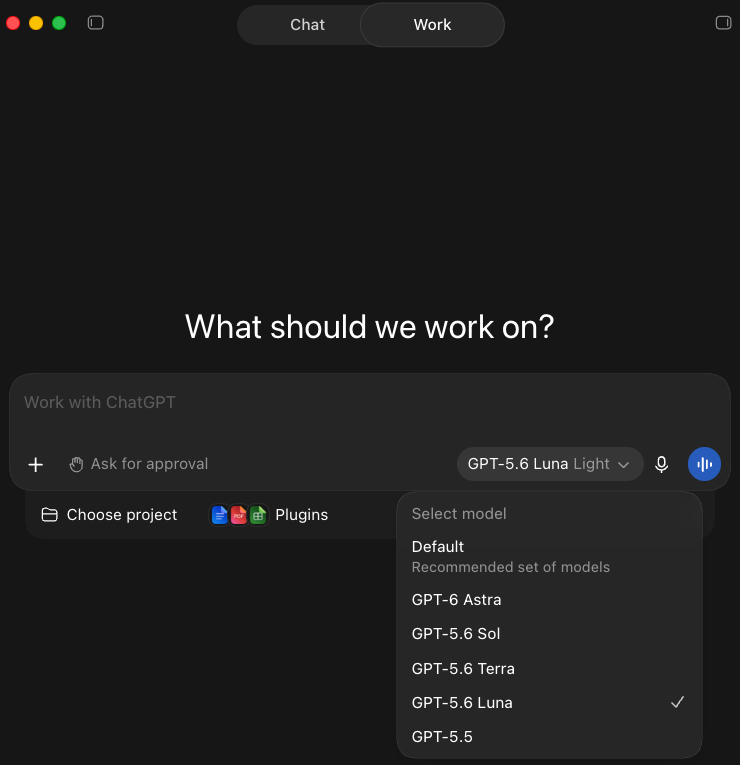 My ChatGPT Pro account, Work tab, September 22, 2026, on the older app build (an update was downloaded, not yet installed). GPT-6 Astra is there. Sol, Terra and Luna are still the GPT-5.6 versions. No GPT-6 Sol, no GPT-6 Luna yet.
And here is the same list twelve days earlier, for comparison:
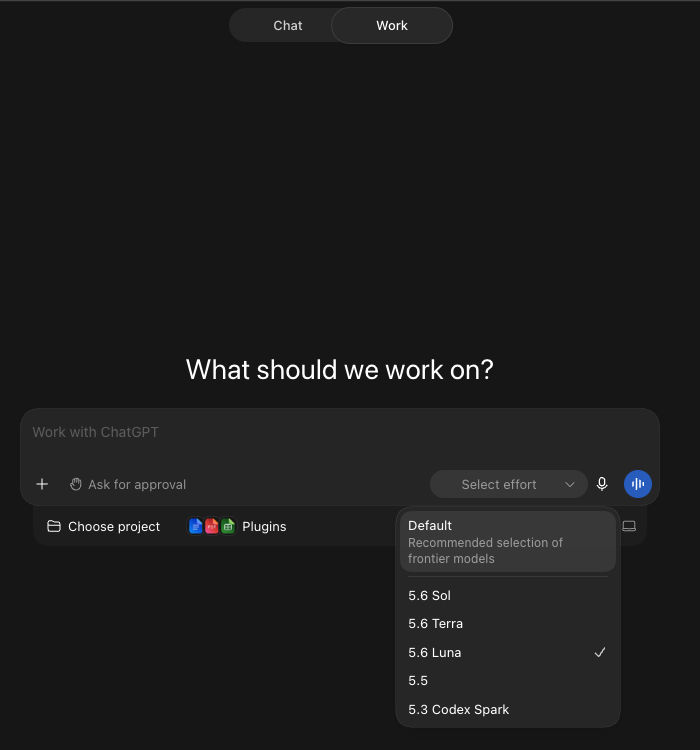 Same account, same tab, September 10, 2026. No Astra, and the names did not even carry the “GPT-” prefix yet.
Two things to take from that. “Rolls out today” and “is in your list today” are different days. And when GPT-6 Sol does land, it is going to sit right next to GPT-5.6 Sol, so check the number, not the name.
If yours is missing too, update the desktop app before you conclude anything about your plan. Mine had an update downloaded but not yet installed when I took that screenshot, so a newer build may already show them. That is the same step OpenAI documented when GPT-6 Astra went missing for people.
Leave Plus on Sol for everyday work and save Astra for the hard jobs
Would I tell a Plus user to leave Work on Sol for the everyday stuff and save Astra for the hard jobs?
Yeah, I would.
Here is the honest part. I got used to using Astra, not gonna lie. But I run it on low, because it burns usage fast.
That is literally a complaint, and it’s legit. It’s not efficient right now. It burns tokens.
The numbers back me up. OpenAI’s own allowance table from September 10 puts Astra at 5 to 45 messages per five hours on Plus, against 10 to 100 for GPT-5.6 Sol. That is roughly double the usage for the same conversation, and I walk through every tier in Astra’s usage limits.
That table is for the old Sol. OpenAI has not published ChatGPT limits for GPT-6 Sol or Luna yet.
The same OpenAI help article is also why running Astra on low is not crazy. It says Astra at Low effort can outperform Sol at High effort. That was written about GPT-5.6 Sol, so treat it as a hint, not a rule for the new one.
So my advice is simple: Sol stays selected for the everyday stuff. Astra comes out for the hard job, on low effort first.
Sol’s real wins are price and a reliability claim
Sol deserves a fair hearing, and it has two genuine wins.
The first is price. At $2 in and $10 out per million tokens, Sol is one fifth of Astra’s API price. An OpenAI spokesperson told VentureBeat these “are permanent prices, not promotional or introductory pricing.”
The second is reliability. OpenAI says, per TechCrunch, that “GPT-6 Sol makes about half as many mistakes as its predecessor, reaching Astra-level reliability at much lower cost.” That is OpenAI’s own internal test, not an independent one.
OpenAI’s Tibo (Thibault Sottiaux) went further, in a post the community thread reposts: “GPT-6 Sol and Luna are out. Not only are they a very significant improvement across the board, but also in writing and general ‘you know when you try it’ quality.”
My read, before I have run it: Sol should be good for a lot of the stuff. I expect it to be better than GPT-5.6 Sol, and more efficient. OpenAI’s claim points the same way.
OpenAI compared Sol to Opus 5 at medium effort, and Opus 5.5 shipped the same day
Here is where I am a little disappointed.
My opinion, going by the benchmarks and not my own runs: OpenAI basically dropped a cheaper, lower-tier model. It’s nowhere near Claude Fable. It’s nowhere near Opus 5.5. It’s barely at Opus 5 level.
That read holds up on OpenAI’s own chart, with one caveat you should know about:
| Model | Effort setting | OSWorld 2.0 (computer use) | Cost per task |
|---|---|---|---|
| GPT-6 Sol | xhigh | 60.5% | About 80% lower |
| Claude Opus 5 | medium | 60.3% | Baseline |
These are OpenAI’s numbers, as reported by VentureBeat on September 22.
Look at the effort column. Sol’s effort dial runs none, low, medium, high, xhigh, max, so xhigh is its second-highest setting. Opus 5 was at medium.
Sol had to run near its top setting to tie Opus 5 at medium, and by OpenAI’s math it still did that for about a fifth of the cost.
Then Anthropic released Claude Opus 5.5 hours before OpenAI’s announcement. Anthropic says Opus 5.5 performs at the level of Fable 5.1 on most work, at $4 in and $20 out per million tokens. OpenAI’s material has no Opus 5.5 comparison.
In fairness to Sol, it is still half of Opus 5.5’s price per token. I compare Opus 5.5 with Fable properly in Opus 5.5 vs Fable.
The way I see it, 5.5 is a huge leap. You literally got a better model and it’s cheaper.
Sol is a sidekick for grunt work, not my main model
Does Sol feel like a real option to me? To be honest, no.
I think it’s gonna be a good sidekick for research and the grunt work I just want to burn usage on. If I want to tinker around and brainstorm, I’m still gonna use Astra.
So I have to find a use case for it. That is the honest status on day one: I have not run GPT-6 Sol or Luna on a real job yet, and it was not even in my list when I wrote this, on an app build one update behind.
I also have a complaint about the model count, and then I have to take half of it back.
I think this whole game of having five different models makes it seem like you have more options, when really you’ve got one or two good things. That’s what I like Anthropic for right now, because it’s not complicated. You’ve got Haiku, Sonnet, Opus and Fable.
So they do have a lot of models too, actually. Never mind.
But I rarely use Haiku. I rarely use Sonnet. I’m just using Opus and Fable. If that is where you are too, how I run Claude at work is the setup I actually use.
What nobody knows yet
A few things were not public when I wrote this, and I would rather say so than guess:
- ChatGPT limits for GPT-6 Sol and Luna. OpenAI has published no message numbers for either one.
- When the Chat tab gets them. The announcement only names Work and Codex.
- How much Luna a Free account gets. Launch coverage says Free and Go users get Luna in the desktop app, with no number.
- Whether GPT-6 Sol still loses to Astra on Low. OpenAI’s effort advice was written for GPT-5.6 Sol.
I log plan and limit changes with dates on the AI plan tracker, and the box at the bottom of this page emails you when one moves.
Which one to pick depends on what you pay for
- If you are on Plus: leave Work on Sol for everyday tasks once it shows up. Pull out Astra for the hard job, on low effort first, because it cost roughly double the usage of the old Sol.
- If you are on Pro: you have room for Astra, and I still run it on low. Send Sol the bulk research you would rather not spend Astra on.
- If you are on Free or Go: Luna in the desktop app is your only GPT-6 door. Use it for summaries, pulling details out of a document, and quick questions, which is exactly what OpenAI built it for.
- If you also pay for Claude: Opus 5.5 is the one to beat now, and OpenAI did not even compare Sol to it. Treat Sol as a cheap sidekick, not a switch.
Frequently asked questions
What is GPT-6 Sol?
GPT-6 Sol is OpenAI’s middle GPT-6 model, released September 22, 2026. It sits under GPT-6 Astra and above GPT-6 Luna.
OpenAI’s developer docs describe it as built to power complex coding and agentic workflows, and it costs $2 per million input tokens and $10 per million output tokens in the API, one fifth of Astra’s price.
What is the difference between GPT-6 Sol and Luna?
Sol is the everyday model for real work. Luna is the small, cheap one for high-volume tasks with a clear goal, which OpenAI lists as summarizing documents, extracting information, or answering quick questions.
In the API, Sol costs $2 in and $10 out per million tokens, and Luna costs $0.10 in and $0.50 out, so Sol is 20 times the price of Luna.
Is GPT-6 Sol better than GPT-6 Astra?
No. Astra is the top of the GPT-6 ladder and Sol is the middle rung.
OpenAI says Sol reaches Astra-level reliability on its internal factuality test at much lower cost, but Astra is still the model OpenAI builds for the hardest end-to-end work. Use Sol for everyday tasks and save Astra for the hard jobs.
Where can I use GPT-6 Sol and Luna in ChatGPT?
OpenAI says both roll out in ChatGPT Work and Codex for Plus, Pro, Business, Enterprise, and Edu users, and not in the Chat tab. Launch coverage (9to5Mac, VentureBeat) adds that Free and Go users get GPT-6 Luna in the ChatGPT desktop app.
On launch day afternoon, my own Pro account’s Work list still showed GPT-5.6 Sol and Luna, on a desktop app with an update downloaded but not yet installed, so update the app first if yours is missing them.
Is GPT-6 Luna free?
Partly. Launch coverage from 9to5Mac and VentureBeat says Free and Go users get GPT-6 Luna in the ChatGPT desktop app, and OpenAI’s help center had not caught up on launch day. Sol is for paid plans only. OpenAI has not published how many Luna messages a free account gets.
What happened to GPT-6 Terra?
There is no GPT-6 Terra. The GPT-5.6 family had three sizes, Sol, Terra, and Luna. The GPT-6 family announced so far has three different names: Astra on top, Sol in the middle, and Luna at the bottom.
Where this comes from
The facts come from OpenAI’s docs and announcement, plus TechCrunch and VentureBeat, read September 22, 2026. The screenshots are my own Pro account, and the opinions are mine.
I have not run GPT-6 Sol or Luna yet. My list still showed the 5.6 versions, with an app update downloaded but not installed.
Published September 22, 2026. Last reviewed September 22, 2026.
Plan-change alerts
Your plan is gonna change. Nobody emails you when it does.
I pay for Claude, ChatGPT and Grok, so I check the pricing pages every week anyway. When one moves a price or a limit, you get one email that day. No newsletter, no schedule. Last one I caught: Fable 5 quietly dropped out of Claude Pro.

Written by
Chris AlarconChris Alarcon builds Ship Lean: the boring Claude and AI setups that actually work, handed to people who don’t code. He runs his one-person operation on these systems, around a full-time job, and shares every workflow, prompt, and tool combo in public. Start with the 15 prompts he uses every day.
Picked a plan? Now set it up
Whichever plan you buy, it still won't know you tomorrow.
The Setup is one folder. Drop it into a Project, answer three questions, and Claude or ChatGPT stops forgetting you, stops sounding like AI, and runs three real jobs by name. Twenty minutes tonight. No code. $39, 30-day refund.
See The Setup →