If it was as easy as installing a skill and growing a business and you become a millionaire, everybody would be doing it. It's not that easy, man.
That's my whole reaction to the "500 free Claude skills" posts.
Maybe you saved one of those lists anyway. Or you landed on a GitHub page with 100 skills on it and closed the tab feeling behind.
Me too. I'm having a hard time sometimes keeping up with the features, man.
If GitHub is new to you: it's just a website where coders and developers share code and resources for free. People give away business skills there, and some of it is cool. I just think it should be an inspiration versus downloading and hoping that it's gonna do magic for you.
Out of everything I've downloaded, two survived my test (do I still use it?): my copy of Andrej Karpathy's autoresearch loop, which makes my other skills better, and Tesseract, which turns information into motion graphics.
The other three on this page are skills you build yourself: an inbox skill, a weekly prioritizer and a news digest.
Here's the Skills menu in my Claude app today, flaws included.My Claude app's Skills menu, October 2, 2026.
That n8n skill has been on since January. And neither of my two keepers shows up in that menu, because they live in Claude Code, where most of my skills run.
Published October 2, 2026. Skill, plugin and plan facts checked against Anthropic's help center and the GitHub pages linked below that same day.
Two of the 5 best Claude skills are downloads, and you build the other three#
Skill
What it does for you
Where it comes from
The catch1
A skill-improvement loop (my copy of Karpathy's autoresearch)
Runs a skill, grades the result, keeps the better version, repeats
A free GitHub project I copied and rewrote as my own skill
Karpathy's version needs an NVIDIA graphics card. You copy the idea, you don't install it2
Tesseract, by Mirage
Turns information into motion graphics and edited video
Public download on GitHub
Needs Claude Code or Codex on your computer, not a chat toggle3
An inbox skill
Sorts your email so only the things you have to do stay
You build it
Needs the Gmail connector. Keep sending on approval4
A weekly prioritizer
Reads your Trello or Notion tasks and picks the week's top few
You build it
Needs that app's connector5
A news digest
A short read of the sources you actually care about
You build it
You'll tweak the sources for a whileMy rule for the order: a skill I still use beats one that sounds powerful.
If you haven't turned skills on yet, the switches are in how to use Claude Skills. This page is about which ones are worth it.
New to Claude altogether? Start at the Claude guides.
The four built-ins are already on, so don't count them as picks
Anthropic's Use skills in Claude page lists four built-in skills: Excel, Word, PowerPoint and PDF. They're on once code execution is on, on every plan, Free included.
Back in July I made a Short calling PowerPoint, Excel, Word, PDF and Canvas Design the five to install. I'd change that now.
These are all generic. I think Claude is smart enough to just know what to use. Ask for a deck and it reaches for the PowerPoint skill on its own.
If I had to name one to care about, probably PDF.
Design is already in every chat, so skip hunting for a design skill
Claude Design stopped being a separate thing on September 16. Anthropic's release notes say you can now ask for a design, deck or document in any conversation, on every plan including Free.
There's also a separate Design add-on from Anthropic in the skills directory. It's a bundle: 7 skills and 9 connectors for design critique, UX writing and accessibility checks. It's not on my account.Anthropic's Design bundle in my skills directory, October 2, 2026.
A bundle like that is what Anthropic calls a plugin, and its plugins help page lists those on paid plans only. Unless you do design critique for a living, the built-in Claude Design covers you.
1. Karpathy's autoresearch loop makes your other skills better, and I copied it instead of installing it
Best for: anyone with one skill they use every week that's almost right.
The mess: you build a skill, it gets you 70% there, and you tweak it by hand for weeks.
Andrej Karpathy, the AI researcher, put autoresearch on GitHub in March 2026. The idea: an AI agent changes the code, runs a 5-minute experiment, checks if the result improved, keeps it or throws it out, and repeats overnight.
His version trains a small AI model and needs an NVIDIA graphics card. That's not the part I wanted.
I didn't even download it. I just copied it. Meaning I took it and I modified it for me.
Think of it like a smarter way to make a skill loop and just get better instead of painfully doing it for months.
My copy is a skill called refine, in my skills folder since June. It runs the skill I'm fixing, has a separate agent grade the output, changes one thing, and keeps the best version.
You don't need my files to get the same thing. Steal this:
Here is my [name] skill and three outputs from it I didn't like.
Grade each output against what I actually want, out of 10.
Change one thing in the skill, run it again on the same inputs,
and keep whichever version scores higher. Show me the scores.The catch: it only works on a skill you already use. A loop can't fix a job you haven't figured out yet.
2. Tesseract turns information into motion graphics you actually watch
Best for: people who make videos, and anyone who reads a wall of text and retains none of it.
Tesseract comes from a company called Mirage. It went up on GitHub on September 16, 2026, and today it carries four skills: Edit Video, Motion Graphics, Editor and Design.
It's the one that intrigues me the most right now. I'm working with it a lot for motion graphics as I put out video.
You don't have to make videos to get something out of it. It's just one way to render information, to get Claude to give you back information in a way you digest better.My HyperFrames vs Tesseract test render, September 25, 2026.
That frame is from a side-by-side I ran: the same motion graphic in HyperFrames, HeyGen's free, open-source tool that turns a web page into video, and in Tesseract. HyperFrames is the cheap way to get video out of Claude. Tesseract is another one I downloaded, and it's hard to replicate.
The catch, and it's a real one for a non-coder: Tesseract's own page says your agent "needs file and command access." That means Claude Code or Codex running on your computer, not a toggle in the chat. If that's new, start with how to use Claude Code.
As of October 2, its Claude Code plugin is listed as "coming soon."
The 3 best Claude skills to build yourself come from your own back-and-forth
The best skills come from your riffs, when you're going back and forth with Claude about your own work. A stranger on GitHub doesn't know your inbox or your clients.
You don't have to write one from scratch. Anthropic's skill-creator is in the example skills (it's in my menu above), so describe the job and let it draft the folder.
On a Mac with Pro, Max or Team, Record a skill in Cowork's + menu lets you do the task once on screen instead (Anthropic's guide; not on Free).A Record a skill proposal on my Mac, from a September 2026 test run.
It's something that you won't nail perfect in the first time, but you can just get the ball rolling. So don't get lost in trying to optimize it too much. My take: these should take you a few minutes to start, then you tweak them over time.
3. An inbox skill keeps only the email you have to act on
Best for: anyone whose inbox is mostly receipts and notices.
The mess: 300 emails, five that need you. The fix is a skill that asks one question of every message: do I have to do something about this?
My own inbox skill runs on that question across two Gmail accounts. It files receipts and machine notices, and it never sends or deletes anything on its own.
Starting point: Anthropic's Small Business plugin has an inbox-manager skill you can read and borrow from. The catch: it needs the Gmail connector, and sending should stay on ask-first. Which connector to turn on first is in the best Claude connectors.
4. A weekly prioritizer reads Trello or Notion and picks your week
Best for: people with a task list that keeps growing.
It queries your Trello or Notion, then prioritizes your tasks for the week. You tell it what matters this quarter, and it hands back the three or four things to do first.
Starting points: Anthropic's productivity plugin has a task-management skill, and the "morning" example skill renders a morning brief. The catch: it only knows what's in the app it reads, so it needs that app's connector.
5. A news digest reads the sources you'd never get to
Best for: anyone who subscribes to more newsletters than they open.
You tell it which blogs and newsletters to read, what you care about, and how short you want it. It hands back the few items worth your time.
The catch: the first version will pull the wrong stuff. That's normal. You go back and forth, cut a source, add one, and it gets closer every week.
What I'd skip: packs, developer lists, and tiny one-step skillsSkip
Why
Do this instead100+ skill packs and "free skill library" downloads
Built for someone else's workflow
Pick one chore and build for itBusiness skills from GitHub, installed as-is
Inspiration, not magic. Even Anthropic's example repo says "demonstration and educational purposes only"
Read it, copy the idea, make it yoursDeveloper skills (frontend-design, mcp-builder, webapp-testing)
They fill most "best skills" lists, and they're for coders
Ignore them unless you write codeTiny one-step skills
Ten tiny skills fight each other
One skill per job, with the steps inside itI'm not the only one saying this. Kyle Redelinghuys at ksred.com, writing for developers, sums up a reviewer who went through 200+ skills, and it's harsher than mine: "most publicly available skills don't just fail to help, they actively hurt, adding tokens, adding latency and injecting constraints that narrow the output."
And the author of welcomedeveloper.com's list lands where I do: "The point isn't to install everything. It's to start with what matches the work you actually do and let the gaps tell you what to add next."
On the one-step skills, I learned that one the hard way. The story of how my list got too long is in how to use Claude Skills.
A skill earns its spot only if you still use it
My test is one question: do I still use it?
That's why only two downloads made this page. Everything else I tried either got folded into a skill of my own or switched off.
To clean yours up: Customize > Skills, then switch off anything you haven't touched lately. Skills from the directory are view-only, so if you want to change one, download a copy, edit it and upload it as your own.
What changed since my July listJuly 2: my Short picked PowerPoint, Excel, Word, PDF and Canvas Design. Canvas Design is still in Anthropic's GitHub examples, but it isn't on my account and I wouldn't send you looking for it.
September 16: Claude Design moved into every conversation, Free included.
September 24: Anthropic updated its Design bundle (version 1.2.0) in the skills directory.
September 25: Anthropic opened a developer portal for submitting plugins to the Claude directory, so expect the directory to keep growing.Updated October 2, 2026.
Copy the idea, then make it yours
If installing a skill made you a millionaire, everybody would be doing it. The two skills I kept prove the point: one I copied and rewrote, the other I picked because it does a job I already had.
My rule: download for inspiration, keep only what you still use, and build the rest from your own back-and-forth.
So pick one chore from this page and get the ball rolling today. If you live in the chat app, start with the inbox. If you make video and already work in Claude Code, try Tesseract.
When you want the bigger case for building your own, it's in Claude Skills for non coders.
Common questions
Are Claude skills free?
Yes. Anthropic lists Skills on Free, Pro, Max, Team and Enterprise as of October 2026, as long as code execution is on. Plugins, the bundles of skills plus connectors, are paid plans only. What else the $0 plan covers is in Claude's free plan.
What is the difference between a Claude skill and a plugin?
A skill is one folder of instructions Claude loads for a job, like making a PDF. A plugin bundles several skills with connectors for one kind of work. Anthropic's Design plugin carries 7 skills and 9 connectors. Skills work on Free; plugins need a paid plan.
Where do I find a list of Claude skills and examples?
In the app: the + button in the message box, then Skills, then Browse skills, which opens the Discover tab. Anthropic's own example skills sit in its skills repo on GitHub, next to big community lists. Treat those as ideas to copy, and install only from sources you trust.
Are the free Claude skill lists on GitHub safe?
Some are, and nobody checks most of them. A skill can run code, so Anthropic says to install only from trusted sources and check what a skill depends on. Its own example repo says it's for demonstration and educational purposes only.
How many Claude skills should I have turned on?
Fewer than you think. The four built-ins are already there and Claude picks them itself. Past that, keep what you still use and switch the rest off in Customize > Skills.
Where this comes from
The plan, plugin and directory facts come from Anthropic's help center, its GitHub repos and my own Claude app, checked October 2, 2026.
The two keepers, the Tesseract test and both app screenshots are mine. I haven't tried every skill in the directory, and Tesseract and my refine loop run in Claude Code, not the chat app.This post is part of Claude Guides, the hub with every plan decision, task comparison, and setup guide for using Claude without code.
I had 60. That's the worst part. I would create them too granular.
Sixty Claude skills. My main skills folder is down to 26 as of September 25, 2026, and I probably gotta delete a few.
So if you went into Settings looking for a Skills button and it wasn't there, you're ahead of where I was. A commenter on one of my TikToks asked it word for word: "But where in settings". Or you found it, turned something on, and now you can't tell if it did anything.
Both are two switches and one test away from fixed. And you don't need to install a single skill to start, because four of them already ship with Claude.The Skills menu inside my Claude composer, September 18, 2026.
That menu is where you end up. Here is how to get there on your account.
What you need (as of September 25, 2026)Any Claude plan. Anthropic's Use skills in Claude page lists Free, Pro, Max, Team and Enterprise.
Code execution switched on. Skills hide without it. That's step one below.
Claude on the web or the desktop app. The switches are in the same place on both.
On a work account: skills can run code and reach other services. Before you upload one from outside, ask IT what's allowed. On Enterprise, an owner turns skills on for everyone.
Skip for now: skill packs, "500 free skills" downloads, and building your own. You'll get there.Anthropic's skills help page, captured September 25, 2026.
Turn on code execution first, because Skills stays hidden without it
Settings > Capabilities > Code execution and file creation, switch it on.
That one toggle is the gate. Anthropic's troubleshooting list puts it first for both "I can't see Skills" and "my skill is greyed out".
On a work plan, the path is different:Team: skills are on by default at the organization level, so you usually go straight to step two.
Enterprise: an owner has to enable both code execution and Skills in Organization settings > Plugins & skills, on the Policy tab. If it's off, that's IT's switch, not yours.Two things that look like bugs and aren't. Since the September 16 update folded Cowork into every chat, your old Cowork skills carried over. If your message box still shows "Chat" and "Cowork" as two options, your account just hasn't moved to the new layout yet.
And incognito chats can't create files or run code, so don't expect a file skill to fire there. That last part is my read of Anthropic's merge notes, not a line they wrote.
Find your skills in Customize > Skills, not in Settings
Left sidebar > Customize > Skills.
This is where people get stuck. Since February, Anthropic groups skills, plugins and connectors under Customize, and that's where the list and the on/off toggles live now.
You'll see your skills in sections: Personal, Shared with you, and Organization on a work plan. The four built-ins are already in there.
You can also reach them mid-chat: the + button in the message box has a Skills submenu. That's the menu in the screenshot at the top of this page.
Ask for a real file and let the 4 built-ins fire on their own
Anthropic's help page lists four built-in skills: Excel, Word, PowerPoint and PDF. With code execution on, you don't call them by name. Ask for the file, and Claude picks the skill.
Give it 15 minutes with something from your actual week. Paste your notes from the last meeting and send this:
Turn these meeting notes into a 5-slide PowerPoint deck for my team.
One slide per decision, a last slide with owners and due dates.
Keep every slide under 30 words.You should get a .pptx file back, not a wall of text in the chat. Swap the ask and the same thing happens with a spreadsheet ("turn this list into an Excel tracker with a status column"), a Word doc or a PDF.
If Claude answers in chat instead of handing you a file, name the skill once: "Use the PowerPoint skill for this." That's the override, not the normal way.Anthropic's enable steps and the four built-ins, September 25, 2026.
Applicable for: ops leads, HR, project managers, teachers, anyone who turns notes into decks and trackers.
Check it fired by asking Claude straight out
A skill that didn't load looks like a normal answer. That's the trap.
Here is how I tell. First, the output quality. You know what good looks like for your own work, and a skipped skill gives you the generic version.
In Claude Code it literally says it's using the skill when it gets invoked. In the Claude app, Anthropic's advice is to review Claude's thinking and look for the skill loading.
Second, I just ask.
If I see the output, I'm like damn it looks bad. Did you use the skill? And it'll tell you why it didn't.
Did you use my [skill name] skill for this? If not, why not,
and what should I change so you use it next time?Usually the fix it points to is the skill's description.
Carrie Loranger, who teaches creators this in her Claude Skills guide, puts it bluntly: "If you do not see a confirmation that the skill loaded, the skill is not running and you are getting a generic Claude response. This is the single most common mistake new users make."
When it doesn't fire, the fix is usually one of these:What you seeWhat's going onFixNo Skills section anywhereCode execution is off, or an Enterprise owner hasn't enabled skillsStep one above, or ask your admin
A shared skill is greyed outShares arrive switched offToggle it on in Customize > Skills after you read it
Skill is on, Claude ignores itThe description doesn't match how you askName it once in the prompt, then rewrite the description in your words
Upload failsZIP too big, folder name doesn't match the skill name, or no skill.md insideRename the folder to match, check skill.md is there, zip again
You can't edit a directory skillDirectory skills are view-onlyDownload a copy, edit it, upload it as your ownInstall one skill on purpose, and read it before you switch it on
Once the built-ins work, you can add more. There are three ways a skill reaches you:The directory. Customize > Skills > + > Browse skills, then Install. These arrive switched on and view-only.
A ZIP file. Customize > Skills > + > Create skill > Upload a skill. A skill is just a folder with a skill.md inside, zipped.
A teammate's share on Team or Enterprise. It shows up under Shared with you, greyed out until you enable it, and it updates when they update it.Anthropic's own line: only install skills from trusted sources, and review a colleague's skill before you enable it.
My take on the rest. As a beginner, you shouldn't be looking for skills. You're asking the wrong questions.
"What are the best skills to install?" means you don't know your own workflow yet. If it was that easy, you'd plug a chip into your AI and it would write your posts for you.
And no one's gonna give away a really high quality skill for free. They'll give you a starting point. A lot of people on GitHub have released decent ones.
We took a framework Andrej Karpathy shared (his LLM wiki pattern) and molded it to our own, instead of installing it whole, because some of it wasn't relevant to us.
I rarely download skills to be honest. The latest one that was actually worth it was Tesseract's video and motion skills, for motion graphics in my long-form and Shorts.
I'd already tried building my own skill for that job, and it was decent. We're keeping the brain of mine and replacing the motion tool it ran on.
Keep the list short, and build your own only after you've done it by hand
Here's where my 60 came from.
I'll create a skill for YouTube descriptions. I'll create a skill for YouTube headline. I'll create a skill for a thumbnail. Now I just have one skill for long form and it has all that embedded in it.
That's why understanding the architecture of a skill matters. A skill is a folder. The skill.md is like the table of contents: the main instructions, pointing to other files in that folder (scripts, reference notes).
That's how one skill handles a complex job instead of ten tiny ones fighting each other.
My rule is still the same one: do the thing by hand two or three times first. You're gonna have to do the process manually and test it and refine it once or twice and then you're gonna build the skill. Otherwise, you're gonna build something and you're at risk that you're never gonna use it again.
When you get there, don't write it from scratch. Anthropic has a skill builder, skill-creator, in the example skills. Use that and call it a day.
What made the architecture click for me was Anthropic's free Introduction to agent skills course. It's six modules taught in Claude Code, and the folder layout is the same one the app uses.
If you're on Pro, Max or Team and use Claude on a Mac, there's also Record a skill in the + menu: you do the task once on screen and Claude drafts the skill from the recording.A Record a skill proposal on my Mac, from a September 2026 test run.
Where to go from here depends on your plan. On Free, Pro or Max, stay on the built-ins until you've asked for a few real files. On Team or Enterprise, check your Skills list before you install anything, because owners can provision skills for everyone.
The full case for when a skill is worth building, and when it's the wrong tool, is in Claude Skills for non coders. For the rest of the Claude setup around it, start at Claude Guides.
Cleanup matters too, and I'm not preaching from a clean list: my Claude app still has an n8n skill switched on from January. Customize > Skills is where you switch one off or delete it.
When I clean up, I don't just delete. I fold the tiny ones together, because a single skill with the proper architecture can not only fit more and be more complex but be better quality.
That's how 60 became 26. You get to skip the 60. Ask Claude for one real file this week, watch a built-in fire, and build your first skill only after you've done that job by hand.
Common questions
Are Claude Skills free?
Yes. Anthropic lists Skills on Free, Pro, Max, Team and Enterprise as of September 2026, as long as code execution and file creation is on. Older pages, including a Short I made in July, say you need a paid plan, but the current help center says otherwise. For what else the $0 plan covers, see Claude's free plan.
Why can't I find Skills in my Claude settings?
Because it moved. Turn on Code execution and file creation in Settings > Capabilities, then open Customize in the left sidebar and click Skills. On Enterprise, an owner has to enable skills first under Organization settings > Plugins & skills.
Do I have to call a Claude skill by name?
No. The Excel, Word, PowerPoint and PDF skills fire on their own when your request needs a file. Naming a skill is the override for when Claude skipped it.
Where did my Cowork skills go after the September update?
They carried over into the merged Claude, per Anthropic's September 16, 2026 release notes. If you still see Chat and Cowork as separate options, your account hasn't moved yet. The full map of what moved is in Claude Cowork is now Claude, and the new workflow is in how to use Claude Cowork.
Do skills I turn on in the Claude app show up in Claude Code?
Yes, one way. Anthropic says app skills sync into Claude Code from version 2.1.273. If Claude Code is next for you, start with how to use Claude Code.
Where this comes from
The click paths, plans and built-ins come from Anthropic's help center and release notes, checked September 25, 2026.
The 60-to-26 story and the "did you use the skill?" check are mine. I haven't tested every skill in the directory, and most of mine run in Claude Code, not the app.
Published September 25, 2026. Last reviewed September 25, 2026 against Anthropic's help center.This post is part of Claude Guides, the hub with every plan decision, task comparison, and setup guide for using Claude without code.
Every guide ranking for this query teaches you to build a skill in the first five minutes. Folder, frontmatter, ZIP, done. That order is backwards. It's why most non-coders try Skills once and then just stop.
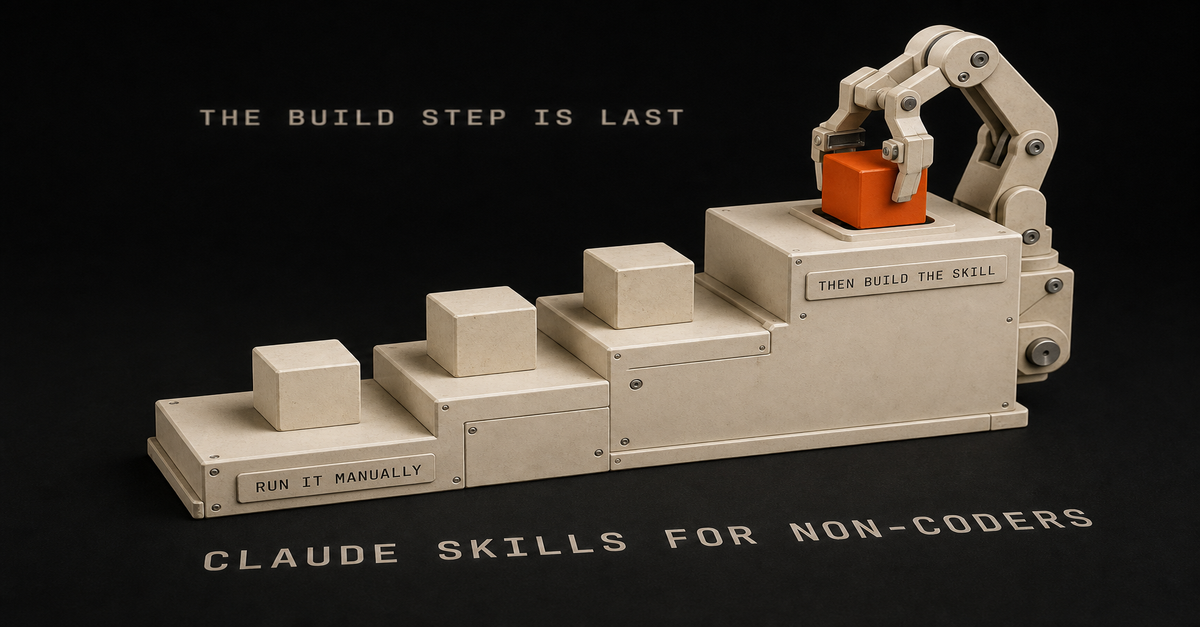
The build step is the last step.
My rule for this one: you are going to change your mind, so run the task manually until you stop changing it, and only then write it down.
That is the rule I landed on in the Claude vs ChatGPT for Excel breakdown. Here's the cool part: Anthropic's own docs agree with it, not with the tutorials. More on that in a second.I walk through this on camera in The 5 Levels of Claude Code Skills (Most People Are Stuck on Level 2) (17 min).A Skill Is a Folder of Instructions Claude Picks Up Only When It Needs Them
Anthropic's definition is one sentence: Skills are folders of instructions, scripts, and resources that Claude loads dynamically to improve performance on specialized tasks.
The key word is dynamically. Per the same page, when you ask Claude to complete a task, it reviews available skills, loads relevant ones, and applies their instructions.
So a skill is not always-on. It sits there until a task matches, then fires.
That is also why the description field matters more than anything else you write. A skill needs two things in its frontmatter: a name capped at 64 characters and a description capped at 200.
Anthropic's skill-creation docs call the description critical, because Claude uses it to decide when to invoke your skill. A perfect procedure with a vague description never runs.
Skills, Projects, and Custom Instructions Do Three Different Jobs
Most of the confusion on this query is people building a skill when they wanted a Project. Anthropic draws the line themselves in the Skills doc: Projects provide static background knowledge that is always loaded, while Skills provide specialized procedures that activate dynamically.What it is
When it loads
Use it forCustom instructions
Standing preferences
Every conversation, always
Tone, format defaults, how you want to be addressedProjects
Static background knowledge
Always, inside that Project
Client docs, brand guide, product spec, past reportsSkills
A procedure with steps
Only when a task matches the description
A repeatable process you run the same way every timeThe quick test: if the answer is stuff Claude should know, that is a Project. If it is how Claude should do a thing, that is a skill. If it is how you like to be talked to, that is custom instructions.
Getting this wrong costs you weeks, because a badly-scoped skill fails silently. It just never triggers.
Anthropic's Own Trigger for Building a Skill Is Retrospective
This is the line that should end the "build your first skill in 5 minutes" genre. From Anthropic's skills documentation: create a skill when you keep pasting the same instructions, checklist, or multi-step procedure into chat, or when a section of your standing instructions file has grown into a procedure rather than a fact.
Look at the tense. When you keep pasting. That means repetition you already lived through.
The tutorials teach it the other way around: have an idea, encode it, ship it. Anthropic's trigger needs you to have already done the thing enough times to be annoyed by doing it again.
And that difference matters. If you encode a procedure you haven't tested, you didn't save time. You installed a wrong answer that fires on its own and looks confident every time. You won't catch it, because the output will look fine.
Anthropic's own doc backs this up. So build the skill second.
Why You Can't Find Skills in Your Settings (the Code Execution Gate)
If Skills is missing from your Claude settings, you almost certainly have not turned on code execution, and no tutorial mentions this.
Skills are available for users on Free, Pro, Max, Team, and Enterprise plans, per Anthropic, so the plan is rarely the problem. The gate is a setting you have to flip.Free, Pro, and Max: open Settings, go to Capabilities, turn on "Code execution and file creation." Then Skills appears under Customize.
Team and Enterprise: an Owner has to enable it first in Organization settings under Skills. If you are not an Owner, you can't turn this on yourself. Ask.Yes, a non-technical person has to turn on something called code execution. That's just what it's called, and flipping it is the whole job.
Where skills work once it is on: claude.ai on web, desktop, and mobile; Claude Code; Claude Cowork; the Microsoft 365 add-ins for Excel, PowerPoint, Word, and Outlook; and the API.
One trap before you plan around Cowork. Cowork is paid only, on Pro, Max, Team, and Enterprise per the Cowork docs, which is a narrower list than Skills itself.
And per Anthropic's skills docs, Cowork sessions and cloud sessions, including routines, do not read the skills folder on your machine. Both interactive and scheduled Cowork sessions load the skills enabled for your claude.ai account, synced at session start.
Translation: a skill saved locally will not show up in your scheduled Cowork run. It has to live on your account.
Start With the Skills Anthropic Already Built for You
You can get real value out of Skills without ever writing one. For a non-coder, that changes the whole question.
Anthropic ships built-in claude.ai skills for Excel spreadsheet creation and manipulation, Word document creation, PowerPoint presentation generation, and PDF creation and processing. Partner skills from Notion, Figma, and Atlassian sit in the Skills Directory.
That covers a large share of what actually lands in a normal work inbox. Deck, doc, spreadsheet, PDF.
So your first week looks like this: turn on code execution, browse the directory, use the bundled skills on real work, and author nothing. If you never get past this step, Skills still paid for itself.The 60-second version, from my Shorts: Stop installing random Claude skills. These 5 actually hand you the file.The Graduation Ladder: Manual Chat, Then Reps, Then Encode, Then Schedule
The right order is a ladder with four rungs, and every rung has to earn the next one.Run it manually in chat. Paste the input, describe what you want, read the output.
Do it again, several times, and change your mind out loud. This is the rung people skip.
Stop changing your mind. When the format holds across runs, you finally know what the procedure is.
Write it down as a skill, then automate it.My inbox automation is the worked example, and I published the sequence in the Claude Cowork scheduled tasks breakdown. I ran the inbox summary manually first.
I started by asking for what I wanted without really knowing what I needed. Then I changed the format run by run: I need this, I do not need this, I like this format. Only once it kept doing the job right did I move it onto a schedule.
The manual reps weren't wasted time. They told me what the automation had to do.
My other rule from the Excel breakdown works the same way: start with one simple skill and keep doing everything else manually until you trust it. One skill you trust beats five you're babysitting.
If you are still deciding where any of this fits in your week, the Claude Guides pillar lays out which lane each task belongs in before you automate anything.
The Signal You're Done Iterating
The real tell is having a clear goal and knowing what good looks like. And the only way you know what good looks like is that you've done the work by hand yourself.
With my own skills, I judge it like this: I use the product, so I can read an output and place it. This is good enough. This is on par with what I would have done.
This is better than I would have done it. That scale only exists in your head because of the manual reps. Skip them and you literally cannot know when the skill is done, because you have no standard to judge against.
In practice: after each manual run, note whether you edited the output. When runs stop surprising you and you catch yourself saying "on par with mine," you have the green light.
And be practical about it. You are not going to spend five weeks perfecting a skill while shipping nothing. Get it good enough to use, ship with it, and keep refining.
Realistically that's a week or two of tweaking when you have time. Either way the work keeps moving. Run it manually while the skill catches up, or keep refining until it clears your bar. Once it's in use, it pays for itself on real output you're QA-ing anyway.
What Actually Goes in Your First Skill
Your first skill should be the most boring repeatable thing you do, not the most impressive.
Good first candidates share a shape: same input type every time, same output format every time, and a judgment call you have already made and settled.The weekly status update you write from the same three sources
The way you reformat a client's messy export before you look at it
The specific structure your boss wants meeting follow-ups in
The checklist you run before sending anything externalWrite it as instructions, not an essay. Steps, the format you want, and one line about what to do when input is missing. Then spend real effort on the description field, because that line decides whether the skill ever fires.
Three No-Code Ways to Actually Create One
There is a terminal-free upload path, a skill whose job is writing skills, and since July 21, 2026, a way to record yourself doing the task and let Claude write the skill from the recording.
The upload path. Create the skill folder, package it as a ZIP, then go to Customize, Skills, the plus button, Create skill, Upload a skill.
One thing that trips people up: the skill folder must be the ZIP root, and per Anthropic's skill guide, files should not sit directly in the ZIP root. Folder in the ZIP, not loose files.
skill-creator. Anthropic maintains a skill that authors skills. Its own description reads: create new skills, modify and improve existing skills, and measure skill performance. Use when users want to create a skill from scratch, edit, or optimize an existing skill. If writing structured instructions is the part you dread, hand that part to it.
Record a skill. This one landed on July 21, 2026, after this page first went up, and it is the most non-coder path of the three.
In Cowork on Claude for Mac, click the plus button in the composer and pick "Record a skill" (or go to Customize, Skills, Add, "Record your screen"). Do the task the way you normally do it, talk through it if you want, click Done.
Per Anthropic's skill guide, Claude then "starts a Cowork task and reviews the recording, then proposes a skill" for you to approve before it is saved. It is Pro, Max, and Team only, Mac only, and a recording runs about 10 minutes.A test run on my Mac mini: I recorded myself turning a Monday brief into a three-line summary in TextEdit, and Claude watched the 15 steps and proposed a skill that does the same thing with file reads and writes instead. That is the part that matters for this page: it built the skill from a task I had already done by hand, which is exactly the order I am arguing for.
Two cautions from the same doc. Everything on your screen is captured while you record, so no passwords, no private tabs. And the video is not kept; what is saved afterward is a set of screenshots from the session, which you can open under the "Recorded demonstration" step in the task.
One correction while you are here. The tip going around LinkedIn, where you open an old Cowork chat and prompt Claude to turn the conversation into a Skill, is not documented by Anthropic anywhere in its support material. It may work. It is not a supported path, so do not build your plan on it.
After the Skill Exists, Verify It Like You Do Not Trust It
When a skill runs on its own, nobody reads it closely. That's exactly when wrong output sticks around the longest.
The habit I keep from the Excel breakdown is trust but verify: run the automated version in parallel with your manual process until it matches your answers, and when a number matters, paste the output into a second tool and ask it to QA the first.
Spot-check numbers against the source. Read the whole thing on the first few automated runs even when you are sure it is fine.
Skills take the typing off you. The review step is still yours.
If you want to see what the finished automated versions look like in practice, the 20 real Claude Cowork use cases page is the catalog of what people actually run on a schedule.
When a Skill Is the Wrong Tool
Skills are the wrong call more often than the tutorials admit, and knowing when saves you the most time.One-off tasks. If you will do it twice this quarter, just prompt it. Encoding costs more than the task.
Anything still changing. New process, new client, new format the team is still arguing about. Encode it and you will be maintaining a stale procedure inside a folder you forget exists.
Judgment calls. Deciding what to include is not a procedure. Formatting what you already decided is. Skills automate the second one.
Stuff that is really reference material. If you want Claude to know things, put them in a Project. Skills hold procedures, not facts.
Work where being wrong is expensive and unreviewed. Anything financial, legal, or client-facing that would go out without a human reading it. Keep a person on that.It always breaks the same way: you encode too early, then trust output that slowly drifted from what you meant.
Frequently Asked Questions
Do Claude Skills require coding?
No. Anthropic ships built-in skills on claude.ai for Excel, Word, PowerPoint, and PDF work, plus partner skills from Notion, Figma, and Atlassian in the Skills Directory, and using them requires no authoring at all.
Creating a custom skill also has a no-terminal path, and since July 2026 a record-your-screen path in Cowork on Mac: package the skill folder as a ZIP and upload it through Customize, Skills, Create skill.
Why is Skills missing from my Claude settings?
Skills sit behind the code execution capability. On Free, Pro, and Max, open Settings, go to Capabilities, and enable "Code execution and file creation," after which Skills appears under Customize. On Team and Enterprise, an Owner has to enable Skills in Organization settings before any individual user can see it.
When should I create a Claude Skill instead of just prompting?
Anthropic's stated trigger is repetition you have already experienced: create a skill when you keep pasting the same instructions, checklist, or multi-step procedure into chat.
If you have not run the task manually enough times that two consecutive runs need no edits, prompting is still the right tool and a skill would just lock in a guess.
Are Claude Skills available on the free plan?
Yes. Skills are available for users on Free, Pro, Max, Team, and Enterprise plans, though code execution must be enabled first. Claude Cowork is stricter and paid-only, on Pro, Max, Team, and Enterprise, so a free user can use skills in chat but not run them on a Cowork schedule.
Do my local skills work in Claude Cowork?
No. Anthropic states that Cowork sessions and cloud sessions, including routines, do not read the skills folder stored on your machine. Both interactive and scheduled Cowork sessions load the skills enabled for your claude.ai account, synced at session start, so a skill has to live on your account to run there.
Do This in This OrderThis week: enable code execution, then use the bundled Excel, Word, PowerPoint, and PDF skills on real work. Author nothing.
Weeks two through four: pick your single most repetitive task and run it manually in chat every time it comes up, changing the format whenever it annoys you.
When two runs in a row need no edits: write it down as one skill, with real effort spent on the description field.
Only then: put it on a schedule, and read the first few automated outputs like you do not trust them.
If the process is still changing, or the call is a judgment call: do not build the skill. Keep prompting.The tutorials sell you the last step first because it's the only step that looks like progress. The point is, the reps are the work. The skill comes last.
Published and last reviewed July 18, 2026. Product capabilities, plan tiers, and setup paths checked that day against Anthropic's official support and developer documentation, all linked inline. The claim that a Cowork conversation can be converted into a skill in one click is explicitly not documented by Anthropic and is flagged as unverified above. These products change often; the official pages are the source of truth.

 Chris Alarcon