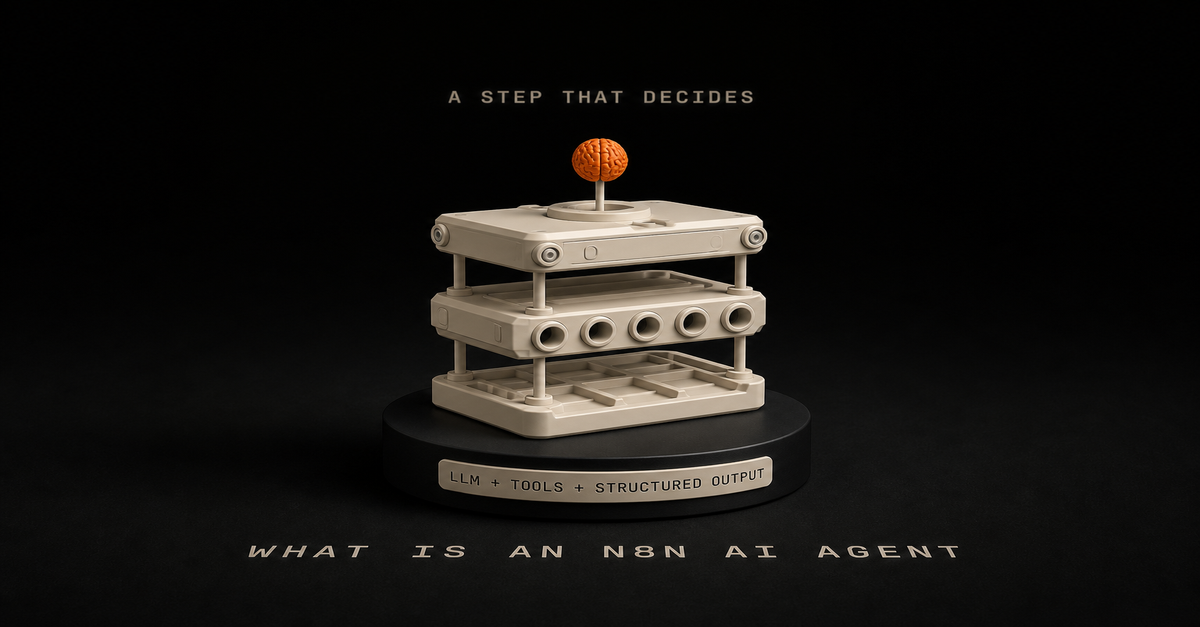
An n8n AI agent is a workflow step that uses an LLM plus tools to make decisions inside an automation. The agent reads context, chooses or calls tools, returns a structured result, and lets n8n route the next step.
Heads up: some links in this post are affiliate links — a small kickback to me at no cost to you. I only recommend tools I’ve actually run.
The short version:
| Part | Job |
|---|---|
| n8n | Trigger, gather data, route output, retry failures |
| AI agent | Read context, decide, draft, classify, score, or plan |
| Tools | Let the agent check data or take action |
| Human approval | Protect anything public, expensive, or brand-sensitive |
The mistake is thinking the AI Agent node is magic by itself. It is not.
The node becomes useful when it has a clear job, enough context, and access to the right tools.
If you want the full build sequence, read the n8n AI agent tutorial. If you want the repeatable pattern, use the n8n AI agent workflow. This page is the short definition.
The plain-English version
Think of n8n as the operations desk.
It knows when something happened. A form came in. A video published. A Search Console export landed. A Notion status changed.
The AI agent is the person at the desk who can read the packet and make a call.
Should this lead go to sales? Should this query become a tool page? Should this transcript become a newsletter? Is this task worth automating?
That decision is the agent’s job.
The routing, logging, retries, and notifications are n8n’s job.
What makes it agentic?
An agentic workflow has more than a prompt.
It has:
- a trigger
- context
- a decision
- tools or actions
- memory or history when needed
- a clear output
- an approval gate when consequences exist
Without tools or actions, the agent is usually just an LLM response inside a workflow.
That can still be useful. But it is not the same as an agent that checks, decides, and routes.
A simple n8n AI agent workflow
Here is the pattern I would start with:
- n8n detects a new input.
- n8n gathers the context.
- The agent makes one specific decision.
- n8n saves the decision.
- A human approves if needed.
- n8n routes the output.
Use the n8n AI Agent Workflow Builder to map that before you build.
For the full Ship Lean path, use the n8n AI Agents hub. It connects this definition to the workflow pattern, builder tool, and Claude Code/n8n handoff.
The distinction matters:
| Search intent | Best next page |
|---|---|
what is n8n ai agent | Stay here for the definition. |
n8n ai agent tutorial | Use the build tutorial. |
n8n ai agent workflow | Use the workflow pattern. |
Good first use cases
For solo builders, good use cases are boring:
- score Search Console queries
- classify inbound leads
- turn a build log into a newsletter draft
- summarize support requests
- route content ideas
- check if a workflow is worth automating
Bad first use case: “run my whole business.”
Start with one judgment step.
n8n AI agent vs Claude Code
n8n AI agents are good inside recurring workflows.
Claude Code is better when the task needs repo context, file edits, code changes, or a real implementation pass.
Use both when the workflow needs a trigger and a code-aware operator:
- n8n detects and gathers
- Claude Code edits or drafts
- human approves
- n8n routes
Read the full decision rule in Claude Code vs n8n.
FAQ
What is an n8n AI agent?
An n8n AI agent is an automation step that uses an LLM plus tools to reason over context and take actions inside a workflow.
Is the n8n AI Agent node agentic by itself?
Not really. It becomes agentic when it can use tools, check context, make decisions, and route work instead of only generating text.
When should solo builders use an n8n AI agent?
Use it when one repeatable workflow needs judgment, classification, drafting, scoring, or routing.
What is the difference between an n8n AI agent and an n8n AI agent workflow?
The agent is the judgment step. The workflow is the full system around it: trigger, context, tools, approval, routing, logging, and retries.

Written by
Chris AlarconChris Alarcon builds Ship Lean: the boring Claude and AI setups that actually work, handed to people who don’t code. He runs his one-person operation on these systems, around a full-time job, and shares every workflow, prompt, and tool combo in public. Start with the 15 prompts he uses every day.
Work With Me
Setting this up for your team?
I do that. The right plan per seat, the boring setup that makes it stick, and the first three chores handed off. A 2-hour workshop or a done-with-you build, for teams of 2-50.
See how it works →The 15 AI prompts I actually use every day
I tested hundreds and kept the 15 that survived at my desk. You get them right away, then one short Ship Lean note every Tuesday.