In this article
- 1 Ten names in the dropdown and you only need two
- 2 The answer in one table: what each plan actually gets
- 3 On Pro, Fable is a paid add-on wearing an included label
- 4 On Max, the 50% is a ceiling and not a bonus
- 5 Nobody publishes how much faster Fable burns, including Anthropic
- 6 Even Claude’s own tooling cannot keep this straight
- 7 My rule: Fable plans it, Opus makes it
- 8 Why I do not just use Sonnet
- 9 The other reason page one is not helping you
- 10 So which one should you pick
- 11 Common questions
Which plan should you buy? Tap 3, get the verdict
Quick answer: pick Opus by default and spend Fable deliberately. On Claude Pro, Fable is not really included: per Anthropic’s support article, it sits outside your plan’s usage limits and runs on paid usage credits. On Max, Fable is capped at 50% of your weekly limits and draws from the same pool as everything else. This is not a quality decision. It is a budget decision, and the budget is your week.
Whether you searched Fable vs Opus or Opus vs Fable, the answer below is the same, and it is decided by your plan rather than by benchmarks.
The Ship Lean rule on the Claude picker: Opus by default, Fable on purpose.
Ten names in the dropdown and you only need two
Open the model picker on a paid Claude plan and you get a wall. Sonnet, Opus, Fable 5, Fable 5.1, and an Effort control next to them. Then ChatGPT starts shouting Sol and Astra at you from the next tab over, and if you want that particular headache sorted, Astra vs Fable does it.
When you have ten models to pick from, it is just too much. What the hell is Sol. What is Astra.

That is the actual picker, and the Effort control next to the model name matters as much as the name itself.
Effort is how hard Claude thinks before it answers: raise it and you get more reasoning and spend more of your limit, lower it and you get a faster, cheaper answer. It shows up again at the end of this page, because my main recommendation depends on it.
So here is the compression. On a paid plan you need two names: Opus for the work, Fable for the thinking. Everything else is detail, and the rest of this page is why.
I did the four names in a minute on camera, before Fable 5.1 landed:
The 60-second version, from my Shorts: Claude's 4 models in plain English (and the one you're wasting).
The answer in one table: what each plan actually gets
Read this before you click anything. The model rows come from Anthropic’s pricing page and the Max cell’s 50% wording comes from their Fable support article, both read September 18, 2026.
| Free | Pro ($20/mo, $17 annual) | Max (from $100/mo) | |
|---|---|---|---|
| Sonnet | Yes | Yes | Yes |
| Haiku | Yes | Yes | Yes |
| Opus | No | Yes | Yes |
| Fable | No | Usage credits | 50% of weekly limits |
| Usage credits available | No | Yes | Yes |
Two cells in that table are the whole page. Fable on Pro reads “Usage credits”, not a checkmark. Fable on Max reads “50% of weekly limits”, not “unlimited”.
On Pro, Fable is a paid add-on wearing an included label
Here is the sentence that every “Fable is on all paid plans” summary stops one line short of.
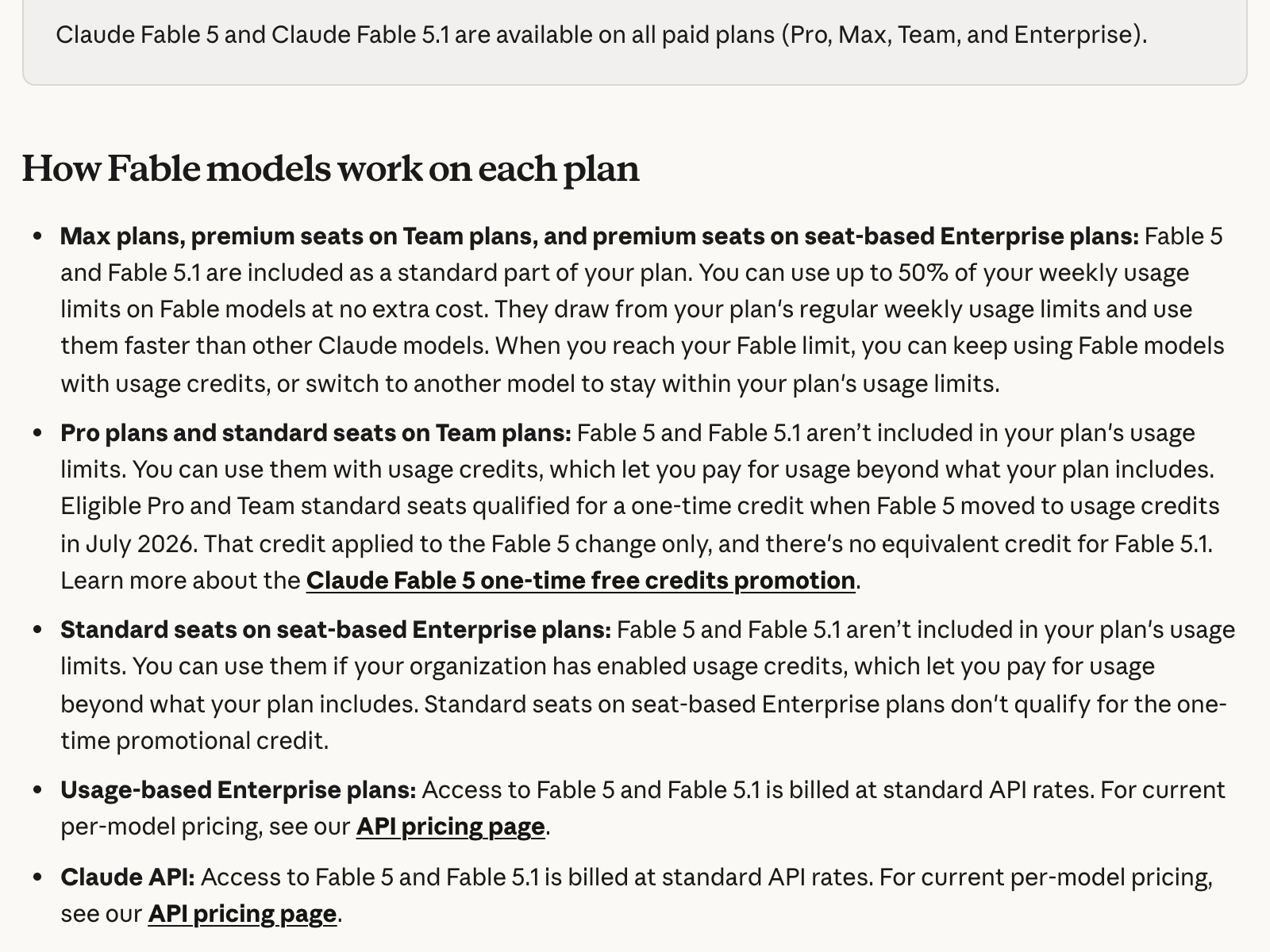
Anthropic’s headline is accurate: “Claude Fable 5 and Claude Fable 5.1 are available on all paid plans (Pro, Max, Team, and Enterprise).” If Fable itself is new to you, what Claude Fable is covers the model rather than the billing.
Then the detail. For Pro plans and standard Team seats: “Fable 5 and Fable 5.1 aren’t included in your plan’s usage limits. You can use them with usage credits, which let you pay for usage beyond what your plan includes.”
Available is not the same as included.
If you are a $20 subscriber clicking Fable expecting it to come out of the allowance you already pay for, you are about to meet a paywall, and page one of Google does not warn you.
There was a one-time credit for eligible Pro and Team standard seats when Fable 5 moved to usage credits in July 2026, and Anthropic is explicit that there is no equivalent for Fable 5.1.
There was also a promotion that gave subscribers up to 50% of their weekly subscription limit on Fable 5 at no extra cost.
Per the same support article, it ended on July 19, 2026, and it never applied to Fable 5.1. If you read a guide saying Pro gets 50% of its limits on Fable, you are reading something written before that date.
On Max, the 50% is a ceiling and not a bonus
The Max rule gets restated online as a perk. It is a cap.
Anthropic: “You can use up to 50% of your weekly usage limits on Fable models at no extra cost. They draw from your plan’s regular weekly usage limits and use them faster than other Claude models.”
Read that twice. Fable does not come with its own tank. It drinks from yours, faster than anything else does, and once half the week is gone that is the end of the free part. After that, Anthropic says you can keep going on usage credits or switch models.
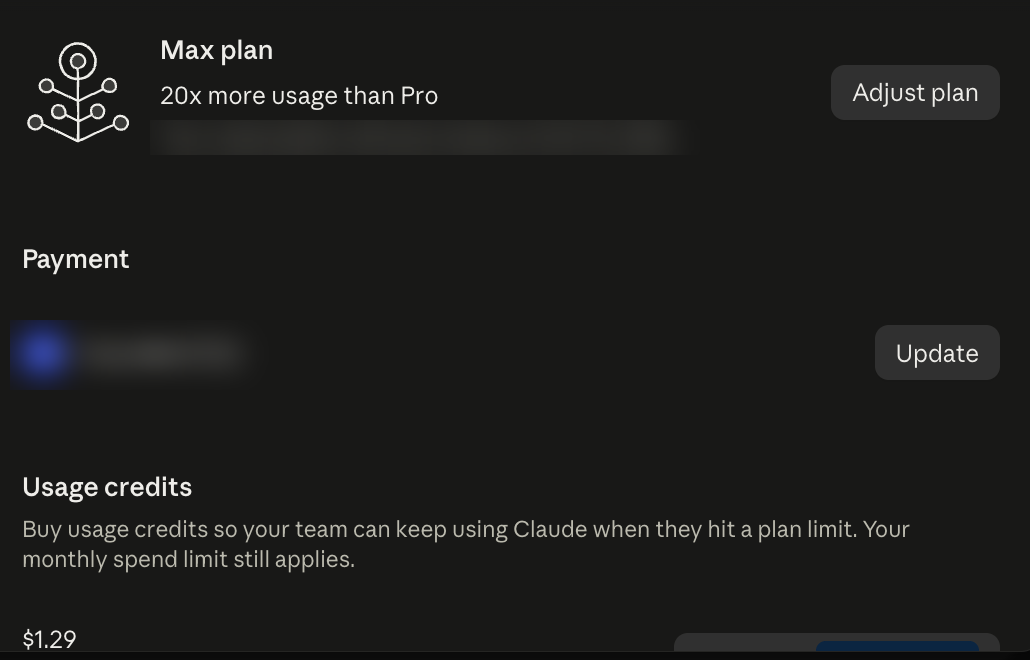
That is my own account today. Max 20x, and a usage credits balance sitting there as the paid-on-top lane for exactly this situation. Card details are blurred, the mechanism is not.
Here is what the ceiling feels like in practice. One day into my week I was already at 20%, and Fable is most of why. I use Opus heavily as well, and I do not use anything below it.

That meter capture is from September 5, 2026, not today. It is what a real Max week looks like when Fable is in the rotation. The full mechanics live on Claude usage limits explained.
Nobody publishes how much faster Fable burns, including Anthropic
I want to be blunt about this because the internet is full of confident numbers.
Anthropic says Fable uses your limits “faster than other Claude models” and, in their model guide, that it “uses the most of your rate limit”. Their ladder is: Haiku lightest, Sonnet moderate, Opus heavy, Fable heaviest.
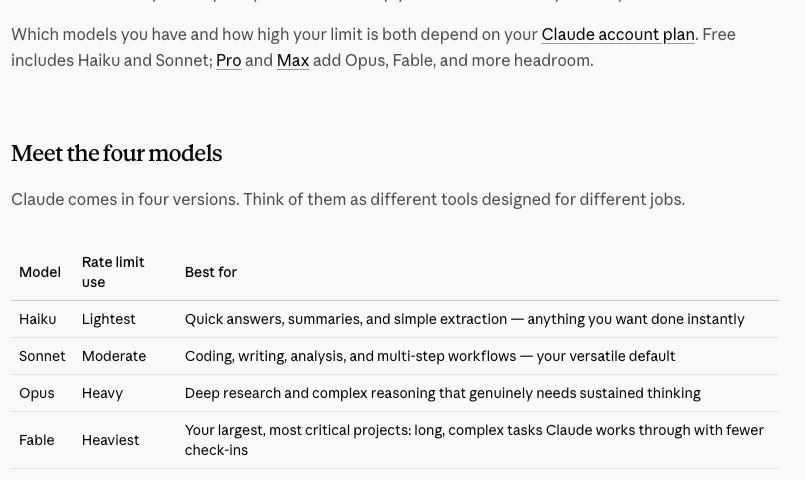
That is the whole published guidance. No multiplier. No “Fable is 5x Opus”.
So my “a day in and I am at 20%” is a dated personal observation on Max 20x with my particular workload. It is not a rate, and you should not plan your month around it.
Even Claude’s own tooling cannot keep this straight
If you find this confusing, you are in good company.
On July 20, 2026 a Max subscriber going by tobowers filed issue #79412 on the Claude Code repository with a title that says everything: “/model shows Fable 5 as credits-only (€0.00) on Max plan, while /usage shows Fable covered by plan (5% of weekly limit).”
In the same session, the picker told him “Fable 5 runs on usage credits, you have €0.00 in credits” while /usage reported “Current week (Fable): 5% used.” His own read: “The Current week (Fable) bucket is a plan-usage allowance that resets on the weekly cycle, i.e. Fable is included in my plan and I’m 5% into it.”
He was right, and the tool was telling him two opposite things at once. The issue is marked as a duplicate and I can see no Anthropic response on it, so I am not going to claim it was confirmed or resolved.
My rule: Fable plans it, Opus makes it
This is the part I get asked about and it is the opposite of what most people assume.
Fable is for planning and orchestrating. Complex thinking, designing a system, working out the architecture of something before it exists. When I was building and refining my content system, that was Fable work.
Opus is for producing the thing once the engine is built. Creating content, writing, executing against a plan that already exists. You are not going to use Fable to write a tweet. You use Opus.
The specific trade I make, and this is the useful bit: for that planning work I would rather run Fable at medium effort than push Opus to high or max. Fable at medium is my sweet spot.
That is a preference, not a measurement, and I am not going to dress it up as a rate when Anthropic publishes none. What I can say is why I prefer it: Fable holds a complicated problem together better, and I would rather buy that with a mid-effort setting than by cranking Opus to its ceiling.
And I do not trust my own judgment in the moment. I put the routing in a rules file so it happens every time instead of whenever I remember. If you find yourself deciding model-by-model, you will default to the expensive one when you are tired.
That is worth saying plainly, because Anthropic’s own advice points in the same direction: Fable is described as being for “your largest, most critical projects: long, complex tasks Claude works through with fewer check-ins”, and it takes longer to answer. That is a planning tool’s description.
Why I do not just use Sonnet
Every page like this gets a comment saying just use Sonnet. Here is the honest answer to that.
The thing that degrades is not the paragraph. It is the number of round trips.
Do research on a cheaper model and you get high-level research. Which means you go back. “This is not what I asked for.” “You are going in the wrong direction.” And you churn.
That churn is invisible in a price comparison and expensive in a real week. When I do not want to waste time, and I want a partner smart enough to actually think with, that is when Fable earns the burn.
Which is also the honest counter-argument to my own rule: if your work does not involve holding a complicated system in your head, you will never feel this, and Sonnet will be fine. Anthropic literally recommends Sonnet as the default for anyone unsure, and it is the only strong model on the free plan.
The other reason page one is not helping you
Every comparison ranking for this question prices it in API tokens. Second Talent’s model roundup is a good example, and a fair one: “Reach for Fable 5 when the task is the hardest you have and the cost of a wrong answer is high”, alongside a price of “$10 input and $50 output per million tokens”.
That is a completely correct answer to a different question.
You do not buy tokens. On Max you have a subscription and a percentage that goes down; on Pro you have a subscription plus a credit balance that Fable draws against. Either way, “twice the price per million tokens” means nothing when your real currency is how much of Thursday you have left.
So which one should you pick
- If you are on Free: neither. You have Sonnet and Haiku, and Sonnet is genuinely good. See the Claude free plan.
- If you are on Pro at $20: use Opus as your ceiling and treat Fable as a paid extra you opt into on purpose. Check your credits before you click it, not after.
- If you are on Max: Opus by default, Fable for planning and architecture, and watch the weekly meter. Half your week is the cap, and it arrives faster than you expect.
- If you write or create for a living: Opus. Fable is slower and heavier and will not make your sentences better.
- If you are designing a system, not using one: this is the case for Fable, at medium effort, and it is worth the burn.
- If you genuinely cannot decide: Anthropic’s own answer is Sonnet. Start there, and Opus vs Sonnet is the next fork when Sonnet stops being enough.
Two other decisions sit next to this one. If the question is really which plan to be on, Claude Pro vs Max answers it with the same weekly-allowance logic.
And the Claude at Work hub is the map for everything downstream.
Common questions
Is Fable included in Claude Pro?
Not inside your plan’s usage limits. Anthropic’s support article says Fable 5 and 5.1 are not included in Pro’s usage limits and that you use them with usage credits, which let you pay for usage beyond what your plan includes. Anthropic’s pricing table marks Fable on Pro as “Usage credits”.
How much Fable do I get on Max?
Up to 50% of your weekly usage limits at no extra cost. That is a ceiling inside your existing allowance, not additional capacity, and Fable draws from that pool faster than other Claude models.
What happens when I hit the Fable ceiling?
You can keep using Fable on usage credits, or switch to another Claude model to stay inside your plan’s limits. Those are the two options Anthropic lists.
How much faster does Fable burn than Opus?
Anthropic does not publish a figure. They rank rate-limit use as Haiku lightest, Sonnet moderate, Opus heavy and Fable heaviest, and say Fable uses the most. Any specific multiplier online is an estimate.
Is Fable better than Opus?
For long, complex projects it works through with fewer check-ins, that is what it is built for. For producing everyday work, Opus is the better trade because Fable is slower and spends more of your week for output you probably cannot tell apart.
Where this comes from: Anthropic’s pricing page, its Fable-on-your-plan article and its model guide, read and screenshotted September 18, 2026. I pay for Max 20x and the usage screens are my account, dated where they were taken. No burn-rate multiplier, because Anthropic publishes none. Last reviewed September 2026.
Plan-change alerts
Your plan is gonna change. Nobody emails you when it does.
I pay for Claude, ChatGPT and Grok, so I check the pricing pages every week anyway. When one moves a price or a limit, you get one email that day. No newsletter, no schedule. Last one I caught: Fable 5 quietly dropped out of Claude Pro.

Written by
Chris AlarconChris Alarcon builds Ship Lean: the boring Claude and AI setups that actually work, handed to people who don’t code. He runs his one-person operation on these systems, around a full-time job, and shares every workflow, prompt, and tool combo in public. Start with the 15 prompts he uses every day.
Work With Me
Setting this up for your team?
I do that. The right plan per seat, the boring setup that makes it stick, and the first three chores handed off. A 2-hour workshop or a done-with-you build, for teams of 2-50.
See how it works →