GPT-6 Astra vs Claude Fable 5.1: Same Price, Two Boards Claude Still Wins

these two models now cost exactly the same and are good at different things. GPT-6 Astra wins computer use, math, cybersecurity and long context. Claude Fable 5.1 wins the two broadest “how smart is it” boards, including one published by OpenAI itself.

Both are $10 per million input tokens and $50 per million output. So price isn’t what decides it anymore.
Every headline yesterday said Astra swept. OpenAI’s own launch table does not say that.
The rows nobody quoted
OpenAI published a comparison table on the Astra launch page with Claude Fable 5.1 in a column. Two lines in that table go to Claude.
Every number below is transcribed from that page, checked September 4, 2026. When OpenAI’s footnotes put a caveat on a Claude score, I flag it in the next section.
| Benchmark (OpenAI’s own table) | GPT-6 Astra | Claude Fable 5.1 |
|---|---|---|
| Artificial Analysis Intelligence Index v4.1.1 | 61.2 | 65.7 |
| Humanity’s Last Exam (with tools) | 57.2% | 65.0% |
| Terminal-Bench 4.0 | 57.9% | 55.8% |
| Terminal-Bench Science 0.1 | 64.6% | 52.6% |
| FrontierMath Tier 4 (v2) | 97.6% | 87.8% |
| GPQA Diamond | 96.0% | 93.7% |
| AutomationBench | 41.4% | 31.4% |
| DeepSWE v1.1 | 74.1% | 67.4% |
| FrontierCode 1.1 Main | 53.3% | 50.9% |
| ARC-AGI-2 | 95.0% | 90.0% |
| Computer use safety, internal (lower is better) | 2.4% | 9.5% |
The Artificial Analysis Intelligence Index is about as close as you get to one number for how smart a model is overall. OpenAI put it in its own launch table, and it hands Claude a 4.5 point lead.
Artificial Analysis, quoted independently:
Sits beside GPT-5.6 Sol in Intelligence: GPT-6 Astra scores equal to GPT-5.6 Sol in the Index at 61. This is 5 points lower than Claude Fable 5.1 (max with fallback).
So on the broadest board, OpenAI’s newest model tied its last one.
Read the footnotes before you read the table
OpenAI ran these numbers. That does not make them wrong, but the footnotes change how you should read four rows.
- BenchCAD: OpenAI’s footnote 5 says Claude’s scores reflect three modifications to the eval.
- ScreenSpot-Pro and ExploitGym: footnote 17 says the Fable scores reported are actually from Mythos, described as “Fable with fewer safeguards.” That is a different model.
- HealthBench Professional: footnote 11 says OpenAI independently evaluated the Claude models itself, using GPT-5.4 as grader, with Opus 5 substituted when Fable 5.1 refused.
- Three science evals: footnote 12 says Claude Fable 5 and 5.1 are excluded from LifeSciBench, GeneBench Pro and MedChemBench because they refuse the majority of questions.
None of that is shady. Every vendor benchmarks its own launch. But “state of the art across the board” is how the press summed it up, and the table doesn’t say that.
The 99.9% asterisk
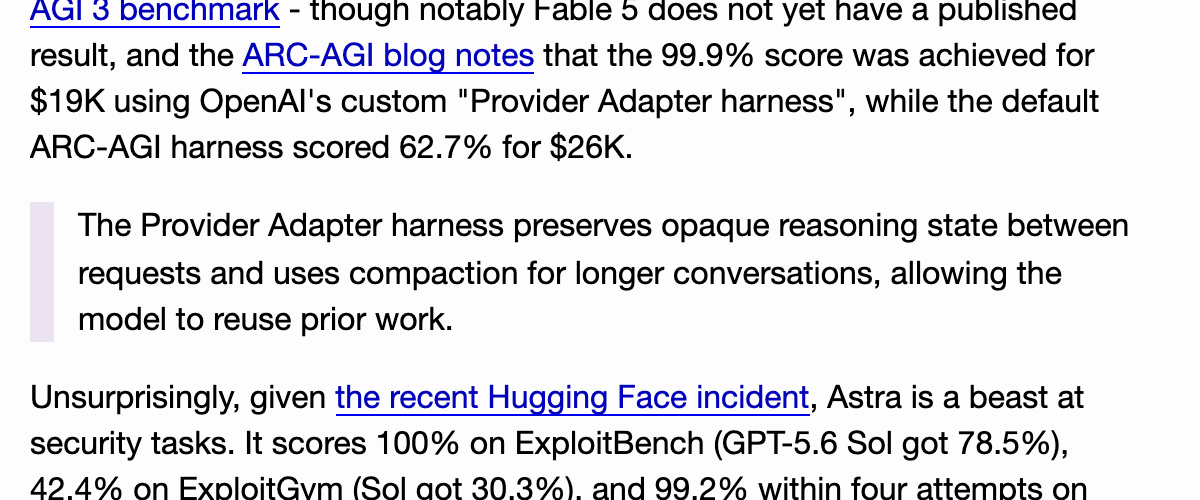
The number that traveled furthest was Astra saturating ARC-AGI-3 at 99.9%. It should count the least of anything in the launch.
Two problems, both disclosed by the people who ran it:
- Harness. Per the ARC Prize blog, the 99.9% came from OpenAI’s custom “Provider Adapter harness” at about $19K. The default ARC-AGI harness scored 62.7% at about $26K. OpenAI’s own footnote 1 confirms it ran a modified responses API harness. That is a 37 point spread depending on plumbing.
- No opponent. Claude Fable has no published ARC-AGI-3 result. So the biggest number of the launch has nothing to compare against.
The Provider Adapter, in ARC Prize’s words, “preserves opaque reasoning state between requests and uses compaction for longer conversations, allowing the model to reuse prior work.” That’s interesting engineering. But it doesn’t tell you how smart the raw model is.
Simon Willison, writing the day it shipped, summed up the launch in one sentence: Astra “appears to score higher than Fable on most of OpenAI’s self-reported benchmarks.”
The key word there is self-reported.
Where Astra genuinely pulls ahead
Strip out the noise and Astra’s wins are real. They just bunch up in a few areas.
Computer use. This is the big new thing in the launch. Astra scores 59.3% on Agents’ Last Exam against 55.5% for Claude Opus 5, and OpenAI reports it hitting 72.6% on OSWorld 2.0 in roughly 47% less time per task than GPT-5.6 Sol.
Math and science. FrontierMath Tier 4 at 97.6% against 87.8%. Terminal-Bench Science at 64.6% against 52.6%. These are not close.
Cybersecurity. 100% on ExploitBench, 88.0% single-attempt on SRE-Bench binary reverse engineering. OpenAI says this crosses the Critical threshold in its own Preparedness Framework, so it put limits on the model at launch.
Long context. 100% on OpenAI’s eight-needle test at 256K to 512K tokens, and 96.3% at 512K to 1M.
Token efficiency. This one matters more than the scores. On Agents’ Last Exam, OpenAI reports Astra using about 65% fewer output tokens than Opus 5 at the highest-scoring settings.
Where Claude Fable 5.1 holds
The broad boards. Intelligence Index and Humanity’s Last Exam, both from OpenAI’s own table.
Coding, closer than the headline. Astra edges Fable 5.1 on FrontierCode 1.1 Main, 53.3% to 50.9%. But look one column over in OpenAI’s table: Fable 5 scores 53.5%, ahead of Astra. On the Artificial Analysis Coding Agent Index, Astra posts 67.0 against 67.2 for Fable 5 and 68.1 for Opus 5. Coding is a wash.
Cost per task at equal quality. Artificial Analysis again: “Per task, the model is less than half the cost of Claude Fable 5, for the same score.” That’s where Astra’s efficiency actually pays off. And it matters more than the trophy rows.
What I actually threw at it on day one
I pay for both stacks, and Astra is one day old as I write this.

I didn’t run a benchmark. I just ran my actual work, because that’s the only test I trust.
The one that changed my mind about Astra was a prospecting task. I asked it to find companies in a specific niche worth reaching out to, and it went and searched forums and threads on its own without me telling it where to look.
What came back was about a month old. That kind of search usually pulls up threads from many months back.
For me that’s the real upgrade: it did the digging on its own.

Another Astra run from the same week, on my Pro account. I asked it to plan two weeks of paid-work experiments around my real numbers; it pulled live listings on its own and priced the options. The top of the answer has my personal figures in it, so it is trimmed. The chip in the composer is the part worth noticing: on this surface it is labeled GPT-6 Astra Ultra, not GPT-6 Pro.
Then I did the thing I would actually recommend: I ran the output back through Claude Fable to QA it, Fable rewrote the prompt, and I sent it back at Astra. The second pass looked good enough that it’s now how I’d run this by default.
Now the other side. I’ve used Fable more, and for building it still feels more familiar and more dependable to me. But Fable 5.1 has also done some dumb things this week, mostly losing track of tools it definitely had access to. It’s minor, but it’s real.
My read on the scoreboard: I assumed it said Astra beat Fable outright. It doesn’t, and that actually matches what I saw hands-on. Fable still feels better at the deep work. Astra feels newer at getting things done by itself.
The decision rule I would give someone today
Don’t switch providers over this. Send each job to the one that’s better at it.
| The job | Open |
|---|---|
| Deep building, writing in your voice, long careful work | Claude Fable 5.1 |
| Anything the AI should do on its own across apps and the web | GPT-6 Astra |
| Research and volume where you need lots of runs | GPT-6 Astra |
| Reviewing and QAing another model’s output | Claude Fable 5.1 |
| Math, science, anything with a checkable right answer | GPT-6 Astra |
| You can only pay for one, and you are a generalist | ChatGPT (usage and resets decide it, not the score) |
I keep coming back to this: smartest isn’t the flex anymore. A model that burns tokens to win a board is worth less to me than a leaner one that finishes the task. Both companies are getting pushed that way, and this launch is the clearest sign of it so far.
Verdict
Same price, split by job, and that split is the useful part. Astra is the better agent. Fable is still the better thinker on the broadest boards OpenAI itself published, and it’s my daily driver for building.
If you were about to cancel Claude because of a headline, read the table first.
Working out which subscription this actually affects? Which ChatGPT plans get Astra, Claude Max vs ChatGPT Pro, and Claude vs ChatGPT for the everyday call. More of how I run both at Claude Guides.
Published September 4, 2026, one day after GPT-6 Astra shipped. Every benchmark figure was transcribed that day from OpenAI’s launch page, and the ARC-AGI-3 harness figures from Simon Willison’s write-up citing the ARC Prize blog, both linked above. These are vendor-run numbers on a vendor page and OpenAI’s footnotes qualify several Claude scores; read the footnotes section before quoting any row. Benchmarks and prices move fast and this page will need re-checking.

Written by
Chris AlarconChris Alarcon shows people who don’t code the boring Claude setup that actually works. He runs his one-person operation on these systems and shares every workflow, prompt, and tool combo in public. Start with the free 1-page setup.
The boring setup
It still won't know you tomorrow.
The Setup is one folder. Drop it into a Project, answer three questions, and Claude or ChatGPT writes your memory file and your voice file itself. It stops forgetting you, stops sounding like AI, and runs three real jobs by name. Twenty minutes tonight. No code. $39, 30-day refund.
See The Setup →Get the free 1-page setup
The boring 1-page setup. No code, no jargon. Get it now, then one short email from me each Tuesday.
