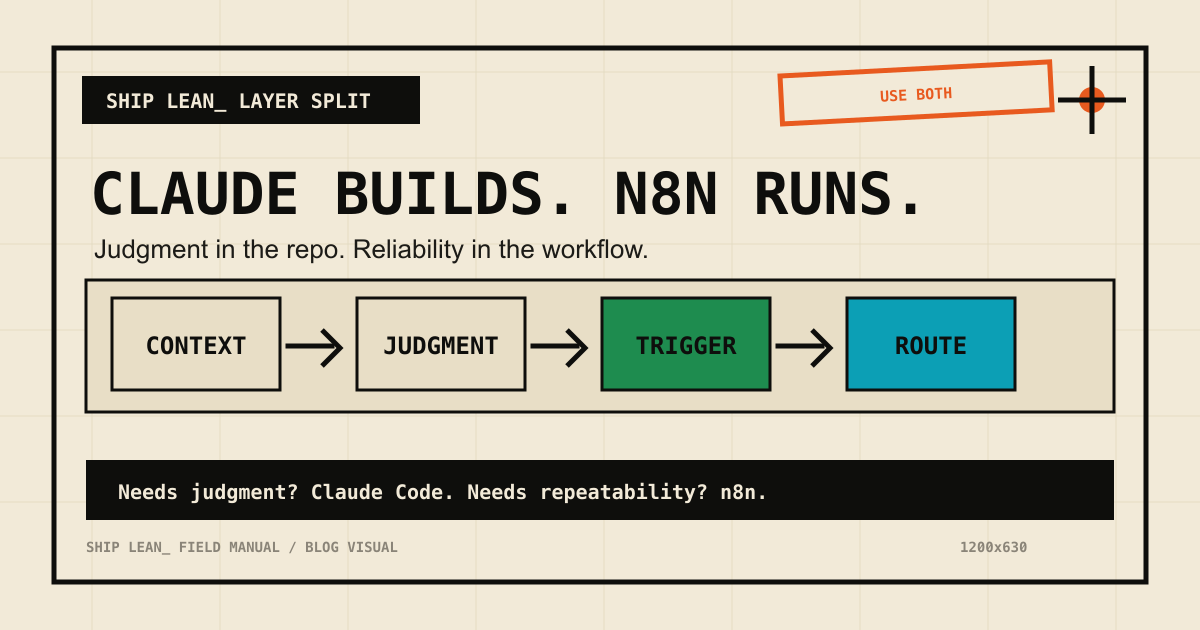
Quick answer: Use Codex when the work lives in a repo and needs judgment, editing, tests, or codebase context. Use n8n when the work needs a trigger, credentials, retries, run history, and repeatable automation. The Ship Lean rule is simple: Codex builds. n8n runs. Human approves.
Start with the n8n AI Agents hub if you want the whole system. If the workflow specifically needs an n8n agent, use the n8n AI Agent Workflow Builder before touching the canvas.
The Difference in One Table
| Question | Codex | n8n |
|---|---|---|
| Can it read and edit repo files? | Best | Weak |
| Can it run tests and inspect diffs? | Best | Weak |
| Can it trigger from forms, webhooks, schedules, and apps? | Possible | Best |
| Can it manage app credentials cleanly? | Not the job | Best |
| Can it retry failed workflow steps? | Possible with scripts | Best |
| Can it show run history? | Not the job | Best |
| Can it draft, refactor, and QA content/code? | Best | Needs LLM nodes |
| Can it route human approvals? | Possible | Best |
This is why the comparison is not “which tool is smarter?” It is “which tool owns which layer?”
Use Codex for Builder Work
Codex is the better choice when the work requires context from your project:
- refreshing a blog article against Search Console evidence
- adding schema, metadata, internal links, or page sections
- building a new calculator, tool, or workflow page
- reading existing files before making a change
- running a build and fixing failures
- turning a messy idea into a concrete implementation
That is builder work. It benefits from repo context and judgment.
If you try to force that whole process into n8n, the canvas gets crowded fast. Prompts, examples, brand rules, page templates, and QA checks belong in files where a coding agent can inspect and update them.
Use n8n for Runner Work
n8n is the better choice when the work needs to happen repeatedly:
- every Monday, pull Search Console data
- when a form is submitted, enrich the lead
- when a video is uploaded, create repurposing tasks
- when a page draft is ready, notify the human reviewer
- when approval is granted, send the next step to GitHub, Slack, Notion, or email
n8n is strongest as the workflow layer because it handles boring operational details: triggers, credentials, retries, node-level debugging, and run history.
That boring part is the part that keeps systems alive.
The Best Pattern: Codex Plus n8n
For organic traffic, the useful system looks like this:
| Step | Owner | Job |
|---|---|---|
| 1 | n8n | Pull Search Console query/page data |
| 2 | n8n | Filter for impressions, weak CTR, and low position |
| 3 | Codex | Read the target page and refresh it |
| 4 | Codex | Run build, SEO QA, and link checks |
| 5 | Human | Approve the point of view |
| 6 | n8n/GitHub/Vercel | Route deployment and notify |
That is the arbitrage: n8n finds and routes repeatable signals. Codex turns the signal into a useful asset.
When Codex Alone Is Enough
Use Codex alone when the task is one-time or repo-bound:
- “refresh this tutorial”
- “add a hub page”
- “fix this favicon”
- “build a comparison page”
- “run the local build”
No workflow runner needed. The value is in the edit.
When n8n Alone Is Enough
Use n8n alone when the rules are clear:
- copy a form submission into a CRM
- send a Slack notification after a status change
- save an RSS item to a database
- send a weekly report
- route approved data between apps
No coding agent needed. The value is in the repeatable run.
When You Need Both
Use both when the workflow has a repeatable trigger but the output needs judgment.
Good examples:
- Search Console opportunity scoring
- weekly content refresh queue
- transcript-to-blog draft routing
- lead triage with human approval
- workflow JSON review before import
The model should not publish directly. It should prepare the work, show evidence, and ask for approval when the output touches the public site, customers, money, or production.
My Default Rule
If the problem is “build the system,” use Codex.
If the problem is “run the system every week,” use n8n.
If the problem is “use real signals to ship useful assets repeatedly,” use both.
Next, read AI coding agent vs workflow automation, then map the runner side with the n8n AI agent workflow example.

Written by
Chris AlarconChris Alarcon builds Ship Lean: practical AI systems for solo builders who need their product work to turn into distribution and revenue. He shares the exact Claude Code, n8n, content, and workflow systems he uses in public.
Work With Me
Turn proof into distribution
If the article exposed a bottleneck, I can help map the system, build the assets, and route it into tools, workflows, AEO content, newsletters, and short-form distribution.
See the offer →Want more workflows like this?
Every Saturday I send one automation workflow you can steal. Real systems, not theory. Join builders turning product work into distribution.
Get Saturday's Workflow →