In this article
- 1 The actual difference, in plain English
- 2 Why I’d still say Codex, even to a beginner
- 3 The honest caveat in Zapier’s favor
- 4 What I actually did: 47 steps out, one kept
- 5 Should you wire a coding agent to a connector?
- 6 Which one you need
- 7 The mistake: making one tool do both jobs
- 8 The decision rule
- 9 FAQ
Quick answer: ask one question before anything else. Does this need to run without you, or does it need to think?
If it truly has to fire on a trigger forever, with stored credentials and retries and a run history when it breaks, that is connector work. Everything else is agent work.
And here is my actual answer, which is not the one most comparison pages give: for most people asking this in 2026, I would point at Codex. Even if you are new. Even if you think you need something visual.
I moved about 47 automation steps out of a visual builder and into code. I kept exactly one workflow running. That experience is why I answer this the way I do, and why the one I kept matters as much as the 46 I did not.
The actual difference, in plain English
| Connector tool (Zapier, Make, n8n) | Coding agent (Codex, Claude Code) | |
|---|---|---|
| What the work looks like | Trigger in app A to action in app B | “Build me the thing that does X” |
| Runs when | On a schedule or trigger, without you | When you run it |
| What you get | Runs, logs, retries, credential handling | Files, code, working output you own |
| Who handles failures | The platform surfaces the failed step | You do |
| App coverage | 9,000+ apps out of the box | Whatever has an API |
| Best at | Repetitive plumbing, forever | One-off or complex logic |
The clearest statement of this I’ve seen wasn’t from either vendor. It was a Reddit comment that Google now features at the top of this exact search. u/ergod_dev on r/automation: “Connector tools (Zapier, Make, n8n) are best when the work is ‘trigger in app A causes action in app B.’ … Code-and-deploy tools (Replit Agent, Cursor, Claude Code) are best when the task is ‘write me an actual script that does X’ and you’re okay running it yourself. What kills people is trying to do agent-shaped work in a connector tool or vice versa.”
That last sentence is the whole failure mode.
Why I’d still say Codex, even to a beginner
This is where I part ways with most of the advice on this topic.
The standard answer is: beginners need something visual, so send them to the connector. I do not think that is true anymore.
If you are staring at this going “I don’t know what to do, I need something I can see,” I would still tell you Codex. It is not as intimidating as a full coding terminal. It looks almost like a chat window.
At that point it is honestly not even Codex versus Zapier. It is a smart assistant that knows how to code versus Zapier. You talk it out, and it gets things done a lot faster than clicking through a canvas.
Because here is the thing nobody selling connector tools mentions: the visual builder is only simple until the logic is not.
I was in an interview once where the Zapier workflow would not work. We were pulling the wrong record for the test. If you have built in these tools you know the dance: you need to pull a sample record that passes certain criteria so you can continue building the steps downstream. That is not simple. That is fighting the tool’s model of the world instead of doing the work.
It is clunky. In my opinion it does not hold up for how I build now.
And if you genuinely want a visual workflow tool, I would not pick Zapier at all. I would use n8n. It is more fluid, and the same logic that takes twenty if-then conditions in Zapier is often about five nodes in n8n.
A little more daunting to look at. Easier once you are in it.
But if you are going to build, the coding agent wins hands down.
The honest caveat in Zapier’s favor
I do not want to sell you a clean story, so here is the strongest point on the other side.
Zapier has far more app connectors out of the box. Zapier MCP advertises 30,000+ actions across 9,000+ apps. That is a genuinely large surface you do not have to build.
With a coding agent, when there is no connector, you connect via API instead. In practice that ends up being about the same thing, with more control and a bit more setup.
Where Zapier is properly ahead is the boring, unglamorous layer: managed credentials, retries, and a run history that tells you which step failed at 3am. That is real infrastructure and an agent does not give it to you for free.
Which is exactly why I kept one workflow instead of zero.
What I actually did: 47 steps out, one kept
Here is my migration, and it does not end the way these stories usually do.
I ran a serious setup in a visual builder. To be precise about what tool: it was n8n, not Zapier. For content it was genuinely good. It would write, it would post, it would call APIs.
The reason I left is the 47-node problem. A complex process might be 47 steps on a canvas. Step one is “scrape this,” fine. But then it is do this, then do that, and now you are embedding complex prompts inside an agent node and wiring specific tools to it. It takes an hour to build something you could have tested and shipped in that same hour as a skill.
Those 47 nodes became one file, with far less to maintain.
But I kept one workflow running, and I still have it. It is a scheduled scraper experiment on a Mac mini: deterministic, on a timer, dirt cheap. Code would not make it better. It would just make it mine to maintain.
That survivor is the honest boundary of this whole argument. My work moved to code because it was agent-shaped, not because connectors are obsolete. My automation was mostly “think, then write, then decide,” which is terrible connector work and great agent work.
If your automation is “when a form comes in, add a row and send a Slack message,” you would be moving in the wrong direction by rebuilding that in code. That job is plumbing, and plumbing belongs in a connector.
I moved because of what my work was. Check what yours is before you copy me.
Should you wire a coding agent to a connector?
Usually, no. I would talk you out of it.
If the app has an API, connect to it directly from the agent. Adding a connector layer in between gives you a middleman for something the agent can already reach, and now you are maintaining two systems and a subscription instead of one.
That said, the pattern is real, documented, and mainstream. It is not a fringe hack, and if you are already deep in Zapier it is a reasonable way to get the agent talking to your existing stack.
So here is how to do it if you decide the middleman is worth it.
How to use Zapier with Codex, step by step
Per Zapier’s own guide, the setup is three steps:
- Open the Zapier MCP dashboard and select + New MCP Server.
- Choose “Other” as the client when asked what you are connecting.
- Configure your first action, which is the specific app-and-verb pair the agent is allowed to call.
That gives Codex what Zapier describes as “governed access to 9,000+ apps and 30,000+ actions.”
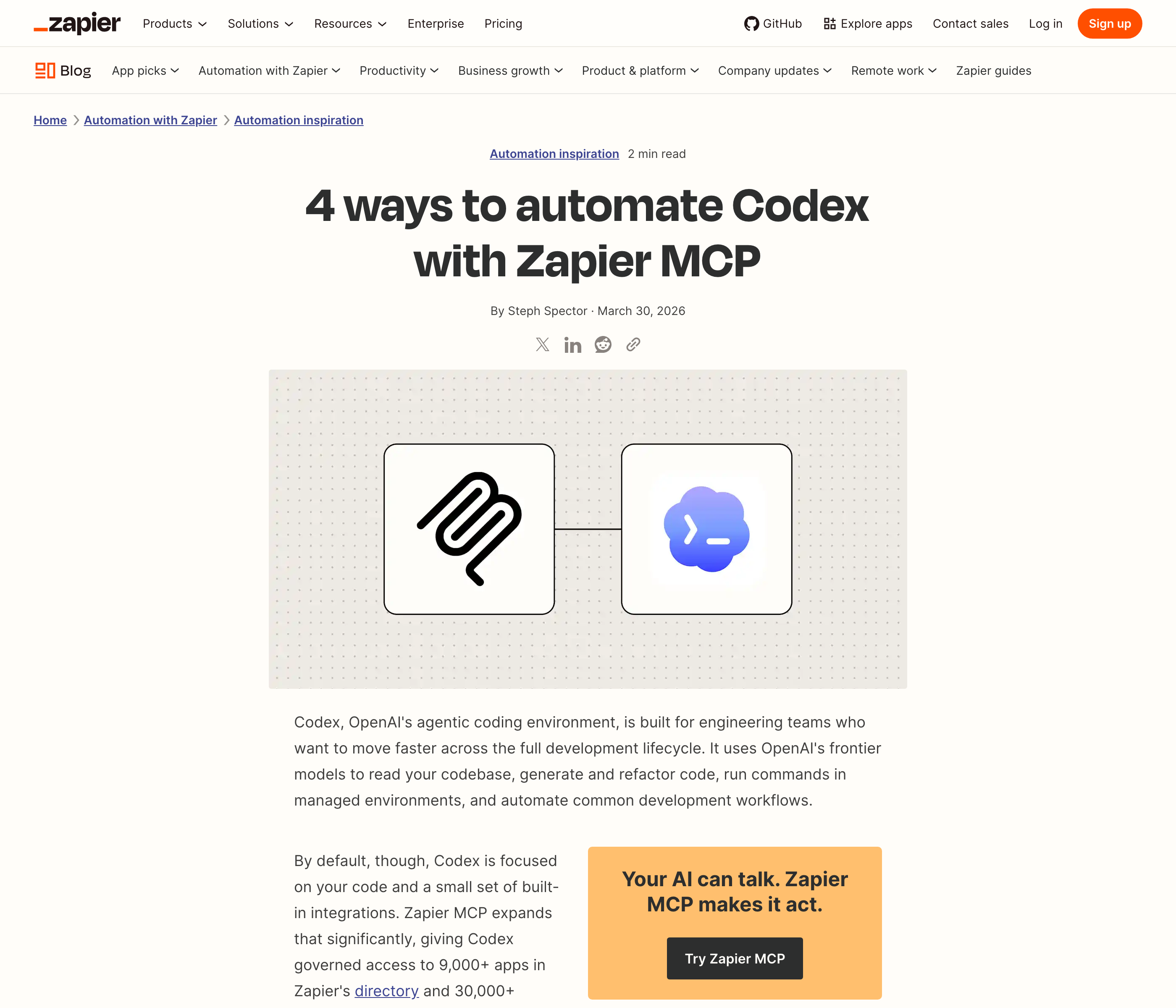 Zapier’s own guide, captured August 14, 2026. Note who is describing whom: the connector vendor is the one documenting that the coding agent borrows its app layer.
Two things worth knowing before you build on it. Zapier draws its own line between the products: Zapier MCP “runs in chatbots like Claude and ChatGPT,” while the SDK “runs in code files.” And every worked example in Zapier’s Codex guide is a developer example: filing a GitHub issue from a failed test run, turning a Jira ticket into a scoped plan, logging deployments to a spreadsheet.
The version for a solo operator who is not shipping to a Jira board now lives on its own page: how to use Zapier with Codex, with the full click-through steps, the scoping safety trick, and the one-direction catch (Codex can reach into Zapier; Zapier cannot start Codex).
Which one you need
Use a connector tool when:
- the work has to happen on a trigger or schedule, without you present
- it moves data between apps you already pay for
- it needs credentials, retries, and a run history when something breaks
- the logic is simple but the reliability matters
Use a coding agent when:
- the task needs judgment across files and context
- the logic is genuinely complicated, the kind that turns into a mess of branches in a visual builder
- you want to own, version, and read the thing afterward
- it’s one-off or occasional, and you’re fine running it yourself
- you are learning, and you would rather talk the problem out than click it out
If you need both, that’s normal. Build with the agent, run the repetitive part on the connector, and keep a human approving anything public.
The mistake: making one tool do both jobs
| Mistake | What happens |
|---|---|
| Complex reasoning stuffed into workflow nodes | Hard to version, review, and debug: the 47-node problem |
| A coding agent used as a permanent scheduler | Weak run history and credential handling, fragile recurrence |
| Automation publishing straight to the public | Fast mistakes with real consequences |
| An agent step added to every workflow | Higher cost, slower runs, harder debugging |
The r/n8n version of this, from u/tesslate after testing the same workflow four ways: n8n is for “trigger → call → write somewhere” flows, while agent work needs “a real workspace.” The tool “wants to be a flow, not an environment.” The top reply put it plainly: “The mistake is trying to make one tool do both.”
The decision rule
Ask one question: does this need to run without me, or does it need to think?
Runs without you, on a trigger → connector tool.
Needs to think, across context → coding agent.
Both? Build it with the agent, schedule the boring part on the connector, and approve anything public yourself.
Codex builds. The connector runs. A human approves. That is my split, and it is the one that survived my migration.
And if you are new and just want one thing done this week: pick the task you keep redoing by hand because it needs a judgment call each time, and build that with the agent. If instead your task is pure app-to-app plumbing, start with the connector. Either way you will know within days, which beats another month of comparing tools.
FAQ
Is Codex a replacement for Zapier?
Not structurally. Zapier’s own docs describe Codex as focused on code and a small set of built-in integrations, reaching other apps through Zapier MCP. Codex does not remove the need for triggers, credentials, or run history. It does replace most of the logic people used to build on a canvas.
Can Codex do what Zapier does?
Mostly. Zapier has more connectors out of the box, and where one does not exist you connect via API from the agent instead, which works out about the same. What you give up is managed credentials and run history.
Do I need both?
Many people don’t. If your automation is app-to-app plumbing, a connector alone is fine. Add a coding agent when you’re building something with real logic in it.
Is AI automation dead now that Codex exists?
No. Coding agents changed who writes the logic. They didn’t remove the need for scheduled, credentialed, retryable plumbing between apps.
Next, compare the two concrete tools in more depth: Codex vs n8n. If you’re picking your whole toolset, see the AI stack for solo founders.
Published July 24, 2026. Last reviewed and updated August 14, 2026: corrected the migration receipt to “kept one workflow” from the earlier “kept nothing” phrasing and made clear it was an n8n migration, rewrote the title and opening verdict, and added the step-by-step Zapier-with-Codex setup. Zapier MCP setup steps and app counts verified against Zapier’s own documentation that day, linked inline. Zapier pricing was not verified for this update and is deliberately not quoted.

Written by
Chris AlarconChris Alarcon builds Ship Lean: the boring Claude and AI setups that actually work, handed to people who don’t code. He runs his one-person operation on these systems, around a full-time job, and shares every workflow, prompt, and tool combo in public. Start with the 15 prompts he uses every day.
Work With Me
Setting this up for your team?
I do that. The right plan per seat, the boring setup that makes it stick, and the first three chores handed off. A 2-hour workshop or a done-with-you build, for teams of 2-50.
See how it works →The 15 AI prompts I actually use every day
I tested hundreds and kept the 15 that survived at my desk. You get them right away, then one short Ship Lean note every Tuesday.