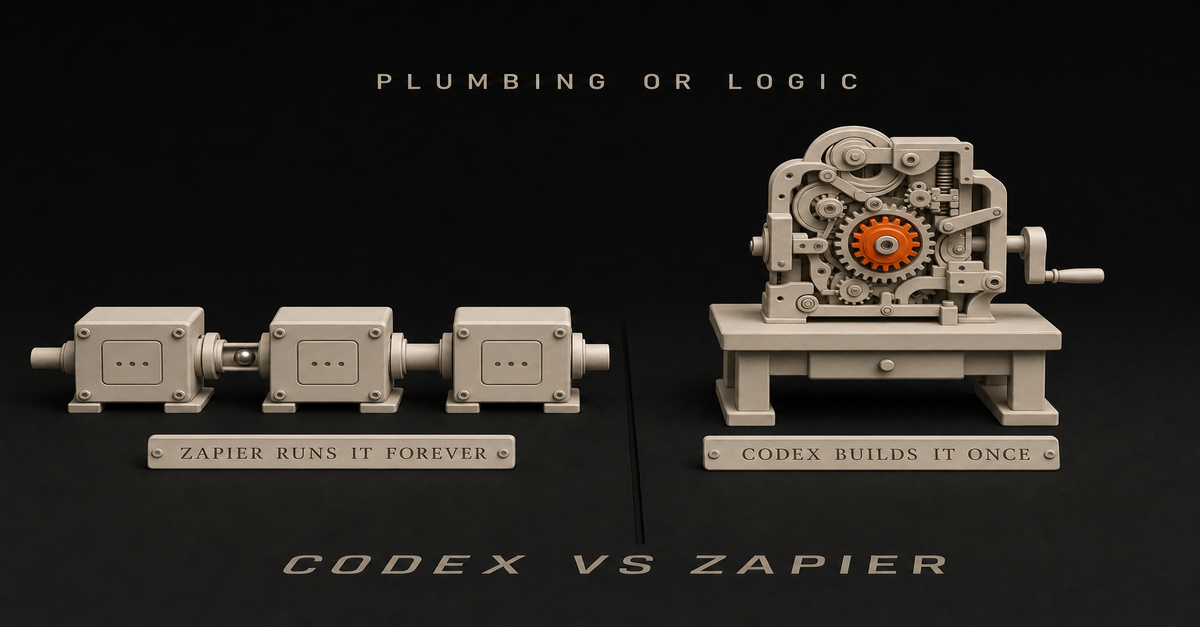
Quick answer: ask one question before anything else. Does this need to run without you, or does it need to think?
If it truly has to fire on a trigger forever, with stored credentials and retries and a run history when it breaks, that is connector work. Everything else is agent work.
And here is my actual answer, which is not the one most comparison pages give: for most people asking this in 2026, I would point at Codex. Even if you are new. Even if you think you need something visual.
I moved about 47 automation steps out of a visual builder and into code. I kept exactly one workflow running. That experience is why I answer this the way I do, and why the one I kept matters as much as the 46 I did not.
The actual difference, in plain EnglishConnector tool (Zapier, Make, n8n)
Coding agent (Codex, Claude Code)What the work looks like
Trigger in app A to action in app B
"Build me the thing that does X"Runs when
On a schedule or trigger, without you
When you run itWhat you get
Runs, logs, retries, credential handling
Files, code, working output you ownWho handles failures
The platform surfaces the failed step
You doApp coverage
9,000+ apps out of the box
Whatever has an APIBest at
Repetitive plumbing, forever
One-off or complex logicThe clearest statement of this I've seen wasn't from either vendor. It was a Reddit comment that Google now features at the top of this exact search. u/ergod_dev on r/automation: "Connector tools (Zapier, Make, n8n) are best when the work is 'trigger in app A causes action in app B.' … Code-and-deploy tools (Replit Agent, Cursor, Claude Code) are best when the task is 'write me an actual script that does X' and you're okay running it yourself. What kills people is trying to do agent-shaped work in a connector tool or vice versa."
That last sentence is the whole failure mode.
Why I'd still say Codex, even to a beginner
This is where I part ways with most of the advice on this topic.
The standard answer is: beginners need something visual, so send them to the connector. I do not think that is true anymore.
If you are staring at this going "I don't know what to do, I need something I can see," I would still tell you Codex. It is not as intimidating as a full coding terminal. It looks almost like a chat window.
At that point it is honestly not even Codex versus Zapier. It is a smart assistant that knows how to code versus Zapier. You talk it out, and it gets things done a lot faster than clicking through a canvas.
Because here is the thing nobody selling connector tools mentions: the visual builder is only simple until the logic is not.
I was in an interview once where the Zapier workflow would not work. We were pulling the wrong record for the test. If you have built in these tools you know the dance: you need to pull a sample record that passes certain criteria so you can continue building the steps downstream. That is not simple. That is fighting the tool's model of the world instead of doing the work.
It is clunky. In my opinion it does not hold up for how I build now.
And if you genuinely want a visual workflow tool, I would not pick Zapier at all. I would use n8n. It is more fluid, and the same logic that takes twenty if-then conditions in Zapier is often about five nodes in n8n.
A little more daunting to look at. Easier once you are in it.
But if you are going to build, the coding agent wins hands down.
The honest caveat in Zapier's favor
I do not want to sell you a clean story, so here is the strongest point on the other side.
Zapier has far more app connectors out of the box. Zapier MCP advertises 30,000+ actions across 9,000+ apps. That is a genuinely large surface you do not have to build.
With a coding agent, when there is no connector, you connect via API instead. In practice that ends up being about the same thing, with more control and a bit more setup.
Where Zapier is properly ahead is the boring, unglamorous layer: managed credentials, retries, and a run history that tells you which step failed at 3am. That is real infrastructure and an agent does not give it to you for free.
Which is exactly why I kept one workflow instead of zero.
What I actually did: 47 steps out, one kept
Here is my migration, and it does not end the way these stories usually do.
I ran a serious setup in a visual builder. To be precise about what tool: it was n8n, not Zapier. For content it was genuinely good. It would write, it would post, it would call APIs.
The reason I left is the 47-node problem. A complex process might be 47 steps on a canvas. Step one is "scrape this," fine. But then it is do this, then do that, and now you are embedding complex prompts inside an agent node and wiring specific tools to it. It takes an hour to build something you could have tested and shipped in that same hour as a skill.
Those 47 nodes became one file, with far less to maintain.
But I kept one workflow running, and I still have it. It is a scheduled scraper experiment on a Mac mini: deterministic, on a timer, dirt cheap. Code would not make it better. It would just make it mine to maintain.
That survivor is the honest boundary of this whole argument. My work moved to code because it was agent-shaped, not because connectors are obsolete. My automation was mostly "think, then write, then decide," which is terrible connector work and great agent work.
If your automation is "when a form comes in, add a row and send a Slack message," you would be moving in the wrong direction by rebuilding that in code. That job is plumbing, and plumbing belongs in a connector.
I moved because of what my work was. Check what yours is before you copy me.
Should you wire a coding agent to a connector?
Usually, no. I would talk you out of it.
If the app has an API, connect to it directly from the agent. Adding a connector layer in between gives you a middleman for something the agent can already reach, and now you are maintaining two systems and a subscription instead of one.
That said, the pattern is real, documented, and mainstream. It is not a fringe hack, and if you are already deep in Zapier it is a reasonable way to get the agent talking to your existing stack.
So here is how to do it if you decide the middleman is worth it.
How to use Zapier with Codex, step by step
Per Zapier's own guide, the setup is three steps:Open the Zapier MCP dashboard and select + New MCP Server.
Choose "Other" as the client when asked what you are connecting.
Configure your first action, which is the specific app-and-verb pair the agent is allowed to call.That gives Codex what Zapier describes as "governed access to 9,000+ apps and 30,000+ actions."Zapier's own guide, captured August 14, 2026. Note who is describing whom: the connector vendor is the one documenting that the coding agent borrows its app layer.
Two things worth knowing before you build on it. Zapier draws its own line between the products: Zapier MCP "runs in chatbots like Claude and ChatGPT," while the SDK "runs in code files." And every worked example in Zapier's Codex guide is a developer example: filing a GitHub issue from a failed test run, turning a Jira ticket into a scoped plan, logging deployments to a spreadsheet.
The version for a solo operator who is not shipping to a Jira board now lives on its own page: how to use Zapier with Codex, with the full click-through steps, the scoping safety trick, and the one-direction catch (Codex can reach into Zapier; Zapier cannot start Codex).
Which one you need
Use a connector tool when:the work has to happen on a trigger or schedule, without you present
it moves data between apps you already pay for
it needs credentials, retries, and a run history when something breaks
the logic is simple but the reliability mattersUse a coding agent when:the task needs judgment across files and context
the logic is genuinely complicated, the kind that turns into a mess of branches in a visual builder
you want to own, version, and read the thing afterward
it's one-off or occasional, and you're fine running it yourself
you are learning, and you would rather talk the problem out than click it outIf you need both, that's normal. Build with the agent, run the repetitive part on the connector, and keep a human approving anything public.
The mistake: making one tool do both jobsMistake
What happensComplex reasoning stuffed into workflow nodes
Hard to version, review, and debug: the 47-node problemA coding agent used as a permanent scheduler
Weak run history and credential handling, fragile recurrenceAutomation publishing straight to the public
Fast mistakes with real consequencesAn agent step added to every workflow
Higher cost, slower runs, harder debuggingThe r/n8n version of this, from u/tesslate after testing the same workflow four ways: n8n is for "trigger → call → write somewhere" flows, while agent work needs "a real workspace." The tool "wants to be a flow, not an environment." The top reply put it plainly: "The mistake is trying to make one tool do both."
The decision rule
Ask one question: does this need to run without me, or does it need to think?
Runs without you, on a trigger → connector tool.
Needs to think, across context → coding agent.
Both? Build it with the agent, schedule the boring part on the connector, and approve anything public yourself.
Codex builds. The connector runs. A human approves. That is my split, and it is the one that survived my migration.
And if you are new and just want one thing done this week: pick the task you keep redoing by hand because it needs a judgment call each time, and build that with the agent. If instead your task is pure app-to-app plumbing, start with the connector. Either way you will know within days, which beats another month of comparing tools.
FAQ
Is Codex a replacement for Zapier?
Not structurally. Zapier's own docs describe Codex as focused on code and a small set of built-in integrations, reaching other apps through Zapier MCP. Codex does not remove the need for triggers, credentials, or run history. It does replace most of the logic people used to build on a canvas.
Can Codex do what Zapier does?
Mostly. Zapier has more connectors out of the box, and where one does not exist you connect via API from the agent instead, which works out about the same. What you give up is managed credentials and run history.
Do I need both?
Many people don't. If your automation is app-to-app plumbing, a connector alone is fine. Add a coding agent when you're building something with real logic in it.
Is AI automation dead now that Codex exists?
No. Coding agents changed who writes the logic. They didn't remove the need for scheduled, credentialed, retryable plumbing between apps.Next, compare the two concrete tools in more depth: Codex vs n8n. If you're picking your whole toolset, see the AI stack for solo founders.
Published July 24, 2026. Last reviewed and updated August 14, 2026: corrected the migration receipt to "kept one workflow" from the earlier "kept nothing" phrasing and made clear it was an n8n migration, rewrote the title and opening verdict, and added the step-by-step Zapier-with-Codex setup. Zapier MCP setup steps and app counts verified against Zapier's own documentation that day, linked inline. Zapier pricing was not verified for this update and is deliberately not quoted.
Direct Answer
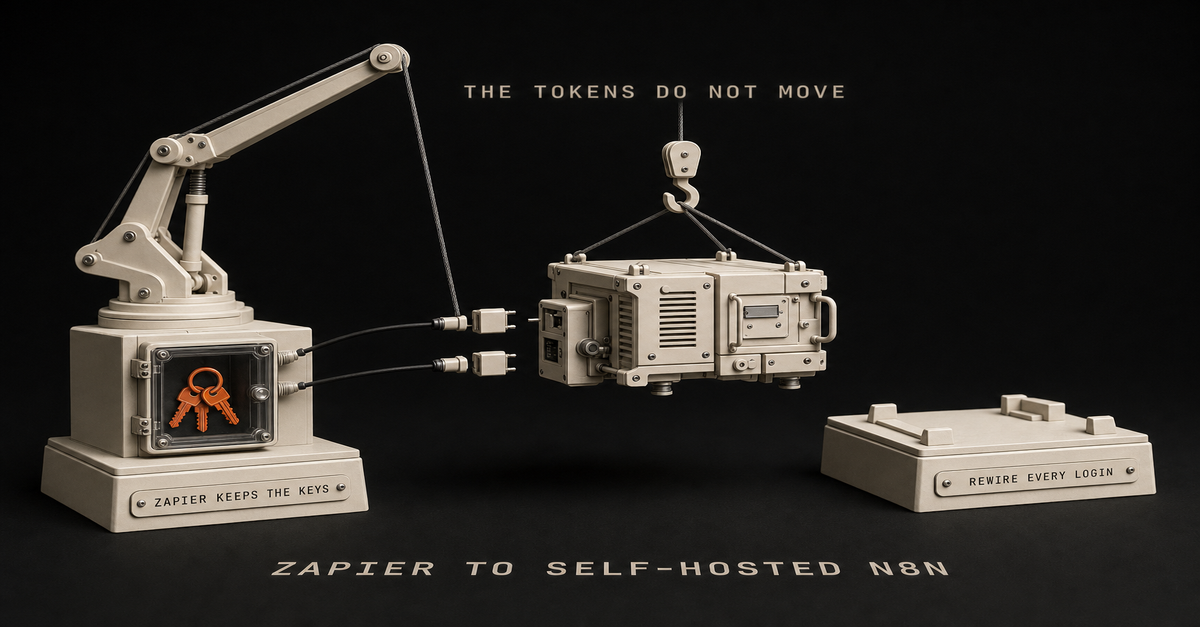
Self-hosted n8n can be cheaper than Zapier when automation volume makes the bill a real business constraint, but the gotcha most tutorials skip is credentials. Zapier holds OAuth tokens you cannot export, so every workflow you migrate needs a fresh OAuth or API key, which means downtime per integration if you migrate sequentially.
Heads up: some links in this post are affiliate links — a small kickback to me at no cost to you. I only recommend tools I've actually run.
The migration order that does not break production: lowest-stakes Zaps first (internal notifications, log writes), medium-stakes second (enrichment, sheet sync), highest-stakes last (billing, customer-facing). Run the new n8n workflow in parallel with the old Zap for a week. Cut over only after the n8n version has produced the same output for seven days. The cost math is real. The time math is the part most posts skip.
Use This When And When To Skip ItUse this
Skip thisThe Zapier bill is a real line item and the workflows are stable
Low volume, no automation cost painYou have one weekend to migrate the low-stakes layer and a month for the rest
You want everything moved by MondayYou are comfortable with Docker, a managed host, or n8n Cloud
You have never deployed anythingAutomation cost is a real line item, not a complaint about the bill
The bill is small and the business is bottlenecked elsewhereTradeoff: this migration costs a weekend plus a month of parallel running. The reward is lower platform cost and code-level access to your workflows. The cost is owning the uptime.
The System
Trigger -> "Zapier is now a real line item and I want code-level access"
Inputs -> Zap inventory (export the list), task volume per Zap, integrations used
Decision -> migrate in 3 waves (low, medium, high stakes); parallel run for 7 days each
Hosting -> managed first (Hetzner, Railway, n8n Cloud); Docker only after 10+ workflows
Approval -> each Zap stays live until the n8n version has produced identical output 7 days
Output -> n8n workflows replacing Zaps in waves, with a documented credential map
Failure -> the old Zap is the rollback for 7 days; do not delete it until parity is real
Feedback -> task-run cost, error rate, time spent maintaining; reviewed monthlyThe migration is not "rebuild every workflow." It is "rebuild in waves, run in parallel, cut over after parity."
Steal This Workflow
This is the migration order and the credential map. Eight steps, three waves.
1. Export the Zap inventory. List every Zap, its trigger, its action, its task volume, and the integrations involved. A 30-Zap stack will have 8 to 12 unique integrations. The credential count, not the Zap count, is the real migration cost.
2. Pick the host before you build the first workflow. Managed: Hetzner with the n8n one-click, Railway, or n8n Cloud. Docker on your own VPS is a second project. Do not make it your first.
3. Wave 1: low-stakes Zaps. Internal Slack notifications, log writes to a sheet, daily digest emails to yourself. Migrate 3 to 5 of these in one weekend. They prove the host, the credentials, and your workflow vocabulary.
4. Build n8n workflows with a planner first. Use the Claude Code n8n workflow planner to map the trigger, decision, and action before you drag a single node. Walking into n8n with a map cuts the build time in half.
5. Audit every workflow JSON you did not type yourself. Templates from the n8n community library, AI-generated JSON, and shared workflows from forums all ship credentials, webhooks, and code nodes you did not write. Pass each through the n8n workflow JSON auditor before activation.
6. Wave 2: medium-stakes Zaps. Lead enrichment, sheet sync, CRM updates. Run each n8n workflow in parallel with the old Zap for 7 days. If outputs match, cut over. If not, find the difference.
7. Wave 3: high-stakes Zaps. Billing, customer-facing automations, anything that affects revenue or invoices. Same 7-day parallel run. Do not migrate two high-stakes Zaps in the same week.
8. Document the credential map. A single file: integration, OAuth or API key, where the credential lives, expiry date, owner. This file is what saves you in 9 months when a token rotates.The 60-second version, from my Shorts: How to self-host n8n for $5/month (without any tech skills).What This Looked Like For This Page
This topic came from the weekly AEO run, not from a stack I migrated this week.
The run pulled 936 raw Reddit RSS entries, scored 314 candidates, generated 25 AEO briefs, and marked 9 as publish_now. This one passed because:Gate
Why it passedSource language
The thread used "spent 24 hours rebuilding my Zapier stack on self-hosted n8n" and "the gotcha that nobody warned me about" in real builder voiceArtifact
The answer maps to a 3-wave migration order with a credential map a reader can copyCluster fit
It links into n8n, Claude Code, the workflow planner, and the JSON auditor without forcingThe page is research-inspired by the thread, not a claim that I ran this exact 24-hour migration.
What Most People Get Wrong
The mistake is treating this as a one-weekend project across the whole stack.
Three failure modes:They migrate everything in one weekend. Day three, a billing Zap fails silently, an invoice does not go out, a customer churns. The fix is the 3-wave order and the 7-day parallel run. Slow is fast here.They underestimate credentials. A 30-Zap migration is really an 8 to 12 integration migration. Each integration needs a fresh OAuth, a documented expiry, and a test run. Most teardown posts brag about workflow count and skip credential count.They self-host before they need to. Managed n8n is fine for the first 6 months. Docker on a VPS is a separate skill. Do not stack two unfamiliar things in one weekend.The cost savings are real. The time cost is also real. If you ignore the time cost, the savings are a lie.
How I Would Build This In Ship Lean
The Ship Lean version uses managed n8n first, the planner for every workflow, and the auditor on anything imported.
Start managed, move to self-hosted later. Hetzner with the n8n one-click or n8n Cloud handle the first 10 workflows. Self-managed Docker is the second project, not the first.
Plan every workflow before you build. The Claude Code n8n workflow planner sketches trigger, decision, action, and gate. Walk in with a map, walk out with a workflow.
Use the n8n agent pattern for the gated workflows. Anything customer-facing follows the n8n AI agent workflow pattern. The shape from the n8n AI agent tutorial handles trigger, judgment, approval, and action.
Audit every imported JSON. Run it through the n8n workflow JSON auditor. This step catches credentials in code nodes and webhooks pointing at hosts you do not own.
The stack stays small. One host, one n8n instance, one credential map, one log sheet. The AI stack for solo founders post goes into what to keep and what to cut.
Use the same SEO workflow on your migration writeup. A teardown post about your migration is one of the highest-converting pieces of content a builder can ship. The Claude SEO workflow post shows how to wire Claude as a workflow step instead of a chat tab.
Next Step
If you are paying Zapier more than you want and the stack has 10 or more Zaps, do one thing this weekend. Export the inventory. Pick the 3 lowest-stakes Zaps. Build them in n8n. Run them in parallel for 7 days.
The Claude Code n8n workflow planner gives you the trigger, decision, and action nodes for each migrated workflow in one map. Use it on the first three.
Source Signal
Research-inspired by a Reddit thread describing a 24-hour Zapier-to-self-hosted-n8n migration with real numbers and an unwarned gotcha. Treat the thread as one operator's note, not as proof of Chris's results. Original: the r/n8n thread, "Spent 24 hours rebuilding my Zapier stack on self-hosted n8n."
Related AEO PagesClaude SEO workflow
AI coding local service offer
Weather-triggered HVAC booking workflow
Learning AI workflows from scratchFAQ
Is self-hosted n8n actually cheaper than Zapier?
Sometimes. It depends on task volume, hosting, maintenance, and your comfort owning uptime. Add your time before deciding.
What is the gotcha most tutorials skip?
Credentials. Zapier holds OAuth tokens you cannot export. Every integration needs fresh credentials.
What is the right migration order?
Low-stakes first, medium next, high-stakes last. Parallel run each for 7 days.
Do I need Docker or can I use a managed host?
Use a managed host until 10+ workflows. Docker is a second project.
When should I skip this and stay on Zapier?
When the Zapier bill is not a real constraint, you have no DevOps comfort, or the business is bottlenecked elsewhere.This post is part of the n8n AI agents hub: definitions, tutorials, workflow patterns, and the build-vs-run decision pages in one place.
Quick answer: Use Zapier when you want the fastest simple automation between popular apps. Use n8n when you need a real AI agent workflow: tools, structured output, branching, retries, self-hosting, and deeper control. For Ship Lean-style systems, Zapier is a shortcut. n8n is the runner layer.
Heads up: some links in this post are affiliate links — a small kickback to me at no cost to you. I only recommend tools I've actually run.
If you are new to the concept, start with what an n8n AI agent is. If you already know you want n8n, use the n8n AI Agent Workflow Builder.
Quick ComparisonQuestion
n8n AI Agent
Zapier AI ActionsBest for
Custom AI workflows with tools
Fast app-to-app AI actionsBuilder type
Technical solo builder, operator, team
Nontechnical operator, speed-first builderAgent depth
Stronger for tool-using workflows
Better for simple AI-assisted actionsHosting
Cloud or self-hosted
CloudWorkflow control
High
MediumDebugging
Node-level runs and logs
Simpler task historyBest first use
Agentic routing, enrichment, approval
Simple summaries, drafts, app updatesThis is not a moral decision. It is an architecture decision.
What n8n Does Better
n8n is stronger when the workflow has real logic:the agent needs to choose between tools
the output needs a structured schema
you need custom code in the middle
you want to self-host
the workflow needs approvals before publishing
the run history matters because this is becoming an operating systemThat makes n8n a better fit for durable AI workflows.
For example, a Search Console workflow might:Pull query/page data.
Ask an AI Agent node to classify the opportunity.
Use a tool to inspect the current page.
Return structured fields: refresh, build, or ignore.
Create a draft task.
Ask for human approval before publishing.That is more than "summarize this row." It is a small operating loop.
What Zapier Does Better
Zapier is stronger when speed and app coverage matter more than control.
Good Zapier use cases:summarize a form submission
draft a Slack reply
move a lead into a CRM
create a simple email draft
connect two common SaaS tools quicklyIf the workflow is simple, Zapier may be the better first move. The fastest useful automation often wins.
The Hidden Question: Do You Need an Agent?
Most workflows do not need an agent.
Use simple automation when the rule is clear:Task
UseNew form submission goes to CRM
Simple automationNew meeting gets a Slack reminder
Simple automationSupport message needs urgency classification
AI stepSearch query needs refresh/build/ignore judgment
AI agentPublic content needs approval
AI agent plus human reviewIf the workflow is just moving data, do not make it agentic. If the workflow needs judgment, tools, and routing, n8n gets more interesting.
The Ship Lean Pick
For a solo builder trying to grow organic traffic, I would use:Codex or Claude Code to build and refresh pages
n8n to pull recurring signals, route tasks, and manage approvals
Zapier only when a simple SaaS handoff is faster than building a custom n8n workflowThat keeps the core system owned by you while still allowing shortcuts when they are actually shortcuts.
When I Would Choose Each
Choose Zapier if:you need a working automation today
the workflow has two or three simple steps
you do not care about self-hosting
you do not need custom agent toolsChoose n8n if:you are building an AI agent workflow
you need structured output and branching
you want lower-level control
you want self-hosting or deeper data ownership
you want the workflow to become part of your operating systemFor deeper n8n patterns, read the n8n AI Agent Tutorial and n8n AI agent vs workflow automation.This post is part of the n8n AI agents hub: definitions, tutorials, workflow patterns, and the build-vs-run decision pages in one place.
 Chris Alarcon