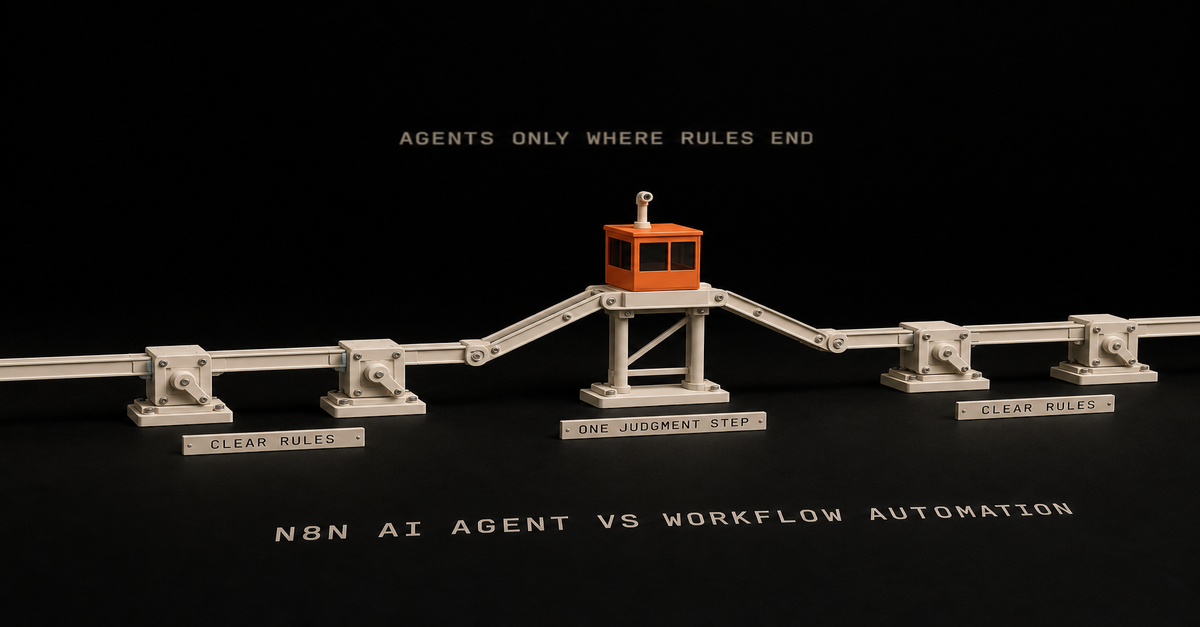
Use normal workflow automation when the rules are clear.
Use an n8n AI agent when one step needs judgment.
Heads up: some links in this post are affiliate links — a small kickback to me at no cost to you. I only recommend tools I’ve actually run.
That is the whole decision. If you already know you need the agent version, the full n8n AI agent workflow pattern shows the build: trigger, context, scoped tools, human approval, and logging.
| Situation | Use |
|---|---|
| Copy data from form to CRM | Normal workflow |
| Send Slack alert after status changes | Normal workflow |
| Classify messy customer messages | AI agent |
| Score Search Console queries for content ideas | AI agent |
| Draft a newsletter from a build log | AI agent plus approval |
| Publish automatically to production | Probably not |
Workflow automation is for known steps
Normal automation is best when you can describe the rule clearly:
- when this happens, do that
- if status is approved, send email
- every Monday, pull this report
- when form submits, create task
You do not need an AI agent for that.
Adding one usually makes the workflow slower, harder to debug, and more expensive.
AI agents are for fuzzy steps
Use an agent when the workflow needs to interpret something:
- Is this lead qualified?
- Is this query worth a page?
- Does this transcript contain a strong proof moment?
- Is this support message urgent?
- Should this draft be published, revised, or killed?
That is not a simple if/then branch. That is judgment.
The clean hybrid pattern
The best setup is usually both:
- n8n triggers the workflow.
- n8n gathers data.
- The agent handles the fuzzy decision.
- n8n routes the result.
- A human approves high-risk output.
That gives you automation without pretending the agent should own the whole process.
Use the Claude Code + n8n Workflow Planner to split the work before building. If you’re choosing between a coding agent and a workflow runner, read AI coding agent vs workflow automation.
What solo builders should build first
Start with a workflow where bad output is annoying, not catastrophic.
Good:
- content idea scoring
- transcript repurposing
- newsletter draft creation
- lead triage draft
- workflow planning
Bad:
- customer refunds
- publishing without review
- deleting production data
- sending sales emails with no approval
The goal is not to make the agent powerful. The goal is to make it useful and bounded.
FAQ
What is the difference between an n8n AI agent and workflow automation?
Workflow automation follows known rules. An n8n AI agent handles the judgment step inside a workflow.
Should every n8n workflow use an AI agent?
No. Use normal automation when the steps are clear and rule-based. Add an agent only when the workflow needs reasoning.
This post is part of the n8n AI agents hub: definitions, tutorials, workflow patterns, and the build-vs-run decision pages in one place.

Written by
Chris AlarconChris Alarcon builds Ship Lean: the boring Claude and AI setups that actually work, handed to people who don’t code. He runs his one-person operation on these systems, around a full-time job, and shares every workflow, prompt, and tool combo in public. Start with the 15 prompts he uses every day.
Work With Me
Setting this up for your team?
I do that. The right plan per seat, the boring setup that makes it stick, and the first three chores handed off. A 2-hour workshop or a done-with-you build, for teams of 2-50.
See how it works →The 15 AI prompts I actually use every day
I tested hundreds and kept the 15 that survived at my desk. You get them right away, then one short Ship Lean note every Tuesday.