How to Use Claude Projects So It Stops Forgetting You (3 Steps, 2026)
Chris Alarcon ·
$ you'll have
One project for a repeat job, with your instructions and real files.
ok your job, with the steps below
- Time
- About 15 minutes
- Cost
- Free (up to 5 projects)
- Tools
- Claude web or desktop
Why this setup, and what you need
Claude is like that friend you can depend on, but he can’t read your mind.
Say you’re in the mood to play video games: you have to tell him every single time, do you wanna play the Xbox? You go back and forth for a few minutes, you agree, and then you’re both locked in the same mode.
Every new chat is that back and forth. You explain your job, your tone and the format again, and tomorrow you do it again.
A landlord on r/ClaudeCowork said it word for word: “What I keep hitting is that every session starts from zero.”
That’s what projects are: Claude already has the context on the task and is already in that mode. It’s like a quick start.
Full disclosure before the steps. I don’t use these classic projects, to be honest. It’s something I want to test. The new threaded version further down is the one I moved to.
Most of my Claude work runs in Claude Code on my Mac. So this is the setup I’d start with, checked against Anthropic’s help center on October 23, 2026, not a report from months of use.
How to use Claude Projects, in three steps and a check:
- Make one project for one area you keep coming back to: Projects > New project.
- Ask Claude to write short instructions, then paste them into Set project instructions. Not the description: Claude can’t see that.
- Add the real files that job runs on.
- Open a new chat inside the project and ask for the job in one line, with no background.
Here’s the Projects page on my account. The cards are there, but I don’t use them:
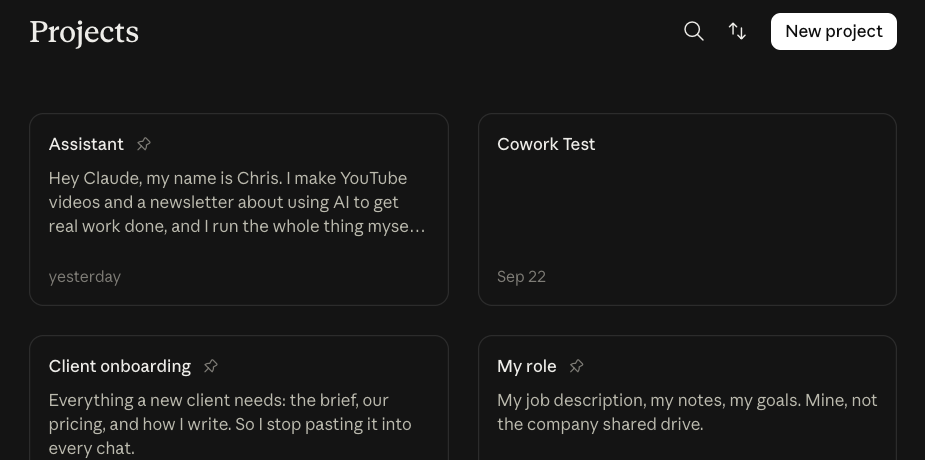 My Claude Projects page, Max plan, October 2, 2026. Four cards, none I use yet.
The three steps below take about 15 minutes: pick the bucket, let Claude write the instructions, drop in the real stuff.
What you need (as of October 23, 2026)
- Any Claude plan. Anthropic’s What are projects page says free accounts get them too, up to five.
- The web app or the desktop app. Projects sit in the left sidebar, or at claude.ai/projects, per Anthropic’s create and manage guide.
- 15 minutes and one job you explained to Claude more than once this week.
- A work laptop? What you upload sits in your Claude account, not on your laptop. Ask IT before a company file goes in.
- Skip for now: the Scheduled row, and the new threaded Projects in Claude Code. Neither is needed to stop re-explaining yourself.
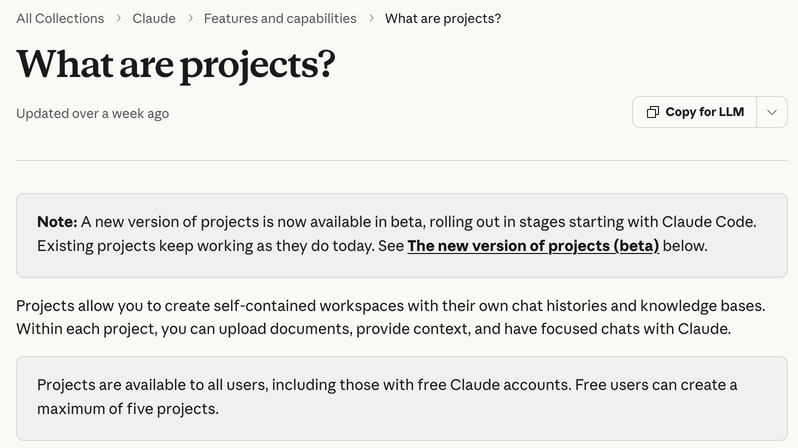 Anthropic’s help center, read October 2, 2026. Same wording on October 23.
Five is plenty to start. What else the free plan gets is in Claude’s free plan.

The short version, from my Shorts: The free Claude folder that remembers you (3 setups beginners never turn on).
Step 1: Make one project for one job you keep repeating
Sidebar > Projects > New project (web) · Project or folder > New project, under the message box (desktop, new layout)
If you’re a business owner, start thinking about what’s important to you, like your accounting, your sales, or productivity tasks. What you want to do there is isolate certain bubbles, and that becomes projects.
It’s like a folder; it becomes a concentrated thing so you don’t have to re-explain the context.
Pick the thing you do every week. Not a one-off question, a job that comes back. Don’t think about it too much, but definitely give it some thought.
Here’s how I’d split it. Creating a bucket for books that you read and summaries, maybe you want to have that separate. And then for leads, that’s separate.
If you find it’s too similar, combine them. Just optimize over time.
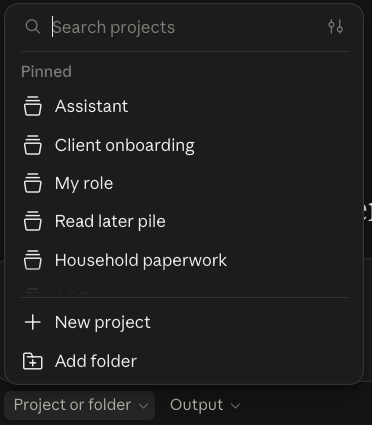 The Project or folder menu in my Claude desktop app, October 2, 2026.
That menu is where projects live since Cowork (Claude’s desktop agent mode) and chat merged on September 16. Anthropic’s merge article says it plainly: “Projects work in every conversation.” Pick one there before you type, and the chat starts inside that bucket.
Don’t see that menu? Your account hasn’t moved to the new layout yet, so use the sidebar path.
“Add folder” is the other door. A folder project works on files on your computer, and the steps for that are in how to use Claude Cowork.
Applicable for: anyone with a weekly report, a client list, a reading pile, a job hunt or a side business.
Step 2: Ask Claude to write the instructions from one concrete goal
Your project > Instructions > Add (desktop) · Set project instructions > Save instructions (web)
You start by giving it clear instructions so that at any session Claude understands what you’re working on. It understands the mode.
I think just keep it high level. Ask Claude a concrete goal that you want to achieve and ask it to write your instructions for you and then just paste that in there.
Copy this into any chat and fill in the brackets:
I'm setting up a Claude project for one job: [the job, e.g. "turn every
book I finish into a one-page summary I can reread in 5 minutes"].
Write short project instructions for it. Keep it high level: who I am,
what this project is for, and what a good answer looks like.
Under 10 lines, plain English.
Paste what comes back into the Instructions box and save. That’s it.
Ruben Hassid at How to AI lands in the same place: “Keep them short. 5-8 lines max.”
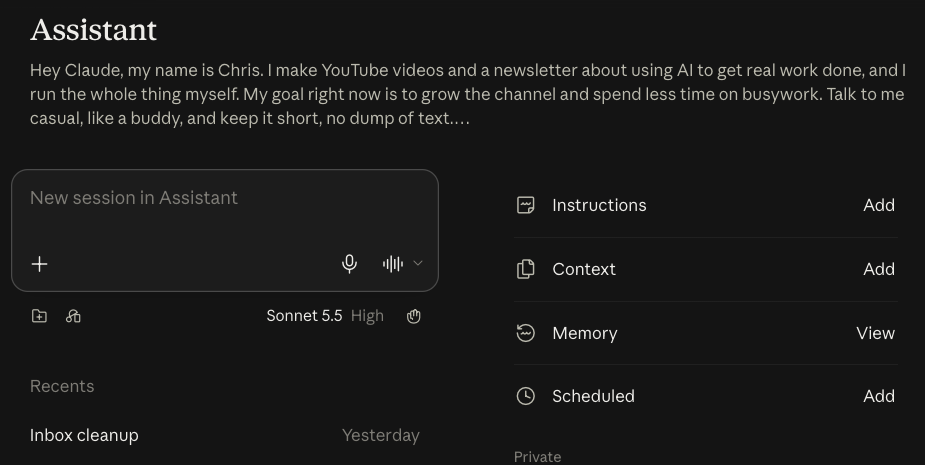 My Assistant project, October 2, 2026. Instructions and Context still say Add.
That screen is a project I never finished setting up. The whole intro sits in the description at the top. Anthropic’s create and manage guide says the name and description are for you: “Claude will not have access to these details.”
So everything up there is invisible to Claude. The Instructions row, the part it does read, still says Add. Put the how-to-talk-to-me part in Instructions.
Where it breaks: long instructions about your style. A line like “plain English, no jargon, no acronyms” sounds like it should fix the voice. On its own, it still gets you generic.
A rule can’t carry your voice. Real material can, which is step 3.
Step 3: Drop in real material, not a description of you
Your project > Context > Add (desktop) · the ”+” button (web)
And it gets better when you start adding relevant files. Now it’s not just in that mode, it has actual knowledge, and you can ask more specific questions.
Files are the step I haven’t done. None of my projects has real files in it yet, and that’s the test I want to run.
Upload the stuff that job actually runs on. For the books bucket, your highlights and one summary you liked. For leads, your real offer and two emails that got a reply.
Use your real sentences, not a paragraph about yourself. I checked my own Claude voice file (a style file I wrote so Claude writes like me) against 11,000 words of me actually talking, and 45 of the 48 phrases in it were things I’d never said. A description of you is not you.
Here’s where each piece goes, per Anthropic’s create and manage guide:
| Where you put it | What belongs there | Does Claude use it? |
|---|---|---|
| Name and description | A label for you | No |
| Project instructions | Who you are, what the project is for, what a good answer looks like | Yes, in every chat in the project |
| Project knowledge (files) | Real documents, examples, past work | Yes, in every chat in the project |
| One chat inside the project | A one-off detail | Only in that chat |
That last row catches people. Anthropic’s words: “Context is not shared across chats within a project unless the information is added into the project knowledge base.”
On a paid plan, a project that gets close to the limit switches on RAG mode, which Anthropic says expands capacity “by up to 10x.” Free plans don’t get RAG.
Upload to the project, not into one chat, so every new chat in it starts with the files. Got a good chat sitting outside? Move it in with the dropdown next to the chat name > Add to project. The same option sits in the ”+” menu under the message box.
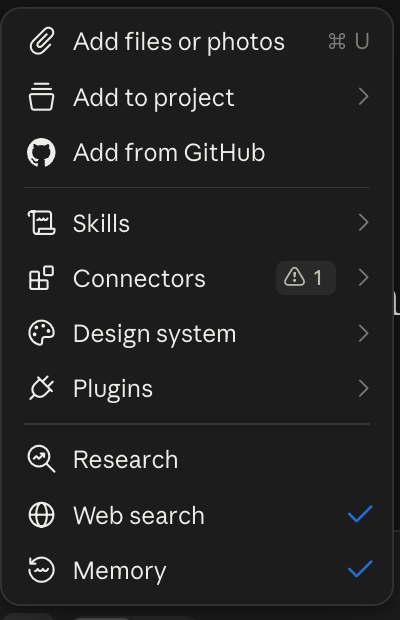 My Claude plus menu, September 18, 2026. Add to project is second.
Files also cost you less over time. Anthropic’s usage tips say project documents “are cached for future use,” and cached parts “count less against your limits.” The catch: “Caches expire after a period of inactivity.” How the meters work is in Claude usage limits explained.
Check it worked: open a new chat and don’t explain anything
Your project > new chat inside it > ask for the job in one line
Type the shortest version of the job, like “summary of the book I just added.” No background, no tone notes.
It worked if:
- The answer comes back in your format without you asking for it.
- It uses names, numbers or phrases from your files.
- It sounds closer to you than a fresh chat outside the project does.
Then click Memory > View. Per Anthropic’s memory guide, “Each project has its own separate memory space and dedicated project summary.” Memory is on by default for Free, Pro and Max, per the create and manage guide. Searching your older chats is paid only, and inside a project it only searches that project.
A project also borrows your account memory from chats outside projects, but never another project’s. Want it walled off? Turn off Use account memory under Memory on the project’s page. The full memory picture is in Claude memory.
If two projects keep giving you the same answers, that’s your sign to combine them.
The new Projects run as one conversation in Claude Code
Anthropic is rolling out a second kind of project, starting in Claude Code. In the new version, a project is one ongoing conversation. You say what you need as it comes up, and Claude splits the work into threads that run at the same time in the cloud.
Every thread starts with the project’s files, instructions and memory. A Library tab collects the files you add and the files Claude makes. Close your laptop and the cloud threads keep going.
When I first wrote this, I hadn’t tried it. Now I have, and I definitely migrated. I think this is the way to do it, in the Claude app, and I’m never gonna use the VS Code app again. I do think the orchestrator (the main conversation that hands out the threads) is pretty good, and I like that I can get to it from my phone.
It has quirks. I can open a lot of them and lose track of some threads. And I sometimes get annoyed when it spawns a cloud session, so I have to be very specific about when it should.
The tip I’d give you: after your regular prompt, just tell it to open the threads it needs. My full notes are in Claude Code Projects.
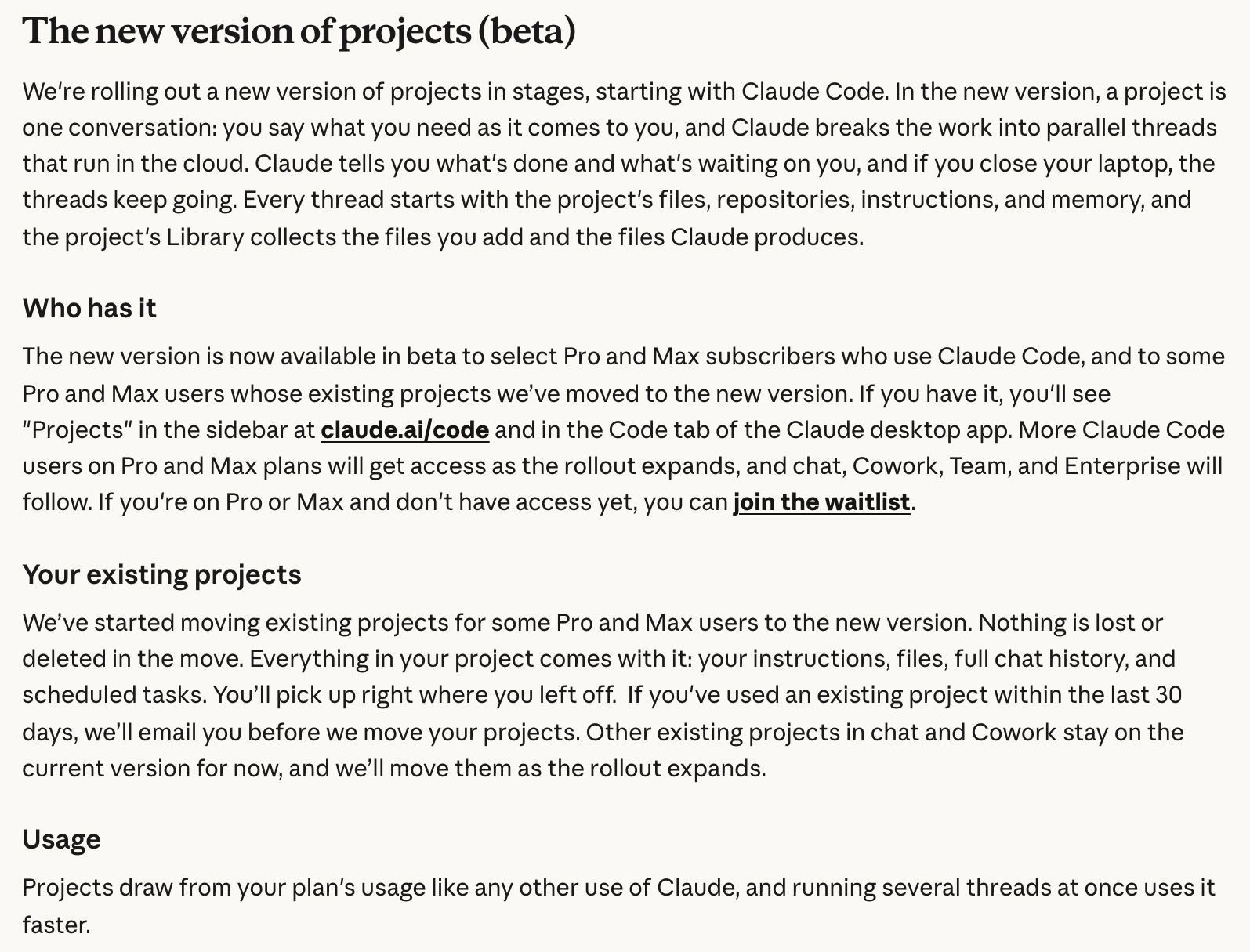 Anthropic’s help center on the new Projects, read October 23, 2026.
What to know if yours changes, per Anthropic’s What are projects page and the Claude Code Projects docs:
- Who has it: a beta for select Pro and Max users of Claude Code, plus some Pro and Max users whose projects were moved. If you have it, Projects shows in the sidebar at claude.ai/code and in the desktop app’s Code tab. Not on Team or Enterprise yet, and chat and Cowork come later.
- Your old projects: some are being moved. Instructions, files, full chat history and scheduled tasks come with them. If you used a project in the last 30 days, Anthropic emails you first. Other projects in chat and Cowork stay on the current version for now.
- Usage: several threads at once use your plan faster. The Claude Code docs say “a new project runs every thread on Opus at high effort, which draws on your plan fastest.” You can change the thread model in the project’s settings.
- No access yet? On Pro or Max you can join Anthropic’s waitlist.
Not everyone likes the change. A thread by u/Tasty_Stand_7014 on r/ClaudeAI on October 14 is titled “They killed Projects and replaced it with a different product that kept the name.”
You don’t need any of it for steps 1 to 3. Classic projects in the chat app work the way this page describes. If you already live in Claude Code, start with how to use Claude Code.
Use a skill or a folder when a project is the wrong tool
- Same steps, every time, in any chat? That’s a skill, not a project. Start with how to use Claude skills.
- The job is files on your computer? Use Project or folder > Add folder instead.
- On ChatGPT, not Claude? The side-by-side is in Claude Projects vs Custom GPTs.
Every Claude guide for office work, in order, lives on Claude guides.
Start one bucket tonight and fix it as you go
The friend still can’t read your mind. A project just means you have the Xbox conversation once, and he’s already in the mode when you sit down.
Your first buckets will be off. Don’t be afraid to pivot and get it wrong. You’re never gonna nail it 100%.
So pick the job you explained to Claude most this week, and make that your first project tonight. For me, this is actually an opportunity to try it.
FAQ
What are Claude Projects?
A Claude project is a saved workspace for one job, with its own chats, instructions and uploaded files, so every new chat inside it starts with that context. Anthropic’s help center calls them self-contained workspaces with their own chat histories and knowledge bases.
Are Claude Projects free?
Yes. Anthropic’s help center says Projects are available to all users, including free accounts, and free users can create a maximum of five projects. The help center lists no cap for paid plans, and paid plans also get RAG, which can expand what a project holds by up to 10x once it nears the context limit.
Does a Claude project remember my other chats?
Partly. Each project has its own memory, and Claude uses it alongside your memory from chats outside projects, but never another project’s memory. Turn off Use account memory on the project’s page to keep it fully separate. Searching older chats is paid only, and inside a project it only searches that project.
What should go in Claude project instructions?
Keep them short and high level: who you are, what this project is for, and what a good answer looks like. Put them in Set project instructions, not the description, because Anthropic says Claude can’t see a project’s name or description. Your real examples and documents go in the project’s files.
Did the Cowork (Claude’s desktop agent mode) and chat merge or the new Projects delete my Claude projects?
No. Anthropic’s article on the Cowork and chat merge says your chats, tasks, projects and settings come with you when your account moves over. Projects moved to the new threaded version keep their instructions, files, full chat history and scheduled tasks, and Anthropic emails you first if you used the project in the last 30 days.
Where this comes from
Click paths, limits, memory and the new Projects come from Anthropic’s help center and Claude Code docs, read October 23, 2026. The app screens are my own Claude account on my Max plan.
The bucket rule and the friend analogy are mine. I don’t use classic projects yet, and none of mine has files. The notes on the new version come from my own use.
Published October 2, 2026. Updated October 23, 2026 for the new Projects, checked that day against Anthropic’s docs. Updated November 8, 2026 with my own use of the new version.

Written by
Chris AlarconChris Alarcon isn’t a developer. He shows people who aren’t developers how to build real things with Claude Code: a site, an app, an agent. He runs his one-person operation on these systems and shares every workflow, prompt, and tool combo in public. Start with the free 1-page setup.
The boring setup
It still won't know you tomorrow.
The Setup is one folder. Drop it into a Project, answer three questions, and Claude or ChatGPT writes your memory file and your voice file itself. It stops forgetting you, stops sounding like AI, and runs three real jobs by name. Twenty minutes tonight. No code. $49 · 30-day refund.
See The Setup →Want the steps on one page?
The message to paste, the three steps and the check, on one page. Free.
