AI Said 45 Minutes. It Took 2 Weeks. How I Write Blog Posts With AI Without Slop


The first blog post on this site lied about me.
It opened: “My first n8n workflow took 45 minutes to build. It’s saved me over 200 hours since.” AI wrote that line on January 3, 2026.
The next morning I swapped in the truth: “My first n8n workflow took 2 weeks to build. It was clunky, overcomplicated, and had 4 agents when it should have had 1.”
 What AI wrote on January 3, in red, and the truth I swapped in on January 4.
That one was a fact problem, and facts are easy to fix. The bigger problem showed up when I read the pages back. It just didn’t sound like me, bro.
So here’s how I write blog posts with AI now. I pick the topic, I talk it out, and I approve the final say. AI packages the middle.
Reading my own pages back, they didn’t give anyone a reason to stay
The 45-minute line was one bad sentence. The pattern was worse. It just didn’t look good when I started reading them. I’m like, damn, is this providing value?
In September I read one of my own launch pages and said it out loud: if somebody goes in here, they’re gonna think, damn, this is slop. The proof on that page was real. The writing around it read generated.
The reason it bugs me is simple. I’m not gonna disclose which tools I use, but think about it.
Anybody in the right mind can go use the top model at max effort and say, generate me a blog post on this. You can figure that out too: find keywords, start attacking them.
Now is it good? That’s the question. That part is judgment.
Copywriters see the same thing. Vanessa Page, copy director at the agency mdg, put it plainly in mdg’s piece on content quality: “I think a lot of what people are reacting to is the sameness.” Her colleague Alex Velinov added: “Everything is normalized. It looks the same.”
If you run a consultancy or a coaching practice and you want a blog that sells you, sameness is the whole risk. A reader who can’t tell your post from a vendor’s has no reason to call you.
AI can’t hold your vision, so I keep three jobs
Imagine something just generating on your vision. It’s never gonna have your vision. That’s the only thing that separates a blog post from slop.
It’s not that the AI can’t write. It can’t choose the vision with high accuracy, so the vision stays with me. Otherwise it’s not your post. Simple as that.
So I split the work like a sandwich:
- I pick the topic. I would never hand off topic ideation.
- I talk it out. My take goes in raw, out loud, before any draft exists. If talking is easier than typing for you too, here’s how I’d turn voice memos into notes with AI.
- I approve it. Anything that sounds off, I judge it, and it gets fixed before it ships.
AI works in the middle. It can brainstorm, take my raw point of view, mold it and package it. It’s not gonna write it for me.
My taste came from years of blogging by hand
I’ve written blog posts by hand for years, I’ve took courses on it. I really was trying to become a blogger back in the day.
That’s where the taste comes from. I pay attention to the details. I know a good intro is important. Headlines are important. A lot of things are important, and AI can’t guess which ones matter to me.
So the process we built around writing encodes that: my years of blogging, writers I follow and like, and my voice and flow. So AI cannot just guess that. The skill is the moat.
And then my taste is something that people can’t replicate.
I said a version of this back in August, on this blog: “The only difference between AI slop and us is we actually have our experience.” It still holds. Every post here leans on things only I have: my screenshots, my accounts, my mistakes.
Google doesn’t punish AI, it punishes pages with no reason to exist
The fear I hear most is that Google will penalize anything AI touched. It won’t.
Google’s 2023 guidance on AI content says: “Appropriate use of AI or automation is not against our guidelines.” The same post says that if you see AI “as an inexpensive, easy way to game search engine rankings, then no.”
The current generative AI page, updated October 1, 2026, is more specific. AI “can be particularly useful when researching a topic, and to add structure to original content.” Generating many pages “without adding value for users may violate Google’s spam policy on scaled content abuse.”
And the helpful content guide, updated October 5, 2026, asks the question my sandwich answers: “Does your content clearly demonstrate first-hand expertise and a depth of knowledge”?
Sid Bharath, who writes about this same question, lands in the same spot on his own blog: “You are what makes the content new and interesting.”
My clicks went from 60 a day to about 105, and one page carried half
Last week my Google clicks jumped. When I was asked whether that was a real spread or one page carrying it, my answer was: I don’t know, you tell me.
So here’s what the data says. Search Console, the week of October 15 to 21 against October 22 to 28, 2026:
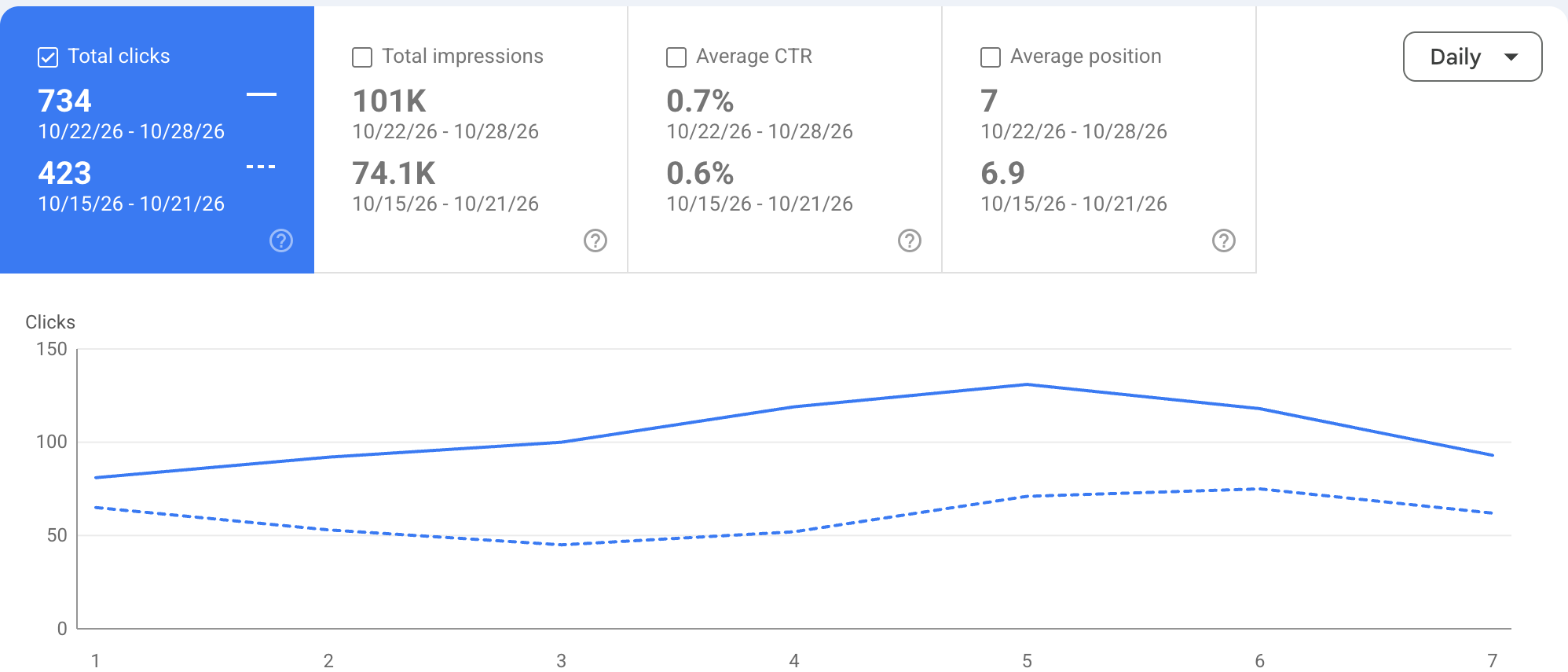 My Search Console, October 22-28 vs October 15-21, 2026.
That’s 423 clicks, about 60 a day, against 734, about 105 a day. The last two days are fresh data and can still move.
Now the part that matters. Split by page, one post did about half the work:
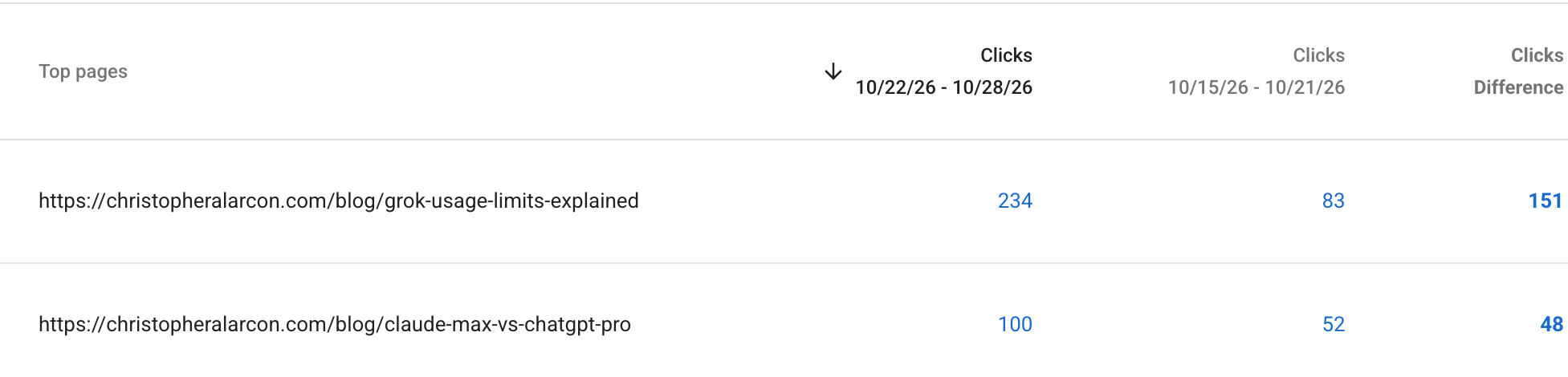 My Search Console, same two weeks, split by page.
My Grok usage limits page went from 83 to 234 clicks, 151 of the 311 extra. That’s one page carrying about half.
The other half is a real spread. Pages that earned at least one click went from 51 to 62. Three pages that got zero clicks the week before earned 18 to 26 each: Codex pricing, Cursor pricing, and running Claude Code on a Mac mini.
Two more things the data says. This is a rebound, not a record: September averaged about 89 clicks a day, and my best day is still 131, first hit September 15 and matched October 26.
And nothing in Search Console proves why. It can show where clicks landed, not whether the writing earned them.
My own read is diversification, plus always asking what makes us different and serving the best answer. The numbers back the spread part. They don’t settle the rest.
The part I’ll never hand off
The first post on this site said 45 minutes because AI filled in a story it never lived. Two weeks was the truth, and only I could have known that.
That’s still the rule: “I’m choosing the topics, I’m talking about them, and I’m approving the final say.” AI can do everything in between. That part’s never gonna change.
If you want to try it, start with your next post. Pick the topic yourself, talk your take out before any draft exists, and read the final draft out loud before it ships. If it doesn’t sound like you, it’s not done.
More of how I use AI at work lives on my AI at work hub.
FAQ
Will Google penalize blog posts written with AI?
Not for using AI. Google’s Search Central blog says appropriate use of AI or automation is not against its guidelines. What Google targets is scaled content abuse: many pages generated to manipulate rankings without adding value for readers, no matter how they were made.
How do you write blog posts with AI that don’t sound like AI?
Keep the three jobs AI can’t do well: pick the topic yourself, say your take out loud before AI touches it, and read the final draft as the person whose name is on it. Let AI research, structure and package the middle. If a line doesn’t sound like you, it goes.
Can AI write a whole blog post end to end?
It can produce one, and anyone can do the same with the same tools. That’s the problem. A post written end to end by AI has no first-hand experience, no screenshots of your own work and no opinion only you would hold, which is what Google asks for and what readers remember.
Should I disclose that I used AI to write a blog post?
Google says AI or automation disclosures are useful for content where someone might think “How was this created?” On a first-person blog, a short note on how the post was made, and what is yours, answers that question before the reader asks it.
Where this comes from
The January rewrite is in this site’s change history for my first post. The clicks are my own Search Console, pulled October 29, 2026, the same day I checked Google’s pages and the quotes.
AI helped package this post. I picked the topic, talked it out and approved it. I haven’t proven this way of writing caused the jump.
Published October 30, 2026. Search Console and Google’s guidance checked October 29, 2026.

Written by
Chris AlarconChris Alarcon shows people who don’t code the boring Claude setup that actually works. He runs his one-person operation on these systems and shares every workflow, prompt, and tool combo in public. Start with the free 1-page setup.
The boring setup
It still won't know you tomorrow.
The Setup is one folder. Drop it into a Project, answer three questions, and Claude or ChatGPT writes your memory file and your voice file itself. It stops forgetting you, stops sounding like AI, and runs three real jobs by name. Twenty minutes tonight. No code. $39 until Nov 8 · 30-day refund.
See The Setup →Get the free 1-page setup
The boring 1-page setup. No code, no jargon. Get it now, then one short email from me each Tuesday.
