In this article
- 1 Every feature gate is the same. Here is the proof
- 2 What the multiplier officially means, and what it does not
- 3 Anthropic is being sued over exactly this
- 4 What a real 20x meter actually says
- 5 What it actually takes to exhaust a Max allowance, measured
- 6 Start at 5x unless one of these is true
- 7 Why I went to 20x, and whether you should
- 8 The two-5x-accounts question, answered honestly
- 9 One billing trap before you switch either way
- 10 The one thing to measure this week, if you are on 5x
- 11 If you are still deciding
Which plan should you buy? Tap 3, get the verdict
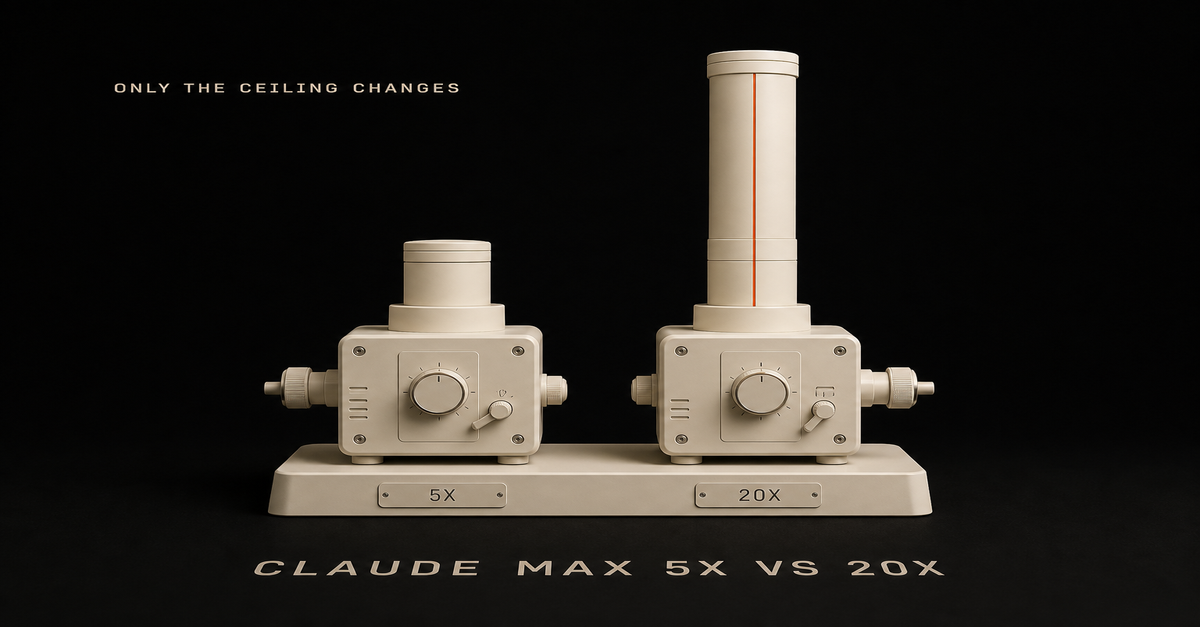
Quick answer: every feature is identical across Claude Max 5x and Max 20x. Same Fable 5 and Fable 5.1 access, same Opus 5 default, same priority access, same 200k default context window with 1M on Fable 5.1, Opus 5.5, Opus 5, Sonnet 5.5, and Sonnet 5. The only thing $200 buys over $100 is capacity.
That makes this a simpler call than most pages make it sound. You’re really just choosing how often you want to wait.
Which leaves one real question: how much capacity is “20x” actually?
Right now there are three answers to that on the table, and they do not agree.
| Source | What 20x is worth |
|---|---|
| Anthropic, published | 20x Pro usage, per five-hour session |
| A filed class action, alleged | roughly 6x Pro |
| Me, paying for 20x since June | feels like 10x to 15x |
I started on 5x and moved to 20x. It felt scary at first, damn near expensive. I mined nine weeks of my own logs on the 20x tier, and what I found points down the ladder, not up.
Every feature gate is the same. Here is the proof
Most pages imply 20x is a better product. It is not.
| Max 5x ($100/mo) | Max 20x ($200/mo) | |
|---|---|---|
| Usage per 5-hour session | 5x Pro | 20x Pro |
| Fable 5 and Fable 5.1 | 50% of weekly limits | 50% of weekly limits |
| Opus 5 | Default model | Default model |
| Context window | 200k default; 1M on Fable 5.1, Opus 5.5, Opus 5, Sonnet 5.5, and Sonnet 5 | 200k default; 1M on Fable 5.1, Opus 5.5, Opus 5, Sonnet 5.5, and Sonnet 5 |
| Higher output limits | Yes | Yes |
| Priority access at peak | Yes | Yes |
| Early access to features | Yes | Yes |
| Annual billing | No | No |
Sources: Anthropic’s Max plan page for the multipliers and priority access, Claude’s pricing page for the Fable 5 and context rows, and the Opus 5 announcement for the default model.
You do not have to take my table for it. Here is Anthropic’s own comparison grid, re-checked on September 10, 2026:
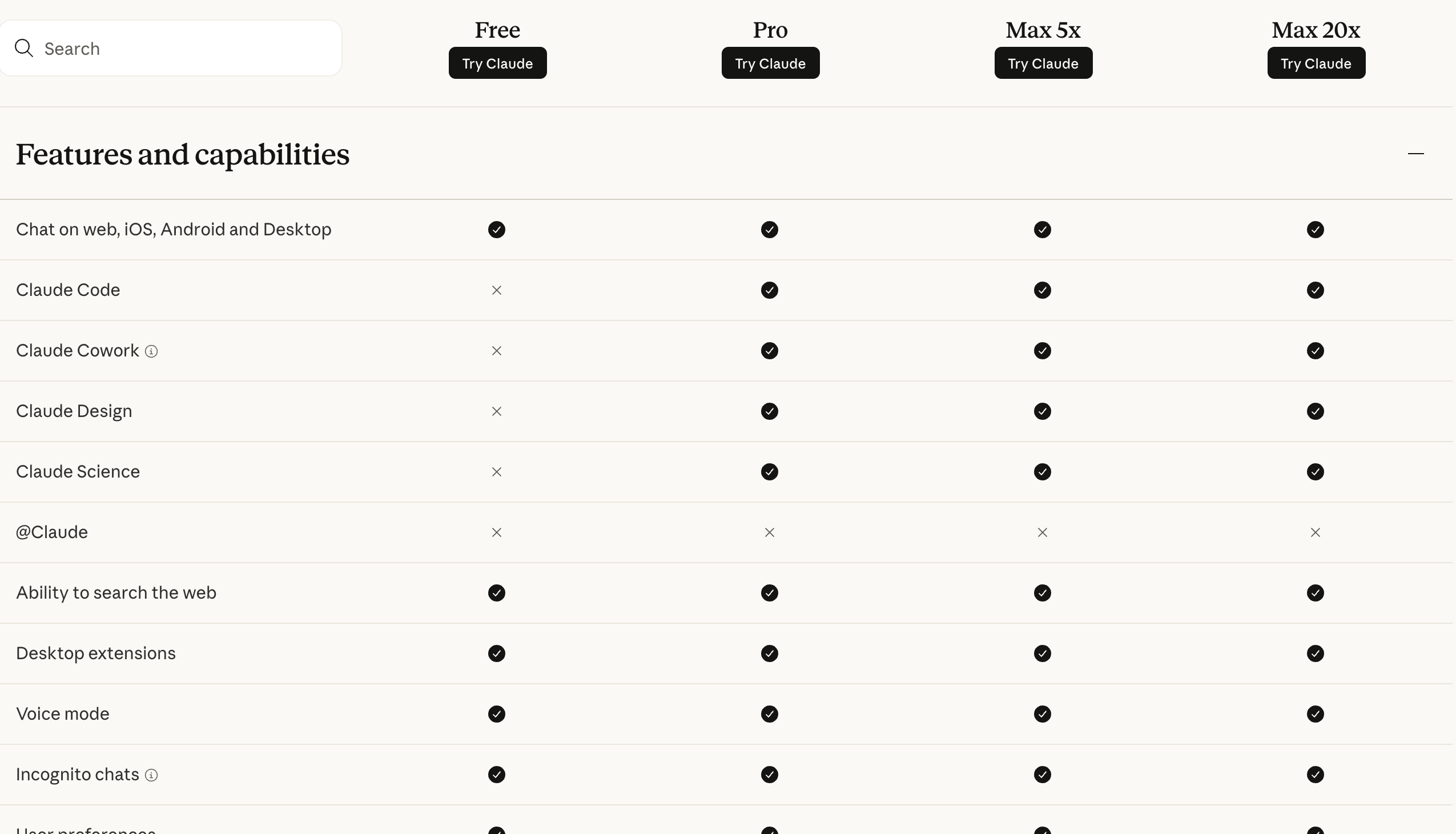 claude.com/pricing, September 10, 2026. Read Max 5x against Max 20x row by row: it’s the same column twice.
The plan cards above that grid say the rest of it out loud.
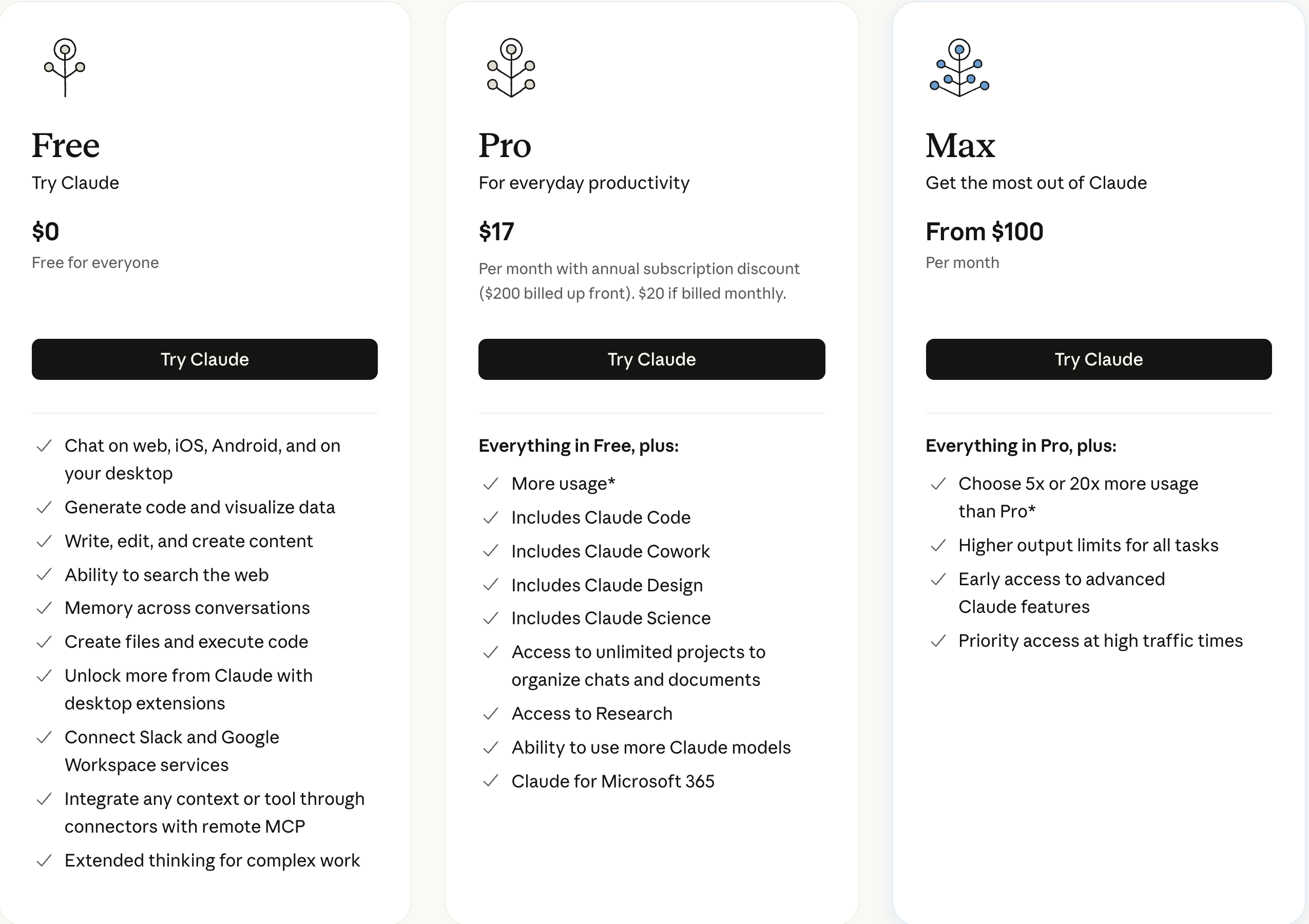 claude.com/pricing, September 10, 2026: “From $100,” and “Choose 5x or 20x more usage than Pro.”
So what the extra money buys is more usage.
One row I don’t see anyone else mention: neither Max step offers annual billing. Claude Pro does, at $17 a month billed as $200 up front. Max is monthly only, at both steps. If you were hoping to soften the jump by committing for a year, that option does not exist.
What the multiplier officially means, and what it does not
This is where the community argument lives, so here’s what’s published and what isn’t.
Anthropic’s wording is per session: Max 5x gives “five times more usage per session than the Pro plan,” and Max 20x gives “20 times more usage per session.” The session window resets every five hours.
On top of that sits a separate weekly limit across all models, which resets at a fixed time each week assigned to your account.
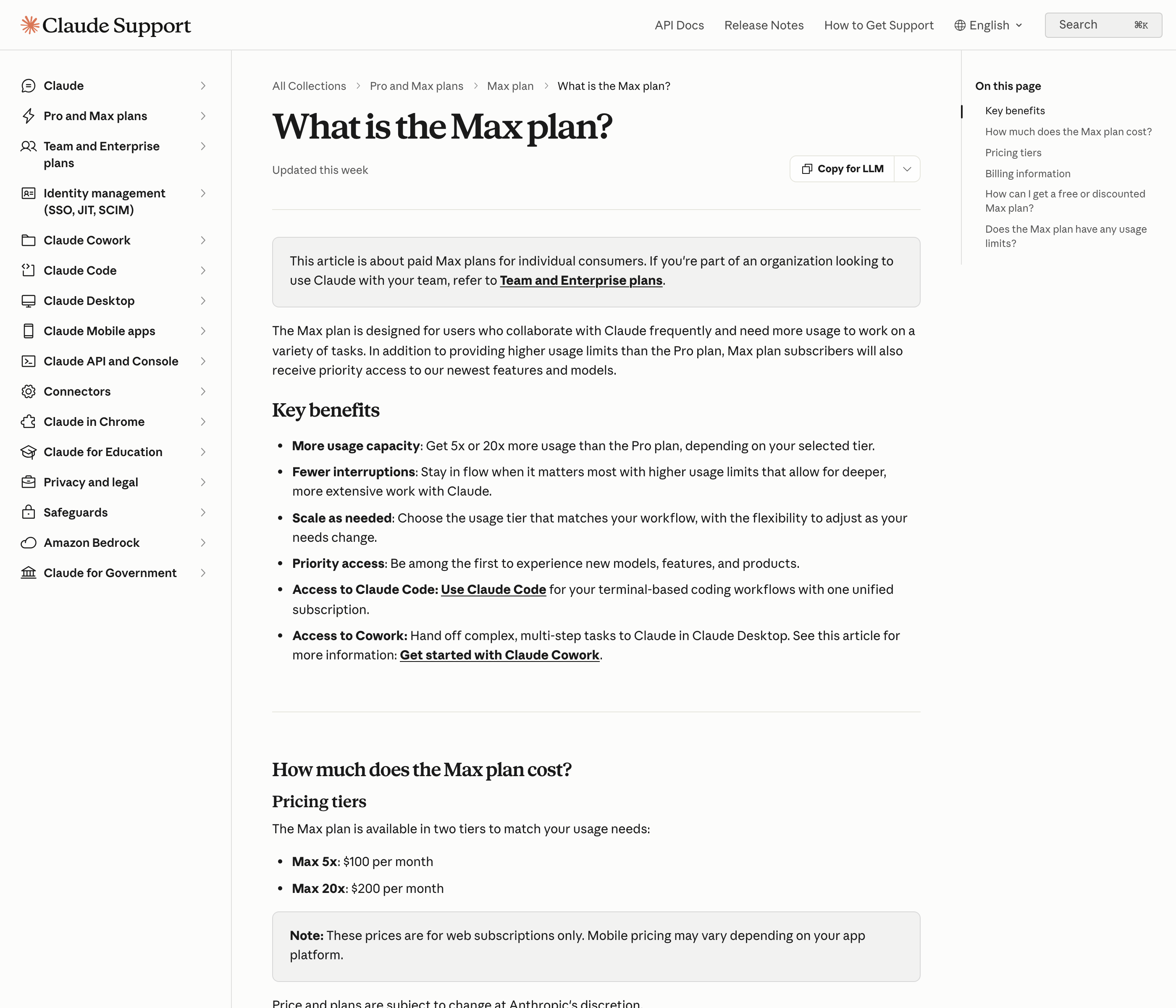 Anthropic’s Max plan documentation, August 14, 2026. Every benefit except the usage multiplier is identical on both.
What Anthropic does not publish: how the weekly limit scales between the two steps. Or any numeric token or message quota at all, on either step.
That gap is exactly what the threads are arguing about. u/cavebreeze on r/ClaudeAI put the question well on August 9: “I heard several people claim 5x Max isn’t a 5x for the weekly limits, but 5x for the 5 hour session limits and around 3x for the actual weekly limits, and that 5 individual pro accounts yield more usage. Has anyone tried this?”
That 3x figure is a user estimate, repeated between users. It’s not an Anthropic number and I haven’t been able to verify it. What I can check is that the official multiplier describes sessions. The weekly cap is a separate limit, and nobody outside Anthropic has the numbers for it.
Anthropic is being sued over exactly this
That unpublished gap is not just a forum argument any more. It is in a filed complaint.
A proposed class action filed June 14, 2026 alleges Anthropic misled Max subscribers about usage limits. To be clear, these are allegations in a complaint, not findings, and no court has ruled on any of them.
What the complaint alleges, per the reporting:
- Max 5x delivers roughly 3.5x Pro’s Sonnet hours, not five.
- Max 20x delivers roughly 6x, not twenty.
- Lead plaintiff Karl Kahn of Washington upgraded to 20x for heavy coding, and one five-hour session consumed 15% of his weekly quota.
- Claims are false advertising and unfair business practices, with an amount in controversy over $5 million, covering US purchasers of either Max tier since the plans launched in April 2025.
Reported by Engadget, Quartz, and tracked at OpenClassActions.
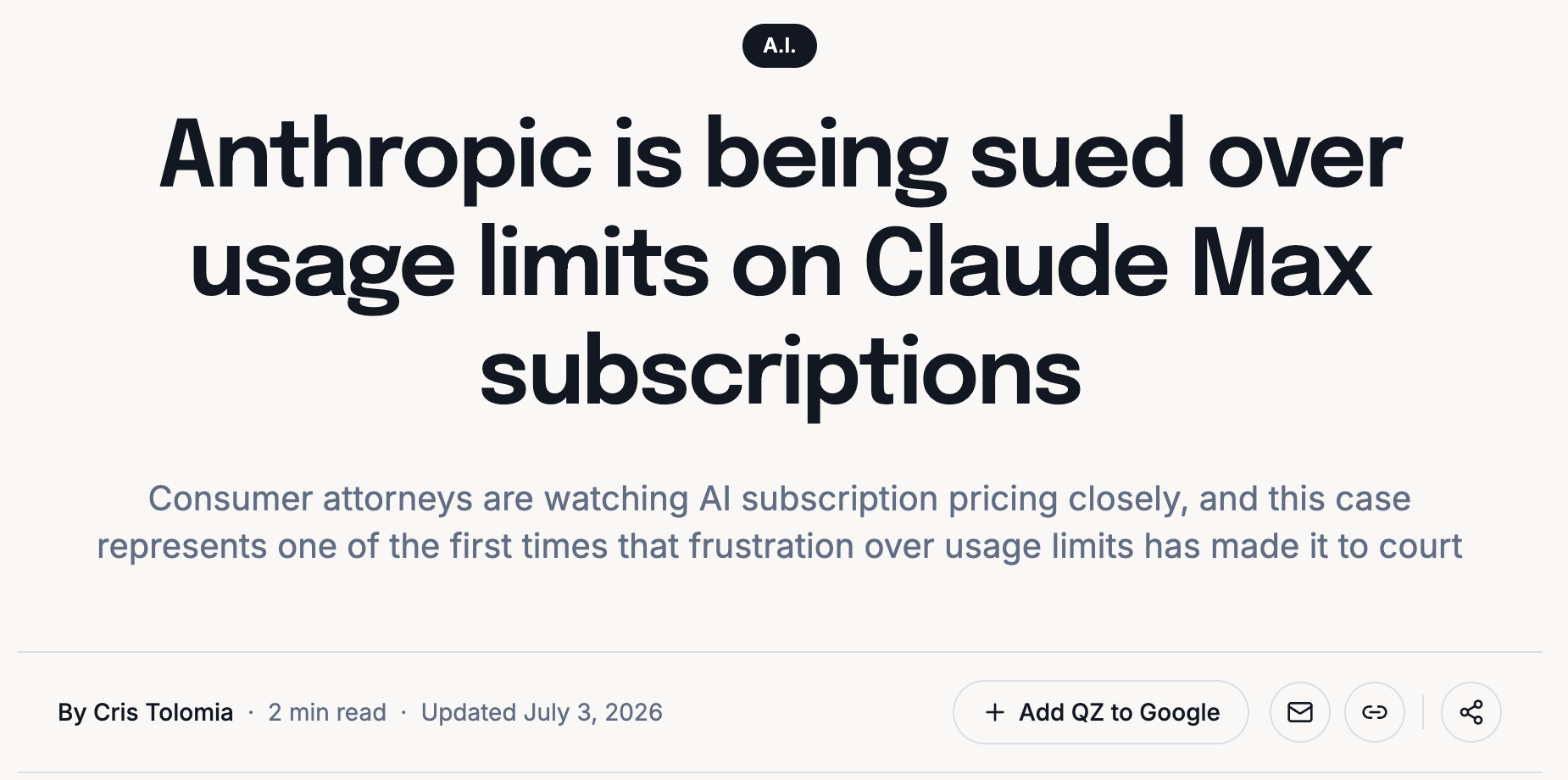 Quartz on the June 2026 filing, captured September 5, 2026. The fight: per-session multipliers versus an unpublished weekly ceiling.
Now the part where I have to be fair to Anthropic, because most coverage is not.
Anthropic’s published wording has always described the multiplier per five-hour session. That is on the support page, it is quoted higher up this article, and it is not hidden.
What the reporting does not say is what the complaint’s figures are measured against, and I have not read the complaint. So I am not going to reconstruct the plaintiffs’ arithmetic for them.
What I can say is that both can be true. The wording can be technically accurate and the average subscriber can reasonably have read “20x” as “twenty times the usage,” because nobody buys a plan thinking in five-hour windows.
So it’s a grey area, and it comes from what Anthropic doesn’t publish. You’re allowed to be annoyed about that without anyone having lied to you.
What a real 20x meter actually says
So here is the third number, from the only account I can show you.
 My Max 20x meters, September 5, 2026. My limits were temporarily boosted that week, so this reading flatters me.
I use this thing most days and I run agents. As the guy paying $200 a month, my read is that it’s not truly 20x. It might be 10x to 15x.
That’s a feel, not a measurement. I have no more access to Anthropic’s weekly formula than the plaintiffs do. What I can tell you is that my usage definitely feels like it drains faster than Codex does, which is the closest comparison I run day to day.
So it belongs in the same column as the complaint’s numbers, not above them.
That’s three numbers for one plan, and the only one with a published method is the one about five-hour windows.
That’s why the next section matters more than any of them. What decides whether you should upgrade is your habits.
What it actually takes to exhaust a Max allowance, measured
This part I can back with my own logs.
I mined nine weeks of my Claude Code usage on the 20x tier. The full measurement is its own post, but the number that matters for this decision is this one:
Limit and overload events came to roughly 119 hits across 220,861 log lines. About 0.05%, retries included.
And I am nearly never stopped.
The reason is that 97.4% of my tokens are prompt cache reads, not new work. Agentic work re-reads the same context constantly, and cache reads are far cheaper than fresh input. So heavy usage looks huge, but most of it isn’t new work.
So when you read a thread where someone says they blew through a Max allowance, the useful question is not “how many tokens.” It is “how much of that was new.”
Now the correction I owe you, because my own data could be read as a flex.
I hit the weekly wall during a sloppy stretch in August. On 20x.
That was me spending badly: long sessions riding up toward the maximum context window until they auto-compacted. Terrible habits. If you work that way, you’ll hit the wall even at the top step.
The 60-second version, from my Shorts: One task ate my whole AI limit, weekly. Here's the fix..
Start at 5x unless one of these is true
The default is the lower step. Move up if:
- You code heavily. Serious apps, games, websites, client work. That burns tokens in a way chat never will.
- You are waiting instead of working. Not “I got a warning.” Actually stopped, mid-task, on something with a deadline.
- You run long agent sessions daily and have already fixed your context habits.
And one warning for anyone new to Claude: expect to be inefficient at first. You will burn far more than you need to for a few weeks, and then you’ll learn the habits: a decent project instructions file, starting a fresh session around 500k of context, routing routine work to cheaper models.
Don’t pay for a bigger tier just to cover those first few weeks of learning.
Why I went to 20x, and whether you should
I started on 5x and I kept running out.
Sometimes I would wait out the five-hour window. And then I got done with it. I’m not waiting; it’s unproductive. I just want to edit this video, I just want to build this skill now.
So I upgraded.
Then I did the math on video editing alone. If you hired an editor just to cut your videos, not even adding animation, you’re paying more than $200 a month and your turnaround is slower. The arbitrage is there, man, and I’m taking advantage of it.
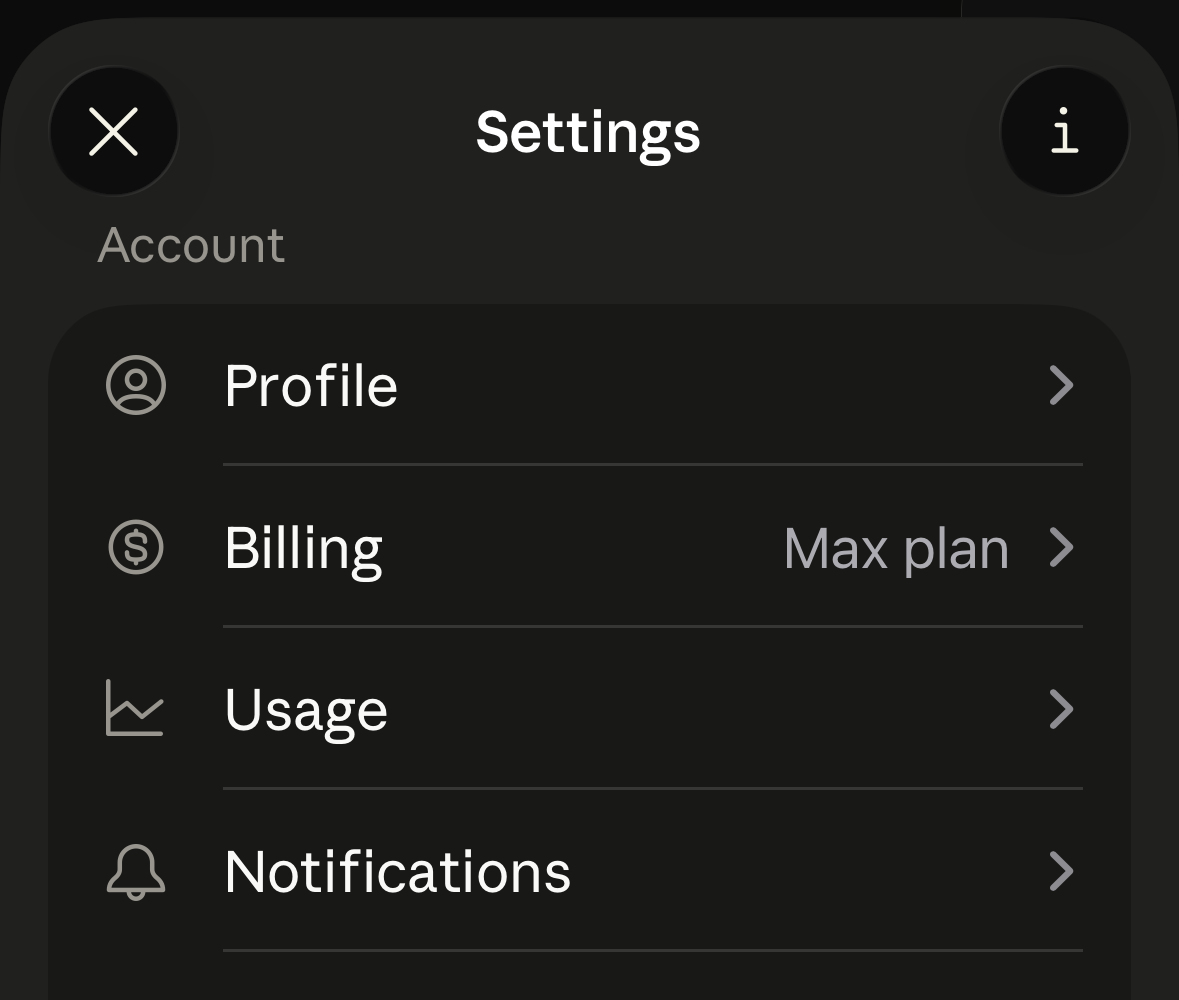 My billing screen: Max 20x at $200 a month, the tier these measurements come from.
But my reason was one expensive job I kept repeating, and I could price it against hiring someone. It wasn’t a feeling that the bigger number was safer.
Do not take my word for it. Do not even take your own word for it. Start at the $20 plan and work your way up. That is my rule for this ladder, and it is how I ended up here without regretting a step.
Every one of my upgrades came from hitting a wall.
The two-5x-accounts question, answered honestly
This is the most-discussed idea in this space, and the top-ranked thread on r/ClaudeAI argues two accounts are the better buy for solo builders.
The math that makes it tempting is real: two Max 5x accounts cost $200, and so does one Max 20x.
This is my opinion, not a calculation.
Nobody has settled the account policy question. Community threads flatly contradict each other. On r/ClaudeCode, one top answer warns that accounts get banned for this; another says Anthropic staff have publicly said it is fine.
I could not verify Anthropic’s current position, so I am not going to tell you it is safe or unsafe. Read the usage policy yourself before you try it.
Even setting policy aside, I think it is a bad trade. You would be logging out, losing context on in-flight chats, and logging back in throughout the day.
Yes, you can point both at the same repo so nothing is technically lost. But the context switching alone eats whatever allowance you gained. My guess is you come out about even and spend the day managing logins.
And the deal itself favors one account. The multipliers stack on a single subscription. That’s my argument for why one 20x beats two 5x at the same price, but it isn’t a precise quota comparison. Anthropic doesn’t publish the numbers that would let anyone do that math exactly.
If you’re really maxed out and this is a real business, running the top model hard on a problem that pays for itself, the aggressive move is a second $200 plan. Not two 5x accounts stitched together to hit the same total.
Two 5x to get the same total? That’s asking for inefficiency and honestly asking for trouble.
One billing trap before you switch either way
Users report a real gotcha: downgrading through support rather than in Settings can cost you a legacy price you were grandfathered into.
Change plans in Settings > Billing where you can. Downgrades take effect at the end of your current billing period, and your chats, projects, and files stay with your account either way.
The one thing to measure this week, if you are on 5x
If you are on 5x and trying to decide whether to move up, here’s the whole answer, and it’s short.
Do not measure anything.
Seriously. You are not going to learn anything useful from a percentage, and staring at a meter is how people talk themselves into $100 a month. The multiplier argument above is interesting, but it shouldn’t decide this for you.
So the wall is real even on 20x if your habits are bad. Measure one thing instead: when you run out, can you wait?
Say you are building something simple and you hit the wall. If your reaction is “fine, I have other things to do, I will step away and come back in five hours,” then it is not that serious. You have your answer, and it is no.
But if you need it right now, and you can feel that what you just did is the tip of the iceberg and there is a lot more you want to do, you might need to upgrade.
Let the pain tell you. That’s the rule, and none of the weekly-limit math above changes it.
If you are still deciding
- Still on the $20 plan and wondering if it holds? Is Claude Pro enough
- Not sure Max is the right family at all? That is Claude Pro vs Claude Max
- Not a developer and wondering if any of this applies? Is Claude Max worth it
- Want the mechanics of the two meters? Claude usage limits explained
- Comparing across vendors at the $100 line? Claude Max vs ChatGPT Pro
Published August 14, 2026. Updated September 10, 2026 with the class action, my own meter and a re-captured pricing grid. My 10x to 15x read is an impression, not a measurement.
This post is part of Claude Guides, the hub with every plan decision, task comparison, and setup guide for using Claude without code.
Plan-change alerts
Your plan is gonna change. Nobody emails you when it does.
I pay for Claude, ChatGPT and Grok, so I check the pricing pages every week anyway. When one moves a price or a limit, you get one email that day. No newsletter, no schedule. Last one I caught: Fable 5 quietly dropped out of Claude Pro.

Written by
Chris AlarconChris Alarcon shows people who don’t code the boring Claude setup that actually works. He runs his one-person operation on these systems and shares every workflow, prompt, and tool combo in public. Start with the 15 prompts he uses every day.
Picked a plan? Now set it up
Whichever plan you buy, it still won't know you tomorrow.
The Setup is one folder. Drop it into a Project, answer three questions, and Claude or ChatGPT stops forgetting you, stops sounding like AI, and runs three real jobs by name. Twenty minutes tonight. No code. $39, 30-day refund.
See The Setup →